


Institutions Have Sold Over $100 Billion in US Stocks; Goldman Sachs: April Rebound Window May Be Quietly Opening
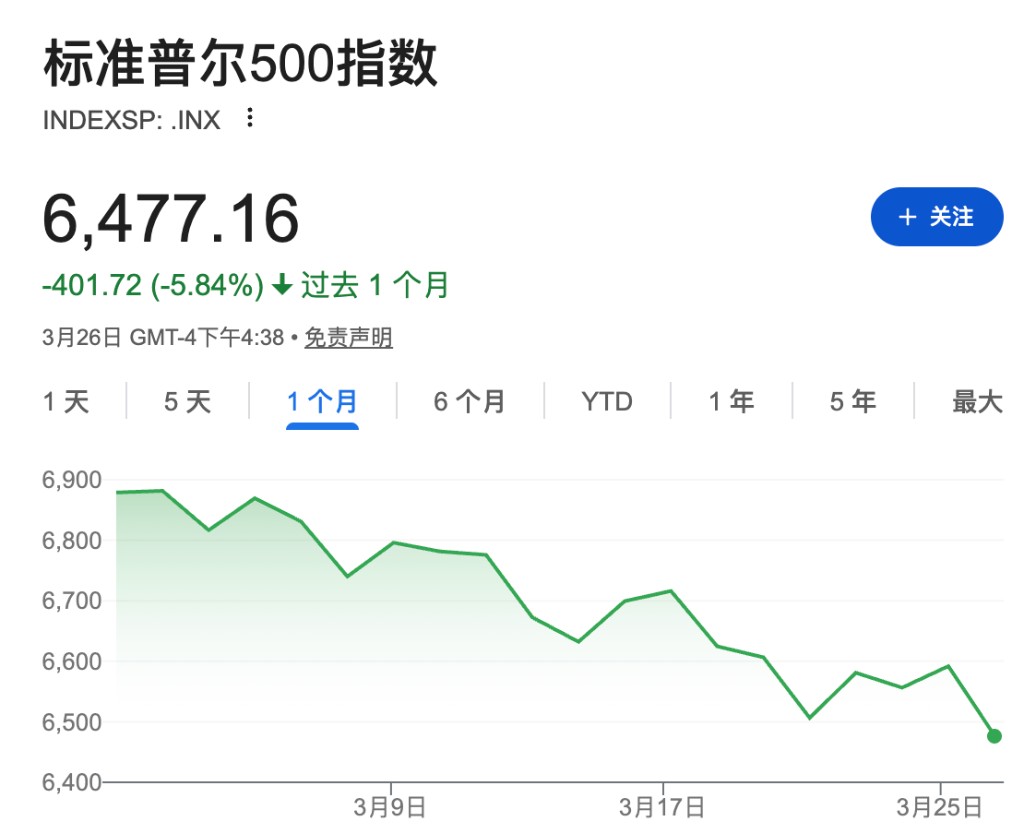
In the past month, the S&P 500 index has fallen by a cumulative 5.8%, marking its worst monthly performance since December 2022. During the same period, CTAs sold off $55 billion, and asset managers reduced their S&P 500 positions by $51 billion. The deleveraging by institutions stands in stark contrast to the influx of retail investors into passive funds. Goldman Sachs notes that the scope for further institutional selling is limited, and a window for a technical rebound may be opening, with geopolitical factors remaining a key driver of the market
A deleveraging wave is sweeping across the US stock market, with analysts suggesting that short-selling forces have reached their limit.
The S&P 500 index has fallen by a cumulative 5.8% over the past month, marking its worst monthly performance since December 2022. Goldman Sachs' trading team believes that as institutional investors complete their large-scale position reductions, the market is poised for a rebound, but geopolitical risks still necessitate hedging for investors.
In their latest report, Goldman Sachs analysts Gail Hafif, Brian Garrett, and Lee Coopersmith pointed out that momentum-tracking Commodity Trading Advisors (CTAs) have sold nearly $55 billion in US stocks since early March, while asset management institutions have also reduced their S&P 500 positions by approximately $51 billion over the past three weeks. Risk parity funds have cut their long exposure by about one-sixth. The three analysts cautioned investors against shorting the market at this time, citing a significant short-squeeze risk in current short positions.
The aforementioned large-scale deleveraging implies that once positive signals emerge, the market could experience a sharp rebound. The Goldman Sachs team estimates that if the market continues to strengthen, CTAs could buy as much as $86 billion in US stocks over the next month.
Meanwhile, the trading strategies of funds that adjust positions based on volatility are shifting. Previously, when the market fell, traders were forced to sell options to hedge risks, which further exacerbated market declines. The situation has now reversed, and traders' position adjustments are beginning to buffer market movements in both directions, helping to stabilize the market.
Institutional Deleveraging Nearing Its End, Geopolitics Remains Key Market Driver
According to Goldman Sachs data, CTAs currently hold a net short position of approximately $18.4 billion in US stocks, with limited further selling potential barring significant shocks. The three analysts stated, "Current positions are highly susceptible to a short squeeze upon the emergence of positive news" and explicitly advised investors against shifting to short positions.
For risk parity funds, Goldman Sachs expects deleveraging to continue but with "limited impact." Overall, active selling by institutions is entering its final stages, and marginal selling pressure in the market is easing.
In stark contrast to the large-scale withdrawal by institutions, US retail investors have only reduced their stock allocation by about 1% from its peak. The Goldman Sachs team noted that retail investors are rapidly funneling money into passive funds, causing the gap between active and passive fund flows to narrow quickly.
"If there was a question of who was buying the dip, that question has been clearly answered," the three analysts wrote. "Institutional clients are continuing to deleverage, while retail investors are rapidly deploying capital into passive funds."
The Goldman Sachs team also emphasized that geopolitical developments remain a critical factor influencing market direction. The significant pullback in the S&P 500 index this month was precisely due to the escalating conflict in the Middle East.
Analysts stated that investors must remain hedged against geopolitical developments and that the market needs to "stay hedged and remain agile in response to new information." This means that despite technical and flow-based indicators pointing towards a potential rebound, any major geopolitical shock could still disrupt this process.
