


Standard Chartered's Arthur Yuen: Grasping Certainty in an Uncertain World
An Eastern Narrative for Standard Chartered's Global Private Banking Business
Shanghai in March, the Formula 1 Heineken Silver Chinese Grand Prix roared back to life at the Shanghai International Circuit, reigniting the city's passion for speed and the thrill of motorsport.
During the event, Arthur Yuen, Head of Global Private Banking at Standard Chartered and Head of Wealth Management and Retail Banking for Greater China & North Asia, visited Shanghai for a series of activities and sat down for an exclusive interview with Yicai Global. Born in Fujian, raised in Singapore, and now residing in Hong Kong, Yuen, who is fluent in multiple languages, engaged in a conversation with us about F1, AI, and his latest observations on the high-net-worth market.
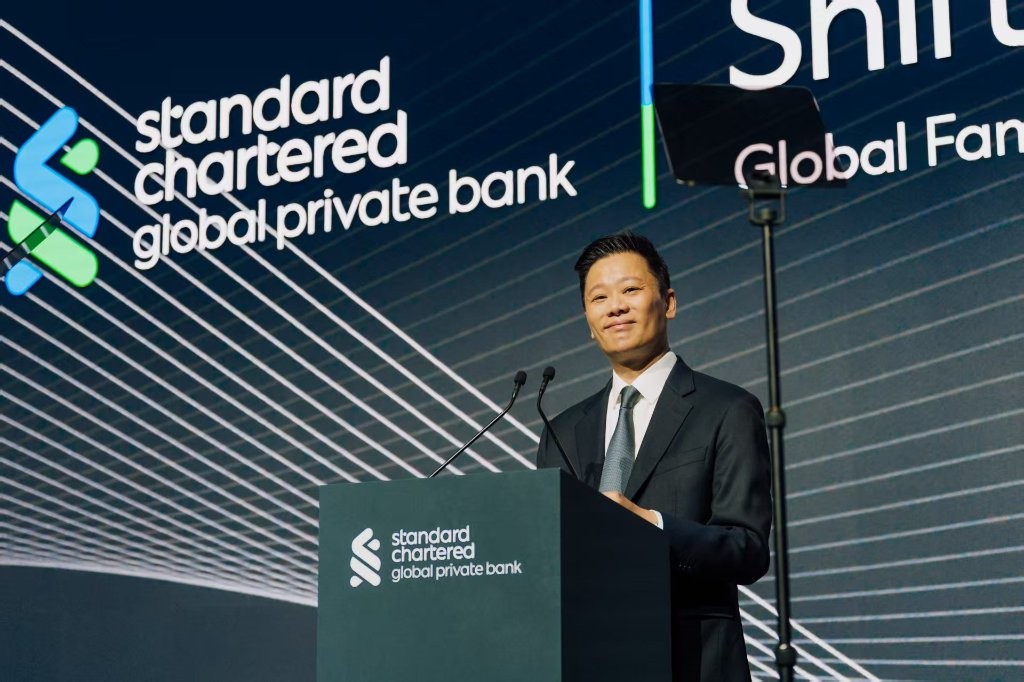
The Balancing Point of Speed, Risk Control, and Innovation
This year, Standard Chartered is a first-time official partner of F1, inviting high-net-worth clients from around the world to exclusive experiential events.
Speaking about the F1 partnership, Yuen shared, "F1 holds races in 21 countries and regions, and Standard Chartered has a presence in 19 of those markets, showing a very high degree of overlap. Simultaneously, many F1 fans globally possess an international outlook, entrepreneurial spirit, and are active in various markets worldwide – this aligns perfectly with our client base."
The deeper reason lies in the strong congruence of values. F1 teams pursue speed, manage risks, and strike an excellent balance between technological innovation and stable sustainability. Standard Chartered Group also places great importance on balancing these elements.
"No race car can win by simply chasing the highest top speed," Yuen said. "On the track, it's about speed, but victory often hinges on the management of risks, strategies, and various variables, which is highly analogous to the banking industry."
Furthermore, Standard Chartered also sponsors F1 Academy, an all-female racing series, to support and nurture more female drivers in the sport. They will continue to explore more initiatives with F1 Academy throughout the season to support the development of young female drivers. This aligns well with the latest trend in the sport – female racing talent is gradually revealing its potential. F1 Academy, established in 2023, has rapidly grown into a globally influential platform for women's motorsport, and the Shanghai race serves as the season's opening round for this all-female series.
Relying on Technology, Mastering Technology
F1 emphasizes the relentless pursuit of technological innovation, and Standard Chartered internally places significant importance on investments in AI and technological innovation. As a global banking group, Standard Chartered has always spared no effort in technological investment, and its private banking business is no exception.
Yuen revealed that Standard Chartered's latest round of technological investment is aimed at fundamentally restructuring its service models. Among these, AI has extended from backend risk control to frontline client communication and support. AI systems are now used for abnormal transaction monitoring in cross-border fund flows, Know Your Customer (KYC) verification for new clients, and the integration of investment banking and fund information within an open product architecture – providing more timely tools.
For example, his first piece of morning intelligence is a compilation of views from various financial institutions, sourced from Standard Chartered's systems.
"Our system can search for the insights of every investment bank and fund management company, use AI to find them, and provide conclusions to help our relationship managers enhance their understanding."
"Of course, our research team's views also collide with external perspectives, ultimately leading to more comprehensive and integrated conclusions."
Standard Chartered Group will also launch its own AI Agent to help relationship managers improve their skills and serve clients.
Changes in Overseas Markets Driven by Chinese Enterprises Going Global
Globally, the Greater China and North Asia region contributes half of Standard Chartered's private banking business. Among this, the wealth growth and contribution from Chinese clients are particularly outstanding.
This concentration is both an advantage and a challenge. To continue seizing opportunities, Standard Chartered is investing $1.5 billion to upgrade its service capabilities, with half of that allocated to talent. Standard Chartered aims for future relationship managers to possess a broader global perspective and more agile knowledge update capabilities, making increased investment in training junior officers a necessity, with the recruitment and training of talent with Chinese backgrounds being a top priority.
The adjustment in talent strategy reflects deeper shifts in the market landscape. "Chinese enterprises going global" and "intergenerational wealth transfer" are the two most significant themes for Chinese high-net-worth clients today.
As major supply chain leaders globalize, upstream and downstream SMEs are following suit: Hong Kong, Singapore, Malaysia, Vietnam, Dubai, Africa… Yuen listed a typical demand map for Chinese SMEs. More and more enterprises are establishing roots overseas. A Standard Chartered New Year event in Kenya last year gathered two hundred Chinese attendees.
This network effect forms the entry logic for wealth management business. "Initially, clients' needs are for accounts – accounts in specific markets. Then it might extend to family accounts, and finally, after trust is established with the bank, it expands to wealth management."
In an environment of declining interest rates, clients have a more urgent demand for returns from wealth management products. This requires Standard Chartered's retail wealth system to have more layered response strategies: for instance, QDII funds provide international allocation channels, foreign exchange trading meets active management needs, and investment-linked insurance attracts conservative funds with relatively high returns. Simultaneously, products in different markets cater to different clients. For example, "first-generation" entrepreneurs among clients who have a good understanding and experience with leverage can flexibly utilize investment leverage in overseas markets.
Intergenerational Wealth Transfer and Underlying Logic
The cross-border expansion of business landscapes broadens the geographical scope of wealth management, while client evolution – the rise of the younger generation – is redefining the core of private banking services.
"The biggest challenge in private banking is how to effectively serve the second generation of family wealth," Yuen admitted.
"Second-generation clients are different from their parents. The first generation grew up reading newspapers and had a sense of trust in information delivered by relationship managers (RMs); the second generation, however, grew up in an international educational environment with much richer information and knowledge reserves. Our relationship managers must be fully prepared for this."
"Chinese clients are very good at mathematics and learn very quickly. They are interested in good funds, hedge funds, and leveraged products. The rise of family offices is also a sign of the maturity of this trend – everyone is increasingly viewing wealth management from a professional perspective."
The use of family wealth also brings about profound adjustments in service models, requiring banks to redefine their accompaniment methods. Successful patriarchs of large families often return to their "roots" (hometown) – building schools, establishing ancestral halls, or constructing prominent buildings. Banks must follow suit and provide meticulous services.
Of course, in intergenerational wealth transfer, the underlying logic of Chinese culture remains unchanged. "Chinese people emphasize human relationships and emotions more. The more they invest overseas, the more they seek trusted client managers."
Perhaps this is the foundation of Standard Chartered Bank, which has been rooted in China for nearly 170 years and has accompanied Chinese enterprises and individuals in expanding their global footprint.
