


Pony.ai Achieves First Quarterly Profit in Q4, Robotaxi Commercialization Accelerates, Targets 20 Cities by Year-End | Earnings Insights
Pony.ai achieved its first quarterly profit in Q4 2025, driven by an investment gain in Moore Threads, with a net profit of $75.5 million. However, its core non-GAAP business saw an enlarged loss. The company's Robotaxi business performed strongly, with its seventh-generation vehicles achieving positive per-vehicle profitability in Guangzhou and Shenzhen. Pony.ai is currently accelerating its global expansion, planning to exceed 3,000 vehicles in its fleet by year-end and extend its services to over 20 cities worldwide
Pony.ai has recorded its first-ever quarterly net profit, attributing it to the fair value increase of an early investment, and announced plans to expand its autonomous taxi service to over 20 cities globally by the end of the year, setting a fleet size target of more than 3,000 vehicles, thereby accelerating its pace in the global Robotaxi race.
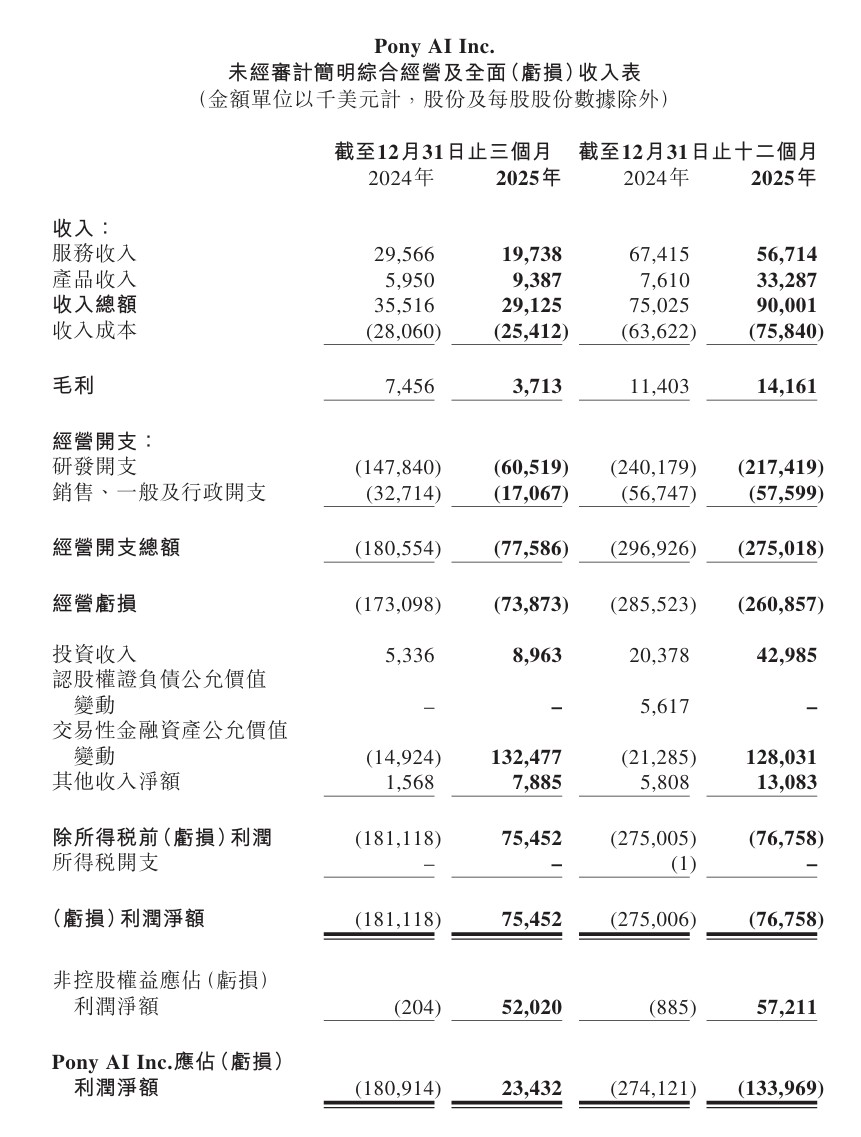
The company announced on Thursday that its net profit for the fourth quarter of 2025 was $75.5 million, a significant turnaround from a net loss of $181.1 million in the same period last year. However, this profitability was primarily driven by a gain from the change in fair value of its early equity investment in Moore Threads, a domestic chip design company – Moore Threads' stock price surged by as much as 425% after its listing last December. Excluding this item and other non-recurring items such as equity incentives, the company's non-GAAP net loss for the fourth quarter was $49 million, an further increase from $41.3 million in the prior year period.
On the core business front, revenue from autonomous driving mobility services in the fourth quarter increased by 160% year-on-year, with passenger fare revenue surging by over 500%. The company has achieved positive per-vehicle profitability for its seventh-generation Robotaxi in Guangzhou and Shenzhen. The CFO stated in the announcement, "We are making upfront investments to accelerate commercialization."
In the global Robotaxi competition, Alphabet's Waymo has expanded to 10 cities in the United States. Chinese companies such as Pony.ai, WeRide, and Baidu Apollo Go are actively deploying in the Middle East and UK markets with partners like Uber Technologies and Lyft. Pony.ai entered Zagreb, Croatia, and Singapore this month, launched commercial services in Doha, Qatar, and plans to expand its fleet to over 3,000 vehicles within the year.
Profit Driven by Investment Gains, Core Operating Loss Actually Widened
The substance of Pony.ai's fourth-quarter profitability needs to be interpreted in the context of its financial structure. During the reporting period, the company recorded a gain of $132.5 million from the change in fair value of its trading financial assets, which transformed an operating loss of $73.9 million for the quarter into a net profit of $75.5 million.
This investment gain is related to the company's subsidiary's early holding of equity in Moore Threads. The CFO stated in the announcement that due to the volatility of trading financial asset prices, this item has been excluded from non-GAAP metrics "to better reflect core operating performance."
From a non-GAAP perspective, which reflects the main business, the full-year operating loss for 2025 was $230.1 million, a significant increase from $158.5 million in the previous year; the full-year non-GAAP net loss was $174 million, also an increase of 31.5% from $132.3 million in the prior year. The company attributed this widened loss to deliberate upfront investments – full-year non-GAAP R&D expenses increased by 42.5% to $196.3 million, primarily for expanding the R&D team and continued development of the seventh-generation model.
Robotaxi Business Accelerates Volume Growth
Despite still being in a loss-making position overall, Pony.ai's Robotaxi business delivered high-growth results in 2025. Full-year revenue from autonomous driving mobility services increased by 129% to $16.6 million, with passenger fare revenue growing by nearly 400%, reflecting the rapid increase in order volume since the launch of the seventh-generation model.
The company achieved substantive breakthroughs in validating its per-vehicle economic model: within four months of its seventh-generation Robotaxi entering operation, it successively achieved positive per-vehicle profitability in Guangzhou and Shenzhen. On March 22, 2026, the average net income per vehicle for the seventh-generation model in Shenzhen reached a historical high of RMB 394 in a single day, with an average of 25 orders per vehicle on that day. The company stated that its AI driving capabilities support a differentiated pricing strategy, enhancing user willingness to pay, which is the core driver for achieving per-vehicle profitability.
User base is expanding at a similar high rate. As of the end of March 2026, the total number of users in China reached 1 million, nearly tripling from the same period last year. In the Shenzhen market, paid orders from January to mid-February 2026 exceeded the total for the entire year of 2025. CEO James Peng stated, "2025 was an outstanding year for Pony.ai, achieving scaled growth in revenue, fleet size, operational footprint, and user base."
Accelerating Global Footprint, Croatia May Become Europe's First Paid Operation City
Based on its validated business model in China, Pony.ai is extending its expansion to the global stage. The company aims to expand its operational city count to over 20 by the end of 2026, with about half of them located in overseas markets. In March of this year, new locations were added, including Zagreb, Croatia, Singapore, Hangzhou, and Changsha.
According to Bloomberg, Pony.ai, Uber Technologies Co., and local startup Verne plan to launch Robotaxi services in Zagreb, which is expected to become the first city in Europe to offer paid autonomous taxi operations. Pony.ai is also conducting pilot programs in Luxembourg; Uber and Baidu Apollo Go are conducting tests in London.
In the Middle East market, Pony.ai has launched its first commercial autonomous taxi service in Doha, Qatar, through its partnership with Mowasalat Karwa; and is proceeding with relevant approvals to conduct fully driverless test operations in Dubai, UAE, by the end of March this year.
In terms of industry landscape, the global Robotaxi race continues to heat up. Alphabet Inc.'s Waymo has expanded to 10 cities in the US; Chinese companies such as Pony.ai, Weride Inc., and Baidu Apollo Go are accelerating their deployment in markets like the Middle East and the UK in partnership with Uber and Lyft Inc.
Toyota Partnership Secures 1,000 Vehicle Production, Fleet Size Target Doubles
To support its aggressive expansion plans, Pony.ai is simultaneously increasing its supply chain and ecosystem collaborations. The company announced the deepening of its strategic partnership with Toyota, with the two parties jointly deploying and eventually commercializing a total of 1,000 bZ4X vehicles. The seventh-generation autonomous taxi officially began mass production in 2026.
The company's current fleet size has surpassed 1,400 vehicles, with a full-year target exceeding 3,000 vehicles. In terms of co-building the fleet model, Pony.ai has collaborated with Ruqi Mobility in Guangzhou and Beijing Ai Te Bo Travel Services Co., Ltd. in Beijing; it is also strengthening its cooperation with BAIC Group and GAC Group, leveraging their mature supply chain and after-sales networks for vehicle deployment in overseas markets.
On the user engagement front, the company has seamlessly integrated with Tencent's WeChat "Travel Services" platform in Shenzhen and Guangzhou, which is expected to further expand its user base.
Upfront Investment Continues to Increase, Commercialization Pace is the Key Variable
From a capital expenditure perspective, Pony.ai's total capital expenditure for 2025 was $43.9 million, a significant increase from $11.4 million in 2024, mainly for the mass production and deployment of seventh-generation autonomous taxis.
The company's autonomous trucking business has also made phased progress: the Bill of Materials cost for the fourth-generation autonomous truck's autonomous driving kit has been reduced by 70% compared to the previous generation, with a target for mass production and initial deployment by the end of 2026; full driverless deployment has also been completed at Jiangmen Port in Guangdong. The company revealed that the autonomous taxi and truck platforms share about 80% of their technological architecture, which helps in amortizing R&D costs.
For investors, the current core focus is on the pace of commercialization realization for the Robotaxi business. The validation of per-vehicle profitability in Guangzhou and Shenzhen provides initial evidence of the business model's viability, but whether the scaling up from localized cities to over 20 cities can be achieved as planned, and whether the full-year non-GAAP losses can narrow with the growth in scale, will be key metrics for evaluating the company's long-term value.
