


How Much Longer Can Trump Suppress Oil Prices?
With the Strait of Hormuz blocked for over a month and 10 million barrels of crude oil disappearing daily, WTI has miraculously held at $92—Trump is constructing a "narrative defense line" using Truth Social posts, strategic ambiguity, and threats to the futures market. However, Chevron's CEO has already issued a warning: physical shortages are not yet priced into the futures curve. Industry executives generally believe the next two weeks are critical; once physical inventories are depleted, rhetoric will become entirely ineffective
With 10 million barrels of crude oil disappearing daily, WTI oil prices remain below $100—this game between physical reality and financial narrative is the core tension in the current global energy market.
The blockade of the Strait of Hormuz has lasted for over a month, and the US-Iran conflict continues to burn, but oil prices have not experienced the "super surge" widely anticipated by external observers. Trump himself admitted last week: "I thought it would be worse, much worse." Behind this outcome lies the White House's successful suppression of panic in financial markets through a system of "verbal intervention" centered on social media.
However, Bloomberg energy and commodities columnist Javier Blas warns that rhetoric alone cannot keep refineries running. As physical crude oil shortages spread from Asia to Europe and the US West Coast, Trump's "narrative weapon" is approaching the limit of its effectiveness.
According to Bloomberg, industry executives and government officials generally believe that the next two weeks will be a critical juncture for the physical crude oil market.
Miraculous Calm: The Anomaly Behind the Numbers
Since the US attacked Iran on February 28th, Iran promptly closed the Strait of Hormuz and launched strikes on Persian Gulf energy infrastructure, resulting in a daily global crude oil supply deficit of at least 10 million barrels. Based on historical experience, a supply disruption of this magnitude should trigger a full-blown energy crisis.
Yet, in reality, WTI crude oil prices have been consistently suppressed below the critical psychological threshold of $100 per barrel, currently trading around $92. According to Bloomberg, the White House has been suppressing oil prices on multiple fronts simultaneously by releasing strategic petroleum reserves (SPR), easing sanctions on Russian and Iranian oil, and through continuous verbal interventions.
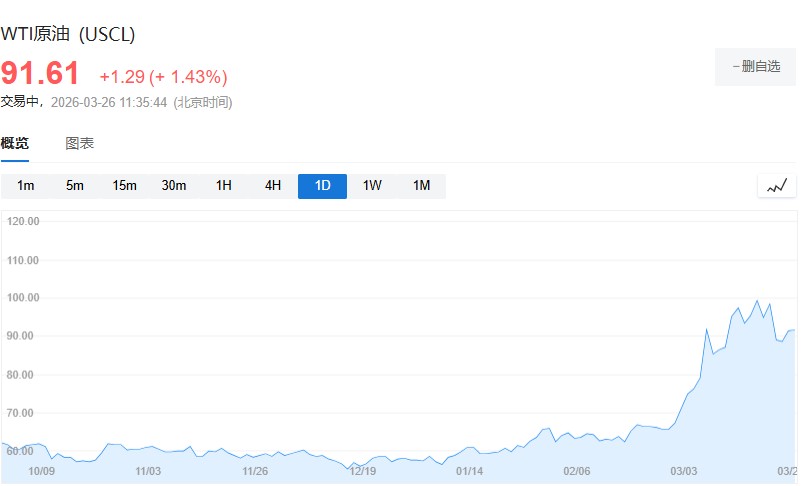
Javier Blas points out that this situation has deeply surprised the market. According to Bloomberg, market observers generally believe that WTI maintaining its position in the $90 range after a full month of the Strait of Hormuz closure was an outcome almost no one had predicted.
The TACO Strategy: Weaponizing "Inconsistency"
Trump's most creative tool is precisely the trait that has long been considered his weakness: inconsistency.
According to Bloomberg, Wall Street has already deeply experienced the so-called "TACO" logic (Trump Always Chickens Out) in the 2025 trade tariff game: he repeatedly announced punitive tariffs, only to withdraw them later. This historical record now serves as a psychological lever to suppress oil prices in the current energy crisis—traders cannot be sure when or if Trump will truly seek to end the conflict, and this uncertainty itself is enough to deter speculative capital from going fully long.
The key is that Trump does not need to actually make a policy shift; he only needs to make the market believe he "might" do so. According to Bloomberg, this strategic ambiguity has proven sufficient to repeatedly freeze market buying sentiment and buy the White House time.
Social Media as a Real-Time Price Regulator
Trump has transformed the Truth Social platform into a real-time market intervention tool, with remarkable precision.
On March 3rd, as oil prices surged, he declared that "the US Navy will begin escorting oil tankers if necessary." Three weeks later, no escort fleet has appeared, but this statement effectively suppressed risk premiums in the early stages of the crisis, buying the US valuable time.
As the market realized the Strait of Hormuz would not reopen before the end of the conflict, Trump immediately shifted his rhetoric, beginning to imply that the conflict was nearing its end. On March 9th, he stated the conflict was "basically very complete"; on March 20th, he sent another signal: "We are very close to achieving our goals and are considering ending our great military operation in the Middle East."
Last weekend, he issued a 48-hour ultimatum to Tehran, demanding the reopening of the Strait of Hormuz, threatening to bomb its domestic power infrastructure otherwise. According to CCTV News, local time March 21st, US President Trump posted on the social platform "Truth Social" that if Iran does not fully open the Strait of Hormuz within 48 hours without any threat, the US will strike and completely destroy various power plants within Iran, with the largest one being the first target.
Then, before most financial markets opened on Monday, he released his most significant verbal intervention signal to date: "They are talking to us, and they are speaking very reasonably."
According to Bloomberg, Iran has not confirmed the existence of negotiations, only acknowledging that there has been an exchange of information. This unilateral statement still effectively quelled the market rally.
Financial Weaponization: Attacking "Paper Oil"
Trump's intervention strategy also extends to the futures market. According to Bloomberg, the US and Japan had considered direct intervention in the crude oil futures market—not just releasing reserves—and related discussions were deliberately leaked to the market, creating a deterrent effect sufficient to make bulls retreat.
Iran is well aware of this. Iranian leader Mohammad-Bagher Ghalibaf wrote on social media: "Fake news is being used to manipulate financial and oil markets, helping the US and Israel escape difficult situations. We are clear about what is happening in the paper oil market." According to Bloomberg, Tehran immediately launched its own social media counter-offensive, attempting to fight fire with fire.
This confrontation reveals a new dimension of modern conflict: belligerents are using the oil price narrative itself as a battlefield, with one side striving to increase the economic cost of the conflict, and the other doing its utmost to lower it, thereby maintaining the capacity to continue fighting.
Cracks Appearing: Physical Laws Begin to Fight Back
However, the effectiveness of financial narratives is being eroded by physical reality.
Chevron CEO Mike Wirth stated at the CERAWeek energy conference in Houston this week that physical supply disruptions "have not yet been fully reflected in the crude oil futures curve." This assessment aligns with the views of many industry insiders.
The pressure in the physical market has already become apparent in Asia. South Korea has entered "crisis mode," implementing its first fuel price cap in nearly thirty years; the Philippines has shortened government working hours to reduce commuting energy consumption; Pakistan has directly closed schools for two weeks and largely shifted to remote work.
According to Bloomberg, based on Javier Blas's conversations with industry executives and government officials, the US clearly recognizes that the next two weeks will determine the direction of the physical crude oil market. And what the US knows, Iran also knows.
Deadline Approaching: The Two-Week Window
The White House initially planned for a conflict lasting four to five weeks. This Saturday, the conflict will enter its fifth week. According to Bloomberg, once this time point is surpassed, the market will significantly reduce its sensitivity to verbal interventions.
The physical crude oil shortages already evident in Asia, without a ceasefire agreement, will spread to Europe and the US West Coast. At that point, Trump's Truth Social posts will gradually lose their ability to move the market—when physical crude oil truly becomes scarce, the power of narrative will have nowhere to be applied.
How much longer can Trump suppress oil prices? There may be only one answer: until the day physical inventories are depleted. At that point, he will face a choice between two distinct paths—either adopt more aggressive physical means to force open supply channels, or, as the logic of the "TACO strategy" suggests, opt for some form of political compromise. Whichever path it is, it signifies that the current contest of words against physical laws has entered its final countdown.
