


JPMorgan Traders End “Bearish U.S. Equities Trade,” Shift to “Neutral,” Explore “Possibility of Going Long Gold Again”
JPMorgan’s Market Intelligence unit stated that it is ending its three-week tactical underweight stance on U.S. equities and adopting a neutral position. This adjustment is not a bullish signal but aims to strip directional risk through hedging. Concurrently, the unit is exploring the possibility of re-establishing long positions in gold. The market's next direction hinges critically on geopolitical developments (ceasefire or escalation), with subsequent focus on the progress of U.S. military aid budgets and signals from the U.S. earnings season
After approximately three weeks of executing a "tactical underweight" strategy, during which the S&P 500 fell between 200 and 300 points, JPMorgan’s Market Intelligence unit announced the closure of this trade and a shift to a neutral stance. Simultaneously, it has begun assessing the possibility of re-establishing long positions in gold.
On March 25th, JPMorgan’s Market Intelligence unit stated in an internal report that this strategic shift does not signify a bullish outlook on U.S. equities. The team explicitly stated they would not be buying dips, but rather prefer to maintain long positions in energy and large-cap tech stocks while employing hedging tools at the index and sector levels to strip away directional risk.
The report pointed out that the key variable determining the market's next direction lies in whether geopolitical tensions escalate further. If a ceasefire agreement is reached, the team anticipates a "comprehensive rebound" rally; conversely, any new signal of escalation would constitute new downward pressure. Concurrently, the progress of the U.S.'s $200 billion emergency budget is also worth monitoring.
Notably, the bank's Market Intelligence unit also stated in its report that it has begun compiling a "shopping list" to prepare for a ceasefire scenario, with long positions in gold being a key area of focus.
Tactical Underweight Trade of Approximately Three Weeks Comes to an End; Neutrality Does Not Mean Bullishness
The report stated that JPMorgan’s Market Intelligence unit adjusted its stance to "tactical underweight" about three weeks ago, after which the S&P 500 fell 200 to 300 points. Now, as the S&P 500 tests its 200-day moving average from below, the team has chosen to close its position at this juncture, updating its stance to "neutral."
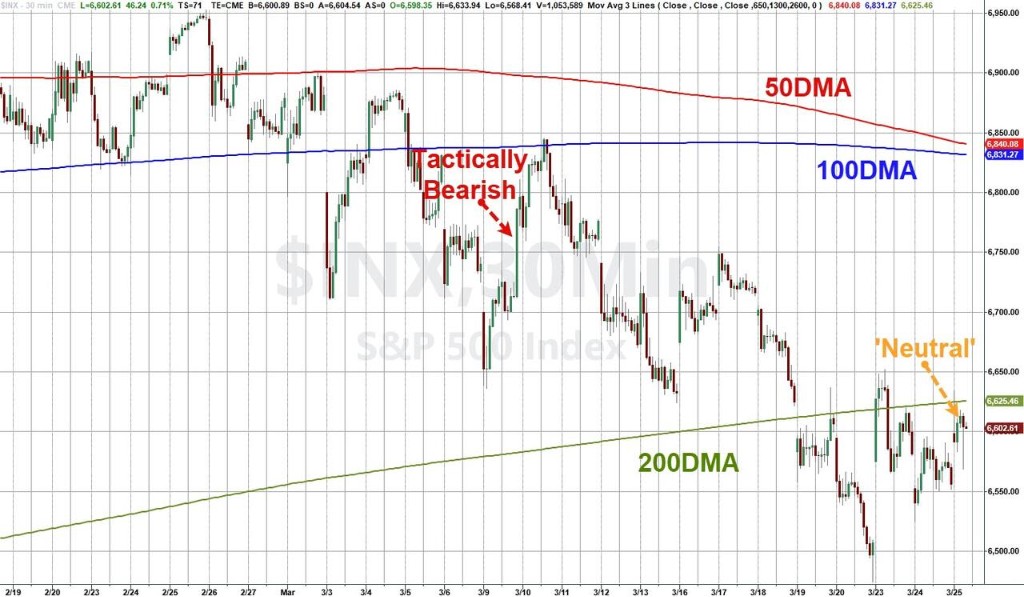
However, the report clearly stated that "neutral" means not chasing rallies or buying dips, and not a shift to a bullish stance. The core logic is that uncertainty regarding current geopolitical situations remains high, and the market direction is not yet clear, making it imprudent to arbitrarily take directional exposure.
At the position level, JPMorgan traders recommend adopting a market-neutral strategy: maintaining long exposure in the energy sector and large-cap tech stocks, while hedging overall directional risk through index hedging tools like the S&P 500 (SPX) and Russell 2000 (RTY), as well as sector-level hedges in materials and consumer staples.
The team emphasized that this is not a significant restructuring of the overall portfolio, but a pragmatic choice to centrally manage and reduce directional exposure amidst frequent market disturbances related to ceasefire and quasi-ceasefire news.
Gold Returns to the Forefront
It is worth noting that in this strategy update, JPMorgan traders specifically mentioned the potential to re-establish long positions in gold.
The team's analytical logic is based on the premise that as the portfolio completes a more aggressive de-risking operation, the recent negative correlation between gold and the dollar may loosen. In other words, gold, previously suppressed by de-risking sell-offs, is expected to reassert its safe-haven attributes once market structures stabilize.
Currently, long gold positions have been included in the team's "shopping list" for a ceasefire scenario, but they do not yet constitute explicit trading instructions. They primarily reflect a forward-looking intention for potential opportunity windows.
Escalation or Ceasefire: Deciding the Market's Next Direction
JPMorgan views the evolution of geopolitical tensions as the most critical driving variable in the current market and has outlined four types of escalation scenarios that could trigger a new round of market decline:
First, attacks on energy infrastructure, particularly targeting Saudi oil production and refining facilities;
Second, intervention by U.S. ground troops or the use of military force to reopen the Strait of Hormuz;
Third, strikes by the U.S. or Israel on Iranian civilian infrastructure;
Fourth, any attacks on water supply.
The report also points out that as long as the Strait of Hormuz remains "closed" to Western allies, the global energy crisis will continue to spread and may further extend to the food, industrial gas, and their derivative product sectors.
Regarding the path to a ceasefire, JPMorgan’s Market Intelligence unit believes that if negotiations fail to achieve substantial progress before the weekend, the market may experience a pullback; however, once an agreement is formally reached, it will trigger a "comprehensive rebound" across various asset classes.
The team expects the market to move relatively quickly towards a clear direction in the future—either through the advancement of the ceasefire process or the arrival of a new wave of escalation.
U.S. Military Aid Budget and Earnings Season: Two Key Subsequent Observation Windows
In addition to geopolitical tensions themselves, JPMorgan’s Market Intelligence unit highlights two subsequent signals worth close tracking.
The first is the progress of domestic U.S. discussions regarding the over $200 billion emergency military aid budget.
The team noted that the scale of this funding is sufficient to support relevant U.S. actions through August of this year and possibly longer. If Congress advances this budget agenda, it implies that the market needs to price in a conflict that could be more protracted than expected.
The second is the upcoming U.S. stock earnings season, which begins in April.
The report suggests that the long-term impact of geopolitical conflicts on the U.S. market, and the eventual landscape of winners and losers, may not truly emerge until corporate management provides substantial statements during the earnings season.
