


Gold's "Golden Pit": After Recovering the $4,500 Mark, Has the Sell-Off Ended?
Following the Iran-U.S. conflict, investors were forced to liquidate gold to meet margin calls in stock and bond markets. Concurrently, the war fueled inflation expectations and suppressed interest rate cut expectations, further pressuring gold prices. Western Securities believes that the rise in oil prices has superficially restored the credibility of the petrodollar system, causing gold to be oversold; in the long term, the credibility of the dollar is likely to weaken trendily, and gold prices are expected to hit new highs
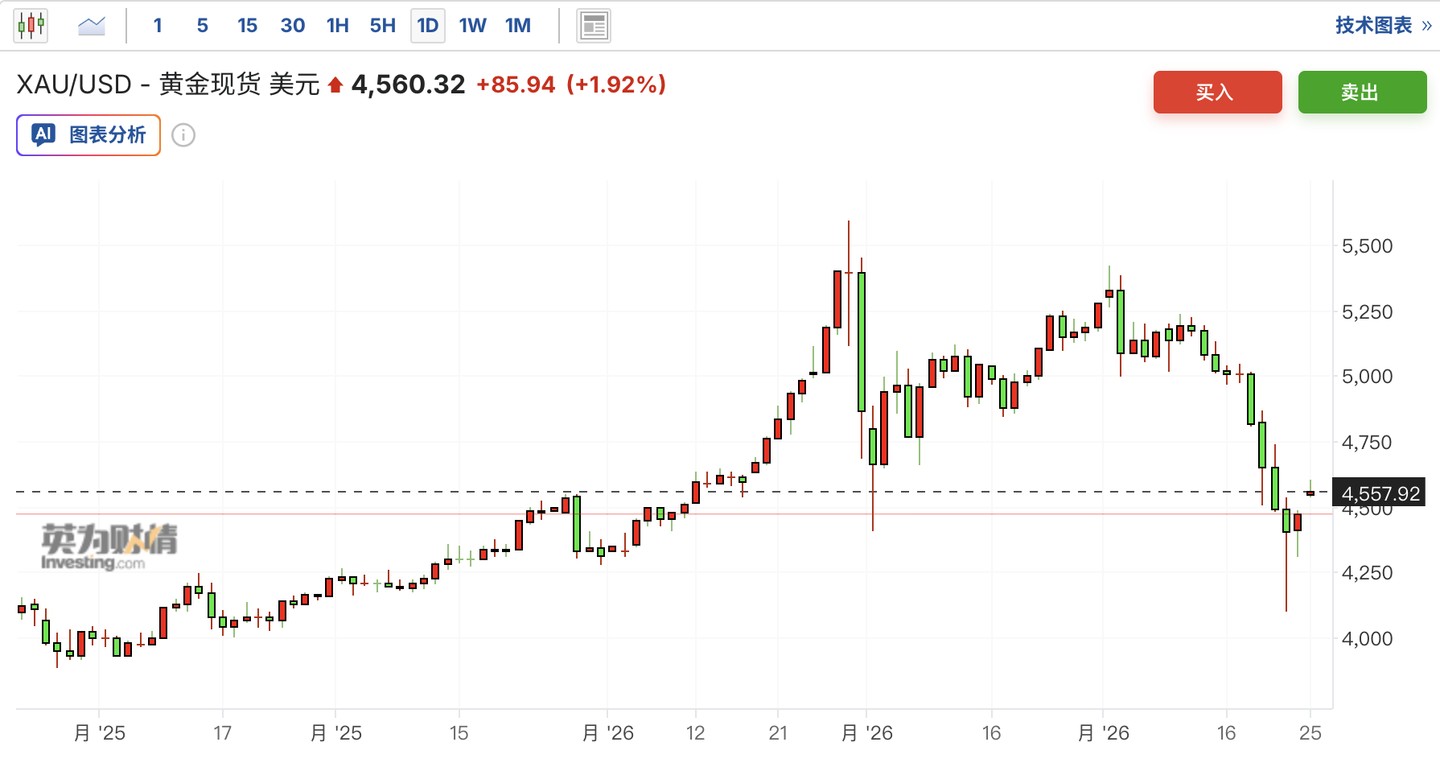
Under the impact of the Iran-U.S. war, gold, a traditional safe-haven asset, has encountered its most severe crisis of faith in recent years. After falling more than a quarter from its January historical high, the sharp decline in gold prices has led the market to re-examine the logic behind its pricing—is this a deep pit during a long bull run, or the beginning of a bubble burst?
Gold prices rebounded this week after Trump hinted that the conflict might end early, briefly reclaiming the $4,500 mark. However, analysts generally agree that the market is far from calm. The clear triggers for this decline were:
The selling pressure following the outbreak of the Iran-U.S. war stemmed primarily from investors being forced to liquidate gold to meet margin calls in the stock and bond markets. Data firm Vanda estimates that global gold ETFs have seen cumulative outflows of approximately $10.8 billion since the conflict began. Simultaneously, the war fueled inflation expectations and suppressed interest rate cut expectations, increasing the relative attractiveness of bonds and further pressuring gold prices.
Western Securities believes that gold's current pricing logic is primarily based on its reserve value, which is negatively correlated with dollar credit. The current rise in oil prices, with stable trade volume and rising prices in the petrodollar system, has created a temporary constraint on gold prices. However, the report suggests that if the U.S. ultimately fails to control the Strait of Hormuz, or chooses quantitative easing under liquidity pressure, it will expand the cracks in dollar credit, and gold is expected to hit new highs.
The True Logic of the Sell-Off: Not Gold's Failure, but a Liquidity Run
The current sharp decline in gold, a drop of 27% from its January intraday high to this week's low, saw its steepest five-day fall since 2013 in the five trading days before Trump threatened to strike Iran's energy facilities.
However, multiple analysts point out that the fundamental driver of this decline is not a complete subversion of gold's safe-haven logic, but rather a passive liquidity run.
Rhona O'Connell, an analyst at StoneX, stated that gold "almost inevitably falls" when stocks and bonds plummet, as investors need to liquidate holdings to cover losses in other markets. She cautioned investors against "falling into the 'safe-haven asset' trap."
According to Bloomberg, Jason Turner at Berenberg in Germany noted that data from hedge funds and brokers indicates financial institutions have been "liquidating profitable gold positions to meet margin calls in the stock and bond markets."
Charles Gave and Louis-Vincent Gave of Gavekal Research attributed the sell-off to a simpler explanation: gold was significantly overbought before the war, and overbought assets are the first to be hit during market turmoil—a pattern similar to gold's "sharp rise, sharp fall, then sharp rise" trajectory during the 1970s oil crisis.
Drift in Fundamental Correlation: The Mystery of Gold Decoupling from Real Interest Rates
The confusion in gold's pricing logic was foreshadowed long before the war began.
From the global financial crisis until early 2022, gold prices maintained a remarkably stable negative correlation with U.S. real interest rates: rising real rates pressured gold prices, while falling real rates benefited them. However, according to research by Tim Baker of Deutsche Bank cited by Bloomberg, this correlation has nearly vanished since 2022.
Instead, gold prices have begun to move in tandem with U.S. nominal interest rates and emerging market stocks in recent years—the latter being typical risk assets, contrary to their "safe-haven" attribute.
A Bloomberg column points out that gold's recent price trend closely resembles that of the Nasdaq Composite Index from 1999 to 2000, before the dot-com bubble burst. Both topped shortly after reaching a significant round number and experienced a rapid 80% surge in the months leading up to the peak.
Data from the World Gold Council for January showed that global gold ETF sales reached a record high that month, with particularly strong buying in Asian markets—a situation mirroring the retail investor rush before the Nasdaq bubble peaked. John Reade also noted that the increasing dominance of speculative investors in the gold market since last year has significantly heightened gold price volatility.
Long-Term Logic Persists: Dollar Credit Cracks May Be Irreversible
Despite short-term pressure, strategists holding a bullish view believe that gold's core pricing logic remains intact and is even being reinforced by the conflict's developments.
Western Securities released a report today stating that U.S. long-term real interest rates have remained high since October 2022, yet gold prices have continued to rise, indicating that the market is pricing gold's "reserve value" rather than its "transaction value." Following the Russia-Ukraine conflict, the cracks in dollar credit began to accelerate, prompting central banks and sovereign funds to diversify their reserve assets more rapidly.
The report suggests that the rise in oil prices triggered by the current U.S.-Iran conflict has superficially restored the credibility of the petrodollar system, leading to a temporary strengthening of the dollar and pressure on gold. This mechanism caused gold to fall even more than risk assets like stocks, resulting in an "oversold" situation.

However, if Iran permanently controls the Strait of Hormuz, the volume of oil trade settled in U.S. dollars will be substantially impacted, leading to a deeper erosion of dollar credit and potentially driving gold prices back into an upward trend.
Looking at historical precedents, from the collapse of the Bretton Woods system in the 1970s to the second oil crisis in 1980, gold saw a maximum increase of nearly 20 times in a decade. During the two oil crises within this period, gold prices rose by 79% and 291% respectively, both experiencing sharp interim fluctuations.
Fed Policy Variable: New Chairman's Appointment Could Be a New Catalyst
Another key variable influencing gold's medium-term trend comes from the personnel and policy direction of the Federal Reserve.
The uncertainty surrounding Trump's nomination of Walsh to succeed the Fed Chairman has itself added uncertainty to gold prices. A Bloomberg column points out that a new Fed chairman typically faces a market "stress test" to prove their commitment to fighting inflation—meaning that even if the White House continues to pressure for interest rate cuts, they might push for tighter interest rate expectations, which would be unfavorable for gold.
However, analysts with an opposing view believe that if the Fed under Walsh is forced into quantitative easing due to liquidity pressures, the cracks in dollar credit will widen more rapidly, and gold could receive a stronger upward impetus.
BMO analysts stated this week that once market risk appetite recovers, gold prices are expected to reclaim "most of the war-induced losses." Ash of BullionVault cited the 2008 financial crisis as a case in point, noting that gold prices also fell during the "period of turbulence and panic" then, but ultimately proved to be "the perfect asset for navigating the financial crisis."
Is the Sell-Off Over? Volatility May Remain the Biggest Risk
The current market consensus is that gold's price volatility will remain high in the foreseeable future, and whether the sell-off can be declared over largely depends on whether overall market volatility can subside.
Analysts at Gavekal explicitly pointed out that in the current crisis, gold has shown a side of itself that is "not an 'anti-fragile' asset," introducing volatility risks far beyond expectations for investment portfolios. They believe that selling pressure will continue until "overall market volatility declines, and companies and countries revert from 'just-in-case' inventory management to 'just-in-time' supply models."
After Trump hinted on Monday that the conflict might end early, gold prices immediately rebounded—crude oil prices remained largely unchanged, while gold quickly recovered its losses from Sunday night's futures trading. This reaction clearly indicates that gold investors are extremely eager for any signal that could reduce geopolitical risk premiums, and it suggests that bullish conviction has not completely collapsed.
For investors seeking buying opportunities in this "gold pit," the question to answer now may not be whether gold's long-term logic holds, but rather when market volatility will truly move past its most treacherous phase.
