


Xiaomi Earnings Call: 60 Billion Yuan Investment in AI Over Next Three Years, Memory Price Hikes "Striving to Absorb, Not Ruling Out Pass-Through," Automotive Overseas Timeline Unchanged
Xiaomi's 2025 earnings call revealed that full-year revenue reached 457.3 billion yuan and net profit was 39.2 billion yuan, both historical highs. The automotive business achieved profitability for the first time, with a delivery target of 550,000 units in 2026. The AI strategy is accelerating, with Xiaomi miclaw entering closed beta and a planned investment of 60 billion yuan over the next three years. Amidst rising memory prices, Xiaomi is leveraging its ecosystem balance and supply chain advantages to manage the situation, not ruling out price pass-through. The company continues to strengthen its chip and high-end strategies, while speeding up overseas market expansion
Key takeaways from Xiaomi's earnings call:
Memory Price Hikes: Significant pressure, but managed calmly. The current price increase's speed and magnitude exceeded expectations. Xiaomi's balanced ecosystem of "people, cars, and home" mitigates the impact differently across product categories (minimal impact on large appliances, moderate on cars, significant on phones and tablets). Long-term supply chain relationships and early inventory stocking ensure stable supply and cost advantages. The focus is on internal absorption in the short term, with price increases not ruled out if pressure persists. Lu Weibing predicts that the industry will undergo significant consolidation after the price hike cycle ends, driving innovation.
Automotive Business: Orders exceed expectations, overseas timeline unchanged. The new generation SU7 received 15,000 locked orders in 34 minutes and over 30,000 in 3 days, with locked orders reflecting true demand. New customers constitute a high proportion, with over 30% being female and nearly 60% being iPhone users. The delivery target for 2025 is 411,000 units, with a target of 550,000 units in 2026. The overseas launch remains scheduled for 2027.
AI Strategy: Xiaomi miclaw begins closed beta, 60 billion yuan investment over three years. The AI agent for mobile, Xiaomi miclaw, has entered a limited closed beta, a crucial step towards the Agent era. Xiaomi has completed the development of three large models, including MiMo V2 Pro, ranking highly globally. The company plans to invest 60 billion yuan in AI over the next three years (including R&D and capital expenditures), with approximately 16 billion yuan allocated for 2026, 70% of which will be R&D expenses for the current period.
IoT and Large Appliances: Huge overseas potential, accelerating high-end push. In 2025, IoT revenue reached 123.2 billion yuan with a record-high gross margin of 23.1%. Large home appliances entered 14 countries in their first year of overseas expansion, establishing a complete sales and service loop. Overseas markets hold several times the potential of the domestic market. Store targets have increased from 4,500 to 10,000 this year. High-end strategy is central, with continuous improvements in Average Selling Price (ASP) through technological innovation and industry empowerment.
Chips and R&D: Long-term strategy remains firm. Chips are a platform-level strategic capability and have not slowed down due to increased AI investment. Some chips are integral to the broader AI strategy. R&D investment in 2026 will exceed 40 billion yuan, with cumulative investment over the next five years surpassing 200 billion yuan, further strengthening its hard-core technology foundation.
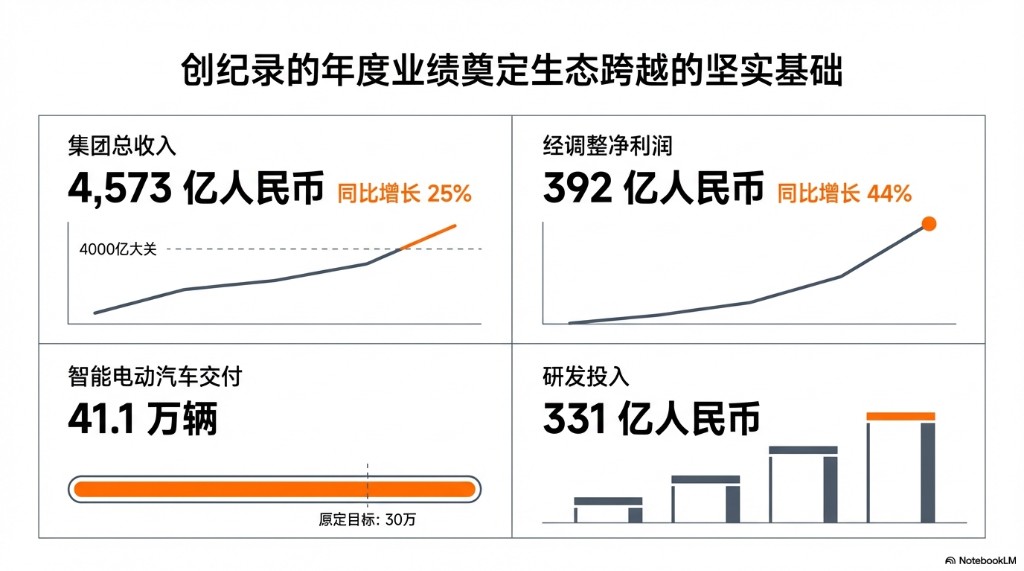
On March 24th, Xiaomi Group held its 2025 full-year and fourth-quarter earnings call. In his opening remarks, Xiaomi Group President Lu Weibing stated that 2025 marks Xiaomi's 15th anniversary, and the group has delivered a "historic leap" performance: full-year total revenue exceeded 400 billion yuan for the first time, reaching 457.3 billion yuan, a year-on-year increase of 25%; adjusted net profit was 39.2 billion yuan, a year-on-year increase of 44%, with both revenue and profit reaching new historical highs. He emphasized that smartphone, automotive, and home appliance businesses are progressing in tandem, and 2025 is also a year of "major technological breakthroughs" for Xiaomi.
The strategic layout of AI large models, embodied robots, and smart ecosystems is becoming Xiaomi's core narrative to investors. Lu Weibing stated that 2025 is the pivotal year for AI to transition from "usable" to "truly useful." With its hardware ecosystem spanning smartphones, automobiles, home appliances, and IoT, Xiaomi possesses over 1 billion connected nodes, offering unparalleled data advantages in the competition for AI extension into the physical world compared to single-product companies. The company announced an investment of 60 billion yuan in AI over the next three years, with over 16 billion yuan dedicated to AI and embodied intelligence in 2026.
Regarding the surge in storage costs, Lu Weibing acknowledged understanding the price increases by competitors. He explained that Xiaomi's synergistic development across its "people, car, and home" ecosystem can partially offset the impact of rising memory prices. Leveraging its global top-three scale advantage and high-end strategy benefits, Xiaomi will dynamically seek incremental opportunities and enhance its differentiated competitiveness in smartphones, with Xiaomi miclaw being an active attempt. He also predicted that the memory price hike cycle will eventually end, leading to industry restructuring across most categories, and that challenging external environments will inevitably drive innovation, presenting significant opportunities for industry innovation.
Lu Weibing further elaborated on the future plans for Xiaomi miclaw, describing it as a new breakthrough for Xiaomi in the Agent era and a crucial step in implementing AI across the "people, car, and home" ecosystem. Recently, miclaw has added support for models like Xiaomi 15S Pro and the REDMI K90 series, with future expansion to PCs, watches, and more devices. He reiterated that Xiaomi has always opposed the conceptualization of AI phones, emphasizing that AI phones must bring substantial changes to human-computer interaction. Xiaomi miclaw will be fully integrated with the澎湃 OS and the "people, car, and home" ecosystem devices in the future. It is understood that Xiaomi miclaw is the first "mobile lobster" in China, aiming to explore the path of model implementation from "conversational capabilities" to "system-level execution capabilities."
Automotive Business Achieves Full-Year Profitability for the First Time, Targeting 550,000 Units in 2026
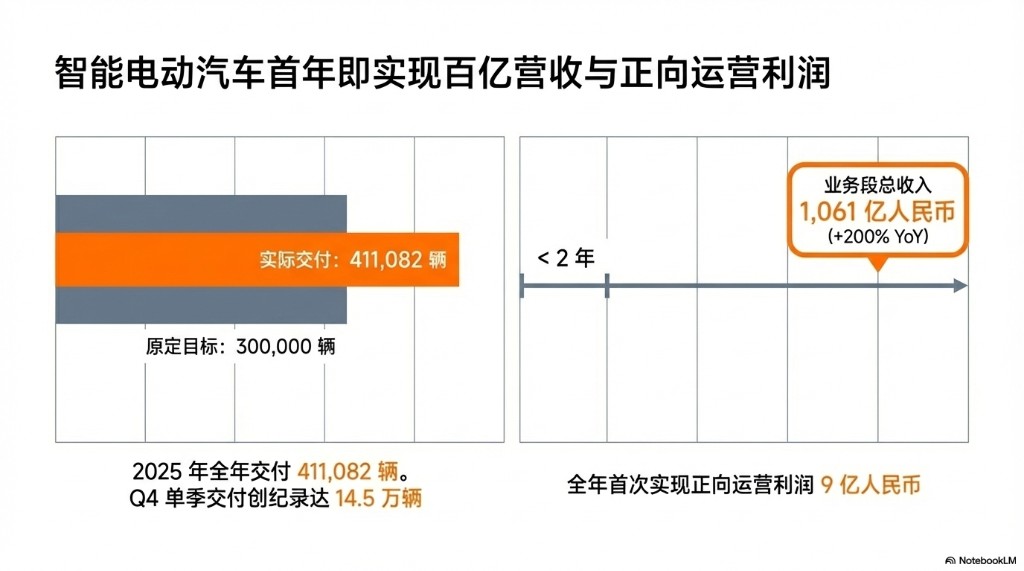
The smart electric vehicle business emerged as the biggest highlight of this earnings report. In 2025, Xiaomi Auto delivered over 410,000 units, significantly exceeding the initial target of 300,000 units. As of February 13, 2026, cumulative deliveries surpassed 600,000 units. In 2026, Xiaomi aims to deliver 550,000 units for the full year.
The earnings report indicates that the smart electric vehicle and AI innovation business segment generated over 100 billion yuan in revenue for the year, reaching 106.1 billion yuan, a year-on-year increase of 223.8%, achieving the 100 billion yuan milestone in less than two years. The gross profit margin for this segment was 24.3%, an increase of 5.8 percentage points year-on-year. Crucially, this segment achieved positive operating income for the first time in 2025, with an operating profit of 900 million yuan for the year.
On March 19, 2026, Xiaomi officially launched the new generation SU7 series. Lu Weibing stated, "The new generation SU7 has undergone significant changes from the inside out. We have comprehensively upgraded the intelligent system, chassis system, and electronic and electrical architecture, while also making substantial advancements in safety." The new car received over 15,000 locked orders in 34 minutes of its launch and exceeded 30,000 locked orders in 3 days.
At the 2026 Mobile World Congress, Xiaomi also showcased its concept car, the Xiaomi Vision Gran Turismo. Lu Weibing commented, "Xiaomi is the first Chinese brand invited to participate, signifying that the design and innovation of China's automotive industry can now compete with the world's top brands."
Xiaomi Group CFO Lin Shiwei revealed at the earnings call that the new generation SU7 received over 15,000 locked orders in 34 minutes and over 30,000 in 3 days, expressing confidence in future orders. The launch of the new SU7 has attracted more new customers and continued to broaden its appeal. Regarding model choices, the Max model accounted for over 25% of orders, with paid paint options nearing 60%, and the "Aquamarine Blue" being the most popular. Lin Shiwei also mentioned that Xiaomi Auto's plan to enter the European market next year remains unchanged.
AI Strategy Accelerates Fully, Embodied Robots Enter Factories
Lu Weibing positioned AI as Xiaomi's "core innovation engine" at the earnings call, predicting that 2026 will be the year of explosive AI application growth, with AI deeply penetrating from the virtual world into the physical world.
In terms of large models, Xiaomi released three models in March: MiMo V2 Pro, MiMo V2 Omni, and MiMo V2 TTS. MiMo V2 Pro boasts over a trillion parameters and supports a context window of 1 million tokens, ranking eighth globally and fifth among brands in the Artificial Analysis large model intelligence index. Lu Weibing disclosed that during the public testing phase, related models on the Open Router platform once reached twice the daily call volume of the second-ranked model.
On the terminal AI front, Xiaomi's AI smart agent for mobile phones, "Xiaomi miclaw," has entered a limited testing phase, making Xiaomi the first OEM to deploy such technology on mobile terminals. Lu Weibing admitted that commercialization is still some way off, and the team has not set any KPIs yet, stating, "We will only set KPIs when the product is sufficiently mature."
In the realm of embodied intelligence, Xiaomi released a tactile-driven precise grasping fine-tuning model in early 2026 and open-sourced the VLA large model for robots, "Xiaomi Robotics 0," achieving multiple SOTA results. In March, embodied robots began "internships" in the automotive factory, successfully achieving a 90.2% success rate in simultaneous bilateral installation of self-tapping screws at the workstation, with a fastest cycle time of 76 seconds, capable of autonomous operation for 3 hours continuously. Lu Weibing stated, "A large number of embodied robots will be put into use in Xiaomi's factories over the next five years."
Memory Price Hike Pressure Unavoidable, Price Pass-Through May Be Delayed but Not Absent
In response to analysts' persistent questions about rising memory prices, Lu Weibing candidly admitted that the duration and extent of the current price hike cycle have exceeded previous expectations, with AI-driven demand expansion being a significant driver. Some low-capacity product categories have even faced production cuts and supply restrictions.
He used "memory cost as a percentage of a product's Bill of Materials (BOM)" as an analytical framework for quantifying the impact: smartphones, tablets, and laptops are most affected, followed by smart vehicles, with IoT and home appliances being relatively least impacted. "For any smartphone manufacturer, it is difficult to maintain operations without passing on costs to consumers; this is unavoidable. Xiaomi is also under significant pressure. We will do our best to absorb it, but if we can no longer do so, we will have no choice but to increase prices. We hope consumers will understand."
Lu Weibing also pointed out Xiaomi's multi-faceted advantages in handling this situation: its diverse product lines dilute the concentrated risk of single product categories; long-term supply contracts with major global memory suppliers eliminate supply disruption risks; and due to a previously pessimistic outlook, the company proactively stocked up aggressively, resulting in a high level of inventory adequacy.
Dual Drivers of IoT Overseas Expansion and High-End Strategy, Chip Investment Remains Unchanged
Regarding the outlook for the IoT business, Lu Weibing believes that the core opportunity in the domestic market lies in high-endization – current product ASPs are still relatively low, with significant room for improvement in categories like watches and large appliances. A large number of high-end new products will be launched this year.
Overseas markets are seen as a greater area for incremental growth. He stated that entering the North American market would mean a volume three times larger than the Chinese market, and combined, they could reach six times the current scale. The plan is to expand overseas stores from 4,500 to 10,000. In mature markets like the UK, Xiaomi Stores are already focusing on high-end products with positive sales feedback.
Concerning the chip strategy, Lu Weibing explicitly stated that despite the significant increase in AI investment, chip R&D will not be reduced. "Chips are a platform capability that can empower multiple product categories, and many chips are themselves part of the broader AI strategy. We will firmly advance this." He cited the recently launched Xiaomi laptop as an example – developed over four years and launched amidst memory price hikes, it still experienced higher-than-expected market demand, proving that product strength is fundamental to resisting cost pressures.
Here is the full transcript of the earnings call (assisted by AI):
Host:
Good evening, everyone, and welcome to Xiaomi Group's 2025 Annual Results Investor Conference Call and Audio Webcast. This call will be recorded. If you have any questions or objections, you may hang up now. Now, I'd like to hand over to Mr. Xu Ran, General Manager of Investor Relations and Capital Markets.
Xu Ran, General Manager of Investor Relations and Capital Markets:
Welcome everyone to our 2025 Annual Results Investor Conference Call and Audio Webcast. Before we begin, we'd like to remind you that this conference call may contain forward-looking statements based on various risks and uncertainties, which may not be realized in the future for various reasons. Information regarding general market conditions is sourced from various external sources. This presentation also includes certain unaudited non-IFRS financial measures, which should be considered as a supplement, not a substitute, for the financial statements prepared in accordance with IFRS. Joining us today are Mr. Lu Weibing, Partner and President, and Mr. Lin Shiwei, Vice President and Chief Financial Officer. Mr. Lu will share recent strategic and business updates, followed by Mr. Lin's review of our financial performance for 2025. We will then move to the Q&A session. Over to you, Mr. Lu.
Lu Weibing, Partner and President:
Good evening, everyone. Thank you all for joining our 2025 full-year results conference call. Tonight, I will share three points: first, a review of our key achievements in 2025; second, breakthroughs in hard-core technology, especially in AI and embodied intelligence; and third, our strategic direction and operational priorities for 2026.
First, regarding outstanding achievements in 2025, Xiaomi Group maintained high-speed growth, with annual revenue and net profit reaching new historical highs. Total group revenue reached RMB 457.3 billion, surpassing the 400 billion yuan mark for the first time, a year-on-year increase of 25%. Adjusted net profit reached RMB 39.2 billion, a year-on-year increase of 44%.
Breaking down by business segment, first, the smartphone business. According to Omdia, our global smartphone shipments in 2025 ranked third, with a market share of 13.3%, maintaining our position in the global top three for 22 consecutive quarters. In Latin America and Southeast Asia, our shipments rose to second place; in Europe and Africa, we ranked third. According to third-party data, in mainland China, our smartphone sales ranked second. In terms of high-end models, in 2025, high-end smartphone sales accounted for 27.1% of our total smartphone sales in mainland China, a year-on-year increase of 3.8 percentage points. In the RMB 6,000 to 10,000 price segment, our market share increased by 2.3 percentage points year-on-year. We have consolidated our high-end base in China and continue to make breakthroughs in the ultra-high-end market between RMB 6,000 and 8,000. By the end of February 2026, we launched our first product priced at 1,999 euros for the global market, a new milestone in our international high-end strategy. We will continue to achieve top pricing in international mature markets and drive overseas high-end sales to new heights.
For the IoT business, in 2025, its revenue exceeded 120 billion yuan for the first time, reaching 123.2 billion yuan, a year-on-year increase of 18.3%, setting new records in both domestic and international markets. The revenue of large home appliances grew by over 23%, with shipments reaching new highs. Wearable devices ranked first globally in shipments, and TWS earbuds ranked second. Tablet shipments increased by 25.2% year-on-year, ranking fifth. Our AI glasses, launched in June 2025, ranked third globally in shipments and first in China. We continue to promote full-category high-endization both domestically and internationally, with strong performance in overseas high-end products under our high-end strategy. In 2025, our technology-driven large home appliance business entered the European market, covering countries such as Spain, France, Germany, and Italy.
For the automotive business, Xiaomi Auto delivered 411,000 vehicles in 2025, far exceeding the initial target of 300,000 units. As of February 13, 2026, cumulative deliveries exceeded 600,000 units. We are fully focused on achieving our 2026 delivery target of 550,000 units. On March 19, we officially launched the new generation SU7. It features significant upgrades in appearance and interior, including the electric powertrain, chassis, and electronic/electrical architecture. Following the SU7's launch, locked orders exceeded 15,000 units within 34 minutes and surpassed 30,000 units within three days. At this year's MWC, we also showcased our Vision GT concept car. This is not just a concept car, but represents Xiaomi Auto's latest exploration in design innovation based on hard-core technology. We are the first Chinese brand invited to participate, signifying recognition from the world's top simulation driving platforms for China's automotive industry. This indicates that Chinese automotive manufacturers can now compete head-to-head with the world's top brands in terms of design and innovation.
Regarding hard-core technology, in 2025, our R&D investment exceeded 33 billion yuan. In 2026, we plan to invest over 40 billion yuan, with more than 16 billion yuan allocated to AI, embodied intelligence, and other innovative areas. These investments build a solid barrier of product capabilities. In AI, we made breakthroughs in 2025. AI is undergoing a historic leap from "usable" to "truly useful," shifting paradigms from single-task to complex task processing, from passive to proactive planning, and from tool attributes to ecosystem attributes. For us, with our rich terminal products and application scenarios spanning smartphones, automobiles, large home appliances, and IoT, the value of AI far exceeds that of single-product companies.
Our foundational large models have entered the global open-source leading echelon. In March of this year, we released three models: Xiaomi MiMo V2 Pro, MiMo V2 Omni, and MiMo V2 TTS, completing the technical foundation for the intelligent agent era. MiMo V2 Pro has over a trillion parameters and supports a context window of one million tokens, ranking eighth globally and fifth by brand in the Artificial Analysis large model intelligence index. During closed and public testing, these models ranked first in weekly calls on the OpenRouter platform, topping the list for multiple consecutive days, with daily call volume even reaching twice that of the second-ranked model. We will continue to upgrade our foundational large models, moving towards general artificial intelligence.
We are poised to lead the way in bringing AI into the physical world. The deep integration of AI with the physical world is the next frontier of intelligent technology. We have over a billion hardware ecosystem entry points. In March 2026, our mobile AI agent, "Xiao Long," entered limited closed beta. We are the first OEM to attempt deploying "Long Xia" on mobile terminals, exploring the provision of true AI phone and ecosystem experiences to users. In the automotive sector, the new generation SU7 is equipped with our XLA cognitive large model, enhancing capabilities in underground parking navigation, complex scenario understanding and reasoning, and voice control. The SU7 Ultra features the Super Xiaoai AI intelligent cockpit, delivering a more intelligent experience. In the home sector, in November 2025, we launched the "Xiaomi Smart Home" whole-house intelligent solution, giving smart homes eyes, brains, and limbs for the first time. This marks the first application of Xiaomi MiMo in real living spaces, painting a new blueprint for the next generation of smart homes.
Fourth, AI has now become Xiaomi's core innovation engine. In the 2025 technology awards, approximately two-thirds of the winning projects utilized AI technology, reimagining work with AI across numerous fields, including basic materials, chips and operating systems, intelligent driving, and smart home appliances. Leveraging China's strong AI industry, the next decade belongs to China, and Xiaomi is well-positioned within the "people, car, and home" ecosystem. We will invest 60 billion yuan in AI over the next three years, believing that in this era, we will forge a new path for China's AI.
Regarding embodied robots, they represent the ultimate integration platform for AI, chips, operating systems, and manufacturing capabilities, with extremely high barriers to entry. In 2026, we released a tactile-driven precise grasping fine-tuning model, a core technology for robotic dexterous hands. Subsequently, we open-sourced the Xiaomi robotic VLA large model – Xiaomi Robotics-0, achieving multiple SOTA results. In March, Xiaomi's embodied robots began "internships" in our automotive factory, successfully achieving a 90.2% success rate in simultaneous bilateral installation of self-tapping screws at the workstation, meeting the production cycle requirement of a fastest 76 seconds, and achieving 3 hours of autonomous operation. This is just the beginning. In the next five years, we believe a large number of embodied robots will work in Xiaomi's factories, breaking down the boundaries between the virtual and physical worlds.
Of course, we face challenges such as memory price hikes, which may bring some pressure to our business in the short term. However, on the other hand, we will firmly execute our strategy and continue to achieve breakthroughs in AI, chips, operating systems, and embodied intelligence. We are committed to scaling our global business model and bringing Chinese technology to the world. This "people, car, and home" ecosystem is not just a product portfolio, but a platform for understanding user data across all scenarios. We will firmly seize the opportunities of the AI era, and the future is full of infinite possibilities and imagination.
Lin Shiwei, Vice President and Chief Financial Officer:
Okay, thank you, Mr. Lu. As Mr. Lu shared, we achieved a historic leap in 2025. Our total revenue reached a record RMB 457.3 billion, a year-on-year increase of 25%, marking the company's best year. Fourth-quarter revenue also hit a new quarterly high. The overall gross profit margin was 22.3%, an increase of 1.3 percentage points year-on-year, also a historical high. The second half of 2025 was more challenging than the first half.
For the full year, our Smartphone × AIoT segment revenue was RMB 351.2 billion, a year-on-year increase of 5.4%, also a record high for the year. The gross profit margin for the Smartphone × AIoT segment also reached a record 21.7%, a year-on-year increase of 0.5 percentage points.
In terms of smartphones, the full-year revenue was RMB 186.4 billion, accounting for 40.8% of total revenue. In 2025, our global shipments reached 165 million units. Our high-end strategy has yielded significant results, with continuous enhancement of product competitiveness. Third-party data shows that in 2025, our high-end smartphone sales in mainland China accounted for 27.1% of our total smartphone sales, a year-on-year increase of 3.8 percentage points. In the RMB 4,000 to 6,000 price range, our market share was 17.3%, an increase of 0.5 percentage points year-on-year.
In the RMB 6,000 to 10,000 price segment, our market share was 4.5%, nearly doubling year-on-year. According to third-party data, in 2025, our global smartphone shipments ranked third, with a market share of 13.3%, maintaining our position in the global top three for five consecutive years. In 58 countries and regions, our smartphone shipments ranked in the top three; in 70 countries and regions, we ranked in the top five. Despite the memory price increase in 2025, our smartphone gross profit margin for the full year remained at a healthy 10.9%.
For IoT business, our revenue and gross margin performed exceptionally well in 2025. IoT business revenue increased by 18.3% year-on-year, reaching RMB 123.2 billion, a new record, with both domestic and international sales reaching historical highs. Benefiting from product mix optimization and enhanced product competitiveness, the gross profit margin of the IoT business reached a record 23.1%, an increase of 2.8 percentage points year-on-year. By category, the smart large home appliance business performed particularly well, with revenue increasing by 23.1% year-on-year, setting a new record. Our wearable devices continued to grow rapidly and hold a leading industry position. Our wearable bands ranked first globally in shipments, and TWS earbuds ranked second. Tablet products continued their rapid growth, with shipments increasing by 25.2% year-on-year, ranking fifth globally.
For Internet Services, we continued to expand our user base. In December 2025, our global monthly active users reached 750 million, a year-on-year increase of 7.4%. Of this, monthly active users in mainland China reached 190 million, a year-on-year increase of 10.1%. In 2025, our Internet Services revenue reached a record RMB 37.4 billion, a year-on-year increase of 9.7%. In the fourth quarter of 2025 alone, Internet Services revenue reached RMB 9.9 billion. For the full year 2025, our Internet Services gross profit margin remained stable at 76.5%. Advertising business continued to drive the growth of Internet Services, with annual revenue reaching a record RMB 28.5 billion. Overseas Internet Services revenue increased by 15.2% year-on-year, reaching a record RMB 12.6 billion, accounting for 33.8% of total Internet Services revenue.
Next, the Electric Vehicle business. Our Electric Vehicle and AI Innovation business segment generated RMB 106.1 billion in revenue for the full year, surpassing the 100 billion yuan mark in less than two years, a year-on-year increase of over 200%, accounting for 23.2% of the Group's total revenue. Of this, smart electric vehicle sales revenue was RMB 103.3 billion, and other related revenue was RMB 2.8 billion. In 2025, the gross profit margin for the Smart Electric Vehicle and AI Innovation business segment was 24.3%, an increase of 5.8 percentage points year-on-year. In 2025, this segment achieved positive operating profit for the year for the first time, recording an operating profit of RMB 0.9 billion. We delivered a total of 411,082 new vehicles for the year. In the fourth quarter alone, we delivered 145,115 new vehicles, a new quarterly high. The average after-tax unit price for the year was RMB 251,171, a year-on-year increase of 7%.
Moving on, our cumulative R&D expenditure over the past five years was RMB 105.5 billion, an increase of 37.8% year-on-year. R&D expenditure for the single year 2025 was RMB 33.1 billion, an increase year-on-year. We expect our cumulative R&D expenditure over the next five years to exceed RMB 200 billion starting from 2026.
In terms of net profit, the Group's adjusted net profit for 2025 was RMB 39.2 billion, a new historical high, an increase of 43.8% year-on-year. In terms of capital expenditures, our capital expenditure in 2025 reached RMB 18.2 billion, an increase of 73% year-on-year. Of this, the Smart Electric Vehicle and AI Innovation business accounted for over 66%. We continue to enhance shareholder value and actively repurchase shares in the open market. In 2025, our share repurchase amount was approximately HK$6.3 billion. Since the beginning of 2026, our total share repurchase amount has been approximately HK$4.7 billion. In January 2026, we announced an automatic share repurchase plan of up to US$2.5 billion, demonstrating our confidence in the company's long-term future.
We actively practice sustainability and low-carbon initiatives. In 2025, the Group procured over 40 million kilowatt-hours of green electricity, more than ten times that of last year. In 2025, our automotive factory's photovoltaic power consumption exceeded 13 million kilowatt-hours, reducing carbon emissions by nearly 10,000 tons annually. In terms of ESG ratings, in 2025, Xiaomi received a management-level B rating in both CDP Climate Change and Water Security questionnaires. Furthermore, in March 2026, we achieved our highest score of 81 in the EcoVadis Gold medal assessment, further recognizing our ESG efforts. We will continue to adhere to a steady and proactive business strategy and look forward to achieving even greater success in 2026.
Thank you very much. That concludes our report for tonight. We can now proceed to the Q&A session. Thank you.
Xu Ran, General Manager of Investor Relations and Capital Markets:
We will now proceed with the Q&A session. To allow more investors the opportunity to ask questions, please limit your questions to a maximum of two. Let's begin the Q&A session.
Q&A Session
Morgan Stanley. Hello. First, congratulations on the 2025 results. Revenue and profit both reached new highs. I have two questions. The first is about memory. We've seen memory prices rise significantly, and investors are most concerned about the impact on the smartphone segment. We've noticed that some smartphone manufacturers have already raised prices to offset the impact of rising memory prices, but your smartphone pricing appears to have remained unchanged. Perhaps you have better supply chain management and inventory compared to competitors, allowing you to perform better than peers amidst challenges? Could Mr. Lu share some new ideas regarding smartphones and how you are addressing this year's challenges?
Lu Weibing, Partner and President:
Regarding memory, it's a topic of concern every quarter. I've shared my views on various occasions. I've said in the past that this is a cycle, and we need to look at 2027. There might be high price increases, and we have prepared for this. On the other hand, my feeling is that this price increase cycle might last longer than I anticipated. Firstly, there's AI-driven demand, and secondly, the increase in memory costs might be higher and more aggressive than I expected. My previous expectations were already considered aggressive within the industry, but the actual situation might be more severe. Therefore, the impact is significant for all consumer electronics products, not just smartphones, which we focus on more. For some lower-capacity categories, there are also situations of supply reduction, which is the reality we face.
To address this, we have a simple algorithm: look at the proportion of memory cost in the product's BOM cost. The higher the proportion, the greater the impact; the lower the proportion, the smaller the impact. In our product line, the proportion is relatively high for smartphones, tablets, and laptops. However, on the other hand, for some high-end smartphones, the memory proportion is relatively lower. So, if a company's product has a high memory proportion, the impact is greater; otherwise, it's smaller. This is a very simple calculation.
Looking at memory price increases over the past two weeks, we've already seen some competitors raise prices for their mid-range smartphones. I completely understand. I believe any smartphone manufacturer would find it difficult to bear such a significant price increase without passing it on to consumers. This is unavoidable. For Xiaomi, the pressure is indeed very high. But as I said, we will do our best to absorb it and protect consumers. When we can no longer bear it, we will also have to increase smartphone prices. We hope consumers and customers can understand this. Our price increases will be slower, but this doesn't mean we are immune. I'd like to mention some of Xiaomi's competitive advantages.
For example, in the home appliance category, the impact is smaller. For smart vehicles, the memory proportion is relatively lower than in smartphones, so the impact is also smaller. With our diversified product lines, I believe we can better cope with this issue. For smartphones, tablets, and laptops, we are global leaders, and in electric vehicles, we are also leaders. Over the past few years, we have established very good relationships with global memory suppliers, built on mutual trust and long-term supply contracts. Therefore, I do not feel any risk of supply disruption at the moment. This is an advantage compared to competitors.
Third, my previous expectations were rather pessimistic, and we made more aggressive preparations, so our inventory adequacy is higher. But overall, the cost impact on terminal products is very significant, and short-term pressure does exist.
Xu Ran, General Manager of Investor Relations and Capital Markets:
Thank you, Mr. Lu, that was very clear. My second question is about our automotive business. The new generation Xiaomi Auto has been successfully launched, and in discussions with investors, I've noticed some investors believe Xiaomi is no longer disclosing certain data, only announcing locked orders. They view this as somewhat negative. But for Xiaomi, I believe sales will remain stable and positive. Could you comment on these two perspectives from investors?
Lu Weibing, Partner and President:
Regarding sales announcements, we've observed some phenomena from the user perspective. The first phenomenon is that within three days of the launch, we achieved significant locked orders: 15,000 units in 34 minutes and over 30,000 units in three days. We fulfilled our promise to start deliveries from the fourth day after the launch because we were prepared for vehicle manufacturing and learned from the experience of previous models where users waited too long, iterating rapidly. As for why we only disclose locked orders, we believe it's fairer. This is not a reservation or a final order, but a locked order, representing a buyer who will actually take delivery, which also determines our production cycle. We believe locked order data is a fairer measure, hence the change. Practices vary across the industry, but we believe this is the correct approach.
Taking this opportunity, I'd also like to share some information about the locked-in users. Many investors are concerned whether locked-in users are from existing customers or new ones. Most are new customers, not those trading in older models. Regarding iPhone users, about 50% for the first generation, and 60% of new users are iPhone users. Our locked order progress is faster than the first generation. Additionally, about 60% of users opted for paid customization. The penetration rate of female users, iPhone users, and paid color options are all better than the previous generation.
Xu Ran, General Manager of Investor Relations and Capital Markets:
Thank you for the question. Next, we'll take a question from Goldman Sachs.
Attendee:
Good evening, I have two questions about AI. First, several models have emerged over the past two years, including foundational models. How are our capabilities in AI within the ecosystem? What is the positioning of Xiaomi miclaw and its synergy with IoT? What is the significance of Xiaomi miclaw? Additionally, how do we view the application of AI for users, developers, and internal tools? What are the KPI considerations for large model commercialization? You mentioned an investment of 60 billion yuan over three years; how will this be allocated between operating expenses and capital expenditures?
Lu Weibing, Partner and President:
In 2023, we invested significant effort in planning our future AI strategy. We first focused on AI infrastructure, algorithms, etc. After infrastructure, applications grow exponentially. Last year, we stated that 2026 would be a year of exponential AI application growth. AI has moved from virtual to the physical world, confirming my earlier prediction. As this prediction becomes reality, we will continue to develop AI large models. We began investing in large language models in 2024 and made significant progress in 2025. Last year, we clearly stated that 2026 would be the year of explosive AI applications. Last year, we were more focused on AI agents. How can AI play a greater role on a single device, helping users accomplish things they couldn't before? The emergence of "OpenClaw" allowed us to quickly launch Xiaomi miclaw for beta testing.
Based on the test feedback, it's very positive. The future market is vast, with AI entering the physical world and being applied in areas like driving, robotics, and humanoid robots. Xiaomi has already made arrangements in this regard. Ultimately, AI will serve the entire Xiaomi ecosystem. This is a major direction, and we will continue to pursue it strategically.
Regarding Xiaomi miclaw, this self-developed AI agent by Xiaomi will test our modeling capabilities, limitations, and our ability for deep integration and data utilization. At Xiaomi, we will integrate our own user data, utilize cloud data, and perform system-level integration to ensure security. For Xiaomi miclaw, it is a prototype for future AI agents. It is still early days, and we have no specific commercialization model, nor does the team have KPIs; these will only be set once it's mature.
My colleague will answer the question about the 60 billion yuan investment.
Lin Shiwei, Vice President and Chief Financial Officer:
Yes. This 16 billion yuan and the 60 billion yuan over three years include R&D expenses and capital expenditures. R&D expenses also include the amortization of R&D expenses from previous years. So, it includes current period R&D expenses, amortization of previous years' R&D expenses, and capital expenditures. Looking at the 16 billion yuan for 2026, the majority is current R&D expenses, accounting for about 70%. The remainder includes capital expenditures plus amortization from previous years. Over the next three years, capital expenditures each year will include some amortization of previous years' capital expenditures into the current year, so the proportion might be less than 70%. Thank you.
Xu Ran, General Manager of Investor Relations and Capital Markets:
China Capital, Wen Han Jin.
Attendee:
Good evening, I have two questions. First, regarding the IoT business. We see excellent performance from IoT in 2025, with strong revenue and progress. There are two points of focus this year: the domestic situation, where some investors worry about a slight economic slowdown; what are your thoughts on this? Second, what are the IoT overseas expansion plans? The second question is about the automotive business; the entire electric vehicle segment achieved profitability in 2025. What is the outlook for full-year automotive profits? How do you view the full-year automotive profit?
Lu Weibing, Partner and President:
I'll discuss IoT first, and then Mr. Lin will answer the other question. Regarding the IoT business, we have many different product categories. Are you asking about the Chinese market or overseas markets? For the Chinese market, I believe there are opportunities for high-endization in the IoT business. Although we have large scale, the average selling price is low. We made significant progress last year, but we are still far from our goals. The average prices of our watches, hairdryers, and other products remain relatively low. With increased R&D investment, I believe there will be many positive developments in high-endization this year, presenting a huge opportunity. For large home appliances, our refrigerators, washing machines, etc., still have significant room for improvement, as does air conditioning. The IoT business as a whole is already at a high level, and we aim to maintain this momentum. For overseas business, I believe the growth potential is enormous because our market has always been China. If we enter the North American market, the volume could be three times that of China; if the potential is fully realized, it could be six times, or at least several times the current domestic scale. There are numerous blank spaces in overseas markets waiting for us to fill. We will deploy personnel and products in overseas markets. As the IoT business grows, we have a lot of information and testing from overseas, indicating enormous potential. For our high ASP products, this is an area of high growth potential. This is our overseas plan. Last year, we had 4,500 overseas stores; this year, the target is to increase to 10,000. I visited the Xiaomi Store in London and observed that most of the sales were high-end products. Our product range is very rich, and in overseas markets, such as the UK, we sell high-end products. So, I believe the growth potential in overseas markets is enormous.
Regarding the automotive business, we delivered over 410,000 units in 2025, far exceeding the initial target of 300,000 units. The delivery target for 2026 is 550,000 units. This represents growth compared to 2025, but there will be overall pressure in 2026. We remain confident in achieving our targets. Concerning profit targets, you know this segment is the AI and New Business division, which includes AI investments and other new development areas. It cannot be viewed solely as the automotive segment; it also includes other new businesses within this division. Currently, new businesses are still in the investment phase. As I mentioned, we will continue to increase investment in AI this year, including in the robotics field. Therefore, we need to consider two aspects: first, the automotive business within the division, and second, the investment in AI plus new businesses. The performance of this division was very strong last year. This year, as automotive growth and results in other areas become apparent, the performance of this division will be encouraging.
Attendee:
Thank you very much for the explanation.
Xu Ran, General Manager of Investor Relations and Capital Markets:
Next question. Citi, Huang Leping.
Attendee:
Thank you, can you hear me?
Xu Ran, General Manager of Investor Relations and Capital Markets:
Yes.
Attendee:
Thank you. I have two questions. First, regarding the recent situation in the Middle East, do you know if it has affected overseas business, including IoT and mobile phones? Have logistics and raw material costs become an issue? The second question is about the gross profit margin of smartphones this year; is there a principle, for example, at what profit level would you adjust prices to protect gross profit margin? You previously mentioned potential pressure on the automotive business; how do you ensure performance superior to competitors? For AIoT, high-endization is the strategy; what are the specific plans for high-endization?
Lu Weibing, Partner and President:
First, the conflict in the Middle East is something we do not wish to see. I hope for a resolution, as it affects global industries and economies, with significant consequences. In terms of Xiaomi's business, revenue from the Middle East accounts for a small percentage, in the single digits. So, from this perspective, it is controllable. However, we have also observed that the situation in the Middle East's oil market affects certain raw materials like plastic pellets, but overall it is manageable. This is the first question.
The second question is about the gross profit margin of automotive, IoT, and smartphones, as well as pricing strategies. Firstly, regarding memory, if we quantify it, in the past quarter, we expected prices to remain high, but they have actually risen even more. It is difficult to predict in advance as we did before, and even a slight increase has a significant impact on costs due to its large proportion in the product's cost structure. However, for smartphones, considering our scale and market share, this is very important. If you ask whether there is a principle, it is that we strive to find a balance. My consideration is to maintain our market position, which is crucial for us. In the smartphone sector, there are not many publicly listed companies, so it is difficult for me to obtain accurate data from industry competitors. But based on years of experience, the impact varies across different categories. In the automotive sector, memory is part of the overall vehicle price, so the impact is not as significant as in smartphones. The impact on IoT is even smaller. Those significantly affected are smartphones, laptops, and tablets, followed by smart vehicles, and then IoT.
Xu Ran, General Manager of Investor Relations and Capital Markets:
Next question. Dittik Shinji.
Attendee:
Thank you for giving me the opportunity to ask questions. I have two questions. The first is about the AI business; Xiaomi miclaw has been launched, and I had the privilege of attending the launch event, which was very impressive. Could you provide more guidance? At what level of maturity will the large model or "Xiao Long" be commercialized? How will revenue be generated? The second question is about chips this year; are there any updates on progress?
Lu Weibing, Partner and President:
Regarding "Xiao Long," I've discussed it extensively. As a user, you should have experienced it. You attended the launch event, and it gave us many pleasant surprises. However, as a new product, there is still significant room for improvement. I myself have received a lot of feedback and know it needs improvement. But I believe the iteration will be very fast, with new versions released within days. For Xiaomi as a whole, AI will continue to create value for users. Regarding AI commercialization, it is still too early. Although our large models are efficient, for example, in the commercialization of tokens, the absolute value might still be relatively high. So, it's too early to talk about commercialization now. We have also seen the XLA model, a cognitive large model, which is already equipped in the SU7. Based on internal testing, its performance is excellent. For both these models, I am a user, and if I encounter any usage issues, I will provide feedback to the team. I have personally experienced the autonomous driving function, and it will be rolled out gradually. Our autonomous driving, whether it's the model or the chips, has some layout and has achieved end-to-end integration. When ready, it will bring many new experiences to users. I'm not sure if you have driven our car; please pay attention to our progress as we integrate more models.
Xu Ran, General Manager of Investor Relations and Capital Markets:
This is the last question, from Sui Xu of UBS.
Attendee:
Thank you for the opportunity. Many questions have already been asked. I have two questions. First, regarding new business investments and IoT. As models iterate faster, you mentioned increasing investment in AI. Will there be adjustments in chip investments? Will new chips be launched? Second, regarding IoT, you mentioned that tablets and laptops will be affected by costs. Will there be a pricing strategy similar to smartphones, emphasizing user experience?
Lu Weibing, Partner and President:
This year, we have significantly increased our R&D expenditure. For chips, this is our long-term strategic capability. As I mentioned earlier, chips are a platform capability that can provide capabilities for various product types and categories. Even with increased AI investment, we have not relaxed our investment in chips. In fact, many chips are part of our overall AI strategy. We will definitely persist with this. For PCs and tablets, we will adopt a strategy similar to that for smartphones. However, please note that the Xiaomi laptop we just launched, after four years of R&D, has sold very well, with demand exceeding expectations. At the time of launch, we were already aware that memory prices would rise. But the market reaction was so positive because the product strength is high; even if the price is slightly higher, users are willing to accept and pay for it. Therefore, product innovation and technological capability are very important. Despite rising memory prices, we still have ways to keep our products attractive. Through our efforts, I believe the company and our management team can deliver a good report card this year. Thank you.
Xu Ran, General Manager of Investor Relations and Capital Markets:
This concludes our call. Thank you all very much for your participation and for your continued support of the company and Xiaomi.
