Overseas Funds Accelerate Withdrawal, US Treasuries Face Largest Selling Pressure in Six Years!
The US Treasury market is facing selling pressure from foreign official investors. A report from Deutsche Bank shows that US Treasury holdings in custody plummeted by $75 billion in the past four weeks, marking the largest drop since the pandemic, with actual net selling estimated at $60 billion. US Treasury yields have surged, particularly mid-term yields. If foreign demand continues to shrink, long-term yields face upward risk. Latest data indicates this reduction was through direct sales or non-renewal upon maturity, not through Fed repo operations
The US Treasury market is facing potential selling pressure from foreign official investors, a development that has triggered heightened market vigilance.
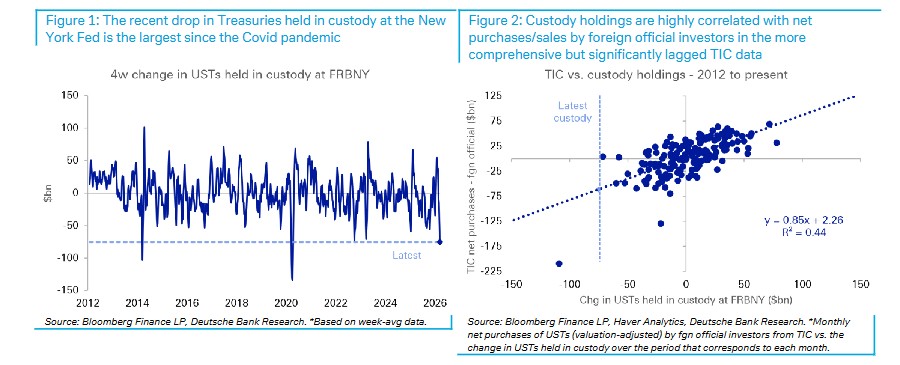
According to Zhuifeng Trading Desk, a research report released by Deutsche Bank on March 23rd showed that US Treasury holdings in foreign official accounts held in custody at the Federal Reserve Bank of New York have plummeted by $75 billion over the past four weeks, marking the largest monthly decline since the COVID-19 pandemic shock in 2020. Combined with historical data model projections, this change implies that foreign official investors have net sold approximately $60 billion of US Treasuries, also the highest since the pandemic.
The aforementioned data corroborates the recent market trend of surging US Treasury yields, particularly the unusual upward movement in mid-term (belly) yields — a segment where foreign official investors' holdings are concentrated. Deutsche Bank warns that if foreign demand continues to shrink, the "convenience yield" advantage of US Treasuries will be eroded, posing a substantial upward risk to long-term yields.

Custody Data Reveals Selling Signal
The most authoritative data source for tracking the US Treasury movements of foreign official investors is the US Treasury Department's TIC (Treasury International Capital) report, but this data has a significant lag — March data will not be available until mid-May at the earliest.
As an alternative indicator, the H.4.1 report released by the Federal Reserve every Thursday includes a memorandum item recording the face value of securities held in custody at the Fed by foreign official and international accounts, with a data lag of only one day. Deutsche Bank strategists Matthew Raskin, Steven Zeng, and Andrew Fu pointed out in the report that the latest H.4.1 data shows that, calculated on a weekly average basis, holdings of US Treasuries by foreign official accounts have decreased by $75 billion over the past four weeks. This decline is not only the largest since March 2020 but also the second-largest single-period drop in nearly a decade.
Notably, unlike the similar situation in March 2023, the scale of FIMA repo operations did not increase simultaneously, indicating that this round of reduction was a direct sale or non-renewal upon maturity, rather than a liquidity provision through repo operations with the Federal Reserve. Foreign reverse repos, foreign official deposits, and FIMA securities lending have also remained largely unchanged over the past month.
High Correlation Between Custody Data and TIC Data
To what extent can custody holding data represent changes in the overall US Treasury holdings of foreign official investors? Deutsche Bank has conducted a systematic verification of this.
The report shows that over the past 15 years, the correlation between changes in custody holdings and the net purchases by foreign official entities in the TIC data has been quite significant, with the former explaining about 50% of the latter's changes. Even when the sample is shortened to since 2019, to eliminate potential interference from changes in reserve management models, this relationship remains robust.
Based on this historical relationship, a decline of $75 billion in custody holdings corresponds to a net selling of approximately $60 billion by foreign official entities. Deutsche Bank points out that this would be the largest net sale by foreign official accounts since the COVID-19 pandemic. To find a comparable case, one would have to go back to December 2018.
Shift in Capital Flows Amidst Foreign Exchange Intervention
The decline in US Treasury custody holdings aligns perfectly with recent market dynamics observed by Deutsche Bank's FX strategy team.
According to previous reports from Deutsche Bank's FX strategy team, against the backdrop of the outbreak of the Iran war and soaring oil prices, the US dollar has not strengthened as expected, partly due to large-scale foreign exchange interventions by several Asian central banks. Concurrently, the team's high-frequency ETF monitoring data also indicates a significant slowdown in foreign investor purchases of US dollar assets.
These two threads, when superimposed, lead to a common conclusion: foreign official investors are reducing their allocation to US dollar assets, and the sell-off of US Treasuries is a direct manifestation of this trend.
Continued Selling Could Push Long-Term Yields Up by Over 100 Basis Points
Deutsche Bank's analysis reveals a structural concern: the "convenience yield" that US Treasury yields have long benefited from due to the dollar's reserve currency status is now being challenged.
The report cites previous research by Deutsche Bank indicating that the current 10-Year Treasury Yield is more than 100 basis points lower than the fair value implied by the US Net International Investment Position (NIIP). Furthermore, recent academic working papers estimate that the dollar's reserve currency status lowers US long-term interest rates by approximately 90 basis points compared to "normal levels."
Deutsche Bank warns that once foreign demand experiences a sustained decline, the aforementioned convenience yield will face pressure to revert, leading to substantial upward potential in US Treasury term premiums and overall yields, posing a direct impact on investors holding US Treasuries.
The above content is from Zhuifeng Trading Desk.
For more detailed interpretations, including real-time analysis, frontline research, and more, please join [ **Zhuifeng Trading Desk ▪ Annual Membership**]

Risk Warning and Disclaimer
Markets are risky, and investments require caution. This article does not constitute personal investment advice, nor does it consider the specific investment objectives, financial situation, or needs of individual users. Users should consider whether any opinion, view, or conclusion in this article is suitable for their specific circumstances. Investment based on this is at your own risk.