


CHINA TELECOM's 2025 Revenue Hits 529.56 Billion Yuan, Net Profit 33.18 Billion Yuan, Focusing on Building a Leading AI Service Provider | Earnings Insight
CHINA TELECOM reported 2025 revenue of 529.56 billion yuan and net profit of 33.18 billion yuan, up 0.1% and 0.5% year-on-year respectively, both missing Bloomberg estimates. Service revenue accounted for 92.7% of the total, while industrial digitalization growth was sluggish at just 0.5% year-on-year. The full-year dividend payout ratio rose to 75%, with a dividend of 0.272 yuan per share. Strategically, the company is accelerating its upgrade to "Cloud Transformation, Digitalization, Intelligent Empowerment, and Benefit for All," with a total intelligent computing scale of 91 EFLOPS, fully embracing artificial intelligence
CHINA TELECOM's 2025 performance fell slightly short of market expectations.
On March 24, the company's 2025 annual report showed that its operating revenue for the year was 529.56 billion yuan, slightly lower than the 535.89 billion yuan estimated by Bloomberg's consensus. Net profit was 33.18 billion yuan, also below the expected 34.84 billion yuan. Despite both revenue and net profit missing expectations, they still grew by 0.1% and 0.5% year-on-year, respectively.
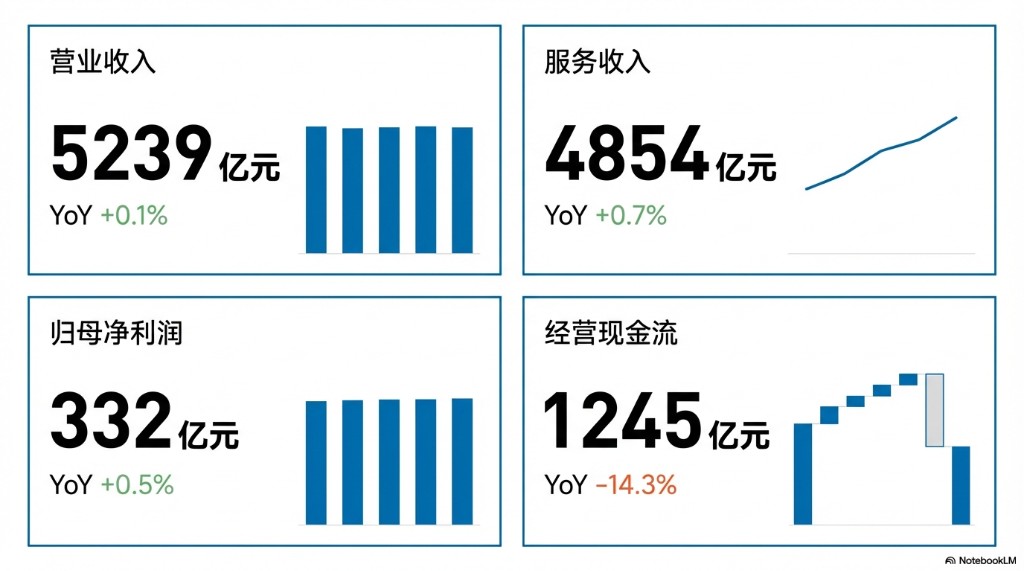
Key data are as follows:
2025 net profit: 33.18 billion yuan, estimated at 34.84 billion yuan (Bloomberg consensus), up 0.5% year-on-year
Operating revenue: 529.56 billion yuan, estimated at 535.89 billion yuan, up 0.1% year-on-year
Service revenue: 485.42 billion yuan, estimated at 488.7 billion yuan
Mobile communication service revenue: 204.53 billion yuan, estimated at 204.27 billion yuan
Fixed-line and smart home service revenue: 125.98 billion yuan, estimated at 127.41 billion yuan
Industrial digitalization service revenue: 147.31 billion yuan, estimated at 153.16 billion yuan
Other service revenue: 7.61 billion yuan, estimated at 7.17 billion yuan
Revenue from the sale of goods and others: 44.14 billion yuan, estimated at 47.1 billion yuan
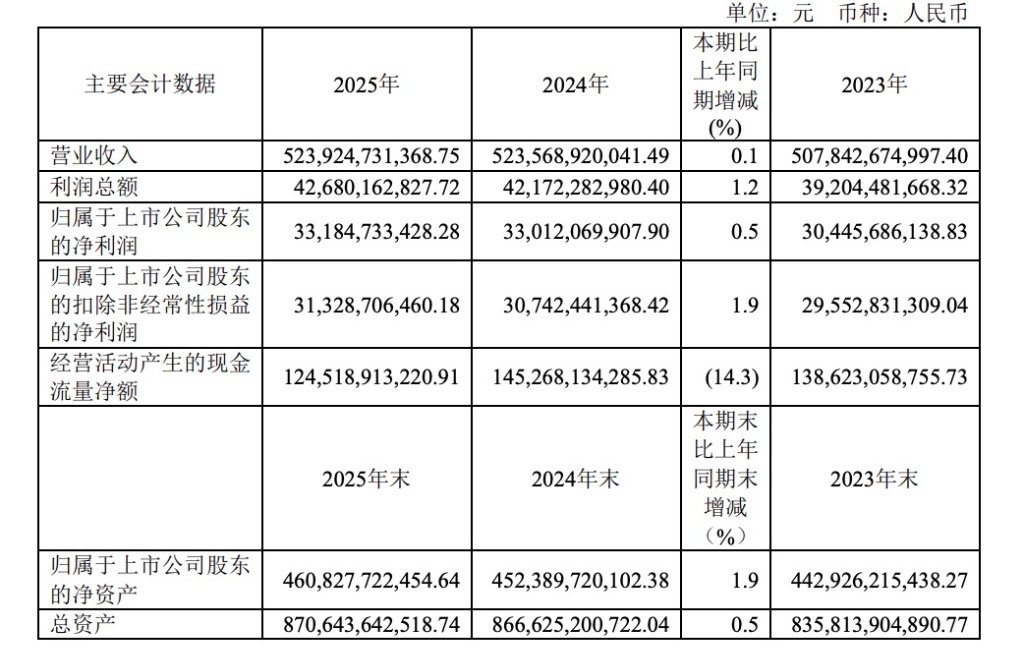
By revenue structure, the company's service revenue was 485.4 billion yuan, up 0.7% year-on-year, accounting for 92.7% of total revenue. Industrial digitalization business revenue was 147.3 billion yuan, up 0.5%. Tianyi Cloud revenue reached 120.7 billion yuan, with its public cloud IaaS market share rising to second in China. Basic business revenue was 330.5 billion yuan, up 0.7%, with mobile users reaching 439 million and 5G network user penetration at 68.8%.
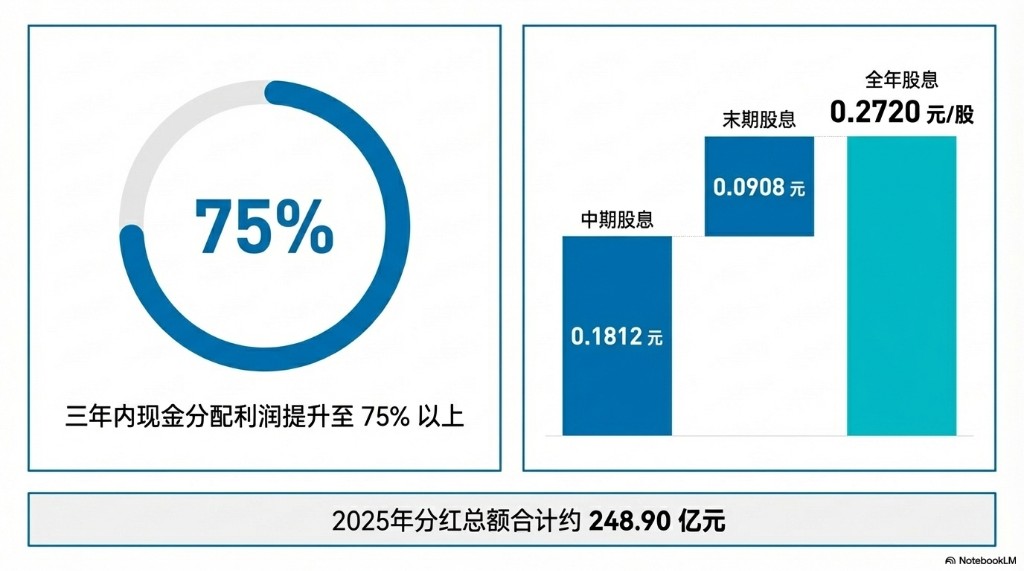
Regarding profit distribution, CHINA TELECOM continued its commitment to high dividend payout ratios. The board of directors proposed a cash distribution of 75% of the profit attributable to shareholders for 2025, with a final dividend of 0.0908 yuan per share (tax inclusive). Together with the interim dividend of 0.1812 yuan per share, the total annual dividend is 0.2720 yuan per share, totaling approximately 24.89 billion yuan.
Slowing Revenue Growth, Industrial Digitalization Growth Appears Sluggish
In 2025, CHINA TELECOM achieved operating revenue of 523.92 billion yuan, a slight year-on-year increase of 0.1%, with the growth rate further slowing from 0.7% in 2024. Service revenue was 485.4 billion yuan, up 0.7% year-on-year, accounting for 92.7% of revenue. Revenue from the sale of goods and others was 38.5 billion yuan, down 7.3% year-on-year.
By business segment, basic business revenue was 330.5 billion yuan, up 0.7%, showing stable performance. Mobile communication service revenue was 204.5 billion yuan, up 1.0% year-on-year, with a net increase of 14.13 million mobile users to 440 million, and mobile user ARPU at 45.1 yuan. Fixed-line and smart home service revenue was 126.0 billion yuan, up 0.2% year-on-year, including 23.8 billion yuan from the smart home business, up 7.6% year-on-year.
However, industrial digitalization business growth was somewhat sluggish. In 2025, revenue from this business was 147.3 billion yuan, a year-on-year increase of only 0.5%, far below the previous double-digit growth. Resource-based revenue (including AIDC, network private lines, IoT, 5G private networks, etc.) was 63.0 billion yuan, up 1.1% year-on-year. Strategic emerging businesses maintained rapid growth: Tianyi Cloud revenue reached 120.7 billion yuan, AIDC revenue was 34.5 billion yuan, security revenue was 16.6 billion yuan, and intelligent revenue was 12.3 billion yuan. Visual network revenue increased by 31.2% year-on-year, quantum revenue grew by 65.4%, and satellite revenue rose by 30.7%.
Effective Cost Control, Sustained R&D Investment
In 2025, CHINA TELECOM's operating costs were 371.56 billion yuan, down 0.5% year-on-year. The company stated that this was mainly due to enhanced refined cost management through AI empowerment, which improved resource utilization efficiency. Depreciation and amortization increased by 3.1% to 99.19 billion yuan; operation, maintenance, and technical support fees decreased by 2.8% to 103.73 billion yuan; and expenses from the sale of goods fell 7.5% to 36.72 billion yuan.
Expense performance was mixed. Selling expenses decreased by 2.9% to 53.90 billion yuan, which the company attributed to strengthening online and offline synergy and accelerating the transition to AI-driven intelligent marketing. Management expenses fell 1.9% to 36.41 billion yuan. R&D expenses increased by 7.3% to 15.59 billion yuan, raising the total R&D investment as a percentage of revenue to 3.6%. The company's R&D personnel reached 47,000, accounting for 16.97% of the total workforce.
Financial expenses surged 70.5% to 390 million yuan, primarily because the company replaced bank deposits with higher-yielding, low-risk structured deposits. Interest income was recorded under investment income, leading to a decrease in interest income from bank deposits.
Strategic Upgrade: From "Cloud Transformation and Digitalization" to "Cloud Transformation, Digitalization, Intelligent Empowerment, and Benefit for All"
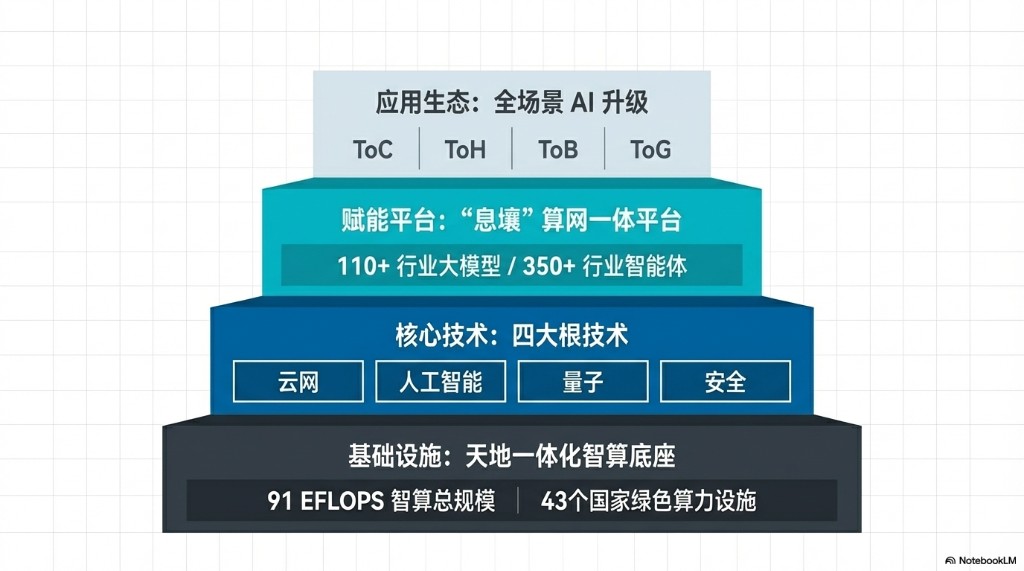
In 2025, CHINA TELECOM advanced its strategy from "Cloud Transformation and Digitalization" to "Cloud Transformation, Digitalization, Intelligent Empowerment, and Benefit for All," fully embracing artificial intelligence. The company has built and continues to deepen an integrated intelligent cloud system covering "computing power, platform, data, models, and applications," centered on its "Xirang" technology as the core and leveraging its cloud-network integration advantages.
As of the end of 2025, the total scale of self-owned and accessed intelligent computing reached 91 EFLOPS, aggregating over 10 trillion tokens of general large model corpus data and high-quality datasets covering more than 14 industries, totaling over 500 TB. The company has developed over 110 industry-specific large models and over 350 industry intelligent agents, serving more than 37,000 customers, with an AI penetration rate of 85% among central state-owned enterprises.
In R&D, the company focused on breakthroughs in four core technologies: in cloud and cloud-network integration, the server operating system CTyunOS passed national security and reliability evaluations; in networking, 5G core patents won the China Patent Award Silver Medal for three consecutive years; in artificial intelligence, the "Xingchen" large model won the 2025 Excellent AI Leader Award; and in quantum/security, the company released the world's first distributed cryptographic system integrating QKD and PQC, and completed the "Tianyuan-287" superconducting quantum computer.
2026 Outlook: Seizing AI Opportunities
For 2026, CHINA TELECOM stated it will fully implement the "Cloud Transformation, Digitalization, Intelligent Empowerment, and Benefit for All" strategy, aiming to become a leading AI service provider with Token services as the core business line. The company will strengthen customer value management and the supply of high-quality products. For 2C2H users, it will use intelligent agents to reshape traditional products, create innovative AI applications, and upgrade AI terminals. For 2B2G users, it will deepen industry-wide AI empowerment and steadily improve the scale and quality of its industrial digitalization business.
The company also warned of risks in the economic and policy environment, technological innovation, network and data security, strategic emerging and future industries, and international operations. Given the accelerating global changes and frequent geopolitical conflicts, the company will continue to strengthen its analysis of the macro environment and enhance its risk response capabilities.
