


Iran severely impacts cartel helium exports, global chip production faces crisis
Iran's attack has severely damaged facilities in Qatar, causing a sudden reduction of one-third of the global helium supply. As an irreplaceable cooling material for chip manufacturing, the spot price of helium has doubled. South Korean chip giants, heavily reliant on this source, are the first to be affected, with a market value evaporating by over $200 billion. Experts warn that the real impact of the shortage will fully erupt in a few weeks, posing a serious threat to the global semiconductor supply chain
Iran's military strike on Qatar's natural gas export facilities is transforming an energy crisis into a systemic threat to the global semiconductor supply chain.
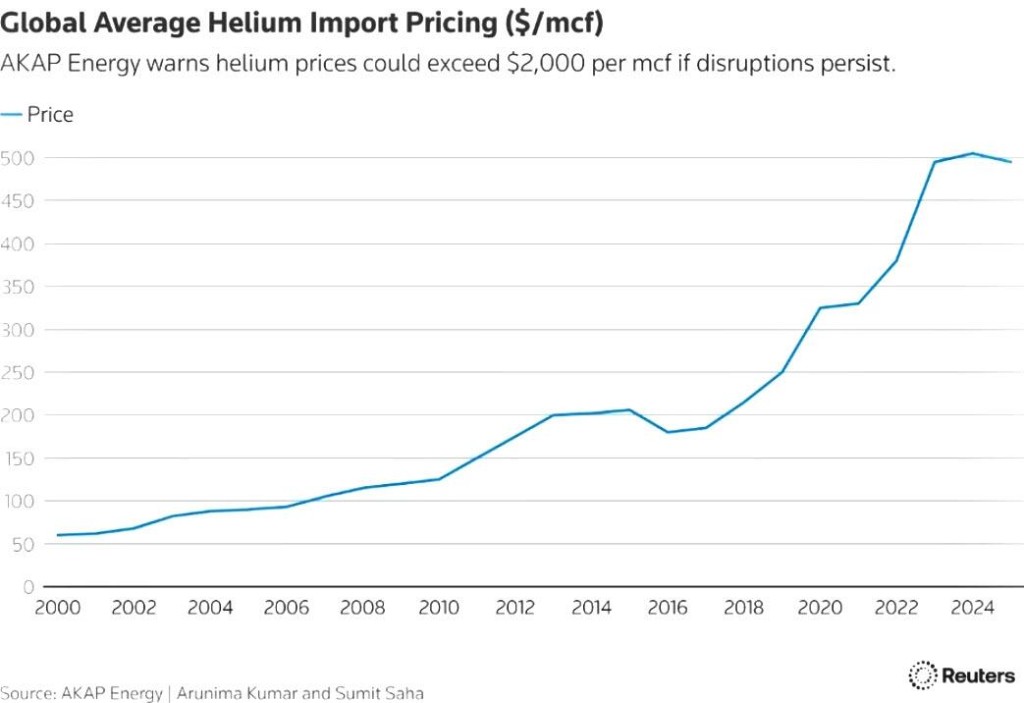
As a source of one-third of the world's helium supply, the Ras Laffan facility in Qatar has suffered "massive" damage, causing helium spot prices to double within 14 days, with contract premiums exceeding 30%.
With Qatar's state-owned energy company announcing a 14% reduction in annual helium exports, this crisis has evolved from an anticipated level to a real impact—South Korean chip stocks have plummeted. South Korean chip giants Samsung and SK Hynix rely on Qatar for about 65% of their helium imports, and the market value of South Korean chip manufacturers has evaporated by over $200 billion this month. Experts warn: The real shortage impact has not yet arrived, but "it will truly erupt in a few weeks."
Qatar Facility Hit Hard, One-Third of Global Supply Suddenly Disappears
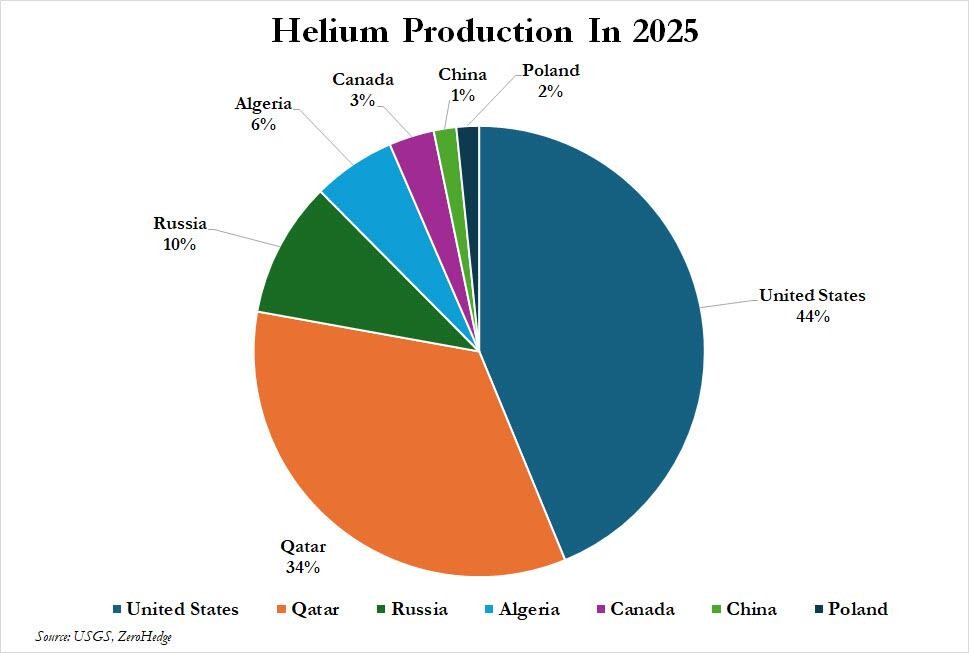
Qatar boasts the world's largest single natural gas field, and its Ras Laffan facility is the largest liquefied natural gas plant globally, where helium is extracted as a byproduct of natural gas production, accounting for about 30% of the world's helium supply.
On March 2, an Iranian drone attack forced Qatar's state-owned energy company QatarGas to halt the production of liquefied natural gas and "related products." Four days later, QatarGas announced "force majeure," meaning it could not fulfill contracts with customers.
Last Wednesday and Thursday, Ras Laffan was again struck by Iranian attacks, and QatarGas subsequently reported "massive" damage to the facility, with repairs expected to take years and a 14% reduction in annual helium exports.
According to an article from Wallstreetcn, all three helium production facilities in Qatar have ceased operations. The publication of the American Chemical Society, C&EN, warned that "if the conflict lasts more than two weeks, the chaos faced by helium users may take months to resolve."
Phil Kornbluth, president of helium consulting firm Kornbluth Helium Consulting, stated:
"This makes the situation worse. The most optimistic scenario is that some helium production can resume in six weeks, but given the current situation, this is highly unlikely."
Helium spot prices have doubled within 14 days of the crisis outbreak, and contract premiums currently exceed 30%. Kornbluth expects prices to rise further, " If the shutdown extends, contract prices could rise significantly, and there is a lot of room for price increases."
However, Kornbluth also pointed out that the shortage has not truly arrived yet. Helium containers that were being loaded at the time of the conflict will still take weeks to reach Asia. " No one has cut off supply yet, but in a few weeks, the shortage will truly erupt. **"
Helium: The Undervalued Lifeline of Chip Manufacturing
In the public's perception, helium is merely an inert gas that makes balloons float, but in the semiconductor manufacturing field, it is an irreplaceable key material in the wafer cooling process.
During the etching process of chip manufacturing, helium gas needs to be continuously blown onto the back of the wafer to quickly and uniformly dissipate heat, maintaining a stable surface temperature of the wafer.
Jacob Feldgoise, an analyst at Georgetown University's Center for Security and Emerging Technologies, pointed out that "in this process, helium is an excellent thermal conductor, and chip factories blow helium onto the back of the wafer to accelerate heat dissipation and maintain consistency in cooling."
Jong-hwan Lee, a professor of semiconductor devices at Sangmyung University in South Korea, clearly stated: under the current semiconductor manufacturing processes, there are no viable alternatives to replace helium for cooling wafers.
The industrial applications of helium also extend to the medical and aerospace fields—used in the medical industry to cool superconducting magnets in MRI machines, and in the aerospace industry to clean rocket fuel tanks. With companies like SpaceX and Blue Origin increasing their launch frequency, this demand continues to grow.
It is worth noting that the physical properties of helium make its storage and transportation extremely complex: Helium molecules are very small, and even the tiniest gaps can cause leaks; liquid helium must be stored in insulated containers and transported through the Strait of Hormuz. These specialized containers can only preserve helium for 35 to 48 days, after which the helium will vaporize and dissipate through pressure relief valves.
Currently, about 200 of these containers are stranded in the Middle East, each costing around $1 million, and the global supply of backup containers is extremely limited. Kornbluth stated,
"Moving these containers out of Qatar and to other places where helium can be filled will take a considerable amount of time. This initial supply chain restructuring period is likely to be the most severe phase of this shortage."
South Korean Chip Giants Hit Hard, Market Value Drops Over $200 Billion
This crisis has particularly direct impacts on the South Korean semiconductor industry.
According to an article from Wall Street Journal, data from the Korea Trade Association shows that 64.7% of South Korea's helium imports in 2025 will come from Qatar.
Fitch Ratings noted in a report that South Korea is one of the countries most vulnerable to helium supply shortages globally, with Samsung Electronics and SK Hynix— the two largest memory chip manufacturers in the world—facing significant supply risks.
The Seoul government has listed helium as one of the 14 semiconductor supply chain materials that need to be closely monitored due to war. Professor Jong-hwan Lee warned:
"Even a few disruptions in material supply can shake the entire semiconductor manufacturing process, as each production stage relies on the previous one."
The market has already reacted: South Korean chip manufacturers have seen their market value evaporate by over $200 billion this month, as investors digest expectations of a 15% to 20% decline in output by 2026 According to an article from Wall Street View, SK Hynix has maintained a certain inventory of helium and has additionally secured new supply channels, currently distancing itself from short-term impacts. However, medium-term risks remain difficult to eliminate— even if supply is not completely interrupted, switching to verified alternative suppliers will also take time.
Bloomberg economic analyst Michael Deng pointed out: "The helium shortage may force chip manufacturers to prioritize the production of higher-margin AI chips over other lower-margin components." This means that the consumer-grade chip market will be the first to feel the pressure.
Global Supply Landscape and Limitations of Alternatives
Global helium production is highly concentrated.
The United States is the largest producer, with a production volume of 81 million cubic meters last year; Qatar, Algeria, and Russia are other major producers, but Russian supplies have been restricted by U.S. and EU sanctions. The U.S. Geological Survey estimates that the U.S. has 8.5 billion cubic meters of recoverable helium reserves, while the rest of the world has 31.3 billion cubic meters.
Although the U.S. and Australia could theoretically provide alternative supplies, restructuring the supply chain is not a quick process. Kornbluth pointed out that about 200 specialized storage and transportation containers are stranded in the Middle East, and reallocating these containers and establishing new supply routes is itself one of the most challenging bottlenecks in this crisis.
Experts generally believe that a comprehensive helium crisis is unlikely to occur— in the event of a shortage, the helium industry will allocate supplies based on importance, with the chip manufacturing and medical industries receiving priority.
Since helium accounts for a small proportion of the total production cost in semiconductors, chip factories are "willing to pay higher prices" to ensure supply. However, this logic is predicated on the timely availability of alternative supplies.
Bromine: The Next Potential Flashpoint
The Wall Street View article also pointed out that, in addition to helium, another critical semiconductor raw material, bromine, is also worth monitoring. Bromine is used in semiconductor etching processes, and high-purity hydrogen bromide is widely used in the polysilicon etching stages of DRAM and NAND flash manufacturing.
97.5% of South Korea's bromine imports come from Israel, making it one of the 14 semiconductor supply chain items with the highest dependence on the Middle East. Currently, bromine is still classified as a potential risk factor and is in a relatively safe zone, but once the situation further escalates, its vulnerabilities will quickly be exposed
