


Tesla's "Flywheel": Long-term focus on Optimus, short-term focus on Robotaxi
Tesla builds its growth logic around Robotaxi and Optimus, with the commercialization of Robotaxi being a recent catalyst for the stock price, while Optimus represents a long-term bet. Morgan Stanley analysts are optimistic about the prospects of Robotaxi, setting a target price of $415, and expect capital expenditures to exceed $20 billion by 2026, with a cash flow gap of about $8 billion. Austin is the main testing ground for unsupervised deployment, and it is expected that by the end of 2026, the Robotaxi fleet will reach 1,500 vehicles
Tesla is building a mutually reinforcing growth logic around Robotaxi and Optimus—Robotaxi commercialization is the most important near-term catalyst for the stock price this year, while Optimus represents the company's long-term bet on physical AI. These two main lines together constitute what Morgan Stanley refers to as Tesla's "flywheel."
According to reports from the Wind Trading Desk, Morgan Stanley analyst Andrew S Percoco expressed a "marginally more optimistic" outlook on the commercialization prospects of Robotaxi after attending the TMT conference in San Francisco and conducting an on-site inspection of the Texas Gigafactory, particularly giving positive feedback on the company's progress in addressing edge cases such as passenger pick-up and drop-off. The report maintains an equal-weight rating on Tesla, with a target price of $415, and keeps the timeline for the mass production plan of Cybercab set to start in April 2026.
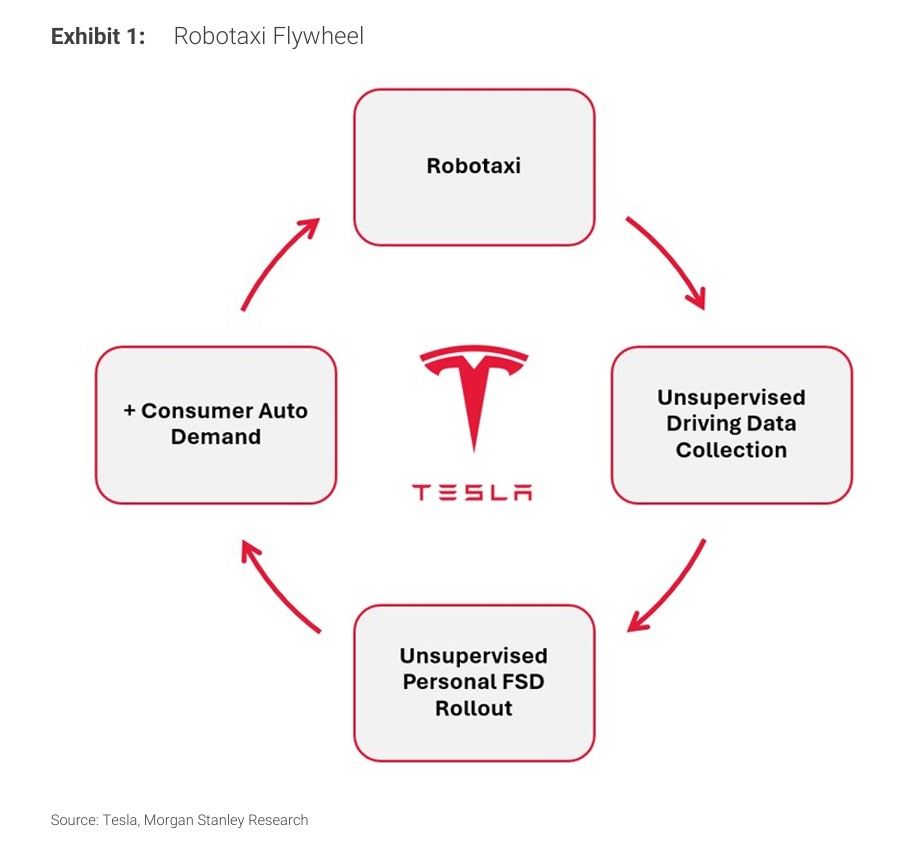
The "Robotaxi flywheel" logic proposed by Morgan Stanley is: Every mile of driving data accumulated by unsupervised Robotaxi will continuously optimize the underlying autonomous driving model, thereby accelerating the unsupervised process of personal FSD (Full Self-Driving), driving improvements in FSD adoption rates, enhancing automotive demand, and increasing free cash flow. This means that the success of Robotaxi commercialization is not only a source of revenue from mobility services but also an important lever to boost the core automotive business.
However, this strategic layout comes with significant short-term financial pressure. Morgan Stanley expects Tesla's capital expenditures to exceed $20 billion in 2026, more than doubling year-on-year, with a free cash flow gap of about $8 billion that year. Tesla's approximately $44 billion cash reserves have provided some buffer recently, but if the recovery of the automotive business falls short of expectations, Morgan Stanley does not rule out the possibility of the company seeking opportunistic financing in 2027.
Robotaxi: Austin is the true testing ground for unsupervised deployment
In Tesla's current Robotaxi layout, hundreds of vehicles have been deployed in the San Francisco Bay Area, but California regulations still require a safety monitor in the driver's seat, making Austin the main testing ground for unsupervised real deployment. Morgan Stanley expects Tesla's Robotaxi fleet to reach about 1,500 vehicles by the end of 2026.
Tesla intends to slow down its pace in Austin to optimize operational strategies and plans to launch Robotaxi in seven additional cities in the first half of 2026. The company stated that the time required to transition from supervised to unsupervised in new cities is expected to be shorter than the approximately six months experienced in Austin. In the short term, fluctuations in NHTSA accident data are seen as normal model stress tests, with issues primarily concentrated on the pick-up and drop-off process, a unique edge case in the ride-hailing scenario—this is also a scenario that Tesla's existing FSD mileage data struggles to cover
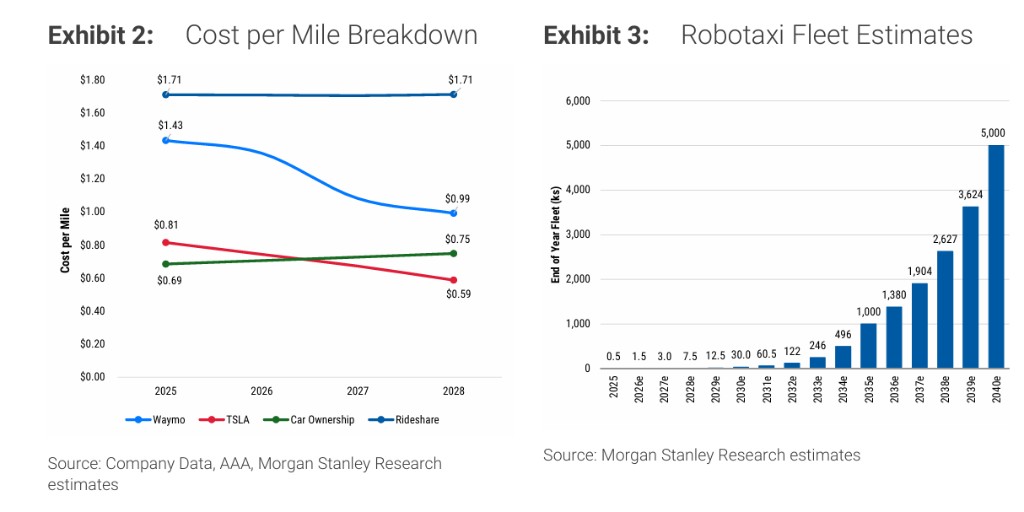
In terms of cost structure, Morgan Stanley believes that Tesla has significant structural advantages. Based on the Model Y, Tesla's total cost is estimated to be about $0.81 per mile, lower than Waymo's $1.43 and traditional ride-hailing's $1.71. With the ramp-up of Cybercab, Morgan Stanley expects costs to further decrease to $0.37 per mile by 2035, close to the management's long-term target of about $0.30 for Cybercab.
Cybercab: Disruptive Manufacturing Process Supports Cost Competitiveness
The low-cost advantage of Cybercab partly comes from its innovative manufacturing process. Tesla employs a modular "unboxed" architecture at its Austin Gigafactory, replacing traditional body-in-white, painting, and sequential assembly processes. The vehicle consists of five main parts: front module, central battery module, rear cargo module, and two side modules, which are produced in parallel and then merged. The body panels are made entirely of plastic, manufactured using reaction injection molding, with colors directly injected into the plastic. This process eliminates the need for traditional paint shops, significantly reducing factory footprint.
Morgan Stanley believes that whether Cybercab can start mass production as planned in April 2026 is a key milestone to test whether the above cost targets can be realized, and it will directly impact the scaling process of Robotaxi.
Optimus: Long-term Narrative, Implementation Still Requires Time
In contrast to the relatively clear progress of Robotaxi, Optimus is still in an earlier stage. Morgan Stanley expects the release of Optimus Gen 3 may be delayed until the second quarter of 2026, but believes the more critical milestone is the start of mass production (SOP) in the second half of 2026.
The humanoid robots rolling off the production line in 2026 are expected to have limited functionality. Tesla has even suggested the possibility of establishing an "Optimus Academy," specifically for data collection, model optimization, and robot training. Additionally, most of the new computing power from the Cortex 2 supercomputing center will be allocated to Optimus training. Elon Musk disclosed on the X platform that Tesla is developing "Digital Optimus"—a task orchestration tool for Optimus and even Cybercab.
Among the five components of Morgan Stanley's $415 price target, Optimus (humanoid robot) contributes $60 per share but has been discounted at a 50% probability, reflecting the market's pricing of its high uncertainty in commercial realization. In contrast, network services (including FSD subscriptions) contribute $145 per share, and Tesla's mobility business contributes $125 per share, which are the two core supports for the price target
Energy Business: Growth Logic is Solid, Recent Profit Margins Under Pressure
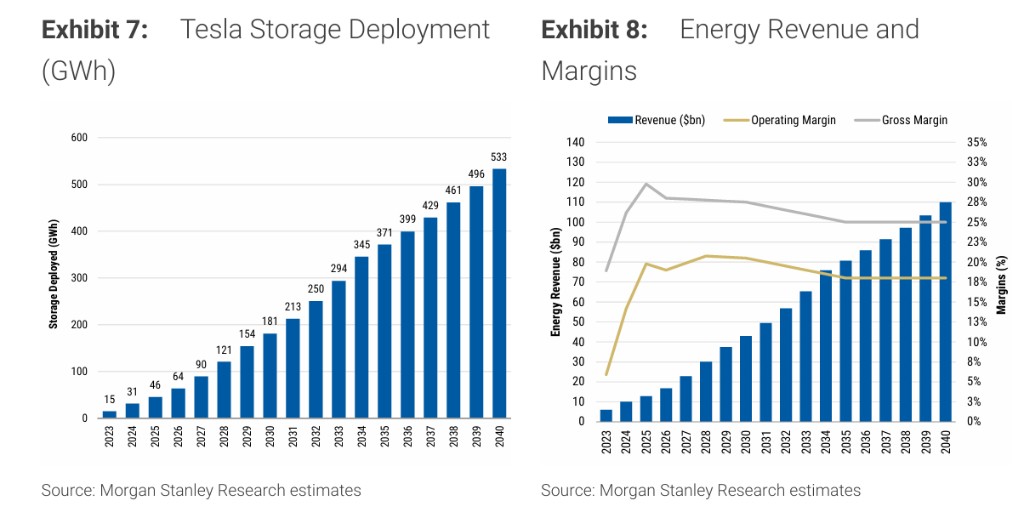
Tesla's energy business remains an important growth driver, with strong demand on both the front-end grid side and the back-end user side. The company is adding 50 GWh of Megapack capacity in Houston while advancing a 7 GWh domestic lithium iron phosphate battery production line.
However, Morgan Stanley warns that attention should be paid to the recent pressure on the gross margin of the energy business—intensified pricing competition combined with the lagging impact of tariffs is expected to compress the gross margin of the energy business to the mid-20% range this year. In terms of core automotive business, although Tesla has halted production of the Model S/X, it has not ruled out the possibility of introducing new models, including derivative models based on the Cybertruck platform, launching the Model YL in new regions, and the Roadster.
Morgan Stanley points out that maintaining the profitability of core automotive (including FSD) and energy businesses is a fundamental prerequisite for supporting the current valuation (corresponding to about 40 times EBITDA in 2030) as Tesla transitions into the physical AI and robotics field.
Peak Capital Expenditure: Ample Cash, but Financing Risks Cannot Be Ignored
Morgan Stanley expects Tesla's capital expenditure (excluding the Terafab project) to exceed $20 billion in 2026, doubling from the previous year, resulting in a free cash flow gap of about $8 billion for that year; capital expenditure is expected to slightly decline to about $16 billion in 2027, and as electric vehicle demand expectations recover and profit margins improve, the company's free cash flow is expected to gradually approach breakeven.
The main variables affecting the direction of capital expenditure include: the scale of Optimus robots purchased internally for training (with a cost of over $250,000 each); the pace of expansion of the Robotaxi fleet (Morgan Stanley estimates that Tesla will deploy about 3,000 vehicles through its own assets by 2027); incremental computing power investment required for FSD and Optimus training; and the scale of Tesla's self-developed chip manufacturing plant construction—Morgan Stanley estimates that the total investment for this project could reach $35 billion to $45 billion.
Tesla's cash reserves of about $44 billion provide recent support for the above massive capital plans. However, Morgan Stanley clearly states that if high capital expenditures continue and the automotive business improves less than expected, the possibility of the company initiating opportunistic financing in 2027 cannot be ruled out.
The above exciting content comes from the Wind Trading Platform.
For more detailed interpretations, including real-time analysis and frontline research, please join the【 **Wind Trading Platform ▪ Annual Membership**】

Risk Warning and Disclaimer
The market has risks, and investment requires caution. This article does not constitute personal investment advice and does not take into account the specific investment goals, financial situation, or needs of individual users. Users should consider whether any opinions, views, or conclusions in this article are suitable for their specific circumstances. Investment based on this is at one's own risk