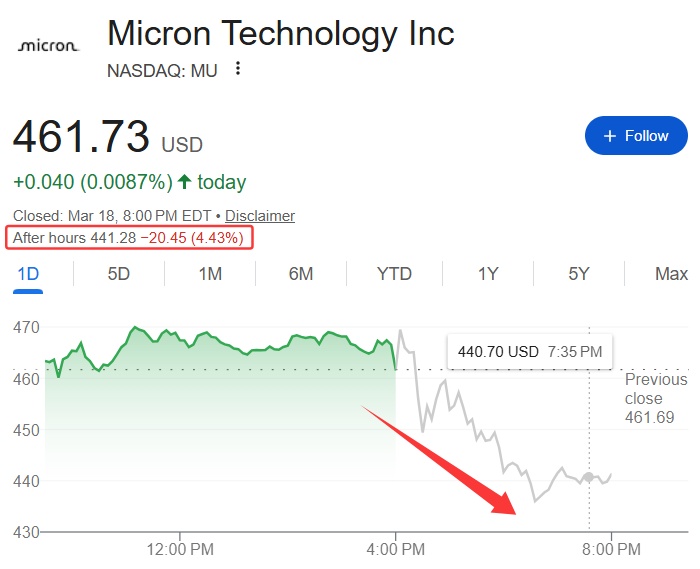
The financial report "made a fortune," but why did Micron Tech plummet?
The company disclosed that its capital expenditure for this fiscal year will exceed $25 billion, with an additional increase of over $10 billion in the fiscal year 2027, both surpassing market expectations. Analysts believe that the stock price correction following this earnings report more reflects the market's reassessment of the sustainability of profits under the combination of high valuations and high capital expenditures. Additionally, the extent to which NVIDIA will rely on Micron for HBM4 will also be a focal point of market attention in the future
Micron's capital expenditures far exceed expectations, and the impressive revenue guidance fails to alleviate investor concerns.
According to Wall Street News, on Wednesday, March 18, Micron released its quarterly report, expecting third-quarter revenue of approximately $33.5 billion and earnings per share of about $19.15, both significantly exceeding analysts' expectations.
However, the company also disclosed that capital expenditures for this fiscal year will exceed $25 billion and forecasted that expenditures for fiscal year 2027 will increase by more than $10 billion on top of that, both surpassing market expectations. After the report was released, Micron's stock price fell by as much as 6% in after-hours trading.

Analysts believe that the stock price correction following this earnings report reflects the market's reassessment of the sustainability of profits under a combination of high valuations and high capital expenditures. Prior to this, Micron's stock had already risen 62% this year, making it the best-performing stock in the Philadelphia Semiconductor Index.
Performance far exceeds expectations, but capital expenditures exceed expectations even more
Micron expects that capital expenditures for the fiscal year 2026, ending in August this year, will exceed $25 billion, while the previous average expectation from analysts was $22.4 billion. The company also disclosed that capital expenditures for fiscal year 2027 will continue to increase by more than $10 billion.
CEO Sanjay Mehrotra stated during the conference call:
We expect capital expenditures for fiscal year 2027 to increase significantly.
In contrast, the performance itself is indeed impressive. The third-quarter revenue guidance of approximately $33.5 billion significantly exceeds the previous average expectation of $23.7 billion from analysts; the earnings per share guidance of approximately $19.15 also surpasses the analysts' expectation of $11.29—both metrics exceed expectations by over 40%.
The recently concluded second quarter (ending February 26) was equally strong, with revenue nearly tripling to $23.9 billion and earnings per share of $12.20, both higher than analysts' average expectations of $19.7 billion and $9, respectively.
HBM4 mass production progress and dependence on NVIDIA become key variables
In the next-generation competition for AI storage, Micron is actively advancing the mass production ramp-up of the new generation of high-bandwidth memory HBM4.
Last month, CFO Mark Murphy clearly stated during investor communications that the company has achieved large-scale production of HBM4, which boosted the stock price significantly.
However, a key uncertainty remains unresolved: to what extent will NVIDIA rely on Micron to supply HBM4?
NVIDIA is the dominant player in the AI acceleration chip market, and its storage procurement decisions for the new generation Vera Rubin product line will directly impact Micron's market share in HBM. If NVIDIA shifts its preference to competitors for this product line, it would pose a substantial impact on Micron.
In this context, Micron's stock price has already risen 62% this year, making it the best-performing component in the Philadelphia Semiconductor Index
(The top three performing components of the Philadelphia Semiconductor Index year-to-date)
AI Storage Demand Drives Price Increases, High Bandwidth Memory Becomes Core Battleground
Micron's explosive performance is rooted in the storage chip shortage driven by the global AI computing power investment wave.
High Bandwidth Memory (HBM) is a necessary data transfer component for training and running AI models, and the sharply expanding demand has prompted storage manufacturers, including Micron, to shift more capacity towards higher-margin HBM orders, further exacerbating the supply tightness of ordinary storage chips and driving overall prices up.
The global storage chip market is highly concentrated, dominated solely by Micron, Samsung Electronics, and SK Hynix, with analysts predicting strong demand will continue for several years.
SK Group Chairman Chey Tae-won stated this week that due to structural bottlenecks in semiconductor production, the global storage shortage may last another four to five years. According to International Data Corporation (IDC) forecasts, smartphone shipments are expected to shrink by 13% this year due to the storage crisis