


Breakfast | US February PPI far exceeds expectations, Powell sends hawkish signals, stocks, bonds, and gold all decline
U.S. February PPI far exceeded expectations, Powell sent hawkish signals, with stocks, bonds, and gold all falling; the three major indices each dropped over 1.3%; Bitcoin fell over 3%, dropping back to around $71,000; energy surged, with WTI crude oil rising 4%, Brent crude soaring 7%, and natural gas increasing over 5%
Market Overview
Energy infrastructure in the Middle East has been hit, U.S. February PPI far exceeded expectations, and Powell released hawkish signals, with traders expecting only a 50% chance of interest rate cuts this year. U.S. stocks, bonds, gold, and cryptocurrencies plummeted, while oil, gas, and the dollar surged.
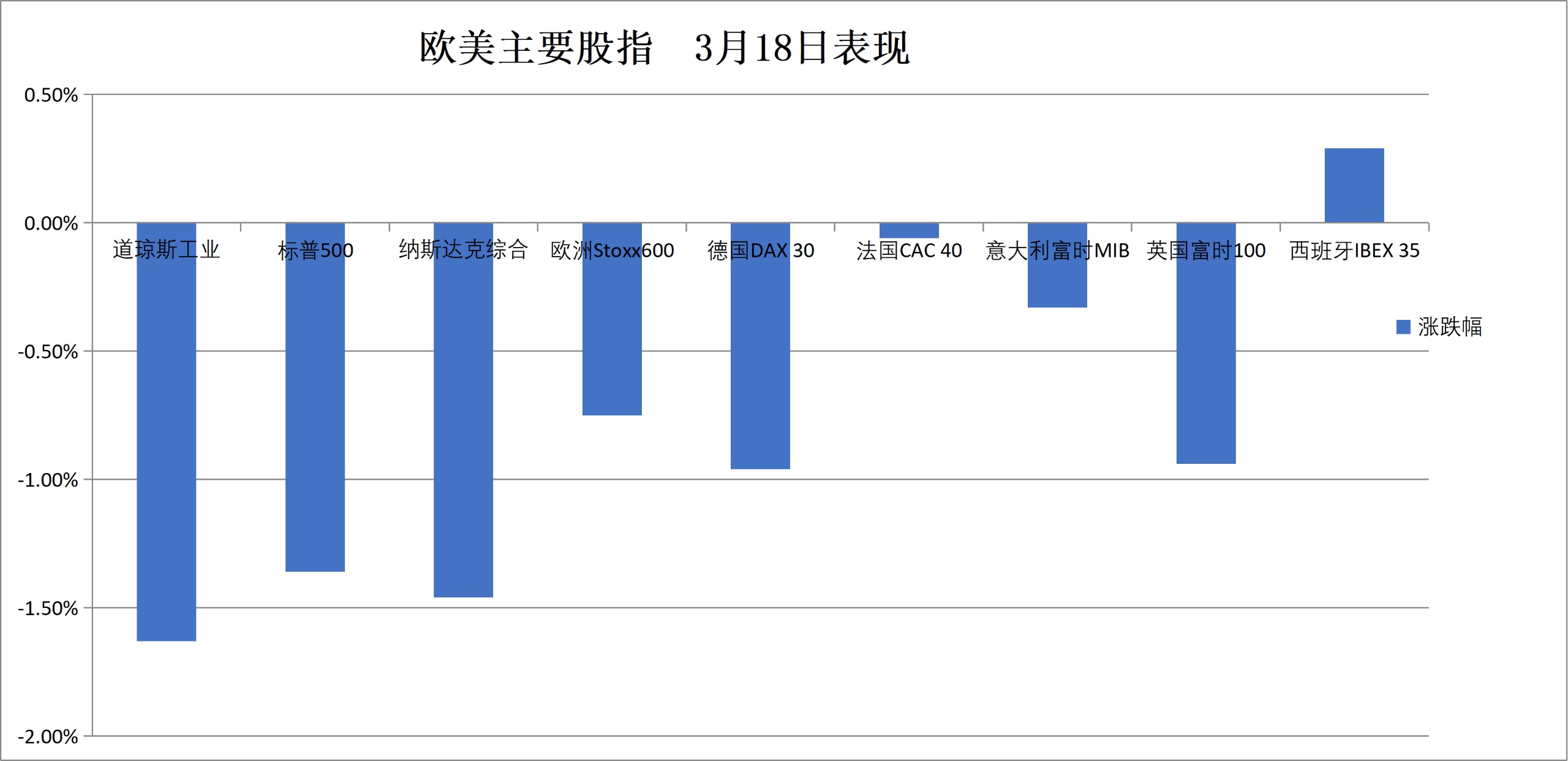
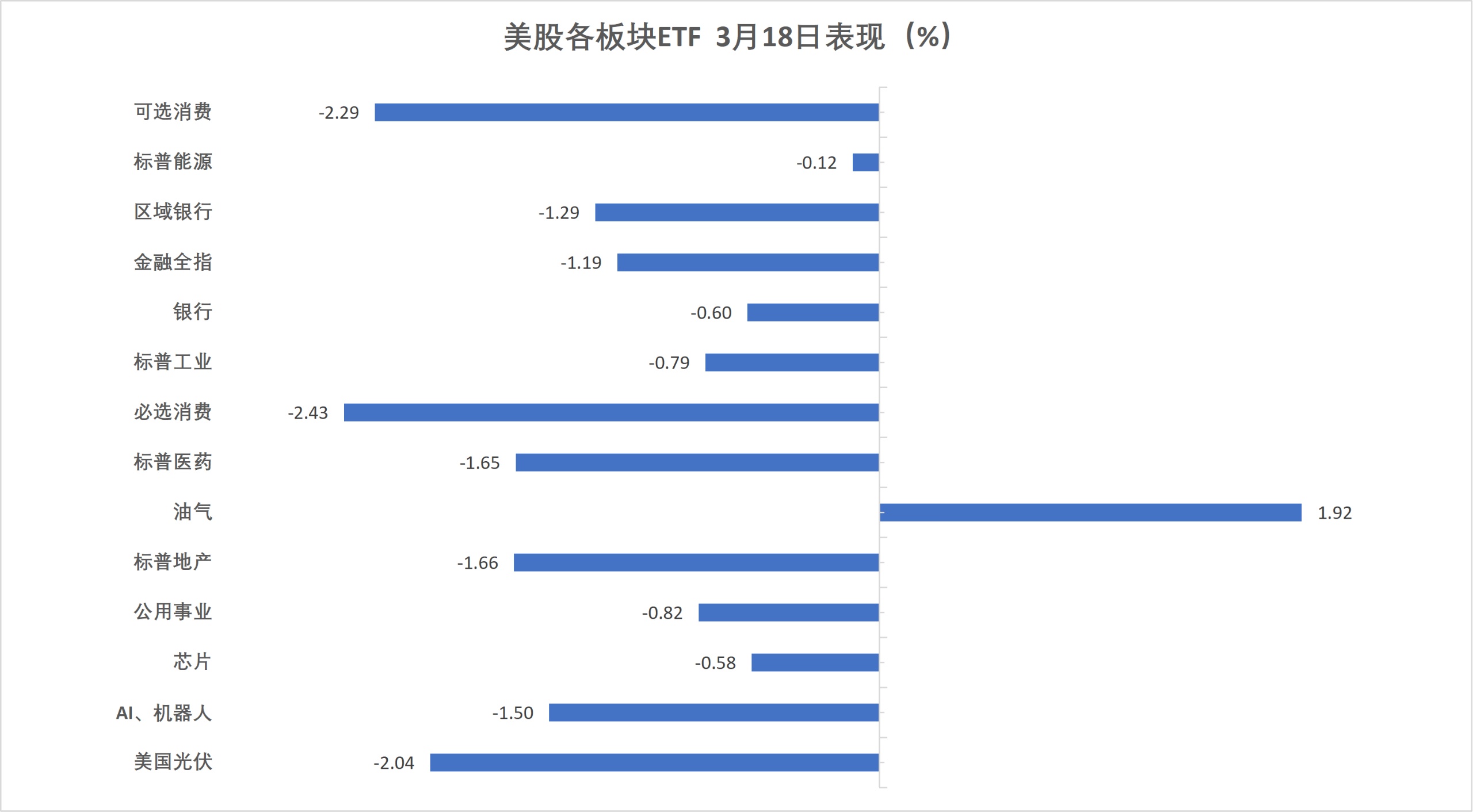
All three major U.S. stock indices fell, with the S&P 500 down 1.4%, hitting a new low since November, the Nasdaq down 1.4%, and the Dow down 1.6%. Energy was the only sector to close higher. Micron fell nearly 6% after earnings.
Yields on U.S. Treasuries across all maturities rose significantly, with the 2-year yield up 10 basis points to 3.775%, and the 10-year yield rising nearly 6.5 basis points.
The dollar rose 0.76%, returning to the 100 mark. The yen fell nearly 0.6%, approaching 160.
Cryptocurrency assets were sold off. Bitcoin fell over 3%, dropping back to around $71,000, while Ethereum declined by 6%.
Spot gold fell 3.6%, nearing the $4,800 support level, hitting a new low in a month. Spot silver dropped 4.9%.
WTI crude oil rose 4%. Brent crude surged 7%, approaching $110 per barrel. Natural gas rose over 5%.
During the Asian session, AH shares rose in the afternoon, with the ChiNext index soaring over 2%. The AI computing power industry chain exploded, with Alibaba rising over 2% and "AI large model stock" Zhipu rising 20%.
Key News
China
Trump stated that his visit to China may be delayed by five to six weeks, and the Foreign Ministry responded.
Tencent's Q4 revenue grew 13% year-on-year, adjusted net profit increased by 17%, and cloud business achieved scaled profitability for the year; on the conference call, Ma Huateng discussed the "shrimp farming" concept for the first time, stating that AI investment will at least double this year, and intelligent agents will foster a decentralized new ecosystem.
DeepSeek seems to have made another move, with a mysterious AI model sparking global developer discussions.
Overseas
The Federal Reserve continued to hold steady as expected, noting the uncertainty of Middle Eastern impacts, raised inflation expectations, and still expects one interest rate cut this year; Powell stated that there will be no rate cuts until inflation improves, and he will not leave the Federal Reserve during the survey period, fulfilling his duties as temporary chairman if necessary. "New Federal Reserve News Agency": The Iranian conflict threatens, and the Fed's battle against inflation may be forced to extend.
Inflation exceeded expectations across the board, with U.S. February PPI year-on-year at 3.4%, and core PPI at 3.9%, hitting a one-year high.
U.S. diesel prices surpassed $5 per gallon, with energy shocks beginning to transmit to the real economy.
Iran launched a large-scale missile attack on U.S. related energy facilities, specifying targets in three Middle Eastern countries, while Trump reportedly does not want to attack such facilities again for now. Iran's largest gas field experienced partial production stoppage due to the attack, marking the first since the outbreak of conflict. The U.S. military plans to replicate Iranian suicide drones on a large scale, and Trump stated he is not ready to end things, not worried about Iran becoming "another Vietnam." After the assassination of the "de facto highest leader," Iran stated it would launch the "strongest" retaliation against the U.S. and Israel. There are current divergences on the "final goal" between the U.S. and Israel. A few ships "can only pass by sailing along the Iranian coastline"! Middle Eastern oil exports plummeted by 61%-71%.
AI has driven a boom in storage, with Micron's last quarter revenue nearly doubling, and this quarter's guidance far exceeding expectations, with fiscal year spending expected to surge, although the stock price fell 6% in after-hours trading
Market Closing Report
US and European stock markets: The S&P 500 fell 1.36%, closing at 6624.70 points. The Dow Jones Industrial Average fell 1.63%, closing at 46225.15 points. The Nasdaq fell 1.46%, closing at 22152.421 points. The European STOXX 600 index closed down 0.70%, at 598.25 points.
A-shares: The Shanghai Composite Index closed at 4062.98 points, up 0.32%. The Shenzhen Component Index closed at 14187.80 points, up 1.05%. The ChiNext Index closed at 3346.37 points, up 2.02%.
Bond market: The yield on the US 10-year benchmark Treasury bond rose by 6.65 basis points, to 4.2650%. The yield on the 2-year US Treasury bond rose by 9.93 basis points, to 3.7729%.
Commodities: WTI crude oil futures rose to the psychological level of $100 per barrel in electronic trading, with an increase of over 4% after the New York close. Brent crude oil futures prices rose above $110 per barrel in electronic trading. COMEX gold futures fell 3.72%, closing at $4821.90 per ounce. COMEX silver futures fell 5.53%, closing at $75.515 per ounce.
Key News Details
Global Highlights
China
Trump says visit to China may be delayed by five to six weeks, Foreign Ministry responds. According to Global Times, Foreign Ministry spokesperson Lin Jian responded at a regular press conference on March 18 regarding US President Trump's statement about delaying his visit to China, which may take place in the next five to six weeks. Lin Jian stated that leader diplomacy plays an irreplaceable guiding role in China-US relations. Both sides will continue to communicate regarding President Trump's visit to China.
Tencent's Q4 revenue grew 13% year-on-year, adjusted net profit increased by 17%, cloud business achieved scaled profitability for the year; Conference call: Ma Huateng discusses "shrimp farming" concept for the first time, AI investment to at least double this year, intelligent agents will foster a decentralized new ecosystem.
- Tencent's performance is expected to grow steadily in 2025, with annual revenue of 751.8 billion yuan, a year-on-year increase of 14%, and a non-international net profit of 259.6 billion yuan, an increase of 17%, with growth accelerating compared to the previous year. Profitability continues to improve, with gross margin rising from 53% to 56%. AI has become the core driving force for growth, with annual R&D investment reaching 85.7 billion yuan and capital expenditure reaching 79.2 billion yuan, both setting historical highs. AI technology has fully penetrated core businesses such as advertising, gaming, and cloud services, accelerating the monetization of the WeChat ecosystem and helping the cloud business achieve scaled profitability
- Tencent has clearly identified AI as a core strategy, planning to double its investment in mixed yuan and new AI products by 2026, with short-term revenue growth potentially outpacing profits. The company emphasizes that its core businesses (games, social networking, advertising) are highly resilient in the AI era and draws on its cloud business experience, viewing AI investment returns with a long-term perspective. Tencent is optimistic about the decentralized opportunities brought by intelligent agents and plans to deeply integrate mixed yuan into ecosystems like WeChat, rather than engaging in monopolistic competition at the foundational model level.
Tencent invests in the "Lobster Three Brothers". With its keen AI layout, Tencent has quietly invested in the "Lobster Three Brothers"—XunCe, MiniMax, and ZhiPu, becoming the biggest winner in the current OpenClaw craze. As an important shareholder in these three companies, Tencent holds a cumulative book value of over HKD 10 billion. With the OpenClaw concept igniting the Hong Kong stock market, Tencent's market value briefly returned to HKD 5 trillion and quickly launched a full line of products like QClaw, taking the lead in the AI intelligent agent track.
DeepSeek reportedly takes action again, a mysterious AI model sparks global developer discussion. A mysterious AI model named Hunter Alpha recently landed on the developer platform, processing over 160 billion tokens within days, thanks to its 1 trillion parameters, 1 million token context window, and free access policy. Due to its training data cutoff and inference style being highly consistent with DeepSeek, the market speculates it to be a secret test version of DeepSeek V4.
Overseas
The Federal Reserve remains on hold as expected, citing uncertainty from the Middle East, raises inflation expectations, still expects one rate cut this year; Powell: No rate cuts until inflation improves, will not leave the Federal Reserve during the survey period, will serve as acting chair if necessary
- There was one dissenting vote against the resolution, with board member Milan continuing to advocate for a 25 basis point rate cut. The statement added a description of the uncertainty of the Middle East situation's impact on the U.S. economy, rephrasing the unemployment rate as "essentially unchanged." In the dot plot, seven members expect no rate cuts this year, while 12 anticipate at least one rate cut; one expects a rate hike next year. The Fed raised its GDP expectations for this year, next year, and the longer term, with inflation expectations for this year and next rising to 2.7% and 2.2%, respectively.
- In a press conference, Powell stated that there would be no rate cuts until further improvements in inflation are seen, and discussions about "potential rate hikes" have been mentioned. He noted that the impact of the Iran war on the economy remains uncertain, and the current progress in inflation decline has stalled, with tariffs and rising oil prices creating cumulative pressure that is gradually transmitting to core inflation, with a cooling of goods expected at least until mid-year. He also mentioned that there has been no AI contribution seen in current macro data, and it may actually push up neutral rates in the short term. Additionally, he confirmed that he would not leave the Federal Reserve during the survey period, and if his successor is not confirmed by the Senate, he will continue to serve as acting chair after his term ends
- "New Federal Reserve News Agency": The Iran conflict threatens, and the Federal Reserve's battle against inflation may be forced to extend.
Inflation significantly exceeds expectations! The U.S. February PPI year-on-year is 3.4%, and the core PPI at 3.9% hits a one-year high. The space for the Federal Reserve to cut interest rates this year continues to shrink.
U.S. diesel surpasses $5 per gallon, energy shock begins to transmit to the real economy. On the supply side, U.S. domestic shale oil is primarily light oil, and the core alternative to Hormuz—the Saudi East-West pipeline—also mainly transports light oil, which exacerbates the shortage of heavy oil needed for diesel production. On the demand side, U.S. diesel consumption is almost entirely driven by commercial uses such as trucking, and demand continues to grow. Cost pressures will directly penetrate every link in the supply chain, transmitting to end consumers in the form of rising prices.
Iran launches large-scale missile attacks on U.S.-related energy facilities, specifying targets in three Middle Eastern countries; Trump reportedly does not want to attack such facilities again. After important gas fields were attacked, Iran stated that it would treat U.S. oil facilities the same as U.S. military bases and would strike back with full force; it specified targets for attacks on energy facilities in Saudi Arabia, the UAE, and Qatar. Brent crude oil surged over 6% during trading, approaching $110. Iran's attack on the U.S. exclusive area of the Riyadh refinery sparked a major fire. Qatar's Ras Laffan Industrial City was hit by missile attacks. Qatar stated that Iranian missiles caused severe damage to the LNG hub, and Brent crude oil later surged past $110. Reports indicate that Trump was informed in advance and supported Israel's attack on Iranian gas fields, but currently opposes further attacks on energy facilities. Iraq reported a complete interruption of natural gas supplied by Iran. Reports suggest that Saudi Arabia's emergency plan to bypass the Strait of Hormuz is showing initial effectiveness, restoring over 50% of crude oil exports. Last week, daily oil exports from Gulf countries fell by more than 60%.
For the first time since the outbreak of conflict! Iran's largest gas field experiences partial production stoppage. Iran's upstream oil and gas facilities have become targets of attack for the first time in this war. Parts of the South Pars gas field were damaged in an airstrike, and multiple facilities will cease production, with nearby Asaluyeh oil industrial facilities also affected.
Iran confirms the assassination of the intelligence minister; the Supreme Leader states that the perpetrators of Larijani's murder will pay the price, and there are differences between the U.S. and Israel on the "endgame" goal. The Supreme Leader of Iran issued a statement regarding the assassination of Larijani: the perpetrators will pay the price for this blood debt. Reports indicate that the U.S. prefers to end major operations after achieving core military objectives, placing more emphasis on stabilizing global oil prices, while Israel is more focused on regime change, having previously attacked Iranian oil storage facilities, which has drawn U.S. dissatisfaction; the White House has requested that Israel seek prior approval for future related actions. The International Atomic Energy Agency stated that now is not the time to consider resuming U.S.-Iran nuclear negotiations The White House states that seizing Iran's enriched uranium fuel is an option under consideration. The German Chancellor reiterates that Germany will not participate in the escort of the Strait of Hormuz. The Israeli military claims it has attacked targets in northern Iran for the first time since the outbreak of war.
The U.S. military dropped multiple 5,000-pound bunker buster bombs, bombing Iranian missile positions along the coast of the Strait of Hormuz, while the U.S. amphibious assault ship USS Tripoli is urgently heading to the Middle East. The U.S. military used several 2.7-ton bunker buster bombs to strike Iranian missile positions along the coast of the Strait of Hormuz; the Iranian Speaker of Parliament immediately declared that the Strait "will not return to its pre-war state." Meanwhile, the U.S. has increased its troop presence in the Middle East by over 5,000, with aircraft carrier groups rushing to assist.
The U.S. military plans to mass-produce Iranian suicide drones! Trump stated: We are not ready to end this yet, and we are not worried about Iran becoming "another Vietnam". Trump stated that the U.S. is not yet ready to end the war in Iraq and is not concerned that sending ground troops would make Iran "another Vietnam." At the same time, the Pentagon is planning to mass-produce the Iranian "Lukas" suicide drone for use in the war against Iran. The U.S. claims that the drone has performed well, has been improved, and is capable of large-scale production.
After the assassination of the "de facto highest official," Iran: will launch the "strongest" strike against the U.S. and Israel. Currently, Israeli airstrikes continue to expand, the U.S. military plans to mass-produce Iranian suicide drones, and Trump stated that "we are not ready to end the war." There are also reports that Israel has assassinated the Iranian intelligence minister, and the situation is being verified. Iran has stated that it will launch its "strongest" strike against the U.S. and Israel to date. Analysts believe that Larijani effectively holds the highest decision-making power and leads the counterattack strategy against the U.S. and Israel, as well as the blockade strategy for the Strait of Hormuz.
- Details revealed about Larijani's "decapitation". In the early hours of March 17, local time, Larijani, the real power figure after Khamenei and Secretary of the Supreme National Security Council, was killed in an attack. Larijani was killed in an airstrike by U.S. and Israeli aircraft at his daughter's home in the Pardis area on the outskirts of Tehran, along with his son Mortaza and several guards.
Only a few ships "can pass by sailing along the Iranian coastline"! To restart the Strait of Hormuz, Iran must ceasefire. Data shows that the number of oil tankers passing through the Strait of Hormuz has plummeted from about 100 per day before the war to about 2, with around 400 still trapped, and only a few ships can pass by hugging the Iranian coastline. JPMorgan analysis states that the Strait has not been officially closed, but passage is becoming "conditional on Iran's approval." Allies have reacted coldly to Trump's escort initiative, and oil prices have risen by about 40% to over $100 since February 28, with the market betting that a ceasefire may alleviate the situation The Strait of Hormuz remains stagnant, Middle Eastern oil exports plummet by 61%-71%. The US-Iran war has effectively closed the Strait of Hormuz, causing an unprecedented impact on the global energy supply chain. Data shows that oil exports from eight Middle Eastern countries last week dropped by 61%-71% compared to the average daily export volume in February, with a daily production cut reaching 10 million barrels. As oil storage facilities become saturated, oil-producing countries are forced to shut down production, and crude oil prices have soared to a four-year high.
Ultimate showdown? The battle for the Strait of Hormuz surfaces. The US Central Command stated on social media on the 17th that US forces used multiple 5,000-pound bunker busters to strike Iranian missile positions along the Strait of Hormuz. Reports indicate that the Iranian anti-ship cruise missiles deployed at these locations "pose a threat to international shipping in the strait." Trump urged allies to participate in escort missions but was rejected, with several European countries stating, "This is not Europe's war."
AI drives storage boom, Micron's revenue nearly doubles last quarter, guidance for this quarter significantly exceeds expectations, and fiscal year spending is expected to surge. Micron announced that its gross margin for the second fiscal quarter approached 75%, with revenue and EPS both hitting record highs for a single quarter; quarterly dividends increased by 30%. The midpoint of the revenue guidance for the third fiscal quarter is over 50% higher than analysts' expectations, and the EPS guidance is nearly 70% above expectations, with a gross margin expected at 81%; the capital expenditure guidance for this fiscal year has been raised by 25% to $25 billion, with spending in the next fiscal year expected to increase by over $10 billion compared to this fiscal year. The stock price initially rose over 2% in after-hours trading but later fell by 6%.
Research Report Highlights
The ghost of the "Saturday Night Massacre" in 1979: The Fed's hesitation to cut rates is unwilling to follow Volcker's old path! The lessons of the 1970s are clear: inflation spiraled out of control under the influence of two energy crises, and the Federal Reserve failed to respond decisively in a timely manner. Ultimately, Volcker had to resort to aggressive interest rate hikes to forcibly suppress inflation, leading to severe damage to global stock and bond markets.
"Fake oil prices" still hover around $100, while "real oil prices" have soared to $155. JP Morgan warns that this massive $55 price gap is due to regional inventory surpluses, benchmark pricing structures, and policy interventions, which are essentially short-term buffers and do not reflect the true tension of global supply. If the Strait of Hormuz remains blocked, Brent and WTI will ultimately be repriced upwards, aligning with Middle Eastern spot prices.
If the Iran war drags on, it will be more than just skyrocketing oil prices. Bank of America’s latest research report breaks down the Iran war into four scenarios: the average price of Brent crude oil in 2026 could rise from $70 to $130, with extreme scenarios peaking at $240 The impact goes far beyond oil and gas—aluminum plant shutdowns are hard to reverse, sulfur supply disruptions threaten African copper mines, urea prices have surged by 30%, driving global food prices, and European natural gas inventories are nearing dangerous lows from 2022. Bank of America bluntly states that in terms of long-dated contracts, cross-commodity spreads, and volatility structures, the market has at least three areas where prices are "not yet settled."
UBS supports gold: The dollar's suppression is temporary, and it remains the "king of safe havens," expected to reach new highs this year! Behind gold's "failure" may lie the entry signal for the next round of new highs. UBS strategists point out that the recent slump in gold prices is not due to a breakdown in safe-haven logic, but rather a short-term suppression from high real interest rates and a strong dollar—the core driving force of the bull market, "global capital continues to reallocate," remains intact. Once growth slows and forces a policy shift, a decline in real interest rates will reopen upward space, making the current consolidation phase a window for building positions.
"The more we think, the more pessimistic we become"! Goldman Sachs: The "next shoe to drop" in the credit market is falling. Goldman Sachs' credit strategy team has issued a rare pessimistic warning, stating that the current pressures in the capital markets have not yet fully released. Under the combined pressures of ongoing energy price shocks, high financing costs, and tight credit spreads, AT1 bonds, investment-grade corporate hybrids, and BB-rated high-yield bonds are likely to be the next assets to be sold off.
Domestic Macro
Opinions from the General Office of the Central Committee of the Communist Party of China and the General Office of the State Council on the Pilot Work of Extending the Second Round of Land Contract Expiration for Another 30 Years. The opinions propose adhering to the principle of extension. Conduct pilot extensions based on the results of rural contracted land rights confirmation and registration, extending the contract period for another 30 years starting from the expiration of the second round of land contracts. Adhere to "big stability, small adjustments," where "small adjustments" refer to appropriate small-scale adjustments of contracted land among individual farmers within rural collective economic organizations. Safeguard the land contracting rights of members of rural collective economic organizations, fully ensuring the right to know and participate for women who are married, divorced, or widowed.
Shenzhen real estate sees a "small spring" with second-hand housing contract volume reaching a five-year high. The Beike Research Institute in Shenzhen indicates that the small spring in the real estate market has arrived as expected in 2026, performing significantly better than the same period last year. In the 22 days following the resumption of work after the Spring Festival holiday, the second-hand housing contract volume in Beike's Shenzhen partner stores increased by 19% compared to the same period last year, reaching a five-year high. Quality school district housing and larger units have seen a noticeable increase in transactions starting this week, expected to become the main force in the second half of this round of small spring transactions.
Domestic Companies
"Lobster" craze, "Token" explosion, can it shake the Chinese concept "BAT"? Behind Alibaba Cloud's 34% price increase, the open-source AI framework "Little Lobster" is sparking a revolution in Token consumption The output pricing of mainstream AI models in China is generally less than 20% of OpenAI GPT-5.4, with most even below 10%. UBS and Barclays believe that the shortage of computing power is intensifying, the demand for cloud services is surging, and the monetization model for AI SaaS in Chinese enterprises is emerging, making core Chinese concept stocks like Tencent, Alibaba, and Baidu the most direct beneficiaries.
An unprecedented price increase wave is coming to the Chinese cloud market! Following Tencent Cloud, Alibaba Cloud and Baidu Intelligent Cloud have also announced price increases. Driven by the explosive growth in Token usage and rising supply chain costs, cloud infrastructure services have officially transitioned from a price reduction phase to a price increase turning point. Morgan Stanley believes that in the AI era, the Chinese cloud market is breaking the deflationary curse of the past twenty years, ushering in an unprecedented price increase cycle.
Apple COO visits China again, exploring senior "Apple supply chain" companies Foxconn and Sunwoda. On March 17, Apple Chief Operating Officer Sabih Khan visited two major veteran "Apple supply chain" companies, Sunwoda and Foxconn. At Sunwoda, he inspected the intelligent production line for iPhone batteries using magnetic levitation technology and digital twins; at Foxconn, he toured the automated mainboard factory and MacBook assembly line. This trip covered key links from battery production to complete machine assembly, presenting a relatively complete picture of the latest progress in China's supply chain in intelligent manufacturing.
"The never-defaulting universe giant" leader has surrendered. Mei Xiangrong, the head of Yingke Law Firm, the world's largest law firm by practicing lawyers, surrendered to the Shanghai police for allegedly raising funds under the name of "market partners," leading to a broken capital chain. The Jing'an branch of the Shanghai Public Security Bureau has filed an investigation into the case. Many investors are involved, with promised annual returns as high as 27.5%. Yingke Law Firm has urgently changed its leadership and severed ties with Mei's family business, announcing that daily operations have not been impacted.
Overseas Macro
Report: Trump temporarily waives the Jones Act, authorizing foreign ships to transport energy to stabilize oil prices. On March 18, the Trump administration announced a temporary 60-day waiver of the Jones Act to address the surge in energy prices caused by conflicts in the Middle East, allowing foreign vessels to transport oil, natural gas, coal, and other goods to U.S. ports. This move aims to reduce fuel transportation costs on the East Coast. However, analysts point out that the closure of the Strait of Hormuz has disrupted the supply of 15 million barrels per day, and the International Energy Agency has called this the "largest supply disruption in history," with limited effects from a single domestic policy adjustment.
The Bank of Canada holds steady, clearly "seeing through" the short-term oil price shock and focusing on growth downside risks. On March 18, the Bank of Canada maintained its interest rate at 2.25%, clearly stating that it will "see through" the short-term impact of the Middle East conflict on inflation, with the policy focus anchored on downside growth risks The central bank has removed the phrase "appropriate interest rates," indicating a more flexible stance. Despite rising oil prices, a sudden drop of 83,900 jobs in February and a GDP contraction of 0.6% have led to growth concerns dominating decision-making. The market interprets the statement as dovish, and economists warn that the window for maintaining stability may not last long.
Chemical giant BASF: Price increases of up to 30% or more for multiple categories in Europe. German chemical giant BASF announced that starting March 18, it will raise prices for various products in the European market, including household care, industrial cleaning, and industrial formulations, with increases of up to 30%. The company stated that this move is a necessary measure to respond to rising prices of key raw materials, increased logistics costs, and escalating packaging and energy costs.
South Korea takes action to regulate "dual listings," stock index surges 5% for three consecutive gains. South Korea has announced a principle ban on the "dual listing" of parent companies splitting off subsidiaries, directly addressing the structural issue of "Korean discount." The so-called "dual listing" refers to the practice where a listed parent company splits off its quality subsidiaries and lists them separately. This practice is believed to systematically dilute the stock prices of holding companies and is seen as a structural root of the long-term discount in the Korean stock market.
Overseas Companies
Jensen Huang calls out "1 trillion," why is NVIDIA still struggling to rise? Jensen Huang presented the largest outlook in history at the GTC conference—visibility of $1 trillion in revenue—but failed to drive up the stock price. Analysts point to the crux of the issue: this figure has limited upside compared to Wall Street consensus, and the deeper dilemma lies in NVIDIA's market value exceeding $4 trillion, where the "law of large numbers" begins to take effect. If investors expect a doubling, it means NVIDIA needs to reach a market value of $9 trillion—approximately equal to the combined GDP of Germany and India.
Microsoft plans to sue Amazon and OpenAI: $50 billion cloud collaboration suspected of breach of contract. Microsoft's relationship with OpenAI has soured as the latter has reached a collaboration worth about $50 billion with Amazon, prompting Microsoft to seek legal remedies. The focus of the dispute is whether OpenAI's new product Frontier violates the exclusive clause that "API calls must be routed through Azure." Although Amazon has carefully controlled its wording to avoid breach of contract suspicions, Microsoft maintains a firm stance: "If they breach, we will sue."
Samsung plans to extend memory chip contracts to 3-5 years to address global supply shortages. According to media reports, Samsung Electronics plans to extend the duration of memory chip contracts to 3 to 5 years to address the long-term shortages caused by the explosion in AI demand. This move has driven its stock price to a daily increase of up to 7.5%, and SK Group has also warned that supply shortages will continue for several years. As production capacity shifts towards HBM, the gap in traditional chips widens, and the long-term contract model will help stabilize industry chain expectations and optimize capacity planning Optical Communication Conference (2026 OFC): Telecom Conference Transforms into AI Conference, Focused on "How to Fit Higher Density Fiber Optics into Smaller Spaces". The OFC Optical Fiber Communication Conference has officially "transformed" into an AI exhibition, with giants like Corning, Cisco, Arista, Ciena, and Nokia gathering in Los Angeles to engage in an arms race around higher density, lower power consumption, and smaller size fiber optics. Arista's new module can quadruple bandwidth per rack while reducing footprint by 75%; Corning's hollow fiber is moving from the lab to large-scale deployment, having signed a mass production agreement with Microsoft last September. An optical revolution reshaping AI infrastructure is quietly accelerating.
Today's News Preview
China's February Swift RMB share in global payments.
U.S. initial jobless claims for last week.
U.S. new home sales for January.
Bank of Japan announces interest rate decision, Governor Kazuo Ueda holds a monetary policy press conference.
European Central Bank announces interest rate decision, President Christine Lagarde holds a monetary policy press conference.
Bank of England announces interest rate decision.
Sanae Takaichi will visit the U.S. to meet with Trump.
EU heads of state hold a European Council meeting.
Alibaba and Pinduoduo earnings reports.
2026 Huawei China Partner Conference
