


The Reserve Bank of Australia raises interest rates for the second consecutive time to 4.1%, Middle East conflict raises inflation risks

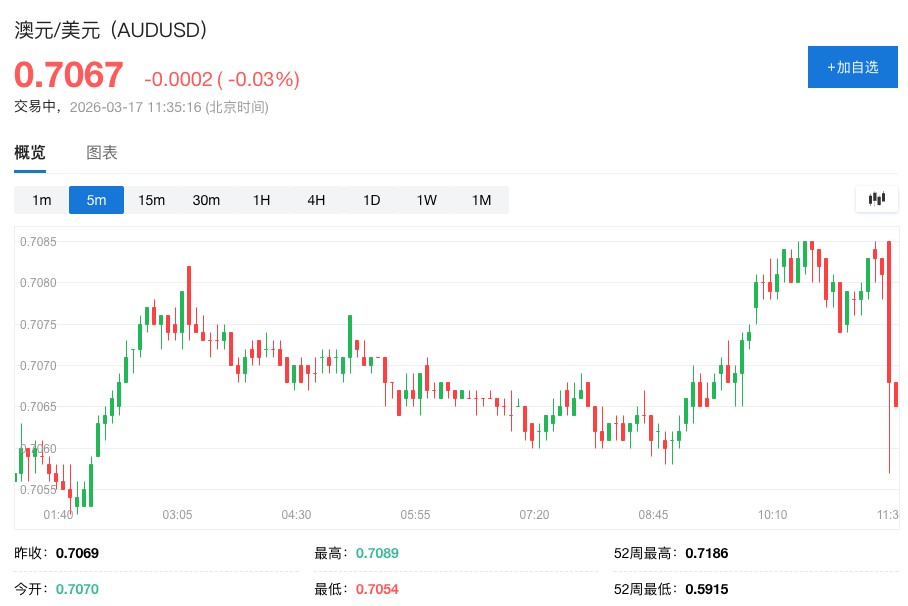
The Reserve Bank of Australia raised interest rates for the second consecutive time, increasing them by 25 basis points to 4.1%, with the decision passed by a vote of 5 to 4. The Reserve Bank of Australia warned that the conflict in the Middle East is driving up oil prices and inflation expectations, with inflation likely to remain above target for some time. As a result, the market adjusted its bets for another rate hike in May to 4.35%. Following the news, the Australian dollar quickly fell, and the yield on Australia's 3-year government bonds decreased by 9 basis points
On March 17, the Reserve Bank of Australia raised interest rates by 25 basis points to 4.1%, in line with market expectations.
This marks the first time since mid-2023 that the Reserve Bank of Australia has raised rates consecutively for two meetings, and it also indicates that last year's six-month, cumulative 75 basis points rate cut cycle has been partially reversed. The committee approved this rate decision with a 5-4 vote.
In its statement, the Reserve Bank of Australia stated that the situation in the Middle East "could elevate global and domestic inflation under various possible scenarios," short-term inflation expectations have risen, and the inflation rate may remain above the target level for some time, emphasizing that there is a "substantial risk" of inflation being persistently above the target level in the long term.
The Reserve Bank of Australia indicated that it would "take all necessary measures" to achieve its price and employment targets, stating that monetary policy is well-prepared to respond to developments, while emphasizing that there is significant uncertainty regarding the economic and inflation outlook, requiring attention to data, the evolving market environment, and risks in decision-making.
Most economists expect the Reserve Bank of Australia may raise rates again by 25 basis points in May, pushing the cash rate up to 4.35%, thereby fully reversing last year's cumulative 75 basis points rate cut.
After the interest rate hike announcement, the AUD/USD quickly fell, and the yield on Australia's 3-year government bonds dropped by 9 basis points.
Middle East Conflict Drives Up Oil Prices, Inflation Risks Rise Further
The Reserve Bank of Australia has placed external shocks in a more prominent position. The statement noted that the Middle East conflict has led to a significant rise in fuel prices and poses a major risk, potentially bringing inflation to both global and domestic levels.
Reports indicate that the U.S. and Israel began attacks on Iran at the end of February, with Iran subsequently retaliating against neighboring countries, involving more than a dozen nations in the conflict.
The Strait of Hormuz, which connects the Persian Gulf to international markets, is "effectively closed," carrying about one-fifth of the world's oil supply, driving oil prices up and posing significant upward risks to global inflation.
In the fourth quarter of last year, the core inflation indicators that the Reserve Bank of Australia focused on remained high, clearly above the target range of 2%-3%. Meanwhile, the unemployment rate, which was expected to gradually rise, unexpectedly fell to 4.1%, 0.3 percentage points lower than the central bank's forecast.
GSFM investment strategist Stephen Miller bluntly stated: "Inflation is a real and urgent threat, and raising interest rates now is the most appropriate choice. If no action is taken, more aggressive policy tools may have to be employed in the future."
Bank of America strategist Nick Stenner also pointed out that in the context of inflation remaining above target and with upward risks, "keeping interest rates unchanged would raise doubts in the market about the central bank's commitment to controlling inflation."
Next Stop: May, Household Cost Pressures and Inflation Warnings Run Parallel
Following the latest interest rate hike, according to Bloomberg, most economists expect the Reserve Bank of Australia may raise rates again by 25 basis points in May, pushing the cash rate up to 4.35%, thereby fully reversing last year's cumulative 75 basis points rate cut. Before this meeting, economists from Westpac Banking Corporation, National Australia Bank, Citigroup, and Deutsche Bank have adjusted their forecasts, expecting the Reserve Bank of Australia to raise interest rates this week; among them, Westpac and National Australia Bank also expect a rate hike in the May meeting. The CEO of Westpac stated before the meeting that he believes households can absorb two more rate hikes of 25 basis points each.
Warnings on inflation are also heating up. Some economists believe that Australia's CPI may reach 5%. Treasurer Jim Chalmers stated on Sunday that households may face greater cost-of-living pressures and warned that the inflation rate will rise above 4.5%.
This assessment is higher than the Reserve Bank of Australia's February forecast of a "CPI peak of 4.2% this year." This forecast is based on technical assumptions, including crude oil remaining at $63.8 per barrel before mid-2028, and the cash rate being 4.2% in December 2026.
In the short term, the market will focus on the February employment report released by the Reserve Bank of Australia on Thursday, as well as the monthly inflation data next week, to determine whether the "May rate hike" will move from expectation to reality
