


Goldman Sachs raises target prices for SK Hynix and Samsung: The strongest storage cycle in history drives record performance

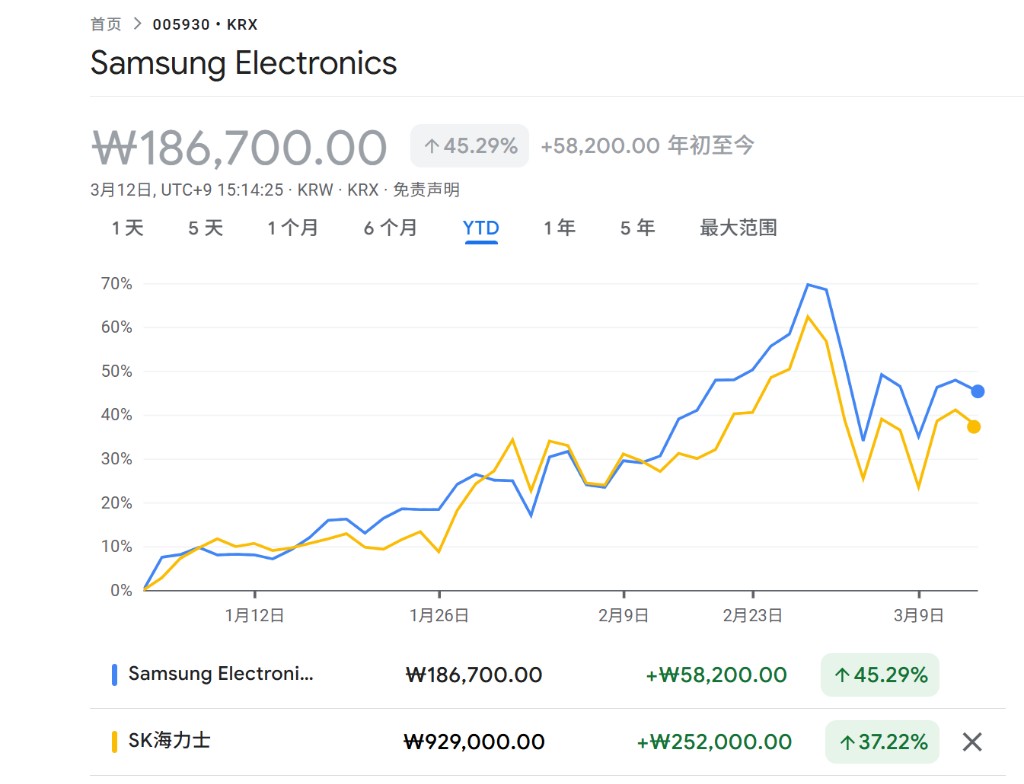
Goldman Sachs raised the target prices for SK Hynix and Samsung Electronics, expecting a strong storage upcycle in the industry due to demand from artificial intelligence and tight supply in the storage market. The target price for SK Hynix was raised from 1.2 million KRW to 1.35 million KRW, and for Samsung Electronics from 205,000 KRW to 260,000 KRW. Goldman Sachs predicts that the operating profits of both companies in the first quarter of 2026 will significantly exceed market expectations, with SK Hynix's return on equity surpassing 80% and Samsung Electronics achieving over five times year-on-year growth in operating profit
Goldman Sachs, the Wall Street investment bank, recently released a report raising the target prices and earnings forecasts for South Korean chip giants SK Hynix and Samsung Electronics. Goldman Sachs pointed out that driven by the demand for artificial intelligence and the tight supply in the traditional memory market, the industry is entering the strongest memory upcycle in history, which will propel both companies to achieve record profits and profit margins by 2026.
According to news from the Wind Trading Desk, Goldman Sachs' Giuni Lee team raised SK Hynix's 12-month target price from 1.2 million won to 1.35 million won, and Samsung Electronics' target price from 205,000 won to 260,000 won, reaffirming a "Buy" rating for both companies. Based on higher expectations for DRAM and NAND flash prices, Goldman Sachs significantly raised its operating profit forecasts for both companies for the first quarter of 2026. According to consensus expectations compiled by Bloomberg, Goldman Sachs' forecast for SK Hynix's operating profit of 34.7 trillion won and Samsung's 40.3 trillion won for the first quarter is 8% and 6% higher than market expectations, respectively.
This aggressive upward revision reflects the strong pricing dynamics in the memory market. Goldman Sachs' latest channel survey shows that the starting point for early pricing negotiations for DRAM and NAND in the second quarter is significantly higher than expectations from months ago. Due to AI and server-driven demand absorbing most of the new supply in the market, even against a backdrop of weak demand for personal computers and smartphones, the supply adequacy of memory chips for core applications remains at extremely low levels.
Strong fundamentals will directly translate into unprecedented financial returns. Goldman Sachs expects SK Hynix's return on equity (ROE) to exceed 80%, a historical high, while Samsung Electronics' operating profit is expected to achieve more than a fivefold year-on-year increase. Although Goldman Sachs has factored in the assumption of a potential mild correction in memory prices in 2027 in its model, it noted that the current valuation levels of both companies still hold significant attractiveness.
Memory Chips Entering the Strongest Upcycle in History
In this report, Goldman Sachs significantly raised its price forecasts for traditional memory chips. For SK Hynix, Goldman Sachs expects its traditional DRAM prices in the first quarter of 2026 to soar by 88% quarter-on-quarter, while NAND prices are expected to rise by 58% quarter-on-quarter. Based on this, the average selling price of SK Hynix's conventional DRAM for the entire year of 2026 is expected to be raised to a year-on-year increase of 243%.
For Samsung Electronics, the expected quarter-on-quarter price increases for DRAM and NAND in the first quarter are projected to reach 88% and 71%, respectively, with NAND prices expected to skyrocket by 164% year-on-year for the entire year.
This pricing environment will lead to unprecedented levels of profit margins. Goldman Sachs expects that SK Hynix's operating profit margins for DRAM and NAND will soar to over 70% and over 40%, respectively, breaking historical records. Samsung Electronics' DRAM operating profit margin is expected to reach 71%, while NAND profit margin is projected to be 46%, not only setting records but also matching or surpassing the peak levels during the upcycle from 2017 to 2018.
AI and HBM Demand Reshaping Performance Landscape
In addition to the recovery of traditional storage, breakthroughs in high bandwidth memory (HBM) business are another core driver. Goldman Sachs reiterated its expectation that SK Hynix will maintain a solid leadership position in AI storage, forecasting its full-year operating profit for 2026 to reach 202 trillion Korean won, with ROE soaring from last year's 44% to over 81% this year.
Samsung Electronics has also made significant progress in the HBM field. Thanks to the industry-first launch and shipment of HBM4, a solid position in Google TPU, and an increase in market share with Nvidia, Goldman Sachs expects Samsung's HBM revenue to achieve a 158% year-on-year growth by 2026, reaching $15 billion.
This change is also directly reflected in Samsung's customer structure, with Alphabet replacing Verizon in its top five customers list before 2025, indicating that its product portfolio is accelerating its shift towards servers and AI. Driven by this, Samsung's overall operating profit for 2026 is expected to reach 239 trillion Korean won.
However, Goldman Sachs also pointed out that the continuously soaring costs of memory components will significantly suppress the profit margins of Samsung's smartphone business, with the smartphone operating profit margin expected to drop to a historical low of 4% this year.
Increased Capital Expenditure and Valuation Attractiveness
In the face of a tight supply situation, both companies plan to further increase capital expenditures. Goldman Sachs raised its forecasts for SK Hynix and Samsung Electronics' storage capital expenditures for 2026 to 40 trillion won and 46 trillion won, respectively.
Goldman Sachs emphasized that industry capital expenditures will be heavily tilted towards high-profit DRAM and HBM, and since most incremental funds are used for infrastructure preparation, there will not be a significant release of substantial capacity to the market in the short term. Additionally, Samsung Electronics invested a record 37.7 trillion won in R&D in 2025 (an 8% year-on-year increase) to consolidate its technological leadership.
In terms of valuation, Goldman Sachs believes that even accounting for slight price adjustments expected in 2027, both stocks remain cheap. Based on 2027 expected data, SK Hynix has a price-to-earnings ratio of 4.5 times, a price-to-book ratio of 1.7 times, and ROE maintained at 46%; Samsung Electronics has a price-to-earnings ratio of 6.8 times, a price-to-book ratio of 1.7 times, and ROE of 28%.
Combining SK Hynix's stock buybacks, dividends, and potential ADR listing plans, along with Samsung Electronics' move to cancel nearly 87 million shares of treasury stock, Goldman Sachs maintains a highly constructive view on the medium to long-term prospects of both companies. The potential risks highlighted by Goldman Sachs mainly include the deterioration of storage supply and demand due to weak macro terminal demand, delays in technological iterations, and the risk of market share loss faced by Samsung in the mobile OLED market
The above wonderful content comes from the Wind Trading Platform.
For more detailed interpretations, including real-time analysis and frontline research, please join the【 **Wind Trading Platform ▪ Annual Membership**】

Risk Warning and Disclaimer
The market has risks, and investment requires caution. This article does not constitute personal investment advice and does not take into account the specific investment goals, financial situation, or needs of individual users. Users should consider whether any opinions, views, or conclusions in this article are suitable for their specific circumstances. Investment based on this is at your own risk