


The largest oil release plan in history has been announced, Trump takes over TACO, why is the market still not buying it?

400 million barrels is an impressive number. However, in the face of a daily supply gap of 15 million barrels, what it can secure may only be a respite measured in days
The global energy market is witnessing a historic moment.
On the evening of March 11, the International Energy Agency (IEA) announced an emergency oil reserve release plan of up to 400 million barrels—this is unprecedented in the history of the IEA, more than double the 182 million barrels released after the Russia-Ukraine conflict in 2022, accounting for about one-third of the total reserves of 1.2 billion barrels held by IEA member countries.
This proposal has received support from G7 countries. A few hours before the meeting, G7 energy ministers stated their principle support for "taking proactive measures to address this situation, including the use of strategic reserves," and the German Minister of Economy also announced participation in the release.
Japan will independently release its strategic oil reserves, starting as early as March 16. As the third-largest holder of strategic oil reserves globally, Japan plans to release a total of about 80 million barrels from both the private sector and national reserves, equivalent to about one and a half months of domestic consumption.
After the largest release plan in IEA history was announced, Trump stepped in to cool the market. According to CCTV News, U.S. President Trump stated that there are "almost no targets left to strike" in Iran, and that U.S. military actions against Iran are "coming to an end."
However, the market responded calmly. Following the announcement, Brent crude briefly dipped before rebounding, firmly staying above $90. Although it retreated from the day's high, as of the time of writing, both WTI and Brent crude were still up nearly 4%.
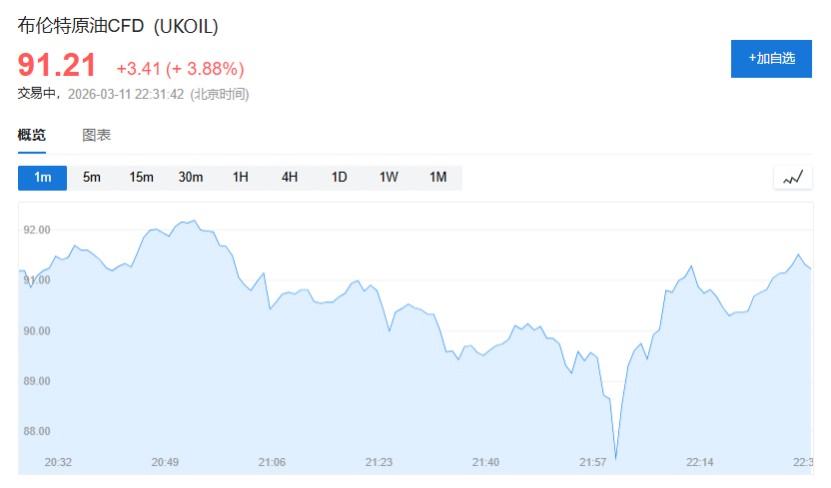
Facing a daily shortfall of 15 million barrels, a release of 400 million barrels is still a drop in the bucket
Behind this is a brutal arithmetic problem of supply and demand.
Bloomberg reporter Alex Longley pointed out sharply: what truly affects the oil market is not the scale of the release, but the speed at which crude oil enters the market. He cited previous estimates from JP Morgan:
The feasible speed of joint releases by various countries is currently about 1.2 million barrels per day. During the U.S. release of strategic oil reserves in 2022, the maximum was slightly above 1 million barrels per day for a month, and in some periods, the release speed was even less than half of that level.
On the other side of the issue is: once the situation escalates, the scale of crude oil supply disruptions transported through the Strait of Hormuz could reach about 15 million barrels per day.
This means that despite the historical record of a release scale reaching 400 million barrels, what will truly determine the impact on the oil market will still be the pace of the release and its execution details.
It is worth mentioning that although the G7 group has indicated it may coordinate the release of strategic oil reserves, beyond this, large crude oil buyers in Asia have yet to signal any intention to utilize their national strategic reserves.
These major buyers continue to purchase crude oil on the international market.
Analysts point out that some countries' strategic reserves can cover several months of import demand, but utilizing reserves is not a priority option when supply channels still exist.
Learning from history: the effects of reserve releases are "uneven"
Historically, there have been five instances of strategic reserve releases The earliest can be traced back to the first Gulf War in 1990-1991, when U.S. President George H.W. Bush ordered the release of reserves on the night of the multinational forces' attack on Iraq, with IEA member countries following suit. On the first day of the attack, oil prices plummeted by more than 20%, making it one of the most successful interventions.
The most recent release, following the Russia-Ukraine conflict in 2022, was entirely different—initially leading to a 20% increase in oil prices, as the market interpreted it as a signal that the crisis was more severe than expected. Although it ultimately had a certain stabilizing effect, the cost was that the U.S. Strategic Petroleum Reserve was reduced by half and remains at a low level to this day.
However, none of the aforementioned releases were sufficient to address the scale of the current crisis.
Morgan Stanley global oil strategist Martijn Rats provided a more straightforward judgment: historical evidence shows that the effect of releasing strategic reserves on lowering oil prices is "uneven."
"Many times, oil prices continue to rise because the release itself sends a signal to the market— we are in a highly tense moment."
The release of reserves does not necessarily change market behavior. Paul Horsnell from the Oxford Institute for Energy Studies summarized this dilemma in one sentence: "Replacing flow with inventory is extremely, extremely difficult. The market has never liked that."
The Real Variable: When Will the Strait of Hormuz Reopen?
All analyses ultimately point to the same question: When will the Strait of Hormuz reopen?
This vital waterway connecting the Persian Gulf to global markets normally carries about 20 million barrels of crude oil and refined products daily, accounting for about one-fifth of global supply. Since the escalation of conflict between the U.S. and Iran, energy transport through this strait has nearly come to a standstill.
Horsnell from the Oxford Institute for Energy Studies characterized this shock as "the largest oil supply shock in history," nearly twice the scale of the Suez Canal crisis. He added, "This is exactly the kind of supply disruption scenario that analysts and strategists have repeatedly simulated in the 70s, 80s, and 90s. But for the past 30 years, it seems no one has been doing such simulations."
In a statement released on Wednesday, IEA Director Birol also stated: “The most important thing is to restore traffic in the Strait of Hormuz.”
Signals of escalating conflict continue to emerge: U.S. forces have sunk several Iranian vessels, including 16 minesweepers; the UK Maritime Trade Operations (UKMTO) reported that three cargo ships near the Iranian coast were attacked by projectiles, one of which was located in the Strait of Hormuz; two drones crashed near Dubai International Airport, temporarily closing the surrounding airspace.
According to CCTV News, on Wednesday, the Iranian Islamic Revolutionary Guard Corps reiterated its absolute jurisdiction over the Strait of Hormuz. The statement claimed that the U.S. and its partners have lost the right to pass through the Strait of Hormuz.
Deputy Commander of the Iranian Islamic Revolutionary Guard Corps, Fadavi, warned that the U.S. must consider the possibility of getting caught in a prolonged war of attrition, which would lead to a complete collapse of the U.S. and even the global economy.
Marex energy market analyst Sasha Foss told CNBC: "The IEA's release of reserves can only buy a few days. This conflict must end within this week, otherwise oil prices will soar back above $100."
Paul Gooden, Global Head of Natural Resources at asset management firm Ninety One, provided two scenarios in a research report:
- Optimistic scenario: If tensions ease in the coming weeks, oil prices may retreat, but "it is unlikely to return to the $60 to $70 range seen earlier this year";
- Pessimistic scenario: If supply disruptions last longer, "oil prices could surge further, potentially breaking through $120 or even higher until high prices begin to suppress demand."
The market's reaction has already made everything clear. This massive oil shock can fundamentally only be resolved by one thing: the gunfire, when it truly stops
