How to grasp the winners of the AI competition? The NASDAQ is fundamentally superior to the S&P

Bank of America believes that it is difficult to predict the winners in the AI race, and instead of betting on individual stocks, it is better to passively invest in the NASDAQ-100 Index (NDX). Its mechanism advantages are: 1. "Survivorship bias" automatically chases up and down, with excess returns approximately twice that of the S&P 500; 2. Proposed rule changes (such as fast inclusion channels) allow large AI IPOs to enter the index more quickly and with greater weight. Coupled with the wave of AI unicorn IPOs, the NDX is expected to continue outperforming the S&P
In the AI competition, investors face uncertainty regarding winners and losers. Bank of America believes that instead of betting on a single stock, it is better to leverage the momentum-friendly characteristics of the NASDAQ-100 Index (NDX) mechanism itself and the upcoming rule changes.
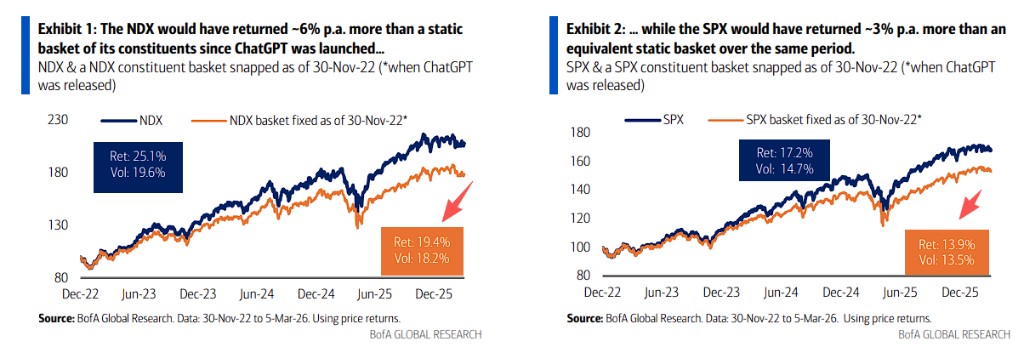
On March 11, according to news from the Wind Trading Desk, Bank of America stated in its latest research report that in the current environment of high uncertainty regarding AI winners and losers, the "survivorship bias" mechanism of passive investment in the NASDAQ-100 Index (NDX) is itself a trump card—since the release of ChatGPT, the NDX has outperformed the static basket of constituent stocks by about 6% annually, which is approximately twice the excess return of the S&P 500 (SPX).
The report also pointed out that the proposed index rule changes by NASDAQ will further strengthen the structural advantages of NDX over SPX at the mechanism level, combined with expectations of a wave of IPOs from large tech/AI unicorns, NDX is expected to continue outperforming SPX in both price performance and volatility.
Survivorship Bias: The Invisible Dividend for Passive Investors in Momentum Markets
In the field of quantitative analysis, "survivorship bias" is often a pejorative term—it means only looking at success cases while ignoring failure samples, thus overestimating future returns.
However, Bank of America pointed out that in an index system centered on market capitalization weighting, this "bias" is precisely a source of structural returns for passive investors: the weight of winners continues to expand, while losers are gradually kicked out of the index, making the index itself an automatic momentum machine that chases gains and cuts losses.
From a data perspective, since the release of ChatGPT at the end of November 2022, marking the official start of the AI era (as of March 5, 2026), the actual return of NDX (25.1% annualized) has been about 6 percentage points higher annually than that of the fixed basket of constituent stocks (19.4% annualized); while the excess return of SPX is about 3 percentage points (17.2% vs 13.9%). In other words, the contribution of NDX's survivorship bias to returns is about twice that of SPX.
It is noteworthy that during this period, the number of changes in constituent stocks for NDX and SPX was similar (about 60 additions and deletions each), but the total number of constituent stocks in NDX is only one-fifth that of SPX (100 vs 500), which means that each adjustment of constituent stocks has a more significant impact on NDX.
Proposed Rule Changes by NASDAQ: Fast Inclusion Mechanism Will Amplify NDX's Tech/AI Concentration
The report states that in February 2026, NASDAQ officially proposed a revision plan for index methodology, with core changes including the following points, each pointing in the same direction—to allow large tech/AI new stocks to enter NDX faster and with greater weight:
1. Total Market Capitalization Inclusion Qualification: The current rules only consider listed shares when calculating market capitalization, while many large newly listed companies have a significant proportion of their market capitalization from unlisted sharesThe new regulations propose to include the company's total market capitalization (including unlisted shares) in the index qualification criteria, while retaining the method of calculating weight based on listed and freely tradable market capitalization.
2. Fast Entry: Newly listed Nasdaq stocks can be included in the NDX as quickly as 15 trading days after the IPO, without needing to meet the current "maturity" and liquidity requirements. In contrast, the S&P 500 requires companies to achieve positive GAAP earnings for four consecutive quarters to be eligible, which is a significantly higher threshold.
3. Fivefold Weight Adjustment for Low Free Float Ratio: New members with a free float ratio below 20% will have their index weight calculated at five times the free float ratio (with a cap of 100%). This means that a company with only 9% of its shares in circulation could have a weight calculation basis of up to 45% of its listed market capitalization. Additionally, the current minimum free float ratio requirement of 10% will also be eliminated.
4. Quarterly Exit Mechanism: The current "10bp rule" (which triggers exit if the weight is below 10bp for two consecutive month-ends) will be replaced by a quarterly ranking system, where constituent stocks that fall out of the top 125 will be removed during regular quarterly adjustments, making the exit of inefficient constituent stocks more timely and predictable.
Bank of America estimates that assuming the passive assets directly tracking the NDX are approximately $700 billion (about 2% of the total market capitalization of the NDX), even if a large newly listed company has a very low float ratio (below 10%), passive tracking funds will still become a significant buying force for its stock.
Large AI Unicorn IPOs: Volatility Impact Cannot Be Ignored
Additionally, it is worth noting that research reports indicate that the market widely expects several super-large private tech companies to go public in the coming months, and the resulting market volatility should not be underestimated.
Currently, the pre-IPO financing valuations of the top ten private companies globally range from hundreds of billions to nearly a trillion dollars, with an average size about twice that of the median constituent stock in the NDX. If calculated at an issuance scale of about $50 billion, it would far exceed the size of the largest IPO in history.
Bank of America estimates the volatility of potential newly listed large tech companies through three methods, arriving at a volatility range of 100%-120%:
Comparable Analysis: AI companies going public in 2025 (CRWV, CARL, AMBQ, FIG, FIGR) have achieved an average volatility of about 96% in the six months following their IPO, with an average free float ratio of about 14%;
Alternative Pricing Channels (perpetual futures, secondary market trading): Estimates for three large private companies widely speculated to be going public show an average volatility of about 108%;
Public Funds Holding Large Pre-IPO Allocations: Volatility data from related funds supports extrapolation to a volatility level of about 120%This volatility range is approximately three times the average volatility of NDX constituent stocks, and due to the low free float ratio of newly listed companies in the initial stage (limited supply of tradable securities will further amplify volatility), this estimate is still considered conservative by Bank of America Merrill Lynch.
The research report states, Impact on the index level: Bank of America Merrill Lynch estimates that the initial impact of newly listed large-cap constituents on NDX index volatility is positive but moderate (+0.1v). However, as the listing scale expands or the free float ratio increases, the impact could rise to +1.1v.
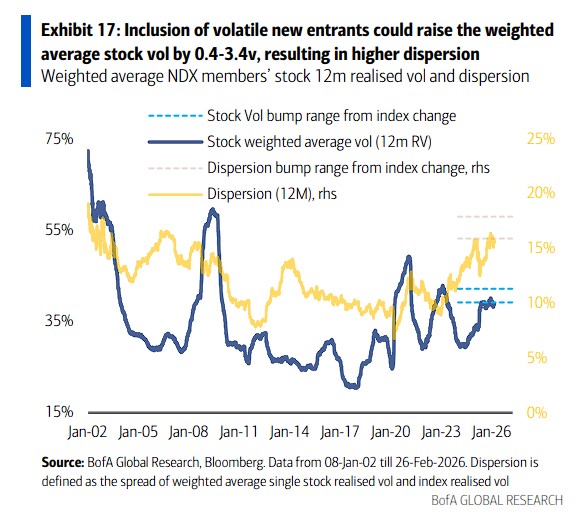
At the individual stock level, the NDX weighted average constituent stock volatility may increase by 0.4v to 3.4v, and the NDX volatility dispersion may widen by 0.3v to 2.3v.