


JP Morgan trading desk: Tactically bearish on US stocks until a clear path is established for the Iran issue

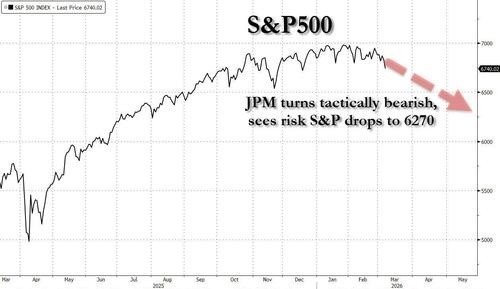
JP Morgan's trading desk has turned bearish on US stocks due to the escalation of the US-Iran conflict and soaring oil prices, lowering the S&P 500 index target to 6,270 points. The head, Andrew Tyler, pointed out that the weakening technicals and heightened geopolitical risks are the main reasons. With oil prices remaining high, WTI crude oil has risen by 35.6%, which will exacerbate market concerns about stagflation. Despite the bearish outlook, JP Morgan emphasizes that this does not mean the beginning of a structural bear market, and the assessment will be terminated if the conflict de-escalates
The escalation of the US-Iran conflict combined with soaring oil prices has led JP Morgan's trading desk to completely shift to a bearish outlook, lowering the recent target for the S&P 500 index to 6,270 points.
Andrew Tyler, head of JP Morgan's trading desk, released a report on Tuesday, upgrading the tactical stance on US stocks from "cautious" to "bearish," primarily due to weakening technicals and ongoing geopolitical risks. Tyler pointed out that the S&P 500 index has now fallen 3.2% from its historical peak, and the continued evolution of the US-Iran conflict could push the index into a technical adjustment range, corresponding to a level of approximately 6,270 points, about a 10% decline from current levels.
The core variable driving this judgment is the extreme volatility in the energy market. WTI crude oil surged 35.6% last week, briefly reaching $119 per barrel, while natural gas rose 11.4% and gasoline increased by 20.2%.
JP Morgan believes that oil prices will remain above $100 per barrel, and combined with weak employment data, this will exacerbate market concerns about stagflation and increase volatility across all asset classes. Notably, JP Morgan emphasizes that this tactical bearish stance does not signify the beginning of a structural bear market; this judgment will be promptly terminated once a clear de-escalation path emerges from the conflict.
Attacks on Oil and Gas Infrastructure, Reassessment of Commodity Risk Premiums
JP Morgan's commodity trading desk detailed the impact of the current conflict on the energy supply chain in its report. According to the team, both the US and Iran have attacked each other's oil and gas infrastructure, with large refineries in Tehran and Haifa being hit, and multiple oil storage tanks used for domestic supply in Iran—primarily storing gasoline—also coming under attack.
JP Morgan's commodity trading desk stated: "The precedent for attacks on oil and gas infrastructure has officially begun, and we believe that the recent rise in oil prices is just the beginning. For every additional day the Strait of Hormuz is blocked, the future supply issues for oil products will grow exponentially."
The report cites historical comparisons: after the outbreak of the Russia-Ukraine conflict on February 24, 2022, WTI crude oil peaked at $123.70 per barrel on March 8 of the same year, and it wasn't until late July 2022 that it consistently fell below $100 per barrel. JP Morgan's commodity analysts currently expect production cuts from Iraq, Kuwait, and the UAE to quickly approach 4 million barrels per day, a level corresponding to an oil price of $120 per barrel.
Rising Stagflation Expectations, Debt Market and Interest Rate Expectations Repriced in Sync
The shock from rising oil prices is rapidly transmitting to inflation expectations. The report shows that the one-year breakeven inflation rate rose 63 basis points last week to 4.46%, while the ISM manufacturing prices paid sub-index reached 70.5, the highest level since the CPI hit 9.1% in June 2022, with the effects of tariff price pass-through also continuing to manifest Expectations in the interest rate market have also undergone a significant shift. As of last Friday, the bond market's expectation for the Federal Reserve to cut interest rates this year has compressed from 61 basis points on February 27 to 43.5 basis points. Meanwhile, the European Central Bank's expectations have reversed direction—from anticipating a 13 basis point rate cut on February 28 to expecting a 39.2 basis point rate hike.
JP Morgan's trading desk also noted that the lack of safe-haven buying in the treasury market last week surprised equity investors. The underlying reason is that rate clients previously held long positions in U.S. short-end, long positions in swap spreads, short positions in interest rate volatility, and long positions in curve steepening, which suffered losses during the deleveraging process. The surge in oil prices further triggered a bear flattening trend in developed market bonds.
Macroeconomic fundamentals still provide support, but downside risks cannot be ignored
Despite a tactical shift towards a bearish stance, JP Morgan remains relatively cautiously optimistic about macroeconomic fundamentals. The report shows that last week's ISM manufacturing, ISM services, and ADP employment data all exceeded expectations. Although the non-farm payroll report was somewhat weak, JP Morgan economists suggest observing the February data in conjunction with the unusually strong January data—over the two months, private employment increased by an average of 30,000 jobs per month, which is basically in line with the full-year average of 25,000 jobs for fiscal year 2025. The unemployment rate rose from 4.32% to 4.44%, consistent with previous expectations.
However, persistently high energy prices are eroding growth prospects. JP Morgan's chief economist Michael Feroli predicts a real GDP growth rate of 1.75% for the first quarter of 2026, but if oil prices remain above $100 per barrel, it will bring about approximately 60 basis points of downside risk.
The report also warns that if the recent trend of U.S. dollar appreciation reverses, it will further exacerbate inflationary pressures in the U.S.; additionally, the lack of extension for subsidies under the Affordable Care Act and the potential rise in Medicare premiums are also worth noting.
Risk warning and disclaimer
Markets are risky, and investments should be made with caution. This article does not constitute personal investment advice and does not take into account the specific investment goals, financial situation, or needs of individual users. Users should consider whether any opinions, views, or conclusions in this article align with their specific circumstances. Investment based on this is at one's own risk
