


From home furnishings and eyewear to small chips, the OpenClaw storm has begun to sweep through the hardware circle

OpenClaw is rapidly sweeping the hardware market, especially in Shenzhen, attracting a large number of users. Zhu Xiaohu from Jinsha River Venture Capital pointed out that the ecological growth rate of OpenClaw is astonishing, and it is expected that AI PCs will be pre-installed with this technology in the coming months. Xiaomi is also conducting internal testing of MiclawAgent, planning to embed AI agents into its ecosystem to drive the redefinition of hardware. The market is gradually realizing that agents may become a new operating system layer, similar to the rise of Android phones
In March, Shenzhen saw a group of people lining up to "install lobster" on their computers, creating such a buzz that even Pony Ma exclaimed in his social circle that he didn't expect Openclaw to spread rapidly in the sinking market at a pace akin to street literature.
When a technology begins to be accepted by such a crowd, it usually signifies one thing: it has crossed the chasm of early adopters.
Zhu Xiaohu, managing partner of Jinsha River Venture Capital, candidly stated that what shocked him about OpenClaw was not the strength of the product itself, but the growth rate of the ecosystem. In his view, within the next one to two months, there will be AI PCs pre-installed with lobster. When that day comes, the war for entry will truly begin.
As Zhu Xiaohu predicted, in this "lobster craze," the most excited individuals are not the developers, but the hardware manufacturers.
Recently, developers jokingly remarked that because Chinese people have an obsession with "buying houses," and Manus's form is renting, local deployment of OpenClaw feels like owning their own house, providing a greater sense of security.
For the lobster "self-built house," the one best positioned to seize this wave of dividends is Xiaomi.
Xiaomi has begun to mimic Openclaw's approach, starting internal testing of its own developed MiclawAgent, hoping to embed AI agents into Xiaomi's "full ecosystem of people, vehicles, and homes," allowing smartphones, cars, televisions, and home appliances to become execution nodes for AI.
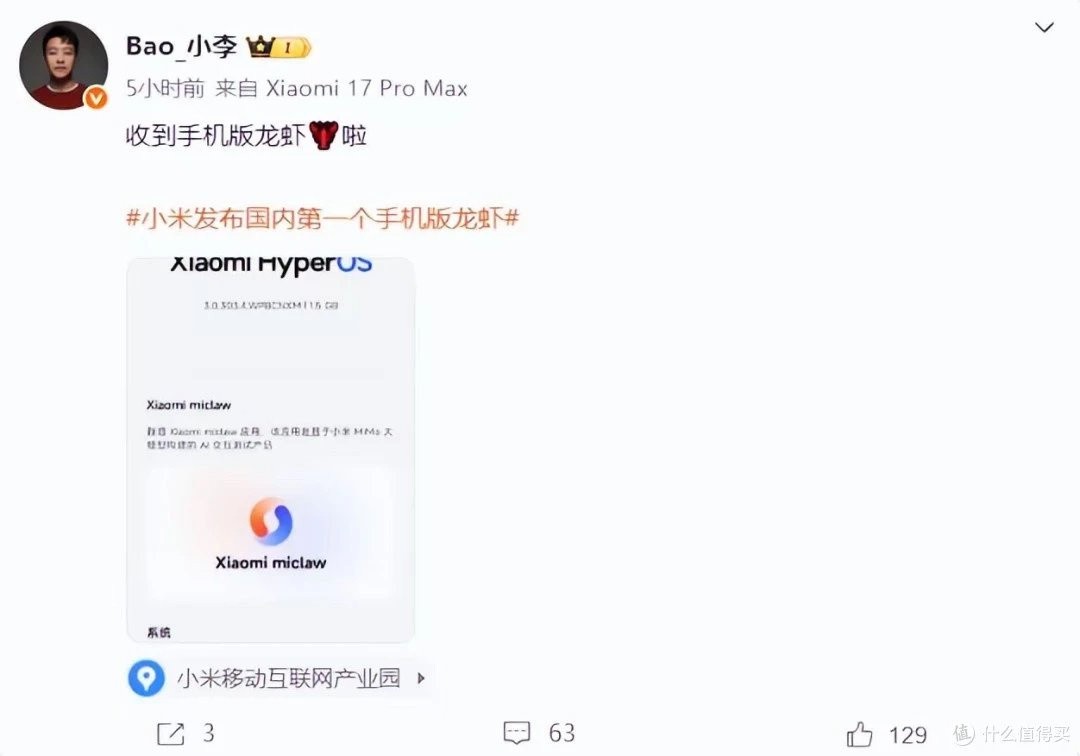
The Miclaw project is led by Xiaomi's Core team for large models, with Luo Fuli, a former core member of DeepSeek, as the person in charge. This product is seen as an important landing attempt for the MiMo large model on mobile devices.
Xiaomi's logic has always been simple: when the software paradigm changes, hardware will undergo a complete overhaul. From mobile internet to IoT, Xiaomi has almost always hit the nodes perfectly.
When Agents began to gain popularity, Xiaomi quickly realized an issue internally—if computers and glasses start running Agents, then devices will no longer just be terminals, but will become small intelligent agents.
In a sense, this logic is very similar to the explosion of Android phones over a decade ago.
Back then, the market thought phones were merely communication tools, only to later discover they were actually gateways to the internet. Now, more and more companies are beginning to realize: Agents may become the new operating system layer.
On the other hand, Rokid has taken a more aggressive approach. This company has been working on AR glasses, but has remained somewhat lukewarm over the past few years. The core issue with glasses is not hardware, but "what exactly can they do?"
The emergence of Agents suddenly solved this problem.
Rokid has opened the SSE interface to users, allowing Rokid Glasses to connect to any backend you desire, including OpenClaw, DeepSeek R1, Qwen3, Kimi K2.5, and more If there were a helper in your glasses that could help you book tickets, write emails, check information, and even automatically complete tasks at any time, then the glasses would no longer just be a display but a portable "action agent."
Hardware manufacturers suddenly realized that agents could become a new demand engine. When demand starts to activate, the most sensitive systems in Shenzhen also begin to operate.
Huaqiangbei is almost the nerve ending of China's hardware world. Any technological trend that can make money will respond within weeks. The first to appear is the "Agent Mini Host." It is the size of a mobile hard drive, plug-and-play, running local models and OpenClaw inside. Some call it the "Lobster Box."
Then came even more outrageous things.
Someone online has already stuffed MiniClaw (a lightweight secondary packaging simplified version of OpenClaw) into an ESP32 chip that costs only a few dozen yuan. The computing power is certainly far from enough, but as long as the inference is moved to the cloud, this small chip can still serve as the control center for the agent.
Thus, a very wonderful scene emerged.
Someone connected the ESP32 to home lights, door locks, and even a vacuum robot, allowing it to monitor whether the baby at home is crying or if there is food in the pet's bowl. The agent would automatically adjust the lighting, refill the pet food, and other actions in response.
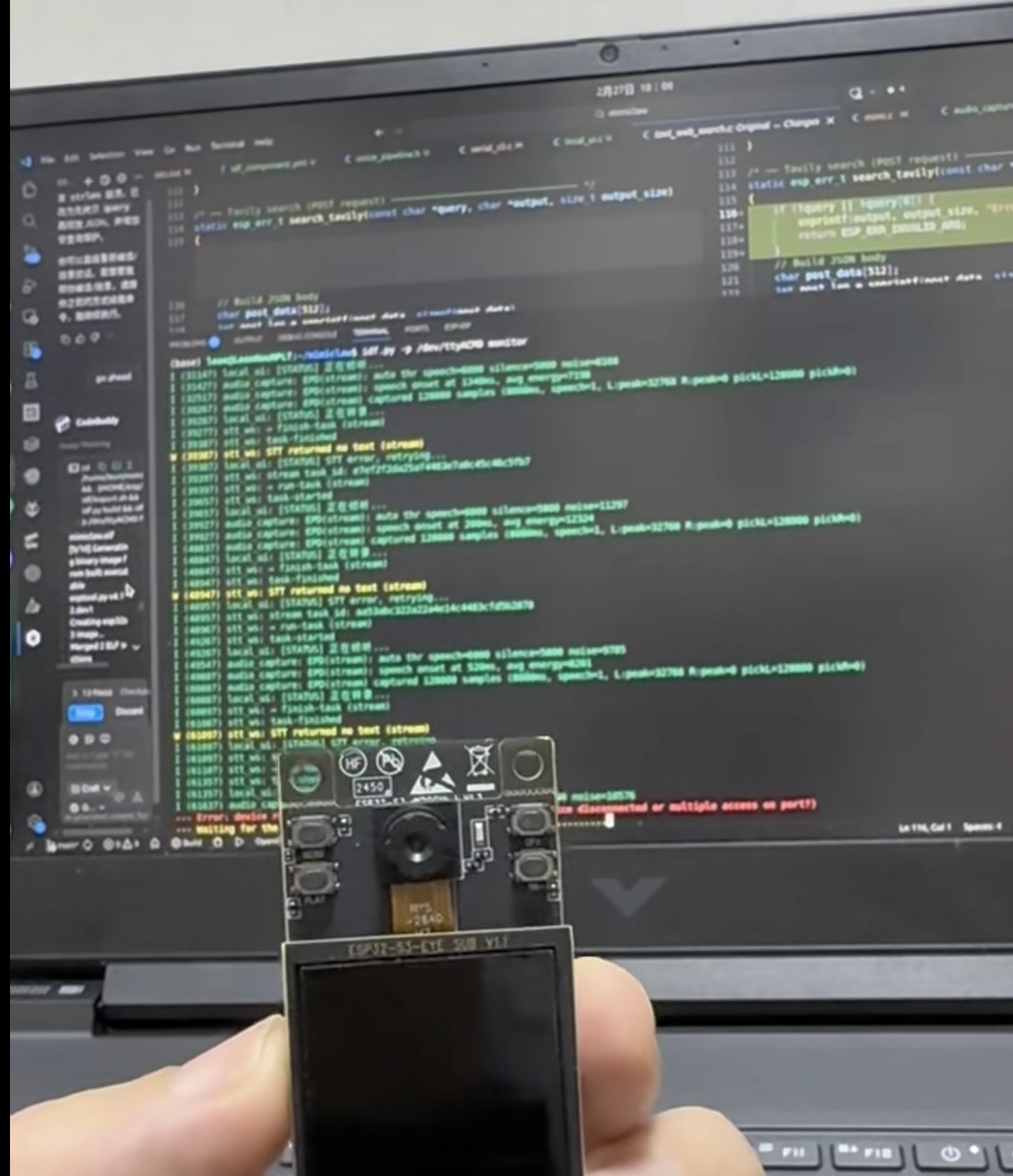
This change in experience is more important than the technology itself. In the future, this lightweight version of the agent may penetrate into thousands of smart hardware, enabling them to actively "work."
Many technological revolutions are not due to stronger technology, but because they change the relationship between humans and machines.
In the PC era, people had to learn to use software; in the mobile internet era, software began to adapt to people; and in the agent era, software began to act on behalf of people. When this change occurs, the entire logic of the hardware world will be rewritten.
For the past few decades, the competitive logic of the 3C industry has remained quite stable: chips, screens, systems, brands. But if agents become the new core layer, then the value structure of hardware will change. Devices will no longer just compete on performance but on "agent capabilities."
Whoever's device can run more agents, connect more tools, and execute more tasks will be more valuable. This also means that some traditional advantages may suddenly become ineffective, just like PCs.
In the past decade, the PC industry has hardly changed. Aside from the performance revolution brought by Apple's M series chips, most manufacturers have been doing similar things: lighter, thinner, and longer battery life. But if agents become mainstream, then PCs may be redefined Because the Agent needs to run continuously, it requires better local computing power and deeper system permissions. Therefore, PCs may become a type of "personal server."
Looking further, the overhaul of 3C hardware is not limited to small appliances and wearable devices; this storm will inevitably sweep through smart cars.
As the largest, most powerful, and energy-rich "3C terminal" on the market today, the automotive cockpit is inherently the most luxurious breeding ground for Agents.
In the industry’s view, the core competitiveness of future automotive cockpits will no longer be a few large screens or leather seats, but rather the degree of evolution of the embedded Agent. Leading new car manufacturers will inevitably accelerate the deep integration of architectures like OpenClaw into the underlying vehicle systems.
This in-car Agent will possess high system permissions; it can understand your vague intentions, automatically plan routes based on your daily schedule, and even book coffee along the way. It can also proactively adjust ambient lighting and chassis suspension comfort when it detects that you are in a bad mood.
At that time, the car will transform from a "sofa on wheels" into an "all-purpose butler on wheels."
This represents a redistribution of value across the entire automotive supply chain, where underlying long-text databases, edge inference chips, and AI companionship emotional algorithms will become new high-margin modules.
Of course, current Agents are still quite primitive and carry risks.
Many "lobsters" can only complete simple tasks and often make mistakes. Sometimes they write scripts that crash the system, and other times they search for information randomly online. But this is not important, as technological revolutions often do not start from perfection.
When the internet first appeared, it was slow; when mobile phones first emerged, they were clunky; and when large models first became popular, they often "spouted nonsense." The key lies in the direction. When a technology begins to move from the geek community to the general public, it has already taken the most crucial step.
People lining up at Tencent's headquarters to install "lobsters" may not realize they are participating in a technological diffusion. However, many hardware companies have already recognized that a new cycle may be starting, and the prophecy that AI can "redo all hardware" may be quietly coming true.
In this carnival of redefining everything, if the old hardware giants remain stagnant, they will quickly become the discarded children of the era; while those who understand how to leverage decentralized computing power and keenly capture scene demands may establish a vast hardware empire belonging to the Agent era on the ruins.
Risk Warning and Disclaimer
The market has risks, and investment requires caution. This article does not constitute personal investment advice and does not take into account the specific investment goals, financial situation, or needs of individual users. Users should consider whether any opinions, views, or conclusions in this article align with their specific circumstances. Investment based on this is at their own risk
