


Releasing oil reserves, canceling tariffs to seize goods, setting price caps on oil... The energy defense battle in Asia escalates!

The Middle East conflict has triggered a surge in oil prices, prompting several Asian economies to rapidly implement a series of energy emergency measures. Vietnam is reducing taxes and loosening restrictions to secure supply through market mechanisms; South Korea is reintroducing oil price controls for the first time in 30 years; Japan is preparing to release strategic reserves; and Bangladesh is cutting demand by closing universities and restricting fuel sales. If high oil prices persist, whether the government subsidy gap can be sustained will be the most critical risk variable in the cost crisis
Since early March, the conflict in the Middle East has continued to escalate, impacting the global energy supply chain. The Strait of Hormuz, a critical global energy transportation route, is nearly paralyzed, with a significant amount of crude oil and natural gas transportation obstructed.
Brent crude oil prices have surpassed $100 per barrel. As the largest crude oil importing region in the world, Asia is at the forefront. Many governments have begun to implement emergency policies, from releasing strategic reserves to limiting oil price increases, in an attempt to stabilize domestic energy markets.
According to Bloomberg, the Vietnamese government announced last Friday that it would eliminate fuel import tariffs and grant state-owned energy group PetroVietnam greater flexibility in buying and selling crude oil and refined products. The government stated that current supply is "basically guaranteed," but warned that if the conflict continues into April, the market may face greater pressure. South Korean President Lee Jae-myung announced on Monday during an emergency cabinet meeting that the government would implement maximum price controls on petroleum products, marking the first use of this administrative tool in nearly 30 years.
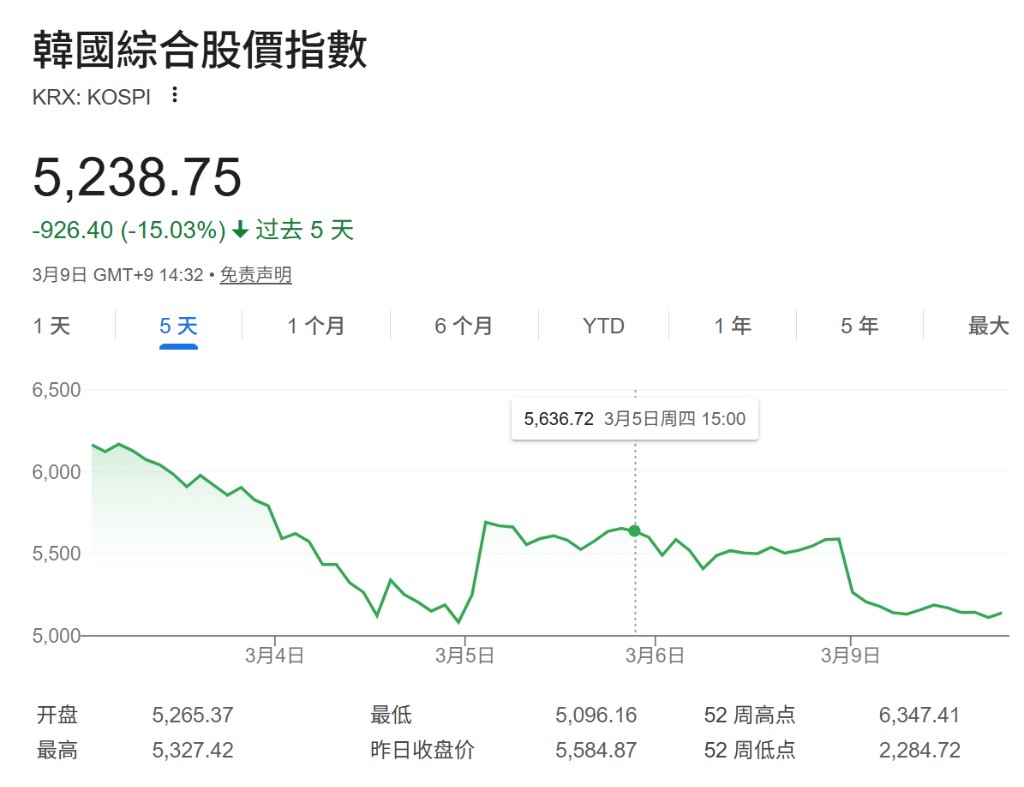
Affected by the ongoing situation in the Middle East, the South Korean financial market is under significant pressure. The Korea Composite Stock Price Index (Kospi) fell by as much as 8% on Monday, triggering the circuit breaker mechanism for the second time this month; the Korean won dropped over 1%, approaching the critical psychological level of 1,500 won per dollar.
Vietnam: Tax Cuts and Deregulation to Guide Supply through Market Mechanisms
According to Bloomberg, the core goal of the Vietnamese government's elimination of fuel import tariffs and relaxation of PetroVietnam's import quota restrictions is to reduce procurement costs, attract more import sources, and enhance supply flexibility.
Pham Luu Hung, chief economist at SSI Securities, stated that the relaxation of controls on PetroVietnam will provide the company with greater operational space to balance supply and demand.
Vietnam's current crude oil production is approximately 180,000 barrels per day, far below domestic consumption needs. The two major domestic refineries are operating smoothly: the Rong Quay refinery currently has a capacity utilization rate of about 118%, which will be maintained at least until the end of April; the supply contracts for the Yishan refinery also extend to the end of March. The government has simultaneously requested the Ministry of Industry and Trade to take proactive measures to ensure sufficient supply and prioritize crude oil access for domestic refineries.
However, signs of supply tightness have already emerged at the retail level. According to VnExpress, the price of RON-95 gasoline has risen from 20,151 dong per liter at the end of February to 27,040 dong (approximately $1.06), with diesel prices increasing nearly 57%, both reaching their highest levels since 2019. The government has raised gasoline retail prices twice within three days. According to Dan Tri, dozens of gas stations in Hanoi have temporarily closed or shortened their operating hours due to consumer fuel hoarding.
South Korea: Reinstating Price Controls after Thirty Years
In South Korea, the government has opted for a more direct administrative intervention. In his opening remarks at the cabinet meeting, Lee Jae-myung stated that the high dependence on energy imports from the Middle East has made the current crisis "a significant burden on our economy," and the government will "swiftly and boldly implement" maximum price controls on petroleum products. He also announced that South Korea would actively seek alternative energy sources outside the Strait of Hormuz to reduce dependence on Middle Eastern shipping routes This is the first time in nearly 30 years that South Korea has implemented a price cap on petroleum products. In terms of market stabilization measures, Lee proposed to expand the scope of the 1 trillion won market stabilization plan and requested the government and the central bank to prepare additional response measures to address the ongoing fluctuations in the financial and foreign exchange markets.
Taiwan has adopted a price buffering approach similar to that of South Korea. According to Taiwanese media reports, Taiwan will set a weekly cap on oil price increases, with the government covering the excess costs to maintain price stability for households and businesses.
Bangladesh Responds to Crisis by "Suppressing Demand"
Countries with a higher dependence on energy imports have begun to directly reduce consumption.
The Bangladeshi government announced that all universities nationwide will close early starting March 9 and will advance the Eid al-Fitr holiday to reduce electricity and fuel consumption.
Officials stated that university dormitories, laboratories, and air conditioning systems consume a significant amount of electricity, and early suspension of classes will help alleviate pressure on the power system.
Approximately 95% of Bangladesh's energy is imported. Recent natural gas shortages have forced four out of five state-owned fertilizer plants to halt production, freeing up natural gas supplies for power generation.
The government is also limiting daily fuel sales and purchasing liquefied natural gas at high prices in the spot market to fill the supply gap.
A senior official from the Ministry of Energy stated, "We are doing everything we can to reduce consumption and ensure the stability of electricity, fuel, and import supplies."
Japan Prepares to Release Strategic Oil Reserves
On the supply side, Japan is also preparing for the most extreme scenarios.
The Japanese government has requested the Shibushi national oil reserve base in Kagoshima to be ready to release crude oil. Multiple officials have confirmed that this is one of the clearest signals yet to utilize reserves.
Approximately 95% of Japan's crude oil imports come from the Middle East, with about 70% transported through the Strait of Hormuz. If the passage is blocked, the risk to supply rises rapidly.
Japan currently holds about 260 million barrels in government strategic reserves, along with corporate inventories and joint reserves with Middle Eastern oil-producing countries, totaling approximately 440 million barrels, equivalent to about 204 days of imports.
If Tokyo ultimately decides to release reserves, the market's focus will be on whether it will bypass the International Energy Agency (IEA) coordination mechanism and act independently.
Gulf Impact Far Exceeds Russia-Ukraine, Asia Under Heaviest Pressure
The scale of this round of energy shocks far exceeds previous ones. Market analysis estimates that the damage to Gulf exports is close to 17 million barrels per day, about 17 times the peak loss of Russian supplies during the 2022 Russia-Ukraine conflict, with oil price volatility soaring to extreme levels above 100.
Goldman Sachs analysis shows that Asia, as the world's largest oil-importing region, is bearing an uneven burden of shock pressure. Singapore is experiencing the most severe impact, followed closely by South Korea. Under the assumption of an $85 oil price, GDP growth pressure has reached as high as 1.6 percentage points, with Brent currently exceeding $100 per barrel, and the actual impact may be deeper.
In this context, Asian economies are responding to the same pressure with various tools. However, if high oil prices persist, whether the subsidy gap created by price controls can continue to be filled by government finances will become a core risk variable closely monitored by investors
