


Middle East crude oil "production halt wave": UAE and Kuwait announce production cuts

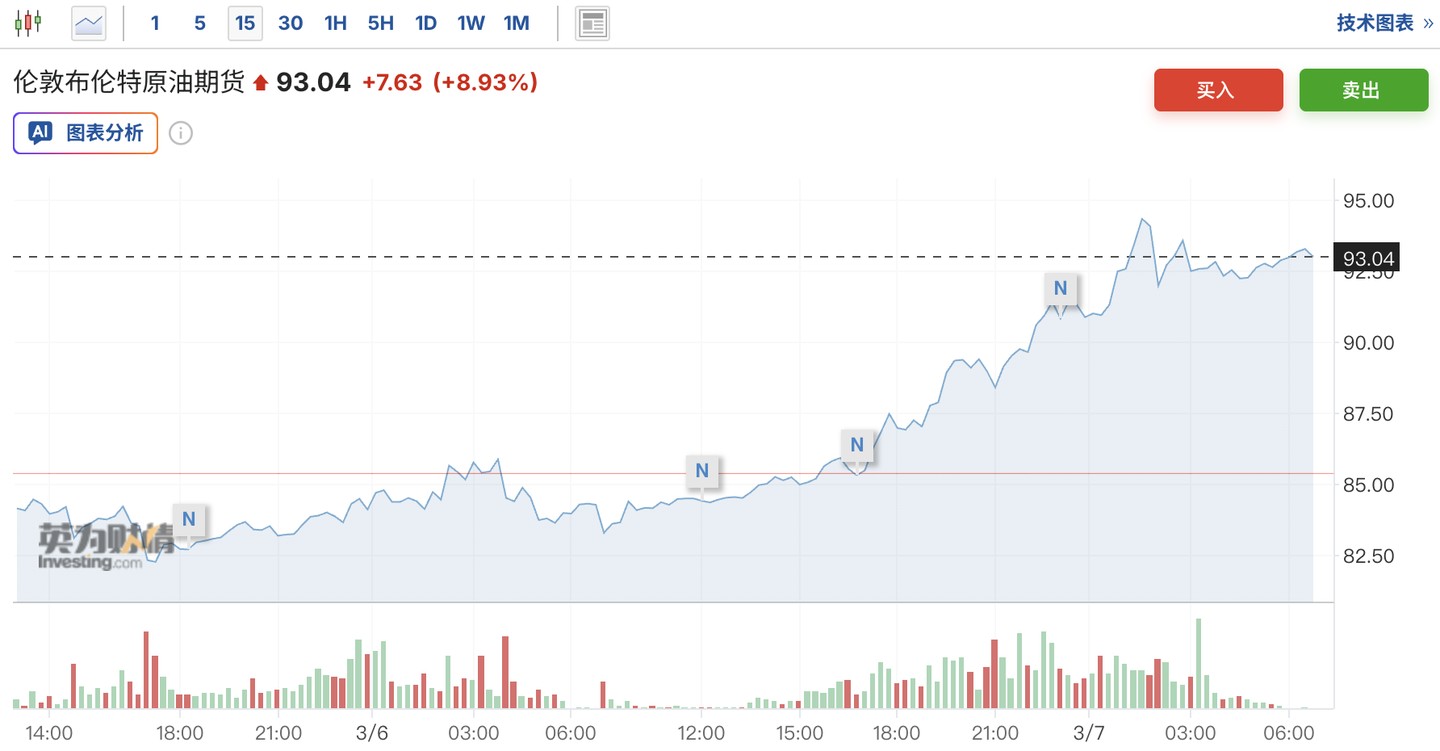
The UAE announced adjustments to offshore production levels to meet storage demands. Kuwait's production cut is expected to expand from 100,000 barrels per day on Saturday to 300,000 barrels per day on Sunday. The wave of production cuts by Middle Eastern oil-producing countries has pushed Brent crude oil prices to a two-year high, surpassing $93 per barrel. Trump stated on Saturday that oil prices will quickly fall back
The near-blockade of the Strait of Hormuz is triggering a chain reaction of production cuts among Middle Eastern oil-producing countries, putting severe pressure on global energy supplies.
Abu Dhabi National Oil Company (Adnoc) and Kuwait Petroleum Company have successively announced production cuts. The former stated it is "adjusting offshore production levels to meet storage demands," while the latter explicitly attributed the production cut to "Iran's threats to the safe passage of vessels through the Strait of Hormuz."
This wave of production cuts has pushed Brent crude prices to their highest closing price in over two years, surpassing $93 per barrel, leading to rising global inflationary pressures. Wall Street Journal previously published an article mentioning that JP Morgan stated the "shutdown wave" among Middle Eastern oil-producing countries is spreading rapidly, and if a full shutdown occurs, oil prices could soar by $30.
Earlier, Iraq had begun limiting production earlier this week due to storage tanks nearing saturation, Saudi Arabia's largest refinery was shut down after a drone attack, and Qatar's largest liquefied natural gas export facility has also ceased operations. The production cut decisions by the UAE and Kuwait are the latest emergency measures from Middle Eastern oil-producing countries.
Kuwait announces force majeure, with production cuts expected to expand to 300,000 barrels per day
Kuwait Petroleum Company has officially announced force majeure (a legal clause that allows companies to be exempt from fulfilling contractual obligations under uncontrollable circumstances) covering the sale of oil and refined products.
According to Bloomberg citing informed sources, Kuwait's production cuts began earlier on Saturday at a scale of about 100,000 barrels per day and are expected to expand nearly threefold on Sunday, with subsequent cut levels depending on storage levels and the situation in the Strait of Hormuz.
Kuwait's crude oil production in January was about 2.57 million barrels per day. Since the country's export route solely relies on the Strait of Hormuz, if the strait remains blocked, its storage capacity will be exhausted within weeks or even days.
Kuwait had previously taken the lead in reducing the processing load of its refineries, with its Al-Zour, Mina Al-Ahmadi, and Mina Abdullah refineries having a combined daily processing capacity of about 1.4 million barrels, with the Al-Zour refinery being one of the largest oil processing facilities in the Middle East.
UAE announces adjustments to offshore production levels to meet storage demands
As the third-largest oil-producing country in OPEC, the UAE's daily production in January exceeded 3.5 million barrels. Abu Dhabi National Oil Company (Adnoc) announced it is "adjusting offshore production levels to meet storage demands." The UAE has alternative routes to bypass the Strait of Hormuz, but these alternatives cannot fully replace the Strait of Hormuz Adnoc operates a pipeline with a daily delivery capacity of 1.5 million barrels, directly to the Port of Fujairah on the UAE's west coast, which can maintain some exports in case of a blockade in the Strait. Adnoc stated that its onshore operations are currently normal and are leveraging international storage facilities to ensure supply to global markets.
Saudi Arabia, as the largest oil producer in the region, has also rerouted some crude oil to the Port of Yanbu on the Red Sea coast to avoid the risks in the Strait of Hormuz.
Impact of the Hormuz Blockade on the Global Energy Market
The Strait of Hormuz is a vital passage connecting the Persian Gulf to the open sea and is the core channel for global crude oil exports. Due to the conflict in the Middle East and Iran's threats to passing vessels, this waterway has nearly closed, severely obstructing exports from the world's most important oil-producing region.
The closing price of London Brent crude oil futures has risen to $93 per barrel, reaching a new high in over two years, prompting consuming countries to seek alternative supply sources and exacerbating global inflation risks.
Gulf countries such as the UAE and Kuwait have become primary targets for Iranian missiles and drones in this round of conflict. The U.S. Embassy in Kuwait has been attacked, and the U.S. Consulate in Dubai has also been listed as a target, with multiple infrastructures in both countries damaged.
Trump: Oil Prices Will Eventually Fall
U.S. President Trump stated in an interview aboard Air Force One on Saturday when asked if he was concerned about gasoline prices: "Not worried."
Trump expects oil prices to drop significantly after the war ends. He characterized this conflict as "a small-scale operation" and mentioned that it "may last for a while."
"We anticipated that oil prices would rise, and they indeed have," Trump said, "but prices will also come down, and they will come down very quickly."
