


The capital behind Luckin Coffee buying Blue Bottle does not mean the price war is over

Bottom Fishing and Testing
As the price war in China's coffee market continues to spread, a new capital transaction has entered the market's view.
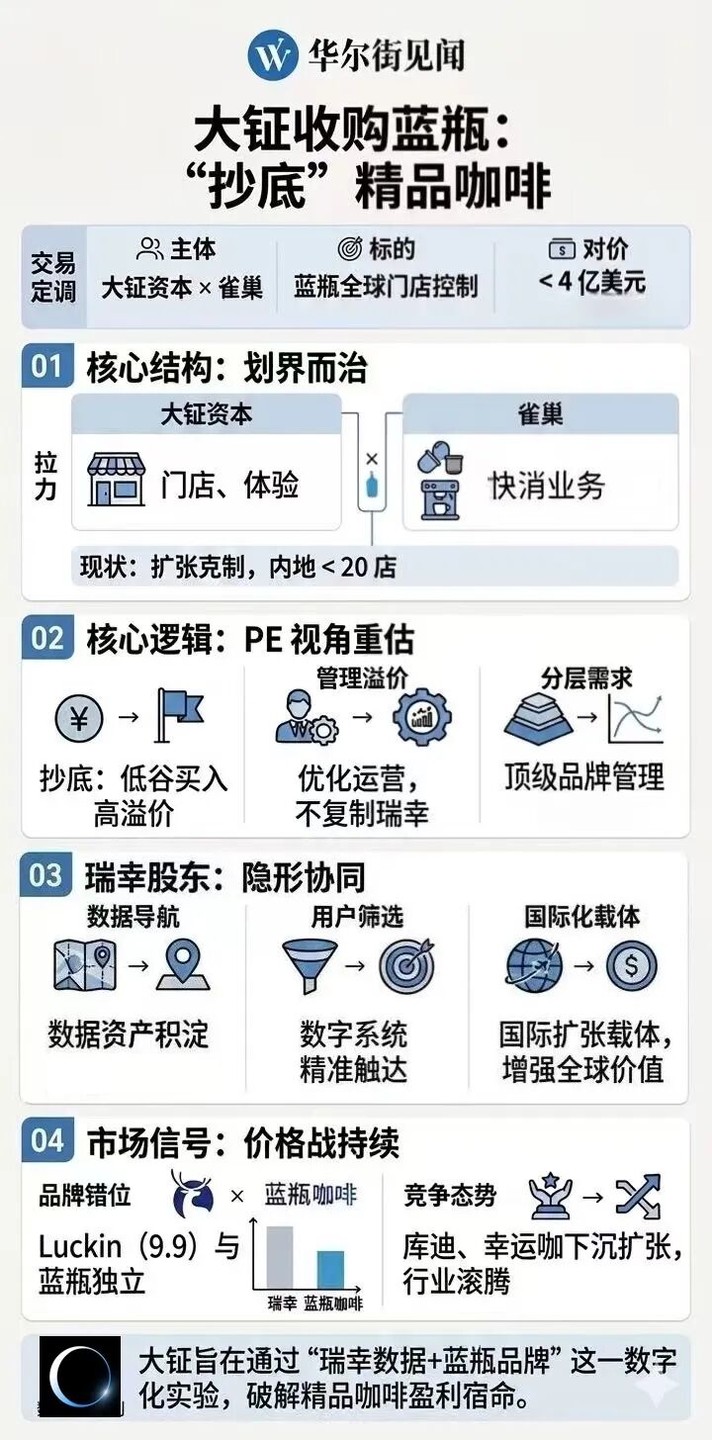
As the major shareholder of Luckin Coffee, Dazhang Capital has reached a deal with Nestlé to acquire all global offline store assets of Blue Bottle Coffee, with the transaction price below $400 million.
According to the business boundaries already defined by both parties: Dazhang Capital will gain complete control over Blue Bottle Coffee's global offline stores, responsible for store operations and brand experience; Nestlé will continue to retain Blue Bottle's fast-moving consumer goods business, including coffee machines, capsules, and other product lines.
A person close to Luckin revealed to All Weather Technology that this transaction is closer to a typical private equity investment logic—buying quality brand assets at relatively low prices and promoting subsequent expansion. However, it cannot be ruled out that, at the appropriate time, some equity shares may be transferred to Luckin.
This acquisition will not affect the independent development of Luckin and Blue Bottle. The two have significant differences in price range, store models, and brand positioning.
Founded in California, Blue Bottle is known for its hand-brewed coffee, specialty coffee beans, and relatively restrained store expansion, regarded by many consumers as a "representative brand of specialty coffee."
In 2017, Nestlé acquired approximately 68% of Blue Bottle for about $425 million, at which time the brand was valued at over $700 million.
Since then, Blue Bottle has gradually entered markets in the United States, Japan, and China, but its expansion speed has remained cautious, entering mainland China only in 2022, with currently less than twenty stores in the country.
If the transaction is ultimately completed, the competitive structure of the Chinese coffee market may introduce a new variable.
Bottom Fishing
Dazhang's move appears more like a typical bottom-fishing of brand assets.
When Nestlé acquired Blue Bottle in 2017, the brand was already valued at over $700 million. If the transaction price is below $400 million, Dazhang's cost for gaining control over global offline stores is equivalent to nearly a 50% discount.
Blue Bottle has yet to achieve stable profitability, and the scaled expansion of specialty coffee stores has always been considered a challenge in the industry. Against this backdrop, Nestlé's choice to sell part of its assets aligns with its global strategy of transitioning to a light-asset model in recent years.
For Nestlé, retaining fast-moving consumer goods such as capsules and coffee machines allows it to continue leveraging Blue Bottle's brand premium; while the heavy asset aspect of store operations is handed over to external capital.
For Dazhang, this transaction resembles a deal to acquire global brand assets at a relatively low price.
Zhao Pengfei, founder of Chengchi Capital, told All Weather Technology that domestic top-tier specialty coffee brands represent the current high-end standard of the market. The consumer market inherently has a layered structure, and this price range is not lacking in demand support.
Zhao Pengfei added: "The slow development of specialty coffee in China over the past few years is not entirely a demand issue, but more about expansion and management methods."
Yang Shun, general manager of Gaoyan Technology, stated that Luckin's success mainly comes from the efficient operation of its management team after the crisis, rather than purely from capital-driven efforts "Therefore, it is highly likely that Dazheng will still operate Blue Bottle from a capital perspective, looking for a suitable management team to take the helm, rather than directly copying Luckin's model," Yang Shun believes.
However, the data and supply chain capabilities accumulated by Luckin over the past few years may still bring certain synergies to Blue Bottle.
Coco, an operational mentor of the Chinese coffee training system, believes that Luckin's recent launch of SOE coffee, expansion of large store models, and increase in specialty products are essentially screening for consumers with the potential for premium coffee consumption within its vast user pool.
"If Blue Bottle enters a certain city, Luckin's data system can quickly identify users within a 3-kilometer radius who frequently purchase SOE, have low price sensitivity, and enjoy trying new brands, allowing for precise outreach for brand education or experience invitations," Coco said.
This data capability may become a new variable for the expansion of premium coffee in China.
From an industry scale perspective, Blue Bottle currently has only a dozen stores in China, making it difficult to change the overall competitive landscape of freshly brewed coffee in the short term.
Scheme
In this acquisition, although Luckin did not directly intervene, it is an undeniable key player.
In recent years, Luckin has rapidly expanded the coffee consumer base through a high-density store network, digital operation enhancement, and platform subsidy strategies, transforming coffee from a relatively high-end beverage into a more everyday consumption choice.
However, after reaching a store count of 30,000, Luckin began to face new growth challenges.
Coco told All Weather Technology that the per capita coffee consumption in China was about 17 cups in 2023, expected to rise to 22.4 cups in 2024, and around 25 cups in 2025. "But the growth rate of per capita cup volume in 2025 may be the slowest in the past decade."
Each coffee user nationwide only drank less than 3 more cups over the year, and this increase also includes some instant and drip coffee products, not all from freshly brewed.
In the context of continuous store expansion, the slowdown in consumption growth also means that the growth space for individual stores is being diluted.
In the recently concluded fourth quarter of 2025, Luckin's profits were significantly eroded by delivery costs and price wars, with same-store growth shrinking to 1.2% year-on-year.
In Coco's view, Luckin has perfected digital site selection, automatic roasting, and algorithmic promotions. However, when the overall industry growth slows down, even the most efficient cost control cannot fully offset the pressures brought by declining consumption frequency and price competition.
More importantly, Luckin has already established a clear price anchor in consumers' minds.
The 9.9 yuan coffee helped Luckin rapidly expand its market, but it also somewhat locked in its brand price range.
If the coffee industry continues to maintain low-price competition in the coming years, while more and more tea brands enter the coffee arena, Luckin's growth space within the existing price range will be further limited.
In this case, introducing a more premium brand becomes a way for Luckin to expand its potential pricing system.
A person close to Luckin revealed that Dazheng Capital is likely to promote Blue Bottle's expansion in the Chinese market in the future and may transfer some equity to the underlying LPs at the appropriate time, and it does not rule out transferring some to Luckin, but initially, it will not promote the restructuring of the two brands. If Blue Bottle's operating data shows significant improvement in the future, it will not only reaffirm Da Cheng Capital's capability to operate high-end coffee brands but may also provide a more recognizable brand vehicle for Luckin's future internationalization, thereby enhancing the company's overall valuation space in the capital market.
Behind this, the relationship between Da Cheng Capital and Luckin is particularly crucial.
In 2018, Da Cheng Capital entered Luckin as an early investor. After the financial fraud incident in 2020, Da Cheng led the company's restructuring and became the actual controller of the company.
In May 2025, Da Cheng's founder, Li Hui, personally took on the role of chairman of Luckin, further strengthening the binding between the two parties.
Currently, Da Cheng Capital and Li Hui collectively hold 23.28% of Luckin Coffee's shares and control 53.6% of the voting rights.
However, even with the support of capital and operational systems, the expansion of specialty coffee in the Chinese market still faces objective difficulties.
Yang Shun pointed out that in recent years, when Chinese capital acquired regional franchises of Starbucks, McDonald's, or Burger King, it was often under the premise that the brand had already formed a stable profit model, enhancing returns through efficiency optimization and scale expansion.
In his view, Blue Bottle has not yet proven that its store model can achieve stable profitability, and therefore does not belong to this "efficiency-driven" expansion model.
"Blindly expanding stores without a fully validated single-store profit model is risky," Yang Shun said. "The key to Blue Bottle's development lies not in efficiency, but in brand, location, design, and operational capability."
Even if Blue Bottle completes its renewal with the support of Da Cheng Capital, it is difficult to interpret this as a signal that the "price war" in the Chinese coffee market is about to end.
In Zhao Pengfei's view, price declines will inevitably lead to an expansion of the consumer base, and this process is still in its early stages. Last year, brands like Lucky Coffee and Kudi Coffee were still opening stores on a large scale, indicating that the market space remains broad and the competitive landscape of the industry is far from settled.
"From both market space and industry actions, there is no support for the judgment that 'the competition has reached its peak,'" Zhao Pengfei said
