


U.S. oil hits the largest increase in nearly six years, Trump says he is not worried, but senior officials say the U.S. government is exploring options to suppress prices

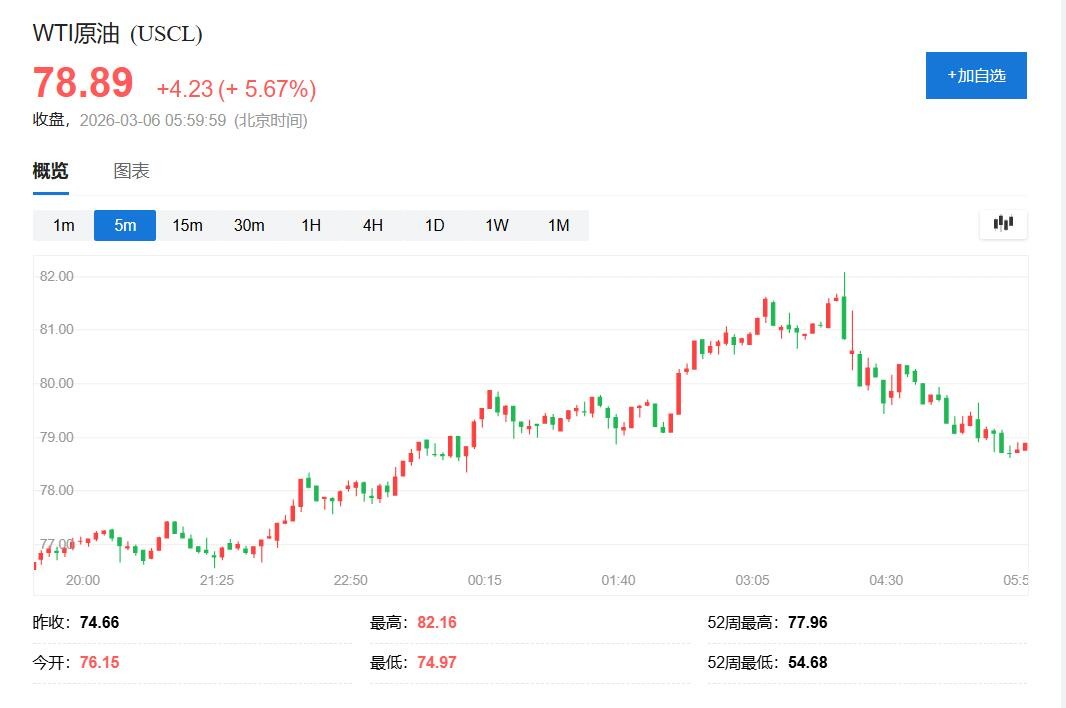
The escalation of the conflict in the Middle East has led to the largest single-day closing increase in U.S. benchmark crude oil futures in nearly six years, with WTI crude reaching as high as $82 and closing at $81.01. Trump stated that he is not worried about rising oil prices and said he would take measures to alleviate pressure on oil prices. Interior Secretary Burghum confirmed that the government is evaluating various options to lower prices, including tapping into the Strategic Petroleum Reserve and providing insurance for oil tankers
The escalation of conflict in the Middle East has triggered supply shocks that have alarmed the market. U.S. benchmark crude oil futures surged sharply on Thursday, marking the largest single-day closing increase in nearly six years. In response to the threat posed by rapidly rising oil prices to inflation and the economy, the Trump administration is urgently assessing all possible price-reduction tools.
On Thursday, March 5, during the midday trading session of U.S. stocks, WTI April crude futures briefly rose above $82, increasing by about 10% during the day and closing up 8.5%, the largest increase since 2020, at $81.01 per barrel. The international oil benchmark Brent crude for May delivery closed up 4.93% at $85.41 per barrel, with both U.S. and Brent oil reaching new closing highs since July 2024.
The average retail gasoline price in the U.S. jumped about 27 cents from last week to $3.25 per gallon. Facing political pressure from soaring gasoline prices, President Trump stated on Thursday that he is not worried about domestic oil price increases due to the escalation of the conflict with Iran, saying, "Actions to further reduce oil price pressure are coming soon."
Trump emphasized in a media interview that U.S. military action is his top priority. When asked about rising oil prices, he said, "I am not worried about it at all. Once the action is over, oil prices will drop quickly; if oil prices go up, then so be it. But this military action is far more important than a slight increase in oil prices."
U.S. Interior Secretary Bernhardt later confirmed that the Trump administration is weighing a range of response options, stating, "All options are on the table," including measures that could have immediate effects as well as more complex long-term solutions. Following this news, crude oil futures retraced some of their gains in after-hours trading on Thursday.
Trump Administration Urgently Evaluates Price-Reduction Options
According to reports, U.S. Interior Secretary Bernhardt stated in an interview on Thursday that Trump convened Bernhardt and other senior advisors on Tuesday to discuss a range of response options, subsequently announcing plans to provide insurance for tankers passing through the Strait of Hormuz and U.S. Navy escorts if necessary.
Options currently being considered by the Trump administration include: utilizing the Strategic Petroleum Reserve (SPR) and possibly coordinating with other countries to maximize effectiveness; waiving fuel blending requirements; and direct involvement of the U.S. Treasury in crude oil futures trading—an unprecedented move if implemented.
However, Bernhardt noted that the government has not yet actually utilized the SPR, and the specifics of the tanker insurance plan are still being drafted, with U.S. Treasury Secretary Mnuchin and Energy Secretary Brouillette already involved.
Bernhardt stated, "We as a federal government have the opportunity to intervene and restore some normal order. The U.S. can take certain risks to help ensure our allies have adequate supplies, and only we can do this because we have sufficient financial and naval strength."
White House Press Secretary Levitt stated on Wednesday that the U.S. government currently has no timeline for determining when the Strait of Hormuz will be safe for commercial shipping again. She said, "I don't want to commit to a timeline, but this is indeed something that the Department of Defense and the Department of Energy are actively assessing."
Escalation of Conflict in Iran: The Strait of Hormuz Effectively Closed
The direct trigger for the surge in oil prices is the ongoing escalation of the U.S.-Iran conflict. Since last Saturday, when the U.S. and Israel launched military strikes against Iran, U.S. oil has seen an increase of nearly 21% in closing prices by Thursday of this week.
According to CCTV News, on the night of March 2nd, a senior advisor to the commander of the Islamic Revolutionary Guard Corps of Iran stated that the Strait of Hormuz has been closed, and Iran will strike all vessels attempting to pass through the strait. Subsequently, the deputy commander of the naval forces of the Islamic Revolutionary Guard Corps, Mohammad Akbarzadeh, stated that the Strait of Hormuz is completely under the control of the Iranian navy, with more than a dozen oil tankers hit by shells in the strait.
Additionally, CCTV reported that on Thursday morning, the Revolutionary Guard stated that a U.S. oil tanker was hit by a missile fired by its navy in the northern Persian Gulf early that day.
The Royal Navy of the United Kingdom reported on Thursday that a large explosion occurred near an anchored oil tanker in Iraqi territorial waters, with a small vessel quickly leaving the scene. Arab countries in the Middle East and Israel continue to intercept Iranian missiles and drones, Qatar has advised residents to stay indoors, and Kuwait has reduced processing loads at three refineries.
Media vessel tracking data shows that transit traffic through the Strait of Hormuz has plummeted by over 95%, with major oil tankers and LNG carriers avoiding the route, and the few vessels still operating have turned off their position transponders.
According to the International Energy Agency (IEA), approximately 15 million barrels of crude oil and 5 million barrels of refined oil are transported through the Strait of Hormuz daily in 2025. The IEA states that the volume of crude oil exported through the Strait of Hormuz is substantial, and with limited alternative routes, any disruption in transportation through the Strait will have a significant impact.
According to CCTV, on Thursday morning local time, Amir Haidari, the deputy commander of Iran's Khatam al-Anbia Central Command, stated in an interview that Iran has not blocked the Strait of Hormuz.
Media reports indicate that although Iranian military officials claim they do not intend to close the shipping lanes of the Strait of Hormuz, in reality, very few shipowners are willing to transit, and some upstream oil producers have been forced to begin production cuts.
Wall Street: Increased Risk of Stagflation, Federal Reserve in a Dilemma
The surge in oil prices has triggered dual concerns in the market regarding inflation and economic slowdown. On Thursday, all three major U.S. stock indices closed lower, failing to maintain the rebound momentum from Wednesday, with the Dow Jones falling over 1% to lead the decline, and the small-cap Russell 2000 index dropping nearly 2%. The airline, banking, industrial, and logistics sectors saw the largest declines, with the U.S. Global Jets ETF dropping about 4.5% in one day. The energy sector, driven by the rise in crude oil prices, rose nearly 0.6%, making it one of the only two sectors in the S&P 500 to close higher that day.
Kevin Khang, a senior global economist at Vanguard Group, stated: "From a market psychology perspective, the longer this conflict drags on, the dimmer the prospects for a sustainable resolution become, and the probability of substantial economic shocks continues to rise."
Ed Yardeni, president of Yardeni Research, wrote in a report to clients: "So far, the only hedge against the risk of war has been energy stocks and commodities." He warned that if the Strait of Hormuz remains closed for an extended period, it will "increase the risk of the economy falling into stagflation" and leave the Federal Reserve "handcuffed," as even if the economy weakens, High inflation will also prevent the Federal Reserve from lowering interest rates.
Expectations for interest rate cuts in the derivatives market have quickly adjusted. Earlier this week, traders anticipated two rate cuts from the Federal Reserve this year, but with the surge in oil and gasoline prices, this expectation has significantly narrowed. As of Thursday, the market estimates the probability of two rate cuts occurring this year to be less than 50%.
Commodity analysis firm Ritterbusch and Associates noted in their research report: "There is no conclusion yet on the end of the conflict, and it seems inevitable that oil prices will strengthen further. If the conflict continues into next week, it is not impossible for WTI to rise to the $95 range."
Priyanka Sachdeva, a senior market analyst at Phillip Nova, stated: "If there is even one more successful attack on a tanker or infrastructure, or if there are sustained disruptions, oil prices could surge again."
Risk Warning and Disclaimer
The market carries risks, and investment should be approached with caution. This article does not constitute personal investment advice and does not take into account the specific investment goals, financial situation, or needs of individual users. Users should consider whether any opinions, views, or conclusions in this article align with their specific circumstances. Investment based on this is at one's own risk
