


February PMI: "Temperature Difference" Signal

In February, the manufacturing PMI experienced a seasonal decline of 0.3 percentage points, lower than the fluctuations under the Spring Festival effect, indicating an improvement in manufacturing sentiment. After excluding the Spring Festival impact, the month-on-month growth rate of PMI is approximately 0.48 percentage points, performing better than in previous years. Although the new orders and production indices have decreased, the decline is smaller than seasonal fluctuations. Price indicators are mixed, with raw material purchase prices falling and factory prices remaining stable, indicating stable bargaining power for mid- and downstream enterprises. Export orders are under pressure, with the PMI new export orders index dropping to 45.0%
2 February Manufacturing PMI Seasonal Decline is Not Surprising — The late timing of the Spring Festival has caused significant disturbances in February's manufacturing sector, as historical patterns suggest. However, the month-on-month decline of 0.3 percentage points is noticeably smaller than the fluctuations typically seen under the "Spring Festival effect." If we exclude the disturbances caused by the Spring Festival, the manufacturing sector's performance is actually showing signs of improvement. Behind this "stability amidst decline" is a hint of warmth in the first year of the 14th Five-Year Plan. At the same time, the divergence in price indicators, the unexpected drop in export orders, and the shifting dynamics between the service and construction sectors collectively outline the "temperature difference" of the economy at the start of the year.
Under the "Spring Festival effect," the February Manufacturing PMI has declined. From historical data, the later the Spring Festival occurs, the greater the decline in February's Manufacturing PMI tends to be. This is primarily because in years when the Spring Festival falls in February, manufacturing production in that month is significantly disrupted. Therefore, given that this year's Spring Festival "landed" in February, the decline in February's PMI is not unexpected.
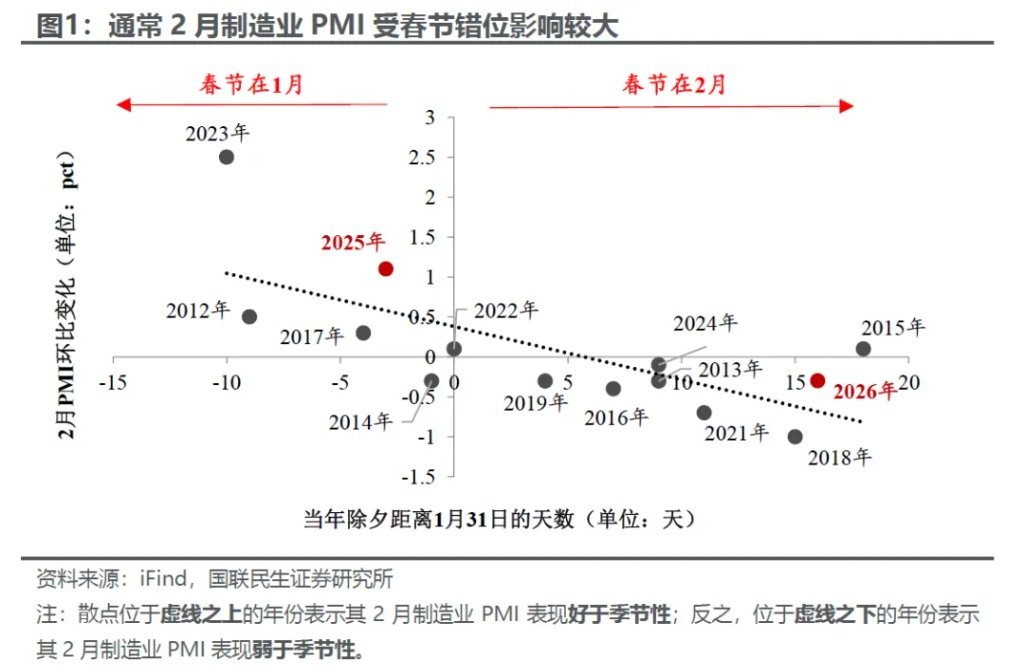
How to interpret the February Manufacturing PMI? Rather than focusing on direction, we should pay attention to magnitude. The month-on-month growth rate of the February PMI is -0.3pct, with its scatter point located above the dashed line in Figure 1, indicating that February's Manufacturing PMI performed better than the seasonal fluctuations caused by the "Spring Festival disturbance." If we exclude the seasonal impact of the Spring Festival, we estimate that the month-on-month growth rate of the February PMI is approximately 0.48pct, corresponding to a value of 49.8%, showing a month-on-month upward trend.
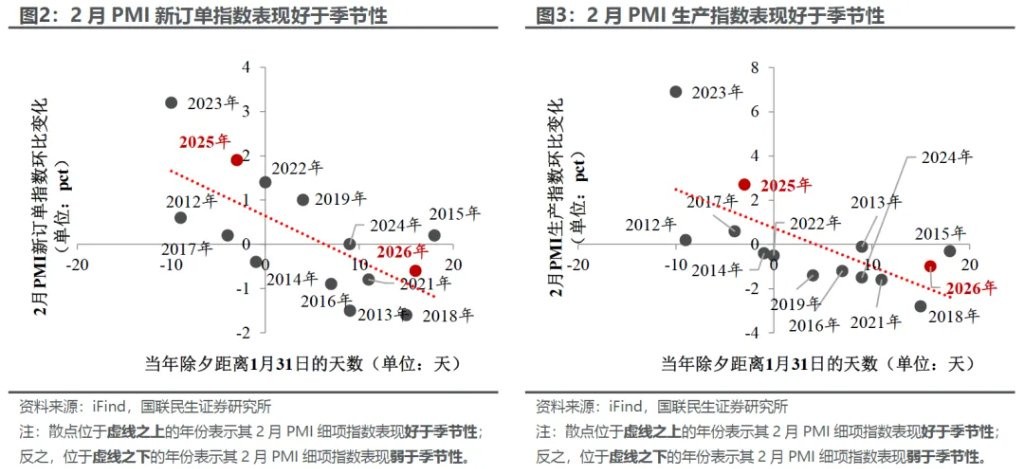
From the detailed data, both supply and demand sides performed better than the disturbances caused by the Spring Festival. The February PMI new orders index and PMI production index recorded 48.6% and 49.6%, respectively, with month-on-month declines of 0.6pct and 1.0pct, but these declines are smaller than the seasonal fluctuations under the Spring Festival effect. This indirectly confirms that the impact of the Spring Festival disturbance on manufacturing operations this year is weaker than in previous years, under the "good start" appeal of the first year of the 14th Five-Year Plan.
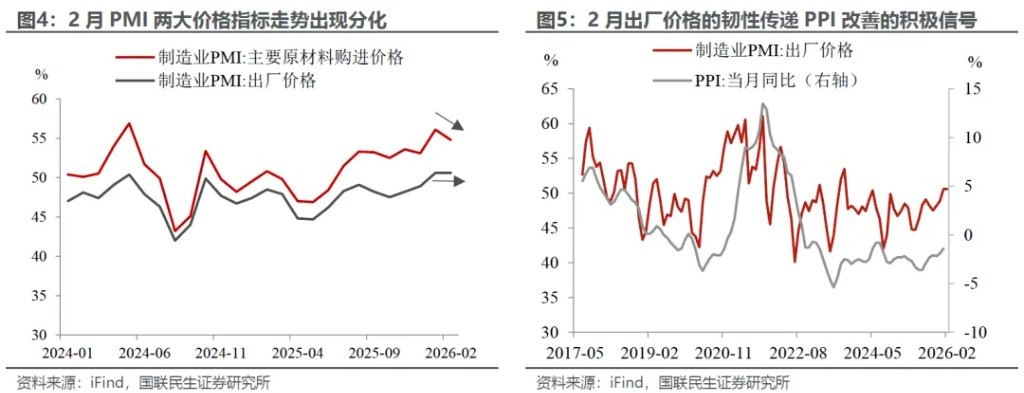
2 February PMI's two major price indicators showed divergence. The February PMI raw material purchase price index fell by 1.3pct month-on-month to 54.8%, mainly due to the initial demand not being fully released after the resumption of work post-holiday. Meanwhile, the PMI factory price index remained stable at 50.6%, reflecting the stabilization of bargaining power among mid- and downstream enterprises, and the resilience of factory prices may provide a positive signal for subsequent improvements in PPI.
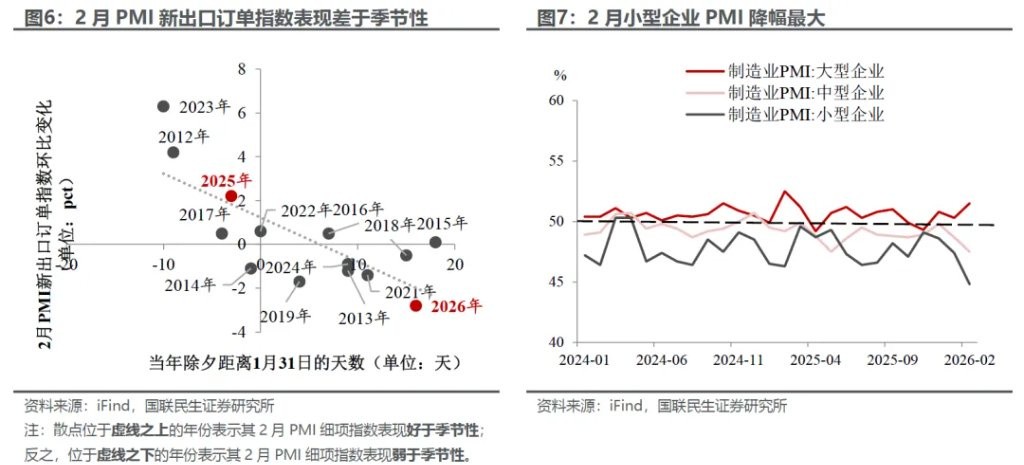
 February PMI data shows certain pressure on the export side. The new export orders index for February PMI decreased by 2.8 percentage points month-on-month to 45.0%, with the decline exceeding what can be explained by the Spring Festival factors. Correspondingly, the PMI for small enterprises, which are more closely related to foreign trade, fell by 2.6 percentage points month-on-month, becoming the category with the largest decline in business sentiment among all types of enterprises. Currently, there is uncertainty in the global demand recovery, and potential risks of weakening external demand need to be monitored.
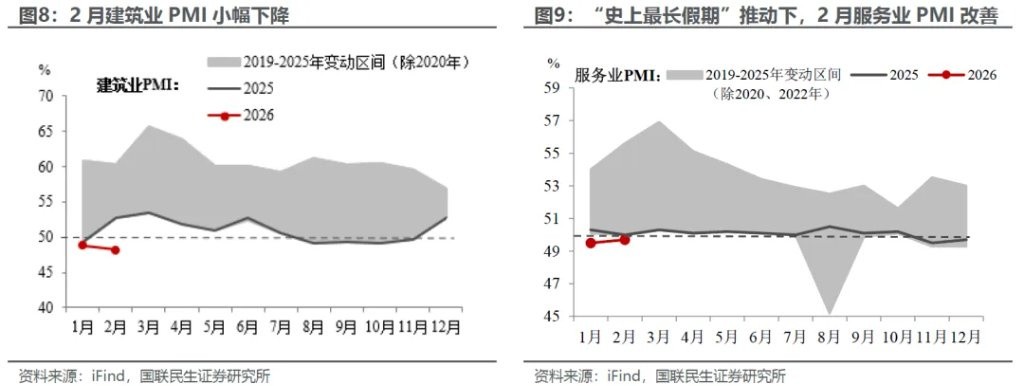
The non-manufacturing sector shows a "rise and fall" differentiation in business sentiment. The construction PMI for February decreased by 0.6 percentage points to 48.2%, mainly affected by the reduction in effective working days during the Spring Festival holiday and project suspensions; in contrast, the service sector PMI rose against the trend by 0.2 percentage points to 49.7%, benefiting from the concentrated release of consumption demand for travel and cultural tourism during the "longest holiday in history" of the Spring Festival.
Risk Warning and Disclaimer
The market has risks, and investment should be cautious. This article does not constitute personal investment advice and does not take into account the specific investment goals, financial conditions, or needs of individual users. Users should consider whether any opinions, views, or conclusions in this article are suitable for their specific circumstances. Investment based on this is at one's own risk
