


The Middle East situation impacts "this year's strongest stock market": South Korean stocks hit the largest single-day drop in 18 months, with Samsung and SK Hynix shares falling about 10%

From "the world's strongest" to intraday circuit breaker, South Korea's stock index Kospi plummeted over 7% in a single day! The conflict between the U.S. and Iran has pushed up oil prices, combined with massive foreign sell-offs of Korean stocks, triggering profit-taking at high levels, with heavyweight stocks like Samsung and SK Hynix suffering heavy losses. Market risk aversion has intensified, the Korean won has weakened, and the shipping, defense, and energy sectors have strengthened
The South Korean stock market rapidly cooled from "the strongest in the world" in just one trading day. Influenced by rising oil prices due to the situation in the Middle East and a decline in global risk appetite, the Kospi index, which had performed well this year, faced concentrated profit-taking, leading to a significant drop in heavyweight stocks.
After a public holiday on Monday, briefly avoiding overseas sell-offs, the South Korean stock market opened sharply lower on Tuesday. The Kospi index fell more than 7% that day, triggering a circuit breaker mechanism, and regulatory authorities temporarily halted program trading.
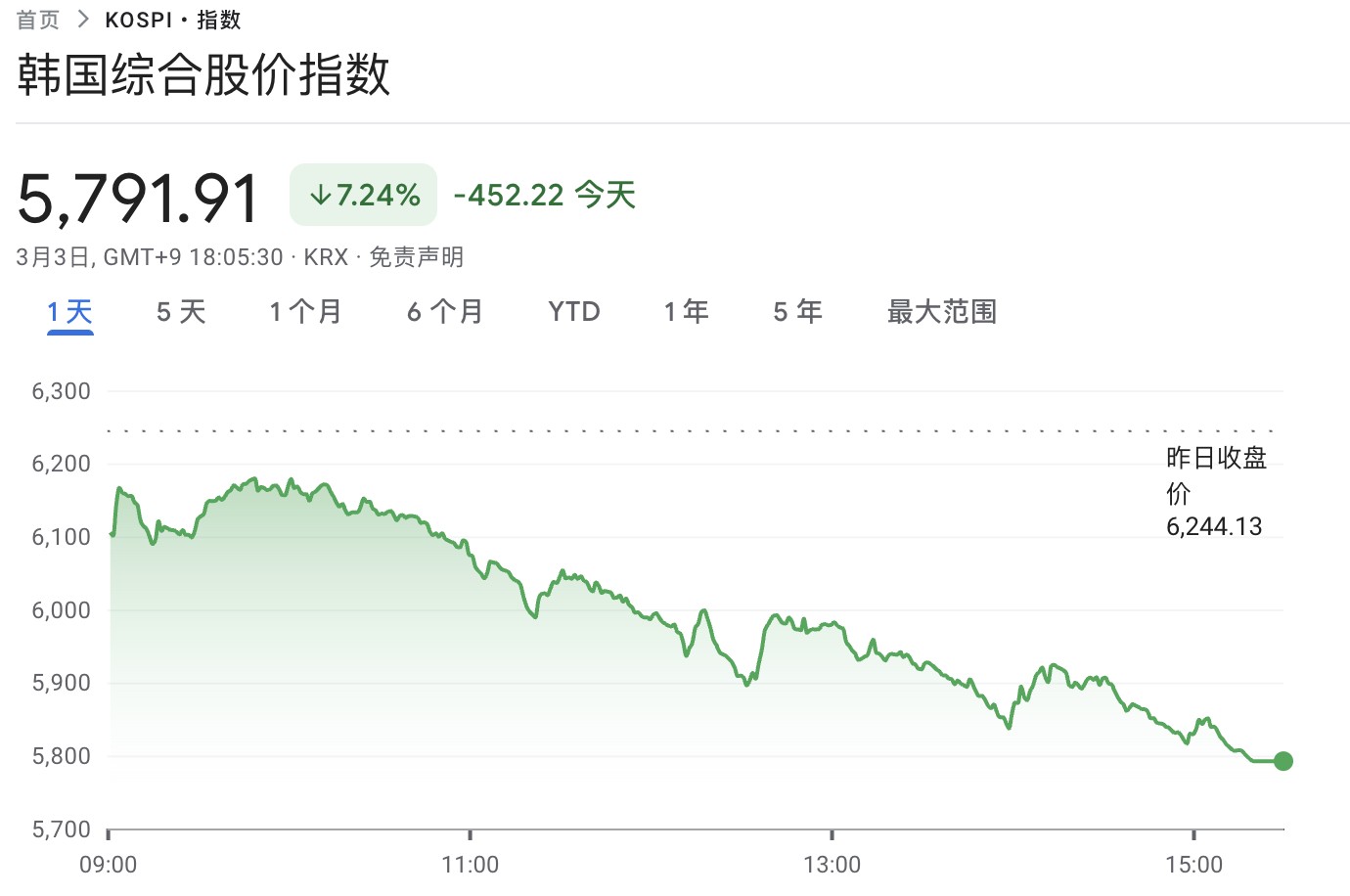
Two major heavyweight stocks became the center of the sell-off. Samsung and SK Hynix saw their stock prices drop by 9.88% and 11.5% respectively, dragging the market down to its largest single-day decline since the sudden unwinding of yen carry trades in August 2024.
Risk aversion was also reflected in the foreign exchange and commodity markets. The Korean won fell 1.34% against the US dollar, which received support from safe-haven buying; meanwhile, oil prices rose after the US and Israel launched strikes against Iran on Saturday, putting direct pressure on South Korea, which heavily relies on Middle Eastern crude oil, and accelerating the market's repricing of the previously overheated situation.
Concentrated profit-taking erupts, annual gains fall from 50% to 37%
This sharp decline occurred after the South Korean stock market had been operating at high levels. As the best-performing stock index globally in 2026, the Kospi's annual gain had reached 50% by the end of February, but after the drop on Tuesday, it has narrowed to 37%.
Even with the sudden drop, the long-term returns of the Korean market remain significant, with a 128% increase over the past 12 months. However, trading activity last week indicated a rise in retail speculative sentiment, laying the groundwork for the concentrated sell-off on Tuesday.
Capital flows show that overseas investors had begun to reduce their exposure before the decline. Data from the Korea Exchange revealed that on the last trading day of February, international investors net sold 7 trillion won (approximately 4.7 billion USD).
On Tuesday, foreign capital continued to act as sellers. According to Bloomberg and Chosun Biz data, international investors net sold another 5.4 trillion won that day, with foreign capital reduction and the rapid pullback of the index reinforcing each other, becoming a significant driver of volatility that day.
Oil prices and the won resonate, South Korea's "Middle East dependence" is repriced
The market decline was not solely driven by internal stock market factors. The weakening of the won reflects an overall increase in risk aversion, with emerging market currencies under pressure and funds shifting towards safe-haven assets like the US dollar.
The rise in oil prices has a more targeted impact on South Korea. Oil prices increased after the US and Israel struck Iran on Saturday, and South Korea is one of the world's largest crude oil importers, requiring about 2.7 million barrels of crude oil daily, with approximately 70% coming from the Middle East.
Amid the broad market decline, some themes related to geopolitical risks were favored in the Korean stock market. Shipping companies like Korea Line and STX Green Logistics, defense stocks like Hanwha Systems and Lig Nex1, as well as energy-related stocks like Daesung Energy saw their prices strengthen This structural differentiation indicates that funds have not directly exited the market, but have quickly shifted to trading directions that are more driven by geopolitical events in an environment of rising uncertainty
