


The first AI Spring Festival battle, who won?
Morgan Stanley estimates that the total promotional expenditure across platforms is likely to exceed 8 billion yuan. Doubao stands out with its top traffic entry from the CCTV Spring Festival Gala and relatively balanced three-dimensional performance; Tongyi Qianwen has achieved an impressive order scale through deep integration within the Alibaba ecosystem, but the quality of user participation needs improvement
Burning 8 billion is a virtual fire of traffic or real gold, Morgan Stanley's latest research report deeply reviews the AI application battle during the 2026 Spring Festival.
According to Hard AI, the 2026 Spring Festival will witness the first large-scale subsidy-driven user competition in the consumer-grade AI sector in China. The four giants Alibaba (Tongyi Qwen/Qwen), ByteDance (Doubao), Tencent (Yuanbao), and Baidu (Wenxin/Ernie) collectively entered the fray, spending money to grab users through cash red envelopes, consumption vouchers, and naming rights for the Spring Festival Gala. Morgan Stanley estimates that the total promotional expenditure across platforms is likely to exceed 8 billion yuan, covering multiple dimensions such as cash red envelopes, per-order subsidies, ecological traffic introduction, and media exposure.
However, after the traffic feast, the quality of each company's performance varies significantly. Based on Questmobile data, Morgan Stanley systematically evaluated each platform from three dimensions: traffic scale, user participation, and post-activity retention. The conclusion is clear and harsh: while short-term DAU explosions are shared by all, only Doubao and Tongyi Qwen can truly retain users; the key to long-term victory lies in product practicality, ecological integration capability, and the creation of real value beyond monetary incentives.
Morgan Stanley believes that this Spring Festival battle is essentially a "super entrance" positioning war. Whoever can maintain their user base after the subsidy tide recedes will gain an advantage in the next stage of AI commercialization competition. From the current data, ByteDance's Doubao and Alibaba's Tongyi Qwen perform relatively well, while Tencent's Yuanbao retention performance is concerning, and Baidu is almost absent from this battle.
Scale of Spending: Alibaba is the most aggressive, total expenditure exceeds 8 billion
The investment intensity of each platform varies significantly:
-
Alibaba (Tongyi Qwen): Officially announced a "3 billion yuan Spring Festival invitation plan," centered around 25 yuan no-threshold consumption vouchers, covering scenarios such as takeout, instant retail, movie tickets, air tickets, and hotels, deeply integrating Taobao, Hema, Tmall Supermarket, Fliggy, Damai, Alipay, and other ecosystems. The validity period of the vouchers has been extended multiple times (from February 23 to February 28, and then to March 3). Morgan Stanley estimates that the actual expenditure is likely to exceed 5 billion yuan (approximately 200 million orders × 25 yuan voucher per order = 5 billion, plus other brand marketing expenses).
-
ByteDance (Doubao): Deeply tied to the CCTV Spring Festival Gala, gaining significant media exposure; simultaneously launched a cash red envelope lottery activity (from February 13 to 16, with a maximum single red envelope of 8,888 yuan), as well as 100,000 high-value technology prizes (robots, drones, etc.). Morgan Stanley estimates that the total expenditure far exceeds 1.5 billion yuan (the value of the prizes alone is approximately 1.5 billion yuan). During the event, Doubao 2.0 (February 14) and Seedance 2.0 (February 12) were also launched.
-
Tencent (Yuanbao): Invested 1 billion yuan in cash red envelopes (from February 1 to 23), distributed through the Yuanbao App and Yuanbao distribution groups, combined with lottery and task systems (such as AI image generation/creative tasks) to gain additional opportunities. Notably, on February 4, WeChat had blocked the direct link to the Yuanbao red envelope activity, which was later relaunched in the form of "password red envelopes." The marketing focus revolves around the capabilities of the DeepSeek model.
-
Baidu (Wenxin): Invested 500 million yuan in cash red envelopes (from January 26 to March 12), distributed on the Baidu App and Wenxin App, and became the chief AI partner of Beijing Satellite TV's Spring Festival Gala.
Traffic Explosion: Doubao > Tongyi Qianwen > Yuanbao, all three achieved significant DAU increases
The three major players achieved significant stepwise growth in DAU during the Spring Festival, but the absolute scale and growth rates varied:
-
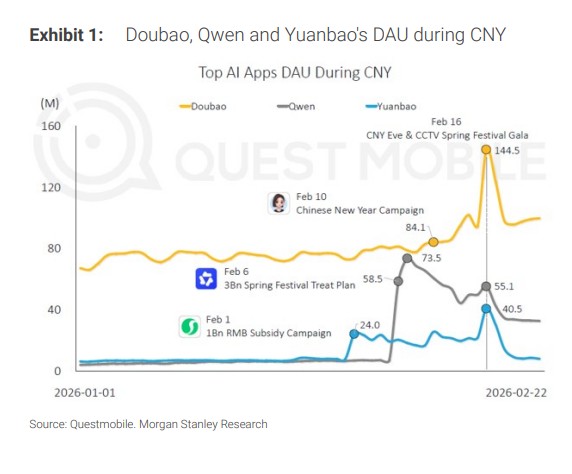
Doubao: The DAU before the event was about 84 million (February 10), peaking at 144.5 million on the eve of the CCTV Spring Festival Gala (February 16), a net increase of about 60.5 million DAU compared to before the event. During the Spring Festival, Doubao's large model reached a peak Token Processing Volume (TPM) of 63.3 billion on February 16, processing over 1.9 billion AI-related queries that night. Weekly Active Users (WAU) peaked at 253 million during the week of February 16 to 22, which is 41% higher than the average of 179 million from the beginning of the year to date.
-
Tongyi Qianwen: From a baseline of about 17 million DAU before the event, it reached a peak of 73.5 million the day after the event started (February 7), a net increase of about 56.5 million DAU. On the first day of the event (February 6), DAU reached 58.5 million, of which 25% (about 14.8 million) were event participants; at peak the next day, 27% (about 19.7 million) were event participants. WAU reached 134 million, 165 million, and 127 million during the three weeks from February 2 to 8, February 9 to 15, and February 16 to 22, respectively (compared to an average of only 17 million from the beginning of the year to date).
-
Yuanbao: From a baseline of 7 million DAU in January 2026, it peaked at 40.5 million on February 16, a net increase of about 33.5 million DAU. As of February 17, the official peak DAU exceeded 50 million, with MAU reaching 114 million. WAU continuously improved from February 2 to 22, peaking at 56 million.
-
Baidu (Wenxin): Performance lagged significantly. Despite promotional activities, the WAU and DAU of the Baidu App have been declining week by week since the beginning of the year. The WAU of the Wenxin App peaked at only 3.4 million during the week of February 9 to 15 (55% higher than the average of 2.2 million from the beginning of the year to date, but decreased by 27% the following week); the peak DAU was 826,000 (32% higher than the average of 627,000, but decreased by 18% the following week).
User Engagement: Doubao > Yuanbao > Tongyi Qianwen, traffic surge accompanied by a sharp drop in average duration
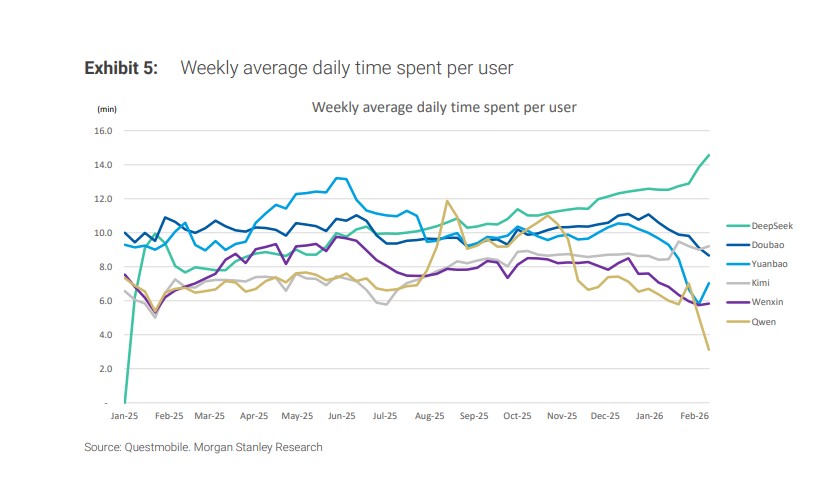
The rapid expansion of traffic is generally accompanied by a compression of per capita usage time, but the extent of compression varies significantly across platforms, reflecting the differences in user quality:
-
Tongyi Qianwen: The average daily usage time per person dropped from 6.3 minutes before the event to 3 to 5 minutes during the peak of the Spring Festival, a decrease of up to 51%. Specifically, the week from February 2 to 8 was 7 minutes, dropping to 5 minutes from February 9 to 15, and further declining to a historical low of 3 minutes from February 16 to 22. This data indicates that the Spring Festival traffic for Tongyi Qianwen was highly concentrated on transactional behavior (placing orders and receiving coupons), with users spending very little time, characteristic of a "transactional, low-duration" usage model.
-
Yuanbao: The average daily usage time per person decreased by about 32% compared to January 2026 levels, with a three-week average of about 6.5 minutes (6.7 minutes, 5.8 minutes, 7.0 minutes respectively), indicating that the average participation of new users is relatively low.
-
Doubao: The average daily usage time per person only saw a moderate decline of about 15%, dropping to 8.7 minutes during the week of February 16 to 22 (previous average was 10.2 minutes), making it the platform with the strongest resilience in user engagement among the three, maintaining relatively robust user stickiness while experiencing significant DAU expansion.
Post-Event Retention: Tongyi Qianwen > Doubao > Yuanbao, the truth emerges after subsidy withdrawal
After February 16, traffic on all platforms showed varying degrees of decline, but the differences in the extent of decline revealed the essential disparities in user retention capabilities across platforms:
-
Yuanbao: The worst retention performance, with DAU quickly falling back to near pre-event levels, making it the platform with the most severe retraction among the three.
-
Doubao: There was a noticeable decline from the peak, but the user base is structurally higher than pre-Spring Festival levels, indicating that a genuine batch of users was indeed retained during the event.
-
Tongyi Qianwen: DAU remains significantly higher than pre-event levels after the event, showing the most impressive performance. However, Morgan Stanley specifically pointed out that this relative resilience is partly due to the extension of the validity period for consumption vouchers until March 3, so the retention data contains a certain degree of "artificial support" that needs to be further observed after the voucher period ends.
Order and Ecosystem Data: Alibaba's AI E-commerce Report Card
The order data for Tongyi Qianwen during the Spring Festival was particularly impressive, fully reflecting the advantages of Alibaba's ecosystem integration:
-
From February 6 to 23, approximately 200 million orders were completed through Tongyi Qianwen (about 120 million orders from February 6 to 12, and about 80 million orders from February 12 to 23);
-
A total of 102 million cups of beverages were ordered through Tongyi Qianwen (55.2 million cups of milk tea, 35.2 million cups of fruit tea, and 11.4 million cups of coffee);
-
The order volume for flight tickets, hotels, and scenic spot tickets increased month-on-month by +540%, +161%, +2429%;
-
Over 4 million users aged 60 and above placed orders through Tongyi Qianwen;
-
Nearly 50% of orders came from users in county and rural areas;
-
As of February 17, over 130 million consumers made their first AI-assisted purchases through the Tongyi Qianwen App.
The Battle for Super Entry Points: The Outcome is Uncertain but the Landscape is Emerging
Morgan Stanley's core judgment is: This Spring Festival battle marks the official start of the competition for China's consumer-grade AI "next super entry point," but a short-term surge in traffic does not equate to a long-term victory.
From a comprehensive assessment across three dimensions:
-
Traffic Scale: Doubao > Tongyi Qianwen > Yuanbao
-
User Engagement: Doubao > Yuanbao > Tongyi Qianwen
-
Post-Event Retention: Tongyi Qianwen > Doubao > Yuanbao
Doubao stands out with its top traffic entry from the CCTV Spring Festival Gala and relatively balanced performance across three dimensions; Tongyi Qianwen achieved an impressive order scale through deep integration within the Alibaba ecosystem, but the quality of user engagement needs improvement; Yuanbao's retention performance is concerning, as the effect of the 1 billion yuan red envelope is more limited to short-term exposure; Baidu has almost fallen behind in this battle, with the data performance of the Wenxin App not on the same level as the other three.
Morgan Stanley emphasizes that the key to long-term success lies in whether users can be retained through product practicality after the event, whether seamless ecological integration can be achieved, and whether real value beyond monetary incentives can be created. For investors, this Spring Festival battle serves as an important window to observe the user acquisition efficiency and retention capabilities of major AI platforms, and the evolution of subsequent data is worth continuous tracking
