


Morgan Stanley's Wilson: Geopolitical shocks cannot stop the bull market; as long as oil prices do not double, the S&P 500 is still expected to rise to 7,800 points

The Iran conflict has triggered a decline in market risk appetite, leading to weaker stocks and stronger gold and oil prices. Morgan Stanley believes that if oil prices do not experience a significant increase of 75% to 100% and maintain that level, and economic growth is in its late stages, the stock market is more likely to experience a temporary pullback rather than a sustained decline. Risk aversion in the market is rising, but U.S. Treasury yields are increasing, and concerns about rising inflation are overshadowing safe-haven buying, reflecting that oil prices are the current core macro variable
The situation in the Middle East has pushed up oil prices and triggered short-term risk aversion in global markets, but Morgan Stanley's chief analyst Mike Wilson believes that such geopolitical shocks typically struggle to drag U.S. stocks into a sustained decline, with the decisive variable still being whether oil prices experience a "historic" and "sustained" surge.
Earlier this week, the conflict between the U.S. and Israel regarding Iran led to a retreat in market risk appetite, weakening stock indices while strengthening gold, oil, and the U.S. dollar. Meanwhile, U.S. Treasury prices fell and yields rose, as the market also assessed the impact of rising oil prices on inflation expectations.
Wilson emphasized that historical data shows geopolitical risk events often do not bring sustained volatility to the stock market, with the S&P 500 averaging gains of about 2%, 6%, and 8% one month, six months, and twelve months after such events, respectively.
Wilson further pointed out that if oil prices do not see a significant year-on-year increase of 75% to 100% and maintain high levels, the logic of a bull market in U.S. stocks remains intact. He maintains a year-end target for the S&P 500 at 7,800 points and stated that if investors remain cautious, his preferred defensive sector is healthcare.
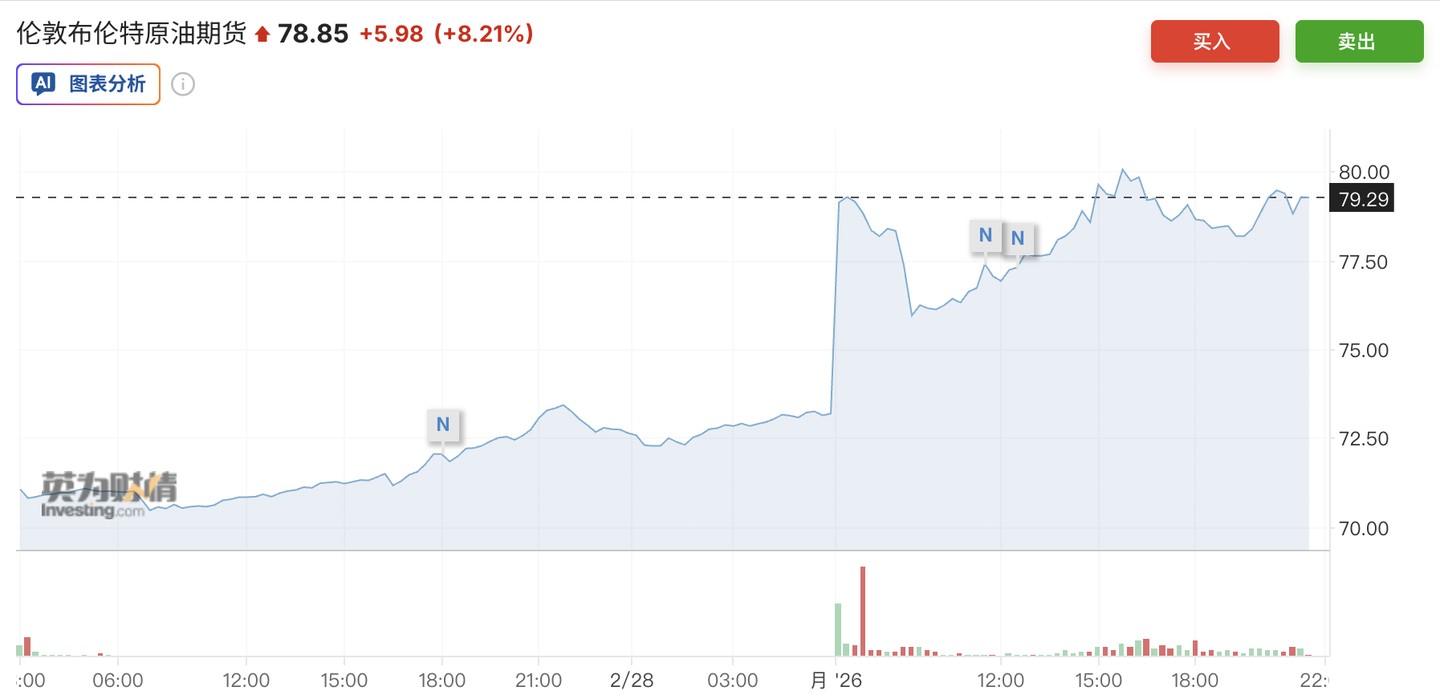
As of the time of writing, Brent crude oil has risen 8.21% to 78.85.
Review: Most stock markets recover faster after geopolitical shocks
In his report, Wilson stated that historical statistics show that geopolitical risk events are more like "short-term sources of volatility" for U.S. stocks, rather than the starting point of a trend-driven bear market. For example, the returns on the S&P 500 after related events are generally positive over one month, six months, and twelve months.
He also noted that the sample that caused the most severe damage to the stock market over a twelve-month period came from the 1973 Yom Kippur War, with the key factor being the subsequent oil supply shock that triggered an economic recession, highlighting the central role of oil prices in transmitting geopolitical shocks to financial markets.
Conditions for triggering a bear market: Oil prices need to "surge and sustain," combined with the later stage of the cycle
In Wilson's view, the "bear market scenario" related to the weekend's events in Iran and the Middle East mainly occurs when oil prices rise significantly and sustainably, thereby threatening the continuity of the business cycle.
He provided a historical experience threshold that requires two conditions to be met simultaneously: first, oil prices must rise by 75% to 100% year-on-year; second, the shock must occur in the later stages of the economic growth cycle. Lacking either of these, geopolitical events are more likely to evolve into a temporary pullback rather than a structural downturn.
Current situation: Oil prices are only about 8% year-on-year, Morgan Stanley maintains a year-end target of 7,800 points
Wilson stated that the current situation does not meet the aforementioned "high-risk combination." He believes we are currently in an "early cycle environment," with profit recovery accelerating.
Currently, the year-on-year change in oil prices remains moderately positive, at about 8%. Therefore, he judges that unless oil prices surge rapidly and maintain high levels, recent events are unlikely to change his bullish outlook on U.S. stocks for the next 6 to 12 months Wilson maintains a target of 7,800 points for the S&P 500 by the end of the year. If investors lean towards defense, he prefers the healthcare sector.
Market Divergence: Energy and Defense Lead, Airline Stocks Under Pressure
The escalation of geopolitical tensions has created a clear sector divergence within the market. Lockheed Martin and RTX saw their stock prices surge, benefiting from expectations that the U.S. military will consume a large amount of munitions and equipment in its strikes against Iran. Software company Palantir was also one of the few tech stocks to record gains in pre-market trading, as it is a major software supplier for the U.S. military.
On the other hand, airline stocks such as United (UAL) and American (AAL) fell, as investors worry that the conflict with Iran will disrupt air travel and drive up fuel costs.
In terms of U.S. Treasury bonds, falling prices pushed the yield on 10-year Treasuries higher, reflecting that market concerns about inflation prospects outweighed safe-haven buying, which itself corroborates Wilson's assessment that oil prices are the current macro core variable. The unexpected production increase decision by OPEC+ is currently viewed by the market as a potential supply-side buffer
