


The epicenter of the "private credit crisis": the once "hottest" company on Wall Street - Blue Owl
The private equity giant Blue Owl Capital, managing $300 billion, has closed fund redemptions, triggering panic on Wall Street. Over-leveraging on software loans has backfired due to AI, and heavy reliance on retail investors has led to fatal asset mismatches and runs. Will this collapse in private credit be the "canary in the coal mine" for the next financial crisis?
A private credit giant managing $307 billion in assets is standing on the edge of a cliff.
Over the past 13 months, Blue Owl Capital's stock price has plummeted by about 50%, with a market value evaporating by nearly $24 billion. Just weeks ago, the company permanently closed the redemption channel for one of its retail debt funds—a decision significant enough to trigger severe turbulence across the entire private credit market. The stock prices of Apollo, Blackstone, Ares, and KKR collectively fell by over 25%. Wall Street is watching the fall of this once "hottest private equity" company with a complex gaze filled with schadenfreude and deep unease.
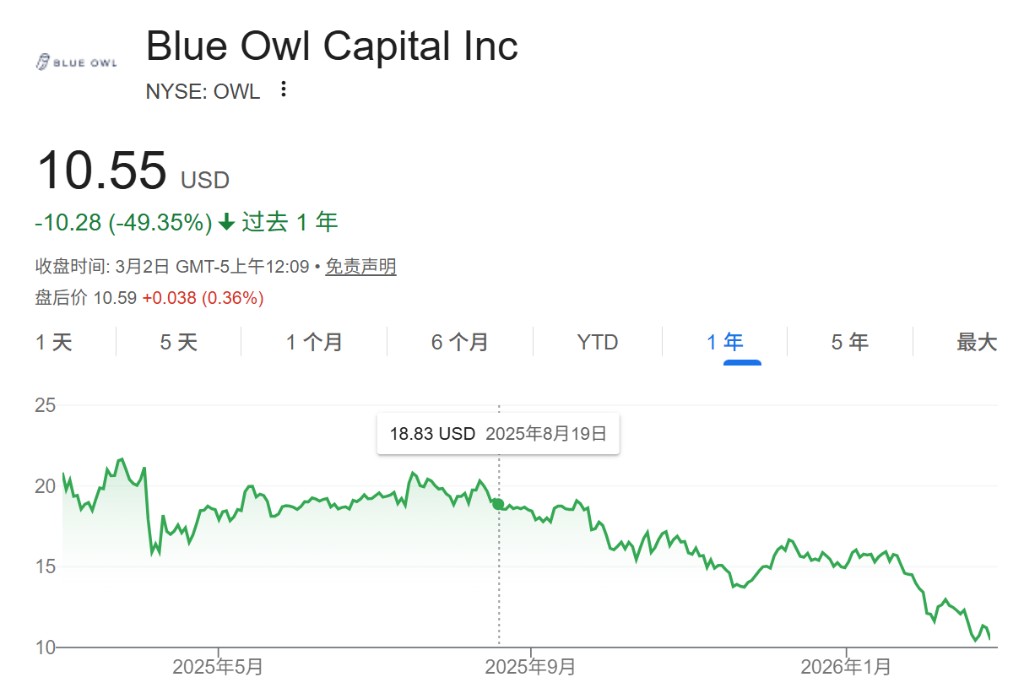
"The alarms we see in private credit are strikingly similar to those in 2007," warned Orlando Gemes, Chief Investment Officer of hedge fund Fourier Asset Management. Former CEO of Pacific Investment Management Company and economist Mohamed El-Erian directly compared Blue Owl's crisis to the "canary in the coal mine" moment before the 2008 financial crisis.
All of this is happening to Doug Ostrover and Marc Lipschultz, two of Wall Street's most seasoned salesmen.
Starting from Scratch, Betting on Private Credit
To understand Blue Owl's rise, one must first understand the backgrounds of its founders.
Ostrover started with junk bond sales and later co-founded the hedge fund GSO Capital Partners, which focused on such debt, selling it to Blackstone Group in 2008. During his time at Blackstone, he was known for his approachability—attending client meetings wearing a Timex Ironman watch and emphasizing humility towards institutional clients like pension funds. However, by 2015, he had come to realize that he would not be taking the helm of GSO.
Meanwhile, Lipschultz faced a career ceiling at KKR. This investment veteran, who started at Goldman Sachs and was known for his networking skills, had early bets on technology, infrastructure, and energy deals within KKR's private equity team but also faced setbacks in several massive transactions, including the leveraged buyout of power producer TXU, which ultimately filed for bankruptcy.
In 2016, the two joined forces with former Goldman Sachs banker Craig Packer, each investing $250 million to establish Owl Rock Capital, focused on direct lending. The family office of George Soros invested $155 million, and Iconiq, which manages the wealth of Mark Zuckerberg and others, co-invested $250 million. Owl Rock focused on providing high-interest loans to companies with below-investment-grade credit ratings, attracting large institutional investors with low fees.
In 2021, Owl Rock merged with Dyal Capital Partners, which specializes in acquiring stakes in investment management companies, leading to the birth of Blue Owl, which went public on the New York Stock Exchange through a SPAC Since then, the company's managed asset scale has expanded from less than $50 billion to over $307 billion, growing more than sixfold.
Empire Map: Betting on Tech Loans and Retail Investors
Blue Owl's rapid expansion is built on two core bets.
First, a deep bet on technology software loans.
Blue Owl positions itself as "one of the largest lenders" to private equity-backed software companies. Its flagship technology fund, Blue Owl Technology Finance (OTIC), concentrates up to 56% of its assets in software and technology service companies, far exceeding the average level of similar funds. Holdings include companies like Anaplan and Zendesk, which were stable cash cows before the AI era, and have been acquired by private equity.
Second, a large-scale expansion into channels for affluent individual investors.
About 40% of Blue Owl's managed assets come from individual investors, significantly higher than most peers.
The company sponsors financial advisor conferences for institutions like Morgan Stanley and UBS, chartering flights to send advisors to Chicago, staying at the Langham Hotel, and dining at Gibsons Steakhouse. Assets surged from $45 billion in 2020 to $307 billion by the end of 2025, with individual wealth channels playing a crucial role.
The personal wealth of the company's executives has also skyrocketed. According to the Bloomberg Billionaires Index, in 2024, Ostrover, Lipschultz, and two other executives had a combined net worth of $7.9 billion. The two used pledged Blue Owl stock (peaking at about $2 billion) as collateral to secure personal loans to purchase the Tampa Bay Lightning and hold minority stakes in the Washington Commanders. Ostrover also acquired approximately $40 million in real estate in Palm Beach, planning to build a mansion.
Cracks Emerge: AI Anxiety and Retail Investor Withdrawals
However, the core selling point that propelled Blue Owl to success has now become its most fatal weakness.
First is the dangerous source of funds. Traditional private credit mostly relies on institutional funds such as pensions or sovereign wealth funds, which are typically locked in for several years. But Blue Owl has taken a different path; of its $307 billion in assets under management, about 40% comes from individual investors, a proportion far exceeding most competitors.
To attract individual investors, Blue Owl employs a "semi-liquid" Business Development Company (BDC) structure, allowing investors to redeem up to 5% of their funds each quarter. Morningstar analysts pointed out that this is precisely the crux of the problem: using short-term funds from individual investors that can be withdrawn at any time to fund long-term loans of three to ten years is a classic case of "asset-liability mismatch."
Secondly, there is an excessive concentration of tech risk. Before the AI explosion, software companies were seen as perfect loan candidates due to their stable cash flows. Blue Owl once prided itself on being "the largest lender" to private equity-backed software companies. However, with the rise of generative AI like ChatGPT, the market has begun to panic—AI could render these traditional software companies obsolete overnight, leading to a collapse in their valuations. **
As of last September, a technology financing fund (OTIC) under Blue Owl concentrated up to 56% of its funds in software and technology service companies. Panic quickly spread among retail investors, and redemption requests came pouring in.
"Show-off" Failure and Permanent Closure
Faced with a surge in redemption requests, Blue Owl could have delayed time by implementing a 5% redemption cap, but management made a clumsy decision.
In order to "show muscle" to the market and prove its ample liquidity, Blue Owl exceptionally paid out up to 15% of redemption requests for the technology fund (OTIC) in full this January. However, this unconventional generosity did not quell the panic; a few days later, concerns about software companies intensified, and Blue Owl's stock price plummeted again.
A bigger bombshell was detonated in another non-listed fund aimed at retail investors, OBDC II.
Blue Owl originally planned to merge this fund with another listed fund, hoping to allow investors to exit through the public market. However, due to deteriorating sentiment in the private credit market, if the merger were forced, old investors would face a paper loss of about 15% to 20%. Under significant client resistance, the merger plan was forced to be canceled.
Subsequently, the run on the fund intensified. Last week, Blue Owl finally could not hold on any longer and announced the permanent closure of the quarterly redemption channel for OBDC II. Instead, the company will sell about one-third of the fund's loans (approximately $6 million) to return 30% of the funds to investors. Some of these loans were sold to Kuvare, an insurance company in which Blue Owl holds shares, and this internal transaction raised concerns among Barclays analysts, who believed it made systemic risks harder to track.
Future in Limbo
Currently, Blue Owl's direct lending business is operating normally, and most borrowers are still repaying on time.
After the stock price fell for 11 consecutive trading days, Lipschultz repeatedly emphasized on a conference call: "We have ample liquidity, and losses are extremely limited; investors are acting out of fear rather than facts." He also posted on LinkedIn to assert that Blue Owl has the ability to identify AI beneficiaries and victims. Ostrover braved a snowstorm to return to the Park Avenue office, hosting a reassuring conference call for thousands of financial advisors, stating, "I have been through many cycles like this."
However, Blue Owl's predicament reflects the deep contradictions within the entire private credit industry.
Morningstar fixed income analyst Brian Moriarty pointedly noted:
Terminating quarterly redemptions and initiating liquidation may always have been within the design scope of this BDC, but it still highlights the potential mismatch between illiquid assets and semi-liquid funds.
This mismatch stems from the inherent paradox of the "democratization" process of private credit—selling an asset class originally exclusive to sovereign wealth funds, pensions, and other long-term institutional capital, packaged as semi-liquid to more ordinary affluent individual investors. The latter are naturally more prone to withdraw during market turmoil than institutional investors. **
Currently, the value of Blue Owl shares pledged by Ostrover and Lipschultz far exceeds the scale of the loans, and a company spokesperson stated that their pledges have "ample over-collateralization," and neither has sold any shares since the company went public.
Oppenheimer analyst Chris Kotowski maintains an "outperform" rating on Blue Owl, believing that concerns about the deterioration of private credit quality are exaggerated. Evercore senior analyst Glenn Schorr is more straightforward:
The core of market anxiety is the fear of impending large-scale losses in private credit. Blue Owl is one of the largest players, which is why all eyes are on them.
Whether the empire can save itself depends on whether Ostrover and Lipschultz can once again demonstrate the skills of Wall Street's top salespeople to convince the market: this is just another cycle they have experienced, not the end of an era
