After the valuation crash of software stocks, is the era of AI "big mergers and acquisitions" coming?

Deutsche Bank's research report points out that by 2025, only 11% of companies will fully implement AI business functions, and most CEOs are under immense pressure to accelerate AI applications, with mergers and acquisitions becoming a core means to catch up. The external transaction scale of global private AI companies has risen to nearly $40 billion per year. Private equity's share in software mergers and acquisitions has increased to 72%, and exit demand will drive more AI assets to change hands
Deutsche Bank believes that most companies' AI implementation progress is currently far behind market expectations, and the volatility of AI-related market capitalization is driving companies to accelerate mergers and acquisitions.
According to news from the trading desk, on February 26, the Deutsche Bank research team published a report indicating that recent stock market fluctuations and the sell-off of AI concept stocks have forced CEOs to expedite the formulation of AI strategies and clearly articulate these strategies to investors.
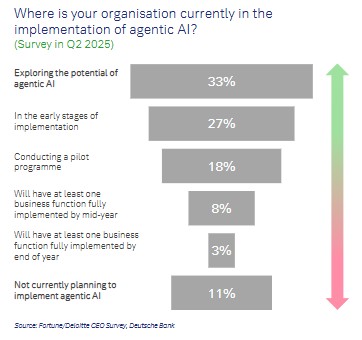
However, by 2025, only 11% of companies are likely to have fully implemented at least one AI-related business function. This means that most CEOs are under immense pressure to accelerate AI applications. In the face of the pressure to implement AI, mergers and acquisitions are becoming a core means for many CEOs to catch up with their peers.
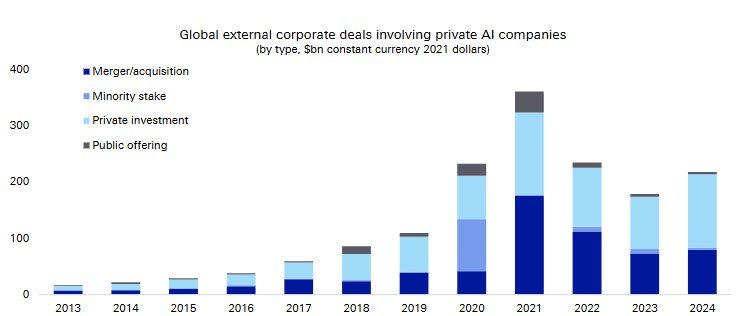
Data shows that the global external transaction scale involving private AI companies (including acquisitions, minority equity investments, private financing, and public offerings) has surged from nearly negligible levels around 2013 to nearly USD 40 billion annually between 2021 and 2024.
(Global external transaction scale involving private AI companies)
The report believes that the historical peak in software sector valuation reassessment, the continued warming of M&A activity in private AI companies, and the increasing differentiation in global M&A rhythms will profoundly impact asset allocation decisions in the next one to two years. Regulatory uncertainties and regional differentiation in the macro interest rate environment will be the biggest variables affecting M&A rhythms and pricing.
Most companies' AI implementation is severely lagging, and CEOs are under great pressure
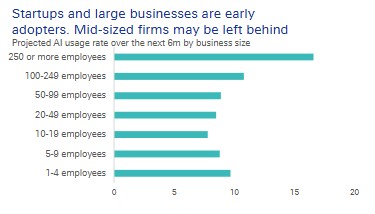
Deutsche Bank points out that the current adoption of AI is not balanced, with startups and large enterprises being the pioneers. The report cites data from a survey conducted in the second quarter of 2025:
Only 8% of companies indicated that they would fully implement at least one AI business function by mid-year;
Only 3% expect to complete it by the end of the year;
11% of companies explicitly stated that they have no plans to implement intelligent agent AI.
The International Monetary Fund (IMF) estimates that about 40% of jobs globally will be affected by AI, especially "cognitive" work. From the analysis of keyword frequency in earnings call meetings of S&P 500 companies:
AI and machine learning continue to top the list of hot topics, with layoffs, chip shortages, and R&D investment also being the fastest-growing topics;
Discussions related to mergers and acquisitions have clearly rebounded after a low point following the tariff shock in spring 2025, and the frequency of mentions has surpassed dividends and buybacks;
The fastest-growing capital allocation theme in the past six months has been capital expenditures and R&D.
(The increase in mentions of specific topics during earnings calls of S&P 500 companies)
From the perspective of individual companies, industry leaders such as Marriott International, Amgen, and S&P Global have clearly expressed a positive strategic attitude towards AI in their earnings reports, viewing it as a net benefit to business rather than a threat.
It is worth noting that medium-sized enterprises with employee counts between 50 and 249 have a significantly lower AI usage rate.

They lack the flexibility and focus of startups, as well as the resources and data scale of giants, making them the most likely to fall behind in the competition. Acquiring ready-made AI capabilities through mergers and acquisitions is a realistic shortcut for them.
Software Valuation Plummets, M&A Window Quietly Opens
Fortunately, the market has provided a window for acquisitions.
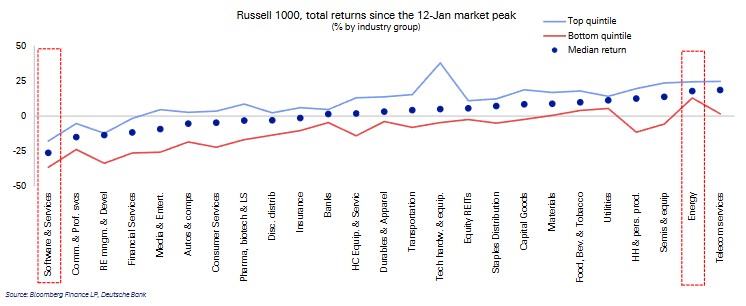
Since the market peaked in mid-January this year, the software and services sector has been the worst-performing industry group in the Russell 1000 index, with a median decline of 25%. Its valuation ranking has dropped from third to ninth.
(Since January 12, the software industry has ranked at the bottom of the Russell 1000 index)
More importantly, when adjusted for growth expectations, the valuations of software companies have become relatively average. In the U.S. market, their price-to-earnings growth ratio ranking has significantly dropped from 7th to 17th, while in Europe it has fallen from 3rd to 15th. The valuation bubble has been significantly squeezed, giving corporate buyers more leverage at the negotiating table.
(In terms of PEG ratio adjusted for growth expectations, the valuation ranking has significantly dropped from 7th to 17th)
Looking at the M&A outlook, the U.S. is expected to remain stagnant, while Europe shows "uneven temperatures." Deutsche Bank's M&A leading indicators show:
U.S.: The momentum of M&A activity in the first quarter may slow down entering the second quarter, due to rising policy uncertainty and mixed signals regarding capital issuance;
(M&A momentum in the second quarter of 2026 may slow down)
Eurozone: Rising sovereign debt yields weigh on M&A prospects, under pressure in the short term;
UK: Benefiting from lower bond yields and strong stock market performance, the pace of M&A recovery is expected to be faster than current market expectations.
(Forecast of M&A transaction volume in the Eurozone and UK over the next 3 months)
So, what kind of AI companies are most likely to be acquired? Deutsche Bank believes that the more specialized the AI company, the greater its attractiveness to industry giants. They need tools that delve into specific verticals and solve concrete problems.
Private Equity Dominates Transactions, But Ultimately Needs Exits
A key market structural change is the surge in the share of financial buyers like private equity in global software M&A transactions.
Data shows that the share of financial buyers such as private equity has jumped from 28% in the 2000s to 72% in the 2020s, while the share of software M&A by non-tech companies has shrunk from 17% to 5%.
(Global software M&A situation categorized by amount and buyer type)
These large private equity transactions ultimately need exits. Selling assets to corporate entities seeking AI capabilities will become one of the key exit paths.
The report cites data showing that from 2022 to 2024, M&A transactions account for an average of 42% of the total external transactions of private AI companies, while IPOs account for only 3%.
Many AI challenger companies are small and continuously losing money, while large incumbents have proprietary data, trust endorsements, and scale advantages, especially in highly complex regulated industries where startups can hardly replicate.
Risks and Historical Reminders
M&A is not a panacea. Integration failures, cultural clashes, core talent loss, and high ongoing investments are all risks.
Deutsche Bank points out that the number of AI-related bills proposed in the U.S. Congress has surged from about 80 in 2022 to over 200 in 2024, increasing regulatory uncertainty.
(Growth in the number of AI-related bills proposed in the U.S. Congress)
History provides a long-term perspective. During the tech boom of the 1990s, the Nasdaq index experienced multiple corrections of over 10%, yet the average annual increase still reached 32%.
The regulatory evolution at that time ultimately reinforced scale effects, leading to market concentration. This time, giants with capital, data, and scale advantages may also occupy a more favorable position in the long AI race The report believes that the uniqueness of the current situation lies in the fact that large technology companies possess exceptionally abundant free cash flow at the rise of the AI wave. They are among the few entities in the world capable of bearing massive AI capital expenditures and withstanding potential losses. The threshold for this competition has been high from the very beginning.
Ultimately, for investors, the AI merger and acquisition cycle is transitioning from the conceptual phase to the substantive implementation stage, and the valuation reset has brought potential strategic buying opportunities. However, regulatory risks, opaque pricing of unlisted targets, and macroeconomic uncertainties remain major constraints. In the medium term, companies capable of actively navigating AI merger and acquisition strategies will gain an advantage in reshaping the competitive landscape

(The increase in mentions of specific topics during earnings calls of S&P 500 companies)
(M&A momentum in the second quarter of 2026 may slow down)
(Forecast of M&A transaction volume in the Eurozone and UK over the next 3 months)