Wealth Management Subsidiary Sample Slicing: The Migration, Compromise, and Breakthrough of Massive Funds

Wallstreetcn
2026.02.26 21:16
portai
I'm PortAI, I can summarize articles.

With the easing of macro liquidity, the decline in deposit rates is reshaping residents' balance sheets, leading to the migration of funds. Bank wealth management subsidiaries have become the main receiving pool for fund inflows, with the wealth management scale of five institutions reaching 3.19 trillion yuan, a year-on-year increase of 24.21%. The proportion of fixed-income products remains high, with the proportion of fixed-income products in the wealth management of Société Générale Agricultural Bank reaching 100%. The industry landscape is undergoing a deep restructuring, forming a new logical closed loop for the sources, destinations, and channels of funds

With the continued easing of macro liquidity, the successive decline in deposit rates is profoundly reshaping the asset-liability balance of domestic residents. Over the past few years, the belief in guaranteed principal and interest has gradually receded with the switching of macro cycles. When the rates on large time deposits cannot even reach certain inflation indicators, massive amounts of capital are forced to seek new habitats.

This wealth migration, referred to as "deposit relocation," constitutes the most core source of incremental growth in the current large asset management industry.

As wealth management hubs emerging from commercial banks, bank wealth management subsidiaries naturally become the first reservoir for this massive overflow of funds.

A look at the latest industry data reveals that the market evolution is more intense than expected. Taking five institutions as samples, a clear progressive main line is emerging—

As of February 26, it has been noted that the wealth management subsidiaries of Pudong Development Bank, Suzhou Bank, Hangzhou Bank, Qingdao Bank, and the joint venture background of Societe Generale Agricultural Bank have announced their product scales for 2025;

The total wealth management scale of these companies has reached 3.19 trillion yuan, a year-on-year increase of 24.21%, with some institutions' scale growth even approaching 40%.

Behind the digital surge, the industry landscape is undergoing deep restructuring.

From the re-evaluation of funding attributes to the enhancement of asset-side efficiency, and the penetration and breakthrough of channels, a logical closed loop centered on "source, destination, and channel" of funds constitutes the real picture of the current wealth management subsidiary market.

Fixed Income "Fundamentals"

Although the A-shares in 2025 have shown a mild "slow bull" market and the bond market is experiencing cyclical fluctuations, the product structure of the sample institutions still shows an overwhelming absolute advantage in fixed income products.

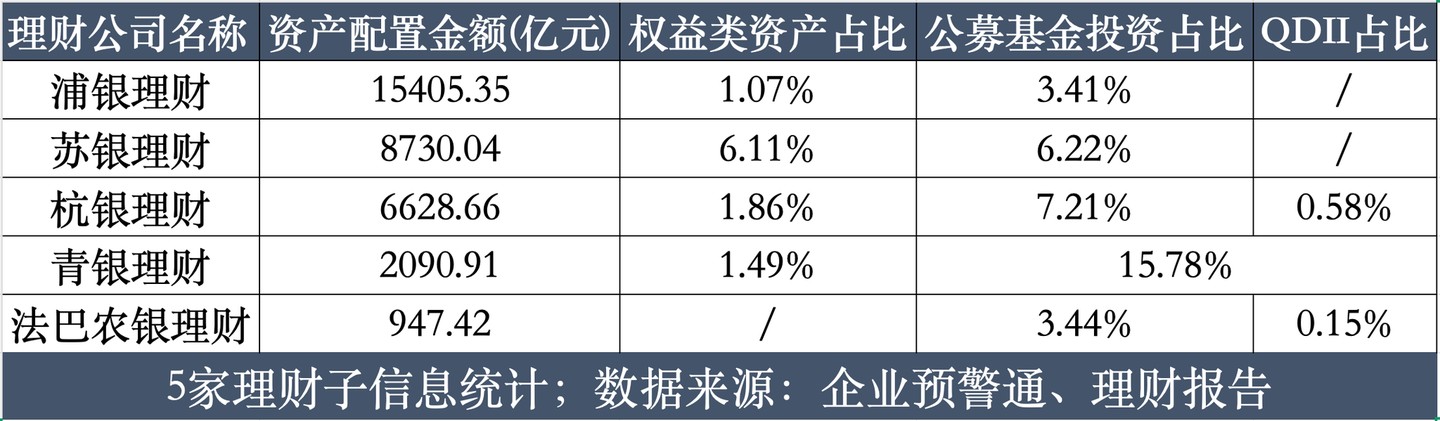
It has been noted that among the aforementioned wealth management subsidiaries, the proportion of fixed income products in Societe Generale Agricultural Bank's wealth management reaches 100%, Qingdao Bank's fixed income accounts for 99.98%, Pudong Development Bank's proportion is 99.91%, and Hangzhou Bank also maintains a high level of 99.22%; on the asset side, the proportion of equity assets in Pudong Development Bank, Suzhou Bank, and Qingdao Bank has slightly declined.

Data from Zhongtai Securities' research report also confirms this trend.

The brokerage report points out that in the investment asset structure of wealth management products, due to the decline in the proportion of bond assets, by the end of 2025, the proportion of bonds, interbank certificates of deposit, and non-standardized debt assets decreased by 3.71 percentage points to 57.03%;

However, at the same time, the proportion of equity assets only decreased by 0.68 percentage points to 1.90% compared to the beginning of the year.

In the context of the stock market having a profit-making effect, why has capital not flowed into equity investments?

A financial consulting agency representative analyzed for us that this is because the clientele faced by bank wealth management has a very low risk appetite, "Clients cannot tolerate high volatility and high drawdowns. Although it is a bull market, they find it very difficult to bear the risks of increasing equity exposure." The individual stated that this choice is not uncommon in the prudent operation of financial institutions.

"It can be compared to the use of OCI (Other Comprehensive Income) by brokerages," the individual said. "Brokerages that perform well in proprietary trading will not use OCI extensively in a slow bull market as they did in the past two years, but will actively seize opportunities; however, some average-level brokerages will still increase their allocation to OCI during a bull market, which is entirely based on considerations of prudent operation."

In addition to proactive defense, another strategy of wealth management subsidiaries is hidden beneath the surface of the data.

An interviewed public fund individual stated, "Wealth management subsidiaries may also increase equity asset positions by allocating public funds, but this is not reflected in the direct investment category on the balance sheet."

"Bank wealth management is indeed shrinking direct stock investments on a large scale," the individual pointed out. "Under the current standards, only direct stock investments and investments in pure stock funds count as increasing equity assets. Secondary bond funds and primary bond funds essentially still belong to fixed income assets. It is equivalent to them achieving an increase in equity asset positions covertly through public fund investments."

However, regardless of the path taken, prudence remains the unshakable main theme of bank wealth management subsidiaries.

The uniform "99% pure fixed income" formation may also aim to accurately absorb massive incremental funds.

Huatai Securities Research Institute estimates that the scale of one-year and above time deposits maturing in 2026 will be about 50 trillion yuan, an increase of 10 trillion yuan compared to 2025, with the largest downward adjustment in renewal rates for two-year and three-year time deposits, resulting in the strongest "moving house" effect.

Data from Tianfeng Securities indicates that among the 180 trillion yuan in national time deposits, the scale maturing in 2026 is approximately between 107 trillion and 114 trillion yuan.

At this stage, the influx of incremental funds into wealth management subsidiaries mostly comes from the overflow of on-balance-sheet savings. The core demand of this customer group is not to seek capital gains but to find a stable "savings alternative."

After experiencing fluctuations in the bond market and a wave of wealth management products breaking the net value, investors have become unprecedentedly sensitive to net value drawdowns, forcing wealth management subsidiaries to reassess the constraints on the liability side.

In the reality of an overall "asset shortage," high-yield quality assets are becoming increasingly scarce. Since funds are seeking certainty, wealth management subsidiaries must unreservedly tilt resources toward low-volatility assets. Even if it means sacrificing some yield flexibility, they must create a thick interest rate safety cushion to smooth out net value.

Stabilizing absolute returns remains the most core survival rule at this stage.

Leveraging Public Funds

In terms of specific asset selection, a clear trend is that wealth management subsidiaries are significantly increasing their allocation to public funds.

The data is the most direct reflection.

In 2025, the allocation of public funds by SuYin Wealth Management rose from 0.5% to 6.22%, HangYin Wealth Management increased from 4.28% to 7.21%, PuYin Wealth Management rose from 0.64% to 3.41%, and FaBa Agricultural Bank Wealth Management expanded from 0.27% to 3.44%, while QingYin Wealth Management has maintained a high level of 15.78% for a long time.

In the current context of asset scarcity, leveraging public funds has become a highly practical form of " rational outsourcing." The investment research system of wealth management subsidiaries is derived from credit culture, with advantages in credit penetration and macro interest rate judgment. However, when faced with the rapid demand for large-scale capital deployment and the layout of niche tracks such as passive index ETFs, internal teams often face limitations in capability radius and trading efficiency.

A person from a joint-stock bank's wealth management subsidiary candidly stated to Xinfeng that previously, wealth management products mainly invested in bonds, and the research capabilities were also primarily focused on bonds.

"Since last year, the equity market has improved, and wealth management subsidiaries also want to issue products with equity rights, but directly investing in individual stocks entails too much net value volatility. Increasing allocation to funds allows for equity investment without the severe fluctuations of buying stocks individually, and funds have professional managers, which is relatively hassle-free," the person said.

The aforementioned public fund personnel also added to Xinfeng the constraints of personnel structure.

The person pointed out that the main focus of wealth management subsidiaries is still fixed income, and the investment scope of fund managers usually only includes bonds, bond ETFs, and bond funds. In an equity bull market, the only choice to keep up with performance is to achieve equity positions through investing in funds.

In addition to the complementary investment research capabilities, liquidity and tax advantages are also core driving forces for wealth management subsidiaries to embrace public offerings;

Especially short-term bond funds and interbank certificate of deposit index funds are becoming important tools for wealth management subsidiaries to hold liquidity positions.

"Public offerings have tax benefits, which can often save dozens of basis points," said the aforementioned consulting agency personnel. "Directly buying and selling bonds does not always have a trading counterpart, while open-end public funds can well meet the liquidity requirements for large subscriptions and redemptions in wealth management. When cash is really needed for redemption, selling bonds is too late, but redeeming funds for cash positions is very quick."

However, relying solely on public offerings is not enough to establish an absolute moat.

In the tide of homogenized pure fixed income, it is still necessary to hone asymmetric competitive advantages to truly possess the winning hand that determines long-term positioning.

Decisive Battle in County Areas

Beyond the deployment of assets, a more intense covert battle is occurring at the channel level.

Analyzing data from five sample institutions, the scale expansion speed shows a significant gap:

Among them, Hangyin Wealth Management stands out with a 38.53% increase, surpassing 600 billion yuan, while Suyin Wealth Management saw a significant increase of 30.48%, reaching 826.159 billion yuan, and Societe Generale Agricultural Bank Wealth Management also achieved a staggering 202.04% surge;

In contrast, Qingyin Wealth Management, also a city commercial bank wealth management subsidiary, only saw its scale increase slightly from 199.326 billion yuan to 205.613 billion yuan, with a growth rate as low as 3.15%, nearly stagnating.

The data contrast reveals a brutal survival logic.

As large banks and joint-stock banks' wealth management subsidiaries ramp up efforts, the penetration rate of high-net-worth clients in first- and second-tier cities has hit a ceiling. In the existing red ocean, customer acquisition costs are rising, and product yield competition is intensifying.

The real incremental space has shifted to the vast county market.

With the active county economy and rising incomes, the wealth management demand in the sinking market is on the brink of explosion. Whoever can first lay out high-quality, low-volatility wealth management products in the sinking channels will be able to reap the dividends of the era For city commercial banks' wealth management subsidiaries, the parent bank's branch network has inherent regional limitations, and the breakthrough lies in expanding the distribution network. Meanwhile, due to the inability to obtain wealth management licenses, the vast rural commercial banks and village banks urgently need to introduce high-quality external wealth management products to retain their customers' funds from being siphoned off by large banks. This mutual pursuit has led to a surge in channel penetration.

The high growth of Hangyin Wealth Management and Suyin Wealth Management benefits from the advancement of this strategy:

As of December 2025, Hangyin Wealth Management expanded its distribution institutions to 223 (69 city commercial banks, 111 rural commercial banks, and 22 rural credit cooperatives). By early 2026, the number of cooperative institutions exceeded 270, extending its network to county areas in Chongqing, Fujian, Sichuan, and other regions.

It adopts a "dual-driven" approach, deepening cooperation with large banks while promoting penetration into city and rural commercial banks, and constructs a pyramid product structure targeting low-risk preferences in county areas.

Suyin Wealth Management is also resolute in its penetration pace.

In February 2026, it added the Jiangsu Jurong Rural Commercial Bank as a sales institution, with its previous cooperation scope already extending across Jiangsu to multiple county areas in Zhejiang.

To match the understanding of the sinking market, Suyin Wealth Management has built a "Xin +" multi-asset product system, visually presenting the ladder of volatility increase, and frequently conducting investor accompaniment activities to deeply reach the grassroots.

Today, the iron law of "channel supremacy" has been reaffirmed. A strong distribution network brings low-cost funds and builds a moat against economic fluctuations in a single region, while institutions lacking channel breadth and penetration capabilities face severe pressure.

The Matthew effect in the wealth management subsidiary market is accelerating, and future competition will not only be a contest of investment capabilities but also a comprehensive comparison of channel reach and customer operations.

Looking back at the current wealth management subsidiary market, one can see a trend of adapting to the flow of funds. In this winner-takes-all era of existing stock, the differentiation of wealth management subsidiaries has just begun, and those who can deliver better results in the test of efficiency and capability will stand undefeated.

Risk Warning and Disclaimer

The market has risks, and investment requires caution. This article does not constitute personal investment advice and does not take into account individual users' specific investment goals, financial conditions, or needs. Users should consider whether any opinions, views, or conclusions in this article align with their specific circumstances. Investing based on this is at one's own risk