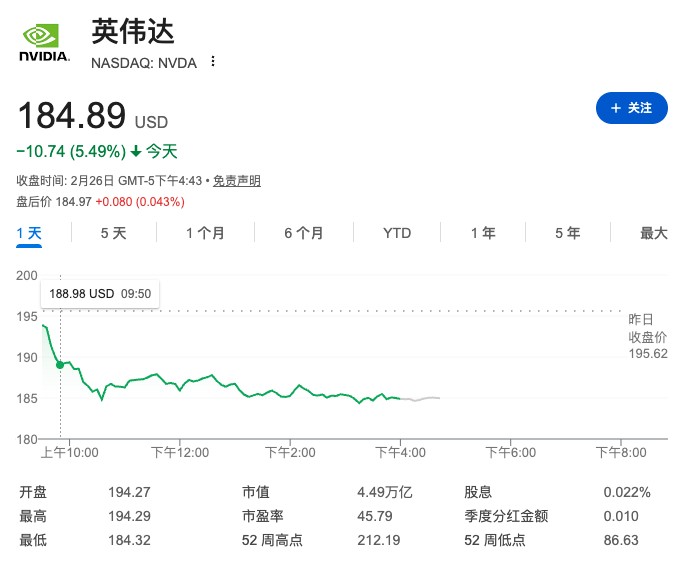
Concerns about AI bubble intensify! NVIDIA's earnings report exceeds expectations, but the stock price plummets 5.6%, marking the largest intraday decline in three months

Despite NVIDIA's latest quarterly revenue increasing by 73% year-on-year and first-quarter guidance exceeding market expectations, the company's outlook failed to alleviate investors' concerns about the sustainability of AI spending. NVIDIA's stock price fell by as much as 5.6% on Thursday, marking the largest intraday drop in three months. Market attention has shifted to whether AI investments can maintain high levels in the coming years, and whether NVIDIA can continue to dominate as AI transitions from training to inference. Additionally, factors such as large-scale procurement commitments and shortages of storage chips have added uncertainty to the company's outlook
The leader in the artificial intelligence (AI) chip market, NVIDIA, experienced its most severe stock price drop in three months on Thursday after releasing a rather impressive latest earnings guidance. Analysts stated that the company's outlook failed to dispel market concerns about an AI bubble.
On Thursday, NVIDIA's stock price in New York fell by as much as 5.6% to $184.58, marking the largest intraday drop since November 25. This decline occurred after the company released its first-quarter sales expectations, where NVIDIA not only easily surpassed analysts' average expectations but also reported a 73% year-on-year increase in fourth-quarter revenue.

However, analysts believe that the market reaction highlights investors' current skepticism towards NVIDIA. The explosive sales growth that previously propelled NVIDIA to the position of the world's most valuable company has led investors to seek stronger assurances that the AI spending boom can be sustained.
Analysts at Hargreaves Lansdown stated in a report following the earnings release, shareholders remain concerned about whether "the current wave of AI spending can continue to support growth in the coming years, and whether NVIDIA can maintain its dominance as AI shifts from training models to operational tasks."
CEO Jensen Huang countered these concerns during a conference call on Wednesday. He stated that customers have already begun to profit from the newly acquired computing power, and thus will continue to maintain high levels of investment.
Jensen Huang said:
"You need computing power, which directly translates into growth and directly translates into revenue. I am confident that their cash flow is growing.
I am very confident in their cash flow growth for a very simple reason. We are now seeing the inflection point of agentic AI and the practicality of intelligent agents. The industry has reached another inflection point.
Investor Michael Burry, known for "The Big Short," further intensified market concerns on Thursday. He pointed out that NVIDIA's current procurement commitments have reached $95.2 billion, compared to only $16.1 billion a year ago. This could pose risks if demand fluctuates.
NVIDIA's Chief Financial Officer Colette Kress attempted to alleviate other concerns raised by analysts, including supply constraints. She stated that the company has secured enough components to meet the growing demand.
She told analysts that producing NVIDIA's most advanced chips remains challenging. However, the current Blackwell product line and the upcoming successor product Rubin are expected to outperform previous expectations. NVIDIA has previously stated that these chips will generate $500 billion in revenue by the end of 2026.
She said:
"We believe we have built inventory and supply commitments that can meet future demand, including shipments extending into 2027."
Storage Chip Shortage, "Circular Trading" Raises Concerns
NVIDIA's revenue for the first fiscal quarter is expected to be around $78 billion, which is higher than the analysts' average expectation of $72.8 billion, although some analysts had previously predicted close to $80 billion. Additionally, NVIDIA's revenue, earnings per share, and adjusted gross margin for the fourth quarter also exceeded expectations.
Among them, NVIDIA's data center segment revenue for this quarter was $62.3 billion, surpassing the analysts' average expectation of $60.4 billion. Other business segments performed relatively weakly. The gaming business, which was once NVIDIA's main source of revenue, generated $3.73 billion this quarter, lower than the analysts' average expectation of $4.01 billion. Automotive-related sales were $604 million, while Wall Street expected $643 million.
Analysts believe that the technology industry is currently facing a hidden concern: the shortage of storage chips. Like most companies in the electronics industry, NVIDIA's products rely on a stable supply of storage chips. These chips provide short-term storage for everything from smartphones to supercomputers. The tight supply has driven up storage chip prices and made it more difficult to ship more devices this year.
This tight situation has weighed down the gaming segment. Kress stated that she is uncertain whether this issue will ease enough this year for the business to return to growth.
In any case, AI data center chips have become a greater focus. Earlier this month, NVIDIA announced that Meta will deploy "millions" of NVIDIA processors over the next few years, further deepening the already close cooperation between the two companies.
NVIDIA's main competitor, AMD, also announced this week that it has reached a similar long-term agreement with Meta. The chip manufacturer stated that this deal could be worth hundreds of billions of dollars.
Chip manufacturers are locking in future computing power demand through a series of large long-term agreements, demonstrating that the AI economy remains strong. However, these trading relationships are too close—suppliers and customers sometimes hold shares in each other—raising criticism. Some believe that such "circular trading" could artificially inflate demand