Chinese technology "feeds back" to Europe! Stellantis plans to use Leapmotor electric technology for the first time in European models

Wallstreetcn
2026.02.26 13:53
portai
I'm PortAI, I can summarize articles.

Stellantis plans to introduce Leapmotor's battery and power technology into its European brands to reduce high costs. If an agreement is reached, this will be the first time a Western car company relies on Chinese underlying technology to support European models, marking a key step in China's technology "feeding back" to Europe. Currently, negotiations are still in the early stages

Stellantis is considering introducing the electric vehicle technology of its Chinese partner Leapmotor into its European mass-market brands, aiming to significantly reduce costs amid fierce market competition.

According to Bloomberg, citing informed sources, the automaker is evaluating the expansion of its cooperation with Leapmotor to gain access to the company's more advanced battery and electric powertrain technologies. Both parties aim to reach an agreement within the year.

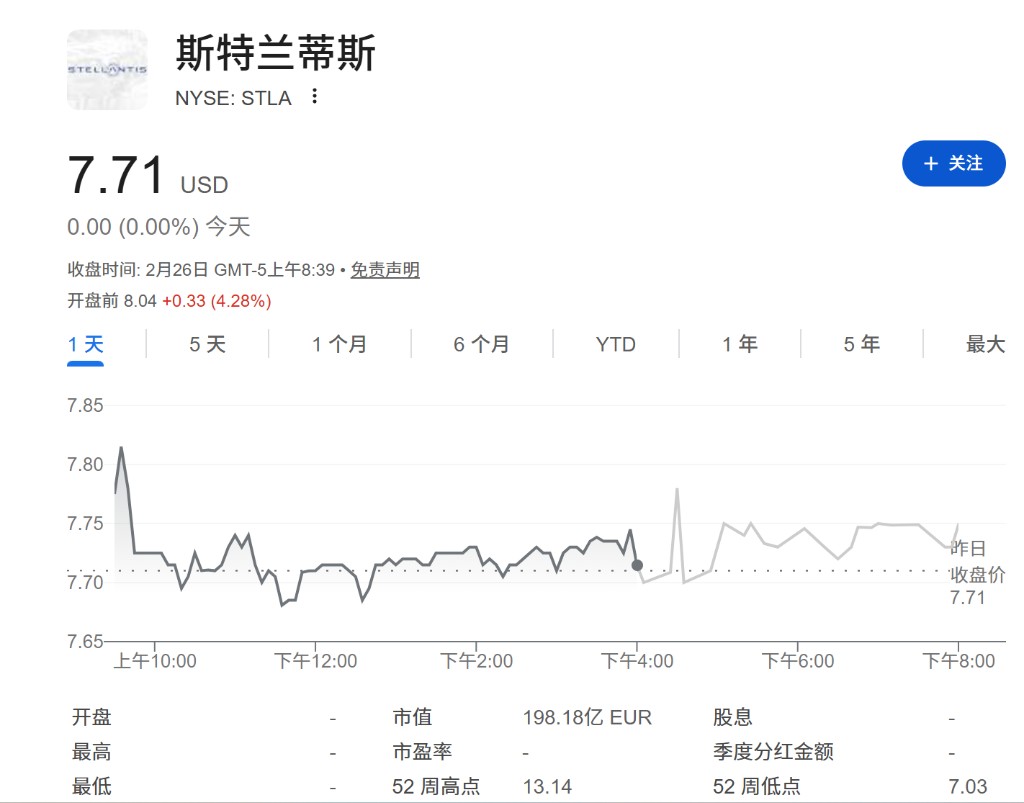
If the collaboration materializes, it would mark the first time a major Western automaker relies on the underlying architecture and software of a Chinese company to support its models in Europe. Following this news, Stellantis's stock price rose 0.6% in the Milan market, although it has fallen 31% year-to-date.

Informed sources pointed out that the relevant negotiations are still in the early stages.

Seeking Cost-Cutting Shortcuts to Address Intense Competition

This potential agreement would help Stellantis save on high development costs and provide a shortcut for better catching up with competitors like BYD and MG, as well as local rivals such as Volkswagen and Renault in the European market. In response to changes in the electric vehicle market, Stellantis is scaling back its electrification strategy. Earlier this month, the company announced impairments and expenses of up to €22.2 billion (approximately $26.1 billion), part of a broader initiative to curb declines in market share and profits.

As part of a business reset, Stellantis is reintroducing its powerful Hemi V8 engine for its Ram pickup brand. In the European market, the company is reintroducing diesel engines in models like the Opel Astra and Peugeot 308, and has launched a hybrid version of the Fiat 500. Informed sources told the media that while deepening cooperation with Leapmotor has long been planned, the company is currently focused on more broadly applying its partner's technology.

Regarding the consideration of expanding cooperation, Stellantis stated that its joint venture aims to combine the strengths of both parties and will regularly discuss potential ways to expand cooperation, but declined to comment further. In a briefing on Thursday, the company indicated that 2025 is the strategic implementation year for this partnership, laying the groundwork for deeper integration. A representative from Leapmotor did not immediately comment.

Accelerating Industry "Reciprocity" Trend

In the European local market, consumers are gradually abandoning traditional Western brands like Volkswagen in favor of attractive models such as the BYD Seal crossover.

In response to this trend, Western automakers are increasingly seeking support from Chinese technology. Volkswagen is currently producing electric vehicles based on XPeng's platform, and its Audi brand has also adopted technology from its partner SAIC Motor, although these models are currently limited to the Chinese market.

Additionally, Renault's upcoming new electric Twingo, set to launch in Europe, relies on the design and technology developed at the French manufacturer's R&D center in China. In contrast, if Stellantis directly applies Leapmotor's technology to its European brands, it would represent a significant step forward in the "reciprocity" of Chinese technology benefiting the European market. **

Deepening Strategic Integration and Restructuring Pressure

Stellantis' cooperation with Leapmotor began in 2023. Under the leadership of then-CEO Carlos Tavares, Stellantis invested $1.1 billion to acquire a 20% stake in Leapmotor (which was diluted to 15% last year) and established a joint venture named Leapmotor International. Currently, Leapmotor has begun offering three models through Stellantis' European distribution network. Following initial assembly in Poland, the company plans to produce vehicles this year at Stellantis' factory in Zaragoza, Spain.

Deepening cooperation with Leapmotor comes as Stellantis strives to address the loss of market share in the U.S. and European markets. Antonio Filosa, who took over as CEO in June, will announce the next strategic plan at the capital markets day in May. Previously, the company reported impairment charges that fell short of expectations on February 6, leading to a significant drop in stock prices by 25%.

Although Stellantis promised to invest approximately $13 billion in the U.S. last year and has seen initial returns, its next steps in the European market remain unclear, as local factories face overcapacity challenges, and intense competition further squeezes profit margins