


Why did the market "turn a blind eye" to NVIDIA's explosive earnings report?

NVIDIA has exceeded revenue expectations for 14 consecutive quarters. When exceeding expectations becomes the norm, merely having good performance is no longer sufficient. Market focus has shifted to concerns about the sustainability of AI demand and NVIDIA's own supply constraints. The massive long orders on the demand side have also faced criticism due to cross-shareholding with customers. Furthermore, although NVIDIA's data center business has seen strong growth, other business segments have fallen short of expectations
NVIDIA delivers results and guidance that far exceed expectations, but failed to reignite its stock price. Market concerns about the sustainability of AI demand and supply constraints are overshadowing the impressive "numbers themselves."
NVIDIA's revenue guidance for the first quarter of the fiscal year is approximately $78 billion, significantly higher than Wall Street's average expectation of $72.8 billion. However, the company's stock price fell about 1.5% during the analyst conference call, and by the end of the evening, it was nearly flat overall.
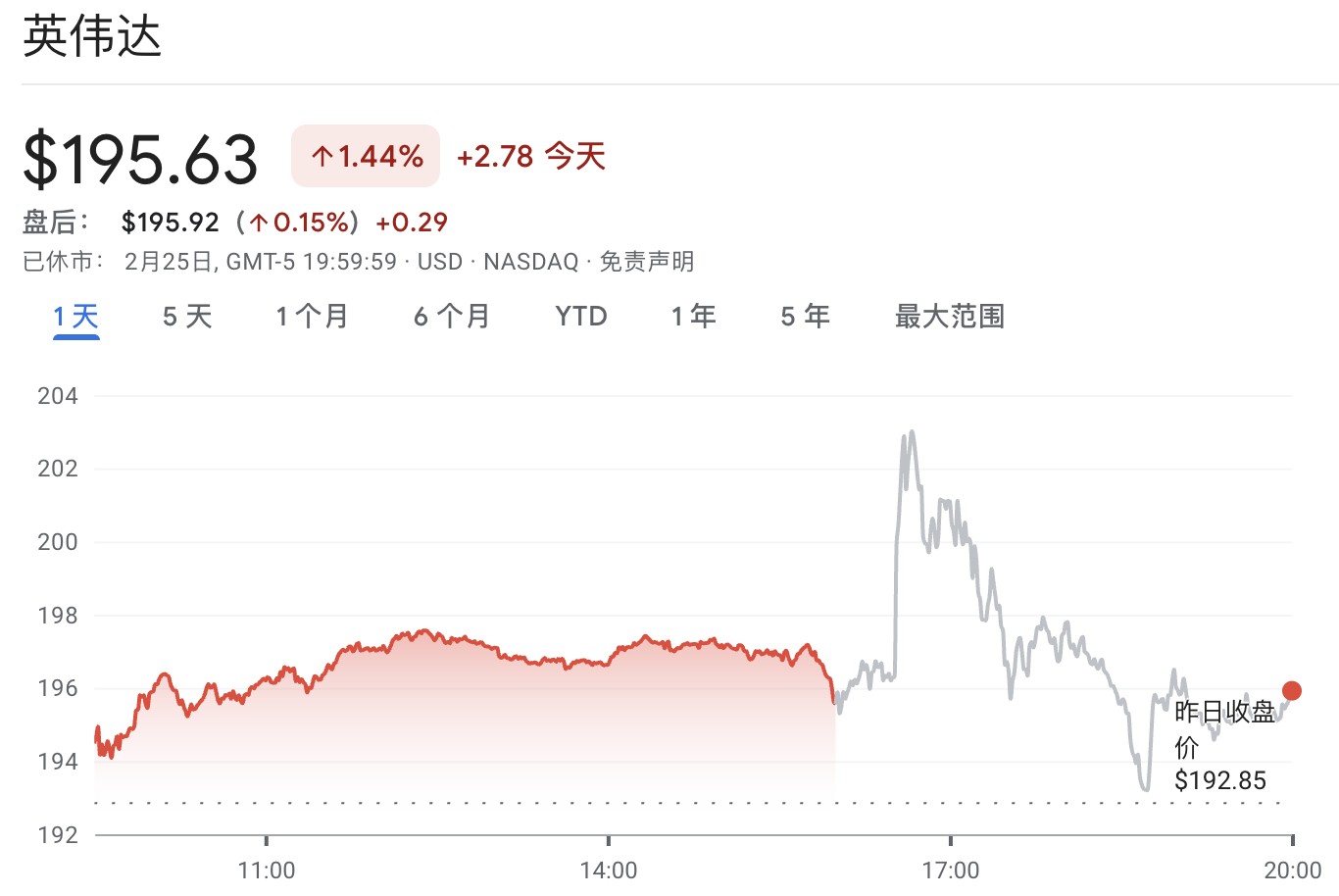
With this earnings report, NVIDIA has now exceeded revenue expectations for 14 consecutive quarters. Analysts point out that investors' "inherent high expectations" for NVIDIA have reached new heights, and simply "beating expectations once again" is no longer enough to bring additional premiums. What the market wants more is a stronger assurance of whether the AI boom can be sustained.
Management is attempting to address these concerns directly. Jensen Huang emphasized that customers are making money with the added computing power, and investments will remain at high levels; CFO Colette Kress stated that the company has secured key supplies and extended shipping commitments over a longer period.
Strong guidance, but the market still feels "a bit short"
NVIDIA's first-quarter earnings guidance is approximately $78 billion. Although this figure exceeds analysts' consensus expectations, it falls short of some analysts' more aggressive forecasts close to $80 billion, which makes the "beat" marginally less impressive.
From the stock price reaction, the strong guidance did not translate into a sustained upward catalyst, but rather saw a decline during the conference call. The market signal is clear: investors are using a higher certainty threshold to assess the growth quality and duration of the AI leader.
Core business remains strong, but non-data center business lags
NVIDIA's revenue for the fourth quarter of the fiscal year grew 73% to $68.1 billion, with an adjusted earnings per share of $1.62 and an adjusted gross margin of 75.2%, all exceeding market expectations.
The main growth engine remains the data center business, which generated revenue of $62.3 billion for the quarter, higher than analysts' average expectation of $60.4 billion.
However, other segments performed weakly, with gaming revenue at $3.73 billion, below the market expectation of $4.01 billion; automotive-related revenue was $604 million, also below the expected $643 million. The structural divergence has heightened the market's sensitivity to the "growth relying more on a single engine."
Concerns about "Overheating" and Returns Persist, Investors Seek Stronger Evidence of Sustainability
According to analysis, in the context of fluctuating sentiment in AI trading and investors' concerns about input-output ratios and industry disruption costs, the market no longer views AI as "the tide that lifts all assets."
Jensen Huang attempted to steer the discussion back to customer-side returns during the conference call, stating that customers have already profited from the increased computing power and will continue to invest at high levels, expressing confidence that "computing power translates into growth, which translates into revenue," and that it will boost customer cash flow.
For investors, the key to such statements lies in whether they can be continuously validated by orders, deliveries, and subsequent guidance.
Supply Constraints and "Massive Long Orders" Coexist, Optimistic Narrative Still Requires Delivery Validation
Colette Kress stated that the company has secured enough components to meet demand growth, and mentioned that it has prepared inventory and supply commitments for future demand, with shipping arrangements extending to 2027.
Currently, the Blackwell product line and the subsequent Rubin are expected to perform better than previous sales forecasts, with the company previously stating that related chips will generate $500 billion in revenue by the end of 2026.
Another variable comes from the supply chain. Analysis indicates that the shortage of memory chips has driven up prices and affected equipment shipments, which has also dragged down the gaming business. Kress stated that it is still uncertain whether this issue will ease this year enough to drive growth in that business.
On the demand side, NVIDIA announced that Meta Platforms will deploy "millions" of NVIDIA processors over the next few years; at the same time, Advanced Micro Devices also announced a similar long-term agreement with Meta, amounting to hundreds of billions of dollars.
However, such transactions have faced criticism due to potential cross-shareholding arrangements between suppliers and customers, raising concerns that they may amplify demand to some extent. For the market, it ultimately depends on the pace of deliveries, the speed of resolving supply bottlenecks, and the realization of customer-side cash flow
