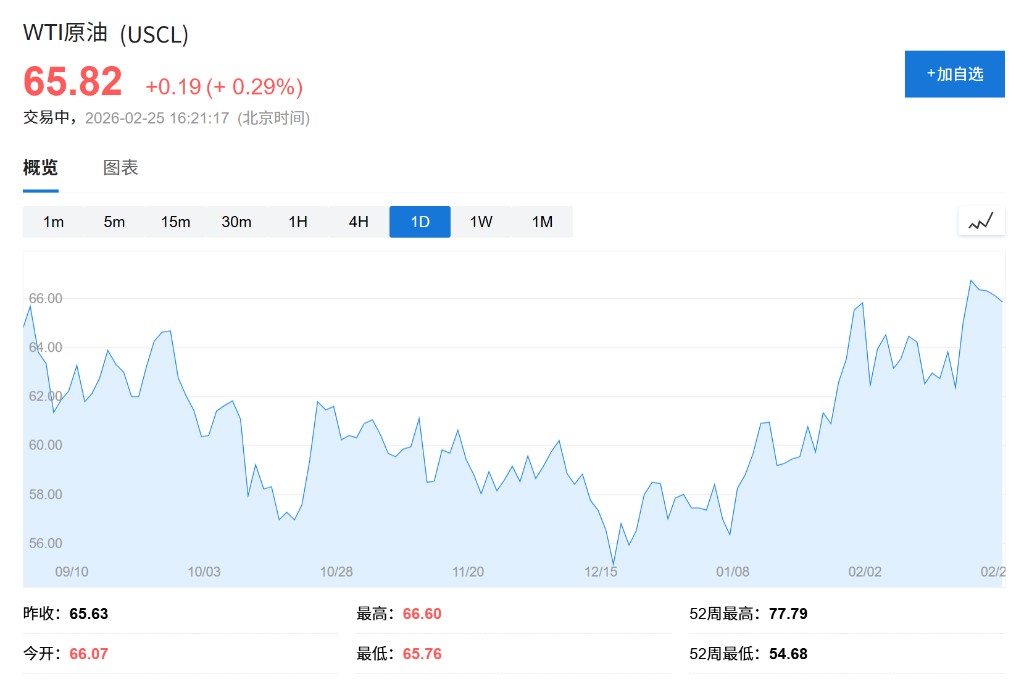
The US-Iran nuclear talks are expected to restart on Thursday, with Trump specifically wanting to hear "never nuclear," leading to early fluctuations in oil prices

In his State of the Union address, Trump again pressured Iran, stating that U.S.-Iran negotiations are still ongoing, but "we have not heard that key phrase: 'We will never have nuclear weapons.'" With Iran controlling the Strait of Hormuz, which has a daily oil flow of 16.5 million barrels, market concerns have driven oil prices to a six-month high. Currently, Iran, which is facing "maximum pressure" due to limited oil revenues, will see the Geneva talks this Sunday determine the short-term direction of the oil market
The nuclear negotiations between the United States and Iran have entered a critical moment, causing fluctuations in the crude oil market.
According to Xinhua News Agency, reports citing insiders from the Trump administration say that although no final decision has been made, Trump is inclined to carry out a preliminary strike against Iran in the coming days to indicate to Iranian leaders that they must agree to abandon their capability to produce nuclear weapons. The global oil market is holding its breath for the results of this week's negotiations to assess the real risks facing energy supplies in the Middle East.
According to MarketWatch, U.S. and Iranian negotiators are expected to resume talks in Geneva on Thursday. Trump reiterated pressure on Iran during his State of the Union address on Tuesday night, stating, "We are negotiating with them, they want to make a deal, but we have not heard that key phrase: 'We will never have nuclear weapons.'" This statement has brought the political prerequisites of the negotiations to the forefront, keeping the market highly alert to the risk of a breakdown in talks.
Oil prices have already reacted in advance. The tense U.S.-Iran relationship has pushed oil prices to a six-month high, with WTI crude rising 0.29% to $65.82 per barrel. Traders are closely monitoring any signals that could affect Iranian oil production or trigger an escalation that would block the Strait of Hormuz. Meanwhile, the U.S. has amassed a large military presence in the Middle East, with Trump indicating that he is considering limited military strikes against Iran.

Iran's Weight in the Global Oil Market
Iran's share of global oil supply has significantly shrunk due to long-term sanctions and the withdrawal of foreign investment. According to Bloomberg data, the country produces about 3.3 million barrels per day, accounting for approximately 3% of global supply, ranking fourth within OPEC, behind Saudi Arabia, Iraq, and the UAE.
Iran's oil industry once had a more glorious history. In the mid-1970s, at its peak, the country accounted for over 10% of global crude oil production and was the second-largest producer in OPEC. After the Islamic Revolution in 1979, the new regime expelled foreign oil companies, leading to a sharp decline in production, which has never returned to peak levels. In 2018, during Trump's first term, the U.S. withdrew from the Iran nuclear deal and reinstated sanctions, thwarting efforts by major European and American oil companies to return to the Iranian market.
Strait of Hormuz: A Vital Choke Point
Analysts believe that the interruption of Iranian oil supply itself is not the biggest risk; the real concern for the market is the possibility of a blockade of the Strait of Hormuz.
The Strait of Hormuz is a narrow waterway connecting the Persian Gulf to the Arabian Sea, through which approximately 16.5 million barrels of oil are exported daily, covering most of the export oil from Saudi Arabia, Iraq, the UAE, and Qatar. The Iranian government has previously stated that it has the capability to implement a maritime blockade of this waterway during periods of geopolitical tension, although it has not yet been put into action According to Bloomberg, during the 12-day conflict between Israel and Iran last June, the regional situation escalated sharply, causing the benchmark freight rates for supertankers transporting 2 million barrels of crude oil from the Middle East to soar dramatically, visually reflecting the impact on energy transportation costs when the Strait of Hormuz is threatened.
It is worth noting that some major oil-producing countries have alternative routes to bypass the strait: Saudi Arabia can use a pipeline approximately 1,200 kilometers long, crossing the country from east to west, to transport crude oil to ports on the Red Sea for loading; the UAE can transfer its daily export volume of about 1.5 million barrels through a pipeline that ends in the Gulf of Oman. However, Iraq and Kuwait do not have similar alternative routes.
Oil Revenue and Iran's Negotiation Leverage
Oil exports remain the core pillar of Iran's economy. According to Bloomberg's estimates, even under sanctions, Iran must sell at a discount price of about $45 per barrel (after deducting transportation and other costs), Iran's oil revenue in just November last year was estimated to reach $2.7 billion. In 2023, the oil industry contributed about 2 percentage points to Iran's GDP growth, with the overall economy expanding by about 5% that year.
However, the "maximum pressure" policy implemented by the Trump administration continues to squeeze this source of income. If this policy successfully deters Chinese buyers, Iran's oil exports will face greater pressure; if Iran further lowers prices to compete directly with discounted Russian oil for market share, its revenue potential will shrink again.
The aforementioned economic pressures not only motivate Tehran to participate in negotiations but may also strengthen its resolve to hold firm on nuclear issues. The direction of the Geneva talks this Sunday will largely determine the short-term volatility of the global crude oil market