


Former Bank of Japan Governor Haruhiko Kuroda calls for interest rate hikes and tightening fiscal policy

Former Bank of Japan Governor Haruhiko Kuroda urged that the Bank of Japan must continue to raise interest rates (expected to raise rates twice a year in 2026-2027), and the government should also tighten fiscal policy. This stands in contrast to the expansionary fiscal stance of the current Prime Minister Sanae Takaichi, with Kuroda warning that her spending plans could exacerbate inflation and pointing out that the current yen is "slightly too weak."
On February 25, former Bank of Japan Governor Haruhiko Kuroda stated that as Japan's economic conditions improve significantly, the Bank of Japan must continue to raise interest rates, while the government should also tighten fiscal policy.
According to Reuters, Kuroda expects the Bank of Japan to raise interest rates about twice a year in 2026 and 2027, gradually pushing the current policy interest rate towards a neutral level for the economy.
He warned that the large-scale spending and tax reduction plan introduced by Prime Minister Sanae Takaichi could backfire, exacerbating inflationary pressures. Earlier reports indicated that Takaichi was cautious about further interest rate hikes, which has put downward pressure on the yen exchange rate.
This statement highlights the significant divergence between the former architect of quantitative easing and the current government's economic policy orientation, providing key references for the market to assess Japan's future interest rate path and yen trends.
Call for Dual Tightening of Monetary and Fiscal Policies
In an interview with Reuters, Kuroda pointed out that Japan's economy is currently in a "good state," achieving robust growth and steadily rising wage levels. Against this backdrop, the Bank of Japan has room to gradually raise the current policy interest rate of 0.75% to around 1.5% to 1.75% over the next few years.
He recalled that during the early implementation of "Abenomics," Japan faced the dual pressures of deflation and a strong yen; now, the macroeconomic environment Japan faces has shifted to inflation and a weak yen. Therefore, both Japan's fiscal and monetary policies need to tighten.
Currently a senior researcher at the National Graduate Institute for Policy Studies, Kuroda emphasized that the Bank of Japan must gradually raise interest rates to neutral levels, while fiscal policy must also tighten in tandem. With inflation rates consistently above the 2% target for years and a tight labor market pushing up wages, the Bank of Japan exited its previous stimulus policies in 2024 and has raised interest rates multiple times.
Warning of Expansionary Fiscal Risks and Yen Weakness
Unlike the normalization path of monetary policy, Japan's current fiscal policy still tends to be expansionary. As a supporter of "Abenomics," Takaichi has increased government spending and promised to suspend the 8% sales tax on food for two years to alleviate the impact of rising living costs on households.
Kuroda expressed skepticism about this. He believes that government support for innovation to enhance long-term potential growth rates is reasonable, but increasing spending merely to alleviate living costs will backfire, as it will further exacerbate inflationary pressures and potentially push up bond yields. Following her election victory on February 8, the market is highly concerned about whether Takaichi will continue to promote loose fiscal and monetary policies. Reports indicate that she recently expressed reservations about further interest rate hikes to Bank of Japan Governor Kazuo Ueda, raising market concerns about policy friction. As a result, the yen fell to 155.80 against the dollar on Wednesday.
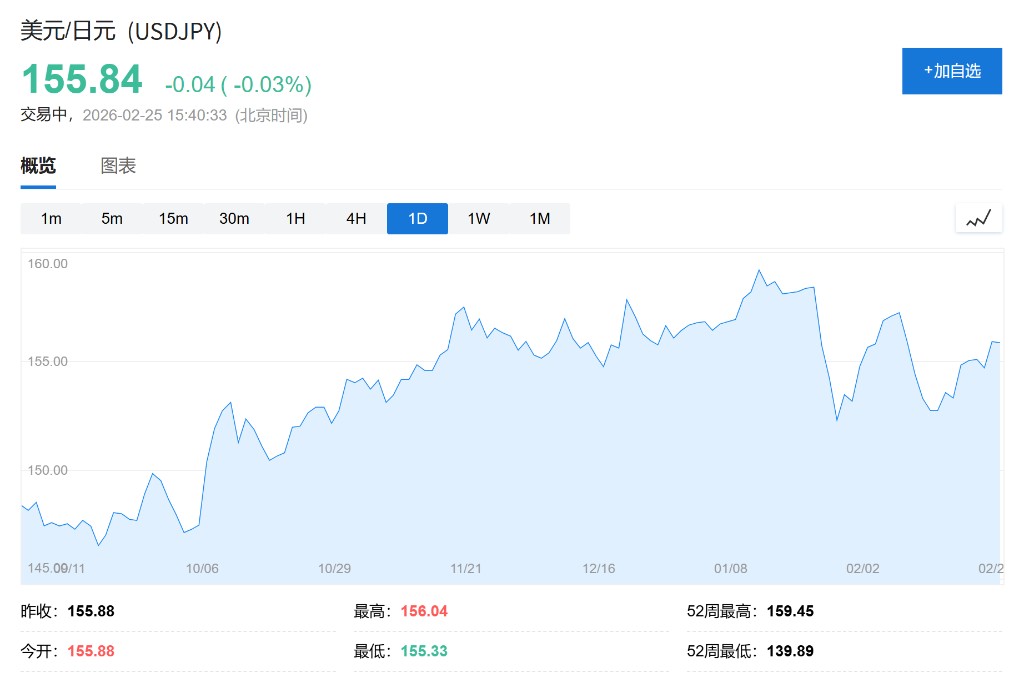 Regarding the current exchange rate level, Haruhiko Kuroda pointed out that, based on Japan's recent economic growth, price trends, and economic competitiveness, the recent level of the yen may be "slightly too weak." Although foreign exchange intervention can influence the yen's movement in the short term, it cannot guarantee that its effects will last in the long term.
Support for the Central Bank's Low-Key Communication Strategy
When discussing the central bank's market communication, Haruhiko Kuroda believes that the current monetary policy environment no longer requires the "shock therapy" used during his tenure. During his time as governor, his simple and bold communication strategy aimed to persuade the public that Japan could emerge from decades of deflationary shadows.
He stated, the current goal of the Bank of Japan is to achieve policy normalization without causing economic turmoil, thus requiring a more low-key communication approach. When the central bank is gradually pushing interest rates toward neutral levels, there is no need for excessive vocalization.
Haruhiko Kuroda expressed approval of the communication strategy of the current governor Kazuo Ueda. He believes that Ueda's maintenance of subtle differences in policy statements and a certain degree of ambiguity is the correct approach, and this low-key stance is more appropriate during the current policy transition period
