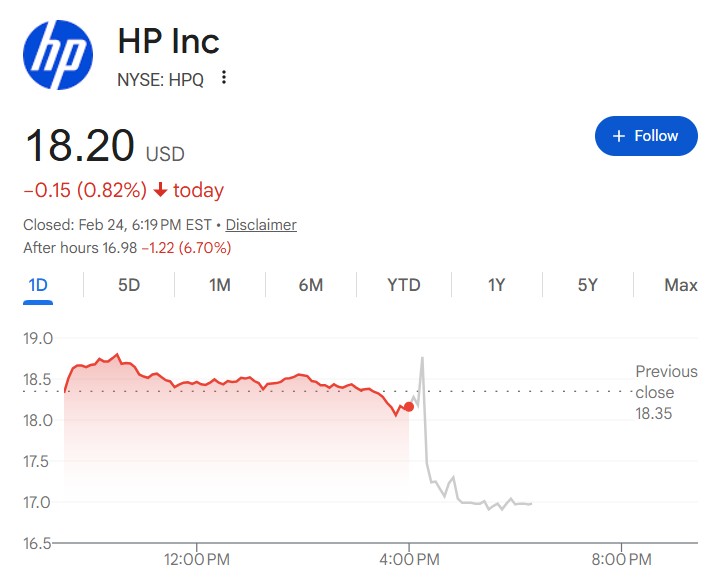
HP's Q1 revenue grew by 7%, exceeding expectations, but the rise in storage chip prices dragged down performance outlook, causing a nearly 7% drop in after-hours stock price | Earnings report insights

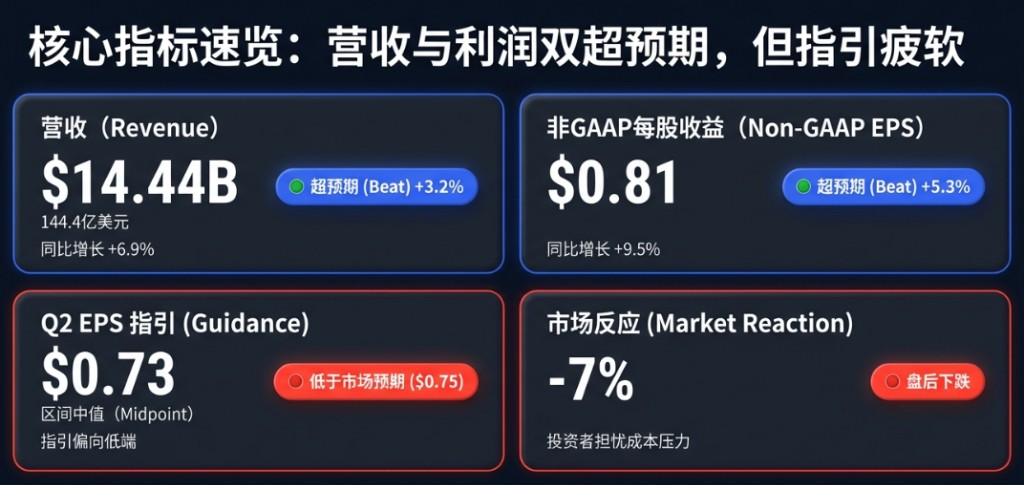
HP's net revenue for the first quarter of fiscal year 2026 was $14.44 billion, a year-on-year increase of 6.9%, exceeding analysts' expectations. However, the company expects the non-GAAP earnings per share for the second quarter to be in the range of $0.70 to $0.76, with a median of $0.73, which is below the market expectation of $0.75. CFO Karen Parkhill stated that as memory costs continue to rise, the company maintains its full-year guidance but expects actual results to "lean towards the lower end of the range."
HP released its fiscal Q1 2026 results, with net revenue of $14.44 billion, a year-on-year increase of 6.9%, exceeding analysts' expectations of $13.9 billion by approximately 3.2%; non-GAAP earnings per share were $0.81, up 9.5% from $0.74 in the same period last year, also surpassing the market consensus expectation of $0.77 by about 5.3%.
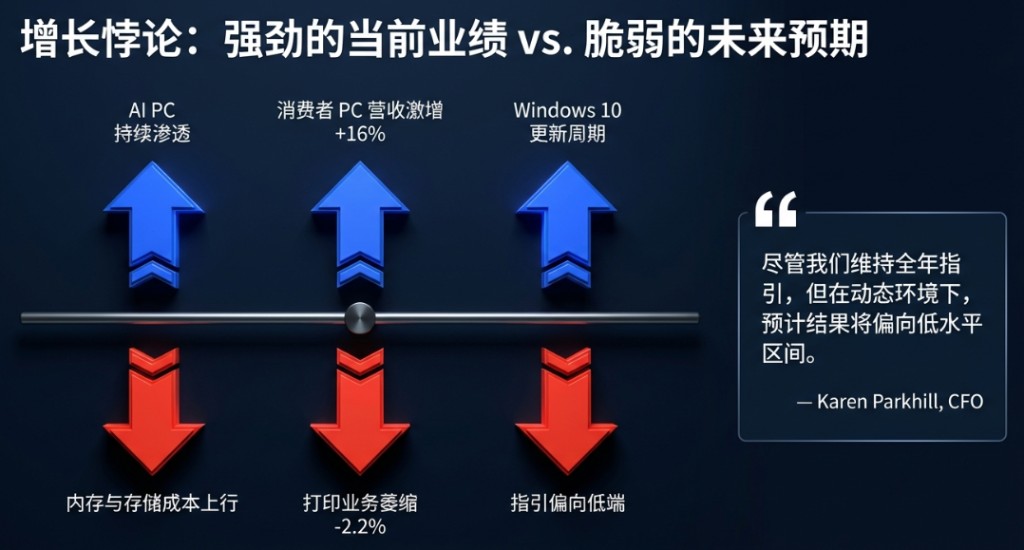
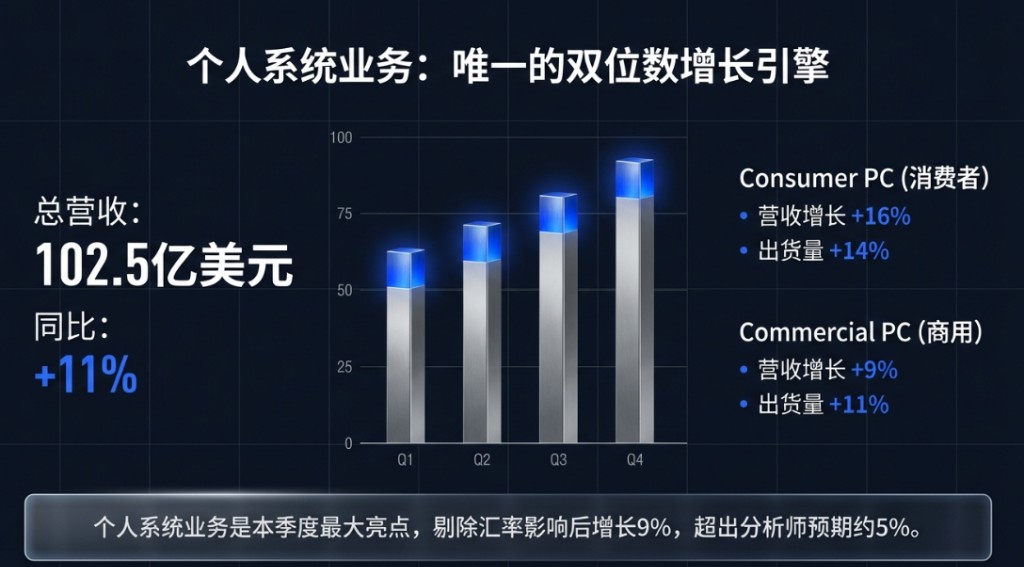
The core engine driving the better-than-expected performance comes from the personal systems business, with the PC division's revenue growing strongly by 11% year-on-year to $10.25 billion, where consumer PCs recorded a high growth rate of 16%, with the continuous expansion of AI PCs being an important driving force.
However, the printing business saw revenue decline by 2.2% year-on-year to $4.19 billion, with consumer printing shrinking even more significantly by 8%. What worries investors even more is the forward guidance. The company expects non-GAAP earnings per share for Q2 to be in the range of $0.70 to $0.76, with a midpoint of $0.73, which is below the market expectation of $0.75.
CFO Karen Parkhill candidly stated that as memory costs continue to rise, the company maintains its full-year guidance but expects actual results "to lean towards the lower end of the range." Interim CEO Bruce Broussard characterized the current situation as "facing industry-level headwinds."
After the earnings report was released, HP's stock price quickly fell in after-hours trading, with a decline approaching 7%.

Outlook: Rising memory prices are the biggest variable, guidance midpoint below expectations
The biggest disappointment in this earnings report from the market focused on the forward guidance.
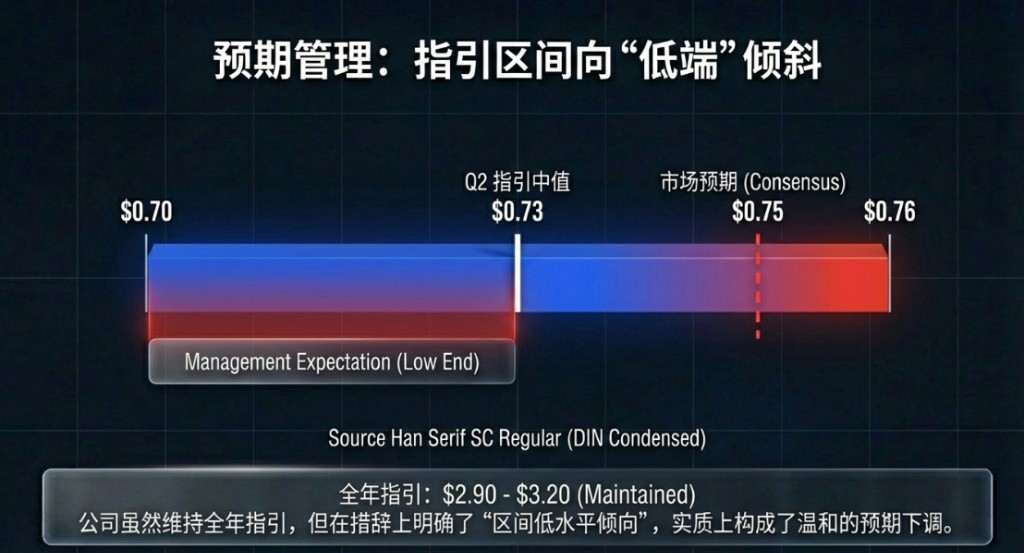
The Q2 non-GAAP earnings per share guidance range is $0.70 to $0.76, with a midpoint of $0.73, which is below the market expectation of $0.75; the GAAP earnings per share guidance range is $0.52 to $0.58.
Management clearly identified "rising memory costs" as the most significant macro headwind, with the CFO stating that while the company is "good at dealing with headwinds," in a "dynamic environment," it currently tends to position the full-year results at the lower end of the guidance range.
For the full year, the company maintains its non-GAAP earnings per share guidance range of $2.90 to $3.20 for fiscal 2026, with a midpoint of $3.05 slightly above the market expectation of $3.00, but the wording of "tendency towards the lower end of the range" essentially constitutes a mild downward adjustment of expectations. The full-year GAAP earnings per share guidance is $2.47 to $2.77.
Analysts currently expect HP's revenue to decline by 2.1% year-on-year over the next 12 months. Between the short-term catalysts of AI PCs and the mid-term pressure of memory costs, HP's path to valuation recovery still faces significant resistance.
Personal Systems: AI PCs drive better-than-expected growth, but structural pressures remain
The personal systems business is the biggest highlight of this quarter and the only core segment to achieve double-digit growth.
Quarterly revenue was $10.25 billion, a year-on-year increase of 11% (growing 9% after excluding exchange rate effects), exceeding analysts' expectations of $9.76 billion by about 5%. **
From a segmentation perspective, commercial PC revenue grew by 9%, while consumer PCs grew by 16%; in terms of shipment volume, total unit volume increased by 12% year-on-year, with consumer PC unit volume growing by 14% and commercial PCs by 11%.
The continued penetration of AI PCs is the key driver behind the better-than-expected performance of personal systems this quarter. HP's management emphasized "the sustained momentum of AI PCs" multiple times in the earnings report, characterizing it as a core execution lever of the "future work strategy."
From an industry background perspective, the PC replacement cycle for enterprise customers is accelerating, coupled with the impending end of support for Windows 10, which has provided a solid demand foundation for the commercial PC market in the short term.
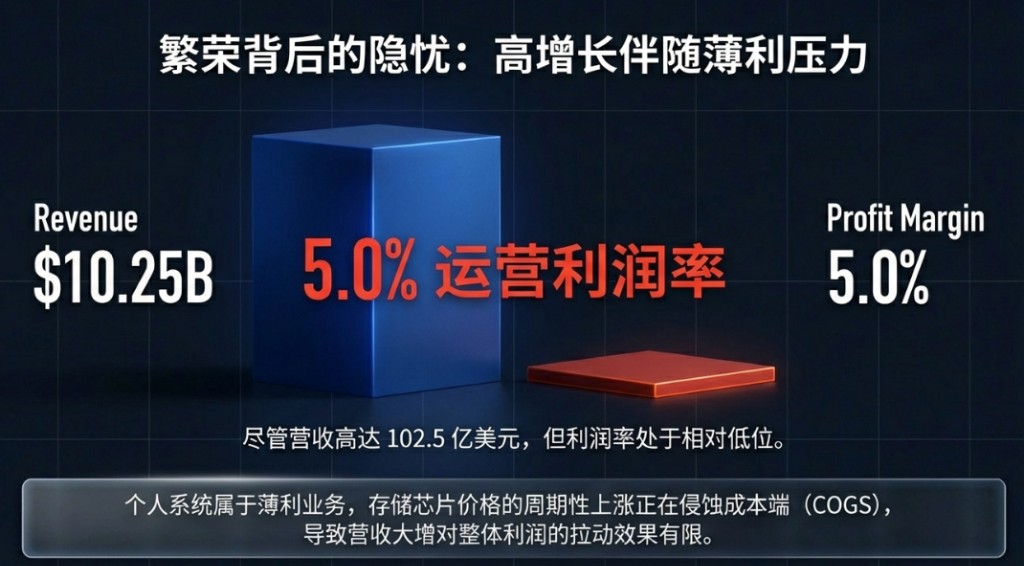
However, from a profitability quality standpoint, the operating profit margin of the personal systems business is only 5.0%, which is relatively low-margin, limiting the impact of significant growth on overall profits.
Additionally, the cyclical rise in storage chip prices is eroding the cost side of this business, which is also one of the direct reasons management has lowered the full-year expectations to the lower end.
Printing Business: High Profit Margins Cannot Conceal Ongoing Shrinkage Issues
The printing business contributed a high operating profit margin of 18.3% this quarter, serving as an important stabilizer for overall profitability, but the revenue decline is becoming increasingly unavoidable.
Quarterly printing revenue was $4.19 billion, down 2% year-on-year (a 3% decline at constant exchange rates), with consumer printing down 8%, commercial printing down 3%, and core consumables revenue slightly down 1%, while total hardware shipments fell by 6%.
From a longer-term perspective, HP's commercial printing business has averaged a year-on-year decline of 3.3% over the past two years, indicating structural contraction pressures facing this business.
The accelerated adoption of digital office solutions and the long-term decline in enterprise printing demand have caused this once "money-printing machine" business to gradually lose its growth momentum. Although high profit margins can still contribute a considerable profit pool to the group, the drag effect on revenue growth is becoming increasingly evident.
Cash Flow and Capital Allocation: Low Free Cash Flow, Buyback Efforts Continue
This quarter, HP generated $383 million in cash from operating activities and $175 million in free cash flow, which, compared to over $14.4 billion in revenue, results in a free cash flow conversion rate of only about 1.2%, which is relatively low and on par with the same period last year.
Despite limited cash generation capacity, HP has maintained an active capital return pace.
This quarter, HP repurchased a total of 13.3 million shares at a cost of $325 million, while also paying a cash dividend of $0.30 per share, totaling approximately $277 million, returning about $600 million in capital to shareholders during the quarter. At the end of the quarter, cash and cash equivalents amounted to $3.2 billion.
Looking ahead for the year, the company expects free cash flow to be between $2.8 billion and $3.0 billion, but has clearly indicated a preference for the lower end of the range. This statement, combined with expectations of rising storage costs, suggests that cash flow pressure in the second half of the year is worth ongoing monitoring.