Breakfast FM-Radio | February 24, 2026

Understand the global market in five minutes, all in the Financial Breakfast
Huajian Morning Voice
Market Overview
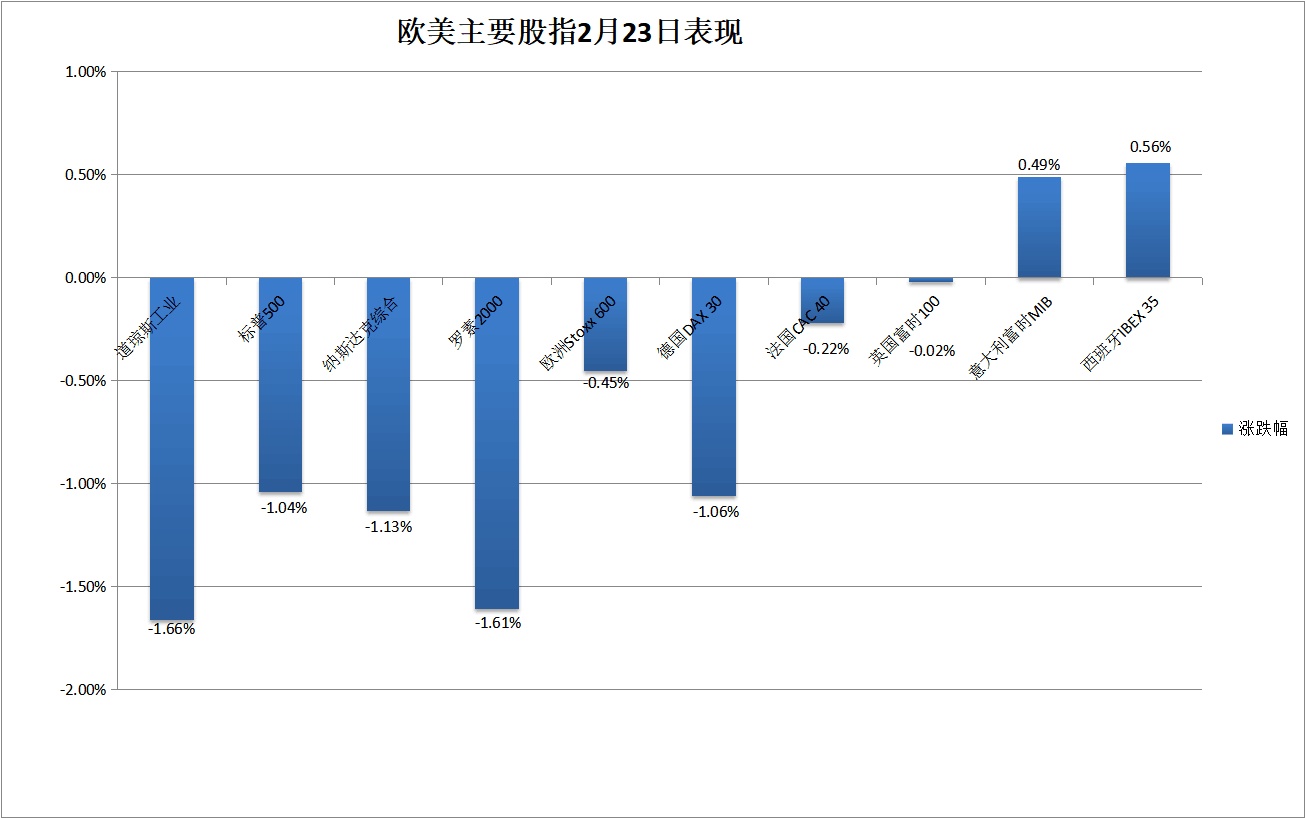
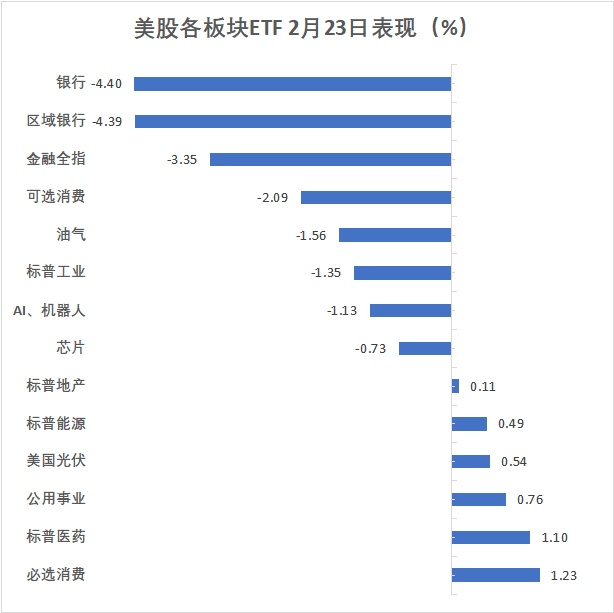
Concerns over AI intensify, and the risk of a trade war reignites, with the three major U.S. stock indices closing down at least about 1%, dragged down by financial and software stocks.
Anthropic's product threatens programming languages, IBM fell 13%, marking its largest drop in 25 years. The financial sector dropped over 3%, leading the S&P, with American Express down over 7%, asset management companies hit hard, KKR fell nearly 9%, and Blue Owl, targeted by aggressive hedge funds for its credit fund, dropped over 3%. Retail stocks sensitive to tariffs fell across the board, with Wayfair down nearly 10%. Cybersecurity stocks continued to plummet after last Friday's threat from Anthropic's new tool, with CrowdStrike down nearly 10%.
European stock indices and UK stocks fell from record highs. Trials showed that its drug's weight loss effect was inferior to Eli Lilly's, Novo Nordisk fell over 16%.
U.S. Treasuries rebounded, with the ten-year Treasury yield approaching a three-month low. After the U.S. Supreme Court overturned Trump's tariffs, the dollar fell from a four-week high over two days. Offshore RMB briefly rose above 6.89, nearing a three-year high.
Bitcoin briefly fell below $64,000 to a new low in over two weeks, down over 5% from its daily high. Gold reached a new high for the month, with futures rising over 3% at one point. Silver futures rose nearly 8% at one point. Crude oil briefly turned up over 1% to reach a six-month high, then turned down, with Brent crude closing after three consecutive increases.
During the Asian session, the Hang Seng Tech Index surged over 3%, with Meituan up over 5%, and the "dual giants" of large models, Zhizhu and MINIMAX, showed significant corrections.
Key News
China
Ministry of Commerce: Urges the U.S. to cancel the relevant unilateral tariff measures imposed on trade partners.
The Dark Side of the Moon becomes the fastest domestic company to reach a decacorn status, with revenue exceeding last year's total in nearly 20 days.
Overseas
U.S. Customs: Will stop collecting tariffs deemed illegal by the Supreme Court starting February 24. The Democratic Party will block any attempts to extend tariffs and push for a mandatory refund plan. The European Parliament has suspended the approval of the U.S.-EU trade agreement. The UK may become the biggest victim of Trump's new tariffs.
Federal Reserve Governor Waller: CEOs claim AI will lead to massive layoffs, and the March interest rate decision will depend on February labor data.
Trump is reported to be considering a strategy of "small strikes" followed by "large strikes" against Iran. Iran's Foreign Minister: A better agreement than the 2015 nuclear deal may be possible.
From the "Research Report of June 2028": When AI exceeds expectations, the economy collapses. The report triggered a sharp decline in delivery, payment, and software stocks.
Anthropic claims it can transform Cobol systems, IBM plummeted 13%, marking its largest drop in 25 years; Claude Code Security caused cybersecurity stocks to plunge again. **
Integrating into the next-generation PC ecosystem, NVIDIA launches laptop chips, returning to the consumer PC market.
Report: ASML reveals breakthroughs in EUV light sources, chip production is expected to increase by 50% by 2030.
A year after the White House press conference, OpenAI's $500 billion "Gateway to the Stars" plan is at a standstill.
Market Report
US and European Stock Markets: The S&P 500 fell 1.04%, closing at 6837.75 points. The Dow Jones Industrial Average fell 1.66%, closing at 48804.06 points. The Nasdaq fell 1.13%, closing at 22627.273 points. The European STOXX 600 index closed down 0.45%, at 627.70 points.
A-shares are closed.
Bond Market: The yield on the 10-year U.S. Treasury bond fell by 5.36 basis points, at 4.0290%. The yield on the 2-year U.S. Treasury bond fell by 4 basis points, at 3.4380%.
Commodities: Spot gold rose 2.38%, at $5229.70 per ounce. Spot silver rose 3.99%, at $88.0245 per ounce. WTI April crude oil futures fell by $0.27, a decrease of 0.38%, closing at $66.31 per barrel.


News Details
Global Highlights
China
Ministry of Commerce: Urges the U.S. to cancel unilateral tariff measures imposed on trade partners. The Ministry of Commerce stated that China has consistently opposed all forms of unilateral tariff measures and has repeatedly emphasized that there are no winners in a trade war and that protectionism leads nowhere. The U.S. unilateral measures such as reciprocal tariffs and fentanyl tariffs violate international trade rules and U.S. domestic law, and do not serve the interests of all parties. Facts have repeatedly proven that cooperation benefits both China and the U.S., while conflict harms both. China urges the U.S. to cancel the relevant unilateral tariff measures imposed on trade partners. We also note that the U.S. is preparing to take alternative measures such as trade investigations in an attempt to maintain tariffs on trade partners, and China will closely monitor this and firmly safeguard its interests.
The Dark Side of the Moon becomes the fastest domestic company to reach unicorn status, earning more in the past 20 days than the entire last year! Public information shows that it took ByteDance over 4 years to surpass a valuation of $10 billion, Pinduoduo over 3 years, while Kimi went from a $300 million angel round to a valuation over $1 billion in just over two years, with its value increasing more than 30 times Overseas
U.S. Customs: Will stop collecting tariffs deemed illegal by the Supreme Court starting February 24. The U.S. Customs and Border Protection announced on the 22nd through its cargo system messaging service that tariffs imposed under the International Emergency Economic Powers Act will no longer be effective, and goods entering the consumer market or being withdrawn from warehouses for consumption starting from Eastern Time on February 24 will not be subject to this tariff. The announcement also noted that the suspension of this tariff does not affect any other tariffs imposed by the Trump administration.
Democrats in the U.S. will block any attempts to extend tariffs and push for mandatory refund plans. After the Supreme Court overturned its previous ruling on equivalent tariffs and other IEEPA tariffs, Trump invoked alternative legal tools under Section 122 to implement a 15% global tariff. If Congress does not approve an extension, the new tariffs will expire this summer. The 15% rate is the tariff rate established in trade agreements signed last year between the U.S. and regions such as the European Union. If this tariff level cannot be maintained, the investment commitments made by these regions due to tariff threats may fall through. A group of Democratic senators in the U.S. Senate has introduced a bill requiring the mandatory refund of taxes paid under the tariffs previously raised by President Trump.
In response to Trump's warning to the EU about dragging things out, the European Parliament has suspended the approval of the U.S.-EU trade agreement. Trump warned that any country attempting to "play tricks" with the Supreme Court ruling will face higher tariffs and more severe consequences. The chairman of the European Parliament's International Trade Committee, Lange, stated that the vote on the agreement originally scheduled for Tuesday has been postponed, as the EU hopes to clarify the situation and expects the U.S. to clearly express respect for the U.S.-EU agreement, which is crucial.
The UK may become the biggest victim of Trump's new tariffs. Following the U.S. Supreme Court's rejection of Trump's global tariff policy, the UK's previously enjoyed 10% preferential tariff rate faces the risk of being uniformly raised to 15%. As one of the few countries that previously received relatively low tax rates, the UK may become the most affected economy in this adjustment, followed by Italy and Singapore. If implemented, the UK's export costs are expected to increase by up to £3 billion, affecting approximately 40,000 businesses.
Federal Reserve Governor Waller: CEOs say AI will lead to massive layoffs, March interest rate decision depends on February labor data. Waller expressed his welcome for the positive employment data in January but also expressed concern that there is "more noise than signal" in it, as the data is only for a single month, especially since the revisions in the report also indicate that net new jobs added in 2025 are close to zero Whether he will support an interest rate cut at the next Federal Reserve policy meeting will depend on the upcoming labor market data.
Trump reportedly considering a "small strike" followed by a "large strike" against Iran. According to Xinhua News Agency, reports citing insiders from the Trump administration say that although no final decision has been made, Trump is inclined to carry out a preliminary strike against Iran in the coming days to signal to Iranian leaders that they must agree to abandon their capability to produce nuclear weapons. The range of targets Trump is considering is broad, including the headquarters of the Islamic Revolutionary Guard Corps, Iranian nuclear facilities, and ballistic missiles.
- Iran's Foreign Minister: A "better agreement" than the 2015 nuclear deal is possible. According to Xinhua News Agency, Iranian Foreign Minister Amir-Abdollahian stated in an interview with U.S. media that it is possible to reach a "better agreement" than the 2015 comprehensive agreement on Iran's nuclear issue, while emphasizing that Iran has the right to peacefully utilize nuclear energy. The situation has changed compared to ten years ago, and some aspects may be much better than the agreement at that time.
From the "Research Report of June 2028": When AI exceeds expectations, the economy collapses. Citrini Research fabricated a report on an "AI Prosperity Crisis": In 2028, despite AI productivity soaring beyond expectations, a "economic plague" occurs due to the complete disruption of white-collar employment. While corporate profits and computational power hegemony expand, household incomes collapse, causing the consumption engine to stall, resulting in "phantom GDP." As SaaS, intermediaries, and financial payment models collapse due to "friction disappearing," risks transmit from private credit to life insurance and mortgage markets, dragging the world into a systemic repricing abyss.
- U.S. stocks across multiple sectors plummet during trading, a hypothetical AI report triggers a sell-off. A scenario report by Citrini Research envisioning AI-induced white-collar unemployment, consumption shrinkage, and economic contraction in 2028 triggered a severe market reaction. Stocks of DoorDash, American Express, KKR, Blackstone, and others plummeted, with the payment and software sectors under pressure. Some market participants also believe that the current reaction may have overestimated AI risks.
Anthropic claims it can modernize Cobol systems, IBM plummets 13%, marking the largest drop in 25 years; Claude Code Security causes cybersecurity stocks to plunge again. Anthropic announced that its Claude Code tool can accelerate the modernization of Cobol systems, raising concerns in the market about the prospects of IBM's mainframe business IBM's stock price plummeted 13% on Monday, marking the largest single-day drop in over 25 years, with a cumulative decline of 27% in February, potentially creating the largest monthly drop in decades.
Integrating into the next-generation PC ecosystem, NVIDIA launches laptop chips, returning to the consumer PC market. The new chips aim to make PCs lighter while maintaining long battery life, allowing hardware running Microsoft Windows to compete more directly with Apple's latest MacBook models. This strategic layout is not focused on short-term profits. Analysts point out that NVIDIA hopes to maintain a connection with consumers in an era where all devices will be equipped with AI capabilities.
Report: ASML reveals EUV light source breakthrough, chip production expected to increase by 50% by 2030. According to media reports, researchers at ASML have found a way to significantly increase the power of the light source for key chip manufacturing machines, potentially boosting chip production by up to 50% before 2030. Michael Purvis, the chief technology expert responsible for EUV light sources at ASML, stated: This is not a gimmick or just a short-term demonstration of feasible technology. This is a system that can continuously output 1000 watts of power under actual customer usage conditions.
One year after the White House press conference, OpenAI's $500 billion "Stargate" plan is stuck. According to insiders, this joint venture formed by OpenAI, Oracle, and SoftBank has yet to staff up or develop any OpenAI data centers. In the weeks following the project's announcement, the three parties fell into disagreements over key issues such as leadership, division of responsibilities, and cooperation structure, causing the "Stargate" plan to stall.
Research Report Highlights
Wall Street's in-depth interpretation of "Trump's IEEPA tariffs being rejected": tariffs may be reduced in the second half of the year, refunds may become comprehensive stimulus, potential industry benefits. Wall Street analysts believe that although the government quickly initiated alternative tariffs, the effective tax rate has slightly decreased, and policies have become more moderate after July. The core variable of the ruling is the potential refund of up to $180 billion, of which about $120 billion may be converted into middle-class stimulus payments before the midterm elections. As inflation transmission has largely been completed, the direct impact of this ruling on economic growth and prices is limited, but it may support the economy through fiscal expansion and lead to a weaker mid-term trend for the dollar due to limited tariff tools.
Are reciprocal tariffs illegal, and can "alternatives" be achieved? CITIC Securities believes that globally, the Trump administration is expected to attempt various tariff alternative mechanisms and maintain stable execution of trade agreements. After the implementation of the 122 tariffs, the 301 investigation may be key However, under the constraints of regulations, congressional restrictions, and midterm election pressures, it is somewhat difficult to fully replicate the previous equivalent tariff structure. For China, influenced by the stability of the "truce period" and Trump's visit to China, it is expected that the overall tariff level imposed by the United States on China may decline, and at least during the low tax rate window period, China's labor-intensive product exports may benefit relatively.
$3.8 trillion in asset backlog difficult to digest, Bain & Company: The predicament of the private equity industry has lasted longer than in 2008. The U.S. private equity industry is experiencing a deeper correction than in 2008: profit return rates have fallen to a 16-year low, and the backlog of assets has reached $3.8 trillion. The Bain report points out that high interest rates and tariff uncertainties are forcing companies to extend their holding periods, with investor thresholds rising to a 20% return rate, as the industry undergoes a shift from extensive growth to deep value creation.
Bank of America: To cope with geopolitical issues, "trade oil, hold gold," and U.S. stocks need "two major external shocks" to break free from stagnation. Hartnett's latest report reveals the most awkward situation for U.S. stocks: fundamentals are good but overcrowded, and liquidity is beginning to loosen and flow overseas. In the face of geopolitical fog and high volatility in U.S. stocks, investors should "trade oil" in the short term and "hold gold" in the medium term; for U.S. stocks to break the current deadlock of "extremely bullish yet stagnant," they urgently need two major "external shocks"—a collapse in Middle Eastern oil prices or a easing of China-U.S. trade tensions.
The "consistent strategic choice" of global mining giants: Copper! Bank of America states that from BHP, Rio Tinto to Glencore, almost all major mining companies are prioritizing copper as a strategic focus, with capital expenditures significantly rising, now recovering to over 50% of previous peak levels. Bank of America predicts copper prices will surge to $15,000 per ton, marking the end of a three-year downward adjustment and entering a profit-upgrading cycle, presenting historic investment opportunities.
CITIC Securities: Code expansion, physical scarcity. CITIC Securities believes that the leap in AI coding capabilities has officially entered a phase of exponential expansion in the scale of globally effective code, while the speed of expansion in the total value of physical production and total income in society is currently lagging far behind the speed of expansion of AI-generated code under the current physical AI technology conditions. The world is likely to first experience a process of code volume expansion, excess execution capacity, intensified competition, and impaired capital return rates. From a short-term market perspective, the A-share industry pattern is dominated by manufacturing and finance, and the impact of this round of AI shock is relatively smaller than that on U.S. and Hong Kong stocks. The inflow of funds and the prevailing bullish sentiment have not changed, and the spring market after the holiday is expected to continue, with price increases remaining one of the core allocation clues for the first quarter New Scene of Commercial Aerospace - Space Pharmaceuticals. Morgan Stanley stated that reusable rockets have reduced launch costs by tenfold, and the pharmaceutical industry may be the first to establish a commercial closed loop. In a microgravity environment, the purity of drug crystals is higher and defects are fewer, with insulin crystal volumes reaching 34 times that on Earth. Industry pioneer Varda has completed the space crystallization recovery of HIV drugs, currently raising $328 million, aiming for monthly return frequency by 2028. However, the FDA approval gap and unverified unit economics mean that commercialization requires a weekly launch rhythm for support.
Domestic Macro
Spring Festival Consumption: How Much "Power" is There? Guolian Minsheng Securities believes that this year's Spring Festival holiday has shown new changes with peak customer flow, diverse travel, explosive service, and localized softness. The trend of "early return to work" is emerging, and the segmented vacation model of "first reunion, then travel" continues to heat up. In contrast to the "high heat" of travel, the recovery pace of some bulk and discretionary consumption remains cautiously differentiated. Sales in categories such as home appliances and automobiles are still flat, and policy dividends await further release.
Main Lines Will Become Clearer After the Holiday. Guojin Securities believes that investment activities are spreading from the previously singular AI-driven focus to a broader spectrum of real sectors; the relatively smooth path of future U.S. interest rate cuts is also providing a favorable environment for the important main line of global manufacturing cycle recovery. In this process, the capacity value of Chinese assets is expected to be repriced, and the return of funds will promote internal consumption and inflation cycles.
Two Main Lines to Grasp the "Red Envelope Market". Industrial Securities believes that AI and resource products remain the two major focuses of the global market. In terms of AI, the "outreach" of robots and large models on the Spring Festival Gala stage marks a key turning point for AI from "concept" to "implementation," greatly boosting confidence in the commercialization of AI in China this year. Regarding resource products, in addition to the global macro narrative continuing to enhance the strategic allocation value of resource products, the upward trend of a new price cycle domestically is further enriching price increase clues. Looking ahead, March-April serves as an important window for verifying price increases and trading price increases domestically. As domestic price increase clues further enrich, price increases may be treated as a core clue for trading, being an important logic for the current recovery of corporate profits and market style diffusion.
Domestic Companies/Industries
Goldman Sachs Evaluates "Spring Festival Gala Robots": Significant Hardware Progress, Driving Application Popularization, Key Future is Underlying AI. Goldman Sachs believes that the humanoid robot performance at the Spring Festival Gala marks significant progress in China's humanoid robot hardware engineering, but the true AI capabilities remain to be tested. Analysts predict that shipments will soar from 20,000 units in 2026-2027 to 76,000 units, achieving several times growth In the short term, supply chain stocks may 迎热潮, but caution is needed regarding the pressure in the electric vehicle market and the risk of rising raw material prices. Long-term breakthroughs depend on the evolution of AI "world model" technology, which will determine whether the target of 1.38 million units by 2035 can be achieved.
Overseas Macro
The Secret Weapon Behind South Korea's Stock Market Leading the World: The President "Once Was a Retail Investor". South Korean President Lee Jae-myung, drawing from his early experiences as a "retail investor" who suffered losses in stock trading, has initiated aggressive financial reforms by strengthening board accountability, reforming dividend taxes, and cracking down on market violations. These measures have propelled the Seoul Composite Index to a 36% increase this year, far exceeding its "Kospi 5000" target. The reforms have shifted the wealth perspective of South Koreans from excessive asset concentration to financial investment.
Overseas Companies
NVIDIA's "Stagnation" for Months, Can This Week's "Most Important Financial Report in the World" Move the Market? If the performance cannot calm the restless market, the ensuing volatility may impact the AI sector and even the entire market.
After a Fourfold Surge in Stock Price, SK Hynix Commits to Continue Expanding AI Chip Production. With its stock price soaring over four times in the past year and setting profit records, SK Group Chairman Choi Tae-won has pledged to significantly increase the production of HBM "monster chips" to address the supply shortage caused by global AI infrastructure development. Benefiting from strong demand from clients like NVIDIA, SK Hynix's production capacity for 2026 is already sold out, with profit expectations raised to as high as $100 billion.
Eli Lilly Upgrades Zepbound to Consolidate Advantage, One Pen for a Whole Month! Novo Nordisk's New Drug Clinical Failure Causes Stock Price Plunge. Eli Lilly launched the Zepbound multi-dose KwikPen injection device on Monday, allowing patients to complete four doses in a month with just one pen, priced at a minimum of $299 per month, and has received FDA approval for label expansion. Following this news, Eli Lilly's stock price surged over 5% during the session. Meanwhile, competitor Novo Nordisk's next-generation weight loss drug CagriSema failed to meet the primary goal of "non-inferiority" to Zepbound in head-to-head studies, causing its stock price to plummet by 16%.
Industry/Concept
-
Gold | As of February 23 at 8 PM, gold prices are making a push towards $5,200 per ounce, with COMEX gold futures reaching a daily high of $5,198.8 per ounce. During the Spring Festival holiday period (from February 16 to February 23 at 8 PM), the international gold market experienced a strong trend of first fluctuating and then significantly rising, with COMEX gold futures accumulating over a 2% increase, and the volatility during the holiday significantly amplified Commentary: Analysis suggests that the significant rise in gold prices in recent years has attracted more short-term trading funds, and the rapid inflow and outflow of trading capital have intensified the volatility of gold assets. After experiencing a quick surge and subsequent pullback, the financial, monetary, commodity, and safe-haven attributes of gold have not shown significant changes from a long-term perspective. The long-term allocation logic for gold remains, but the volatility following each major increase may also be amplified.
-
Robots | The 2026 Spring Festival Gala featured a series of spectacular robot performances that not only attracted the attention of a wide audience but also ignited social networks. The Magic Atom took the "opening position" for robots, showcasing the "Thomas 360," while supporting singers such as Chen Xiaochun and Yan Chengxu in singing the song "Creating the Future"; the robot under Songyan Power performed a skit "Grandma's Favorite" with Cai Ming and Wang Tianfang; the robot from Yushu Technology practiced martial arts instead of traditional dance, collaborating with the Henan Tagou Martial Arts School to present the martial arts performance "Martial BOT"; Galaxy General participated in the microfilm "The Night I Can't Forget Most," sharing the stage with actors Shen Teng and Ma Li.
Commentary: Wang Xingxing, founder of Yushu Technology, stated that the core highlight of the G1 and H2 humanoid robots participating in this event is the debut of fully autonomous cluster control technology, achieving the world's first rapid positioning of clusters, with the fastest arbitrary positioning speed reaching 4m/s. Wang Xingxing expects that the global shipment of humanoid robots will reach at least tens of thousands this year, with Yushu Technology's target shipment volume between 10,000 and 20,000 units.
- Fiberglass | According to Jiemian, suppliers and industry insiders expect that due to rising costs and tight supply, fiberglass manufacturers will initiate a second round of price increases. The planned monthly price adjustment range is 10% to 15%, and if the current plan proceeds, prices may double by the end of the year. This anticipated price increase is based on a cumulative annual increase of over 50% since 2025.
Commentary: Research institutions point out that specialty fiberglass fabrics are born out of the technological era. In the era of computing power, AI hardware and terminal devices have higher requirements for chip materials, leading to a large-scale increase in Low-DK and LowCTE fiber fabrics, where Low-DK is used for mainboard substrates and LowCTE is used for chip packaging substrates. Due to the explosive demand for AI and high supply barriers, a supply-demand imbalance has emerged. In the future, with data communication becoming increasingly high-speed and large-capacity, specialty fiberglass fabrics will see both volume and price rise.
- Computing Power | According to Sina Finance, multiple model updates have driven global token usage to new highs. As of February 9, the week-on-week growth rate exceeded 15%, mainly due to the recent high-frequency iterations of global models, including ClaudeOpus 4.6, Gemini 3 DeepThink, GPT-5.3, in addition to domestic models. According to Openrouter, as of February 16, MiniMax's weekly token usage market share on the platform reached 22%, ranking first, with a market share exceeding 50% in programming scenarios.
Commentary: Analysis suggests that tokens are the purest derivative of electricity. When American users call the API of Zhipu/DeepSeek, the data travels through the Pacific submarine cable to reach the data center in China, where GPUs consume Chinese electricity to complete inference—electricity never leaves the country, but its value is delivered across borders through tokens Electricity and computing power account for over 70% of the Token cost structure, and China's low electricity price advantage is transforming into global AI service pricing power. AWS has broken the two-decade tradition of "only lowering prices" by increasing prices by 15%, fundamentally changing cloud pricing logic, and the inflation of Token demand has already accelerated transmission upstream.
- 6G | According to a report by Shangguan News, Chinese scientists have recently achieved the world's first cross-network integration of optical fiber communication and wireless communication systems, with the independently developed "Optical Fiber-Wireless Integrated Communication System" setting a new record for data transmission rates. The team also simulated a 6G large-scale user access scenario, demonstrating multi-channel real-time 8K video access with 86 channels, achieving over ten times the transmission bandwidth compared to the current 5G standards. This breakthrough was completed by a team from Peking University in collaboration with Pengcheng Laboratory and others, solving the "bandwidth gap" between optical fiber and wireless communication, laying the foundation for 6G development.
Commentary: Analysts believe that the enhancement of computing power in AI data centers and the vigorous development of the next-generation wireless communication network 6G require high-speed, low-latency transmission of signals in diverse scenarios. The new system addresses the "bandwidth gap," refreshing the known record for data transmission rates. This system supports dual-mode transmission of optical fiber and wireless communication, significantly enhancing anti-interference capabilities. The new system makes an important contribution to the advancement of integrated optical and terahertz communication systems, showing great application potential in scenarios such as 6G base stations and wireless data centers.
- New Materials | According to a report by Guangming Daily, a team led by Professor Xu Runhua from Tianjin University, in collaboration with Professor Huang Fei's team from South China University of Technology and other units, has successfully developed organic cathode materials that possess excellent electronic conductivity, rapid lithium-ion transport capability, and high energy storage capacity, breaking through the traditional bottlenecks of organic lithium batteries such as "low capacity" and "difficult to commercialize." Based on this material, the team has produced an organic soft-pack battery with an energy density exceeding 250 watt-hours per kilogram, surpassing the currently widely used lithium iron phosphate batteries. This battery demonstrates outstanding temperature adaptability, functioning normally at temperatures ranging from -70℃ to 80℃, while also exhibiting good flexibility and safety.
Commentary: Currently, most mainstream lithium battery cathode materials use inorganic minerals such as cobalt and nickel, which face multiple issues including resource shortages, high costs, and insufficient flexibility. In contrast, organic electrode materials such as quinone compounds are widely sourced, with molecular structures that can be flexibly designed and are inherently flexible, making them a highly promising "green battery star" that could help China gain an advantage in the next generation of battery technology competition.
- AI Diagnosis | According to a report by The Paper, a significant achievement from the joint team of the School of Artificial Intelligence and the Xinhua Hospital affiliated with Shanghai Jiao Tong University is the world's first intelligent rare disease evidence-based reasoning diagnostic system, DeepRare, which provides a Chinese solution to the global challenge of "difficult diagnosis and high misdiagnosis rates" for rare diseases.
Commentary: It is reported that clinical data has validated the outstanding performance of DeepRare, with a first-position accuracy rate of 57.18% for pure phenotype diagnosis, an improvement of 23.79 percentage points over the best international model, changing the predicament of "difficult diagnosis without genetic testing," and surpassing the diagnostic recall rate of rare disease specialists with ten years of clinical experience. After incorporating genetic sequencing data, the comprehensive first-position diagnostic accuracy rate for complex cases exceeds 70.61%, significantly outperforming internationally used tools The system-generated reasoning report has achieved a 95.40% satisfaction rate among doctors, providing diagnoses that are "well-founded and justified."
Today's News Preview
China's February one-year and five-year Loan Prime Rates.
German Chancellor Merz will visit China from February 24 to February 26.
U.S. President Trump will deliver the State of the Union address.
Federal Reserve Governor Cook, Chicago Fed President Goolsbee, Atlanta Fed President Bostic, Boston Fed President Collins, and Richmond Fed President Barkin will speak.
U.S. February Conference Board Consumer Confidence Index.
U.S. December Home Price Index for 20 major cities.