


The "Consistent Strategic Choice" of Global Mining Giants: Copper!
Bank of America stated that almost all major mining companies, from BHP to Rio Tinto to Glencore, are prioritizing copper as a strategic focus, with capital expenditures significantly rising and currently recovering to over 50% of previous peak levels. Bank of America predicts copper prices will surge to $15,000 per ton, marking the end of a three-year downward adjustment in the industry and entering a profit upgrade cycle, presenting historic investment opportunities
Bank of America Securities pointed out in its latest report on global large mining companies that a clear industry trend is forming: global mining giants are collectively turning to copper assets.
After the 2025 earnings season, the Bank of America analyst team observed that almost all major mining companies, from BHP and Rio Tinto to Glencore, are prioritizing copper as a strategic focus, with capital expenditures significantly rising and currently restored to over 50% of previous peak levels.
Bank of America maintains a strong bullish outlook on copper prices, expecting them to reach $15,000 per ton. The institution believes that the current period is the 7th month of an earnings upgrade cycle, and after three years of downgrades, not only copper and gold but also coal, nickel, and zinc are experiencing upgrades. Investors should pay attention to allocation opportunities in this sector, as fund manager surveys indicate that this sector has shifted to an overweight position.
Strategic Shift to Copper: Industry Consensus Formed
The Bank of America research team found that all large miners are seeking more copper growth opportunities after analyzing the 2025 earnings.
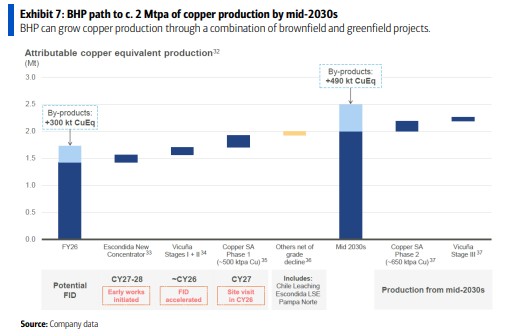
BHP has become the most typical case—its copper business's profit contribution has now surpassed that of iron ore, becoming the group's largest profit source. BHP claims to have the highest EBITDA sensitivity to a $1 per pound increase in copper prices among large diversified miners. Although BHP is already the world's largest copper producer, the company still plans to increase copper production to over 2 million tons per year by the mid-2030s through a combination of brownfield and greenfield projects.
Rio Tinto is also actively transforming. Although iron ore remains an important product, the absolute growth of its copper and aluminum businesses has completely offset the decline in iron ore.
Glencore's copper growth options are more prominent, showcasing the strongest copper growth potential in the industry through a combination of brownfield and greenfield projects. The company is seeking partners for its projects, particularly for the El Pachon greenfield large project in Argentina.
Significant Increase in Capital Expenditures: Growth Story Regains Favor
Bank of America data shows that the capital expenditures of large miners have now recovered to over 50% of previous peak levels and are still rising. This indicates that companies have regained growth authorization, and investors are eager to hear growth stories.
However, project execution has been "mixed," with examples such as the Jansen project exceeding budget and the QBII project encountering technical issues. Notably, Glencore is seeking partners for its projects, reflecting the company's cautious attitude towards reducing single project risks.
On the specific project level, BHP is advancing its joint venture project with Lundin Mining, the Vicuña project, with the first phase expected to cost $7-8 billion and deliver approximately 300,000 tons per year of copper equivalent production. South32 has recent growth options of 20%, mainly from the Hermosa polymetallic project in the U.S. and the Sierra Gorda copper joint venture project in Chile
Commodities: Copper Prices Remain Strong, Gold and Silver Pull Back
Bank of America maintains a bullish stance on copper, predicting prices will reach $15,000 per ton.
Bank of America points out that there is an accumulation of inventory in the U.S., but not in other regions. Strategic reserves may indicate an increase in apparent demand. In terms of iron ore, prices continue to decline, and Bank of America believes that around $90 per ton is the cost support level. The market is paying attention to the dispute between BHP and China Mineral Resources Group (CMRG) regarding the pricing of Jimblebar ore.
Gold and silver have significantly pulled back from recent peaks, but this still implies huge implied free cash flow for related companies. Bank of America's commodity research team holds a bullish view on various cyclical commodities, forecasting copper prices at $11,750 per ton in 2026 and $13,688 per ton in 2027.
Early Signals of a Cycle Turn
Bank of America notes that classic "beginning of the late cycle" signals are emerging: resource currencies are strengthening—first the South African Rand, Chilean Peso, Brazilian Real, and now the Australian Dollar and Canadian Dollar. Oil prices have also rebounded from lows, and cost pressures have begun, although not severely. These signals remind investors to pay attention to cost inflation risks, although they do not currently pose a significant threat.
Bank of America's research team emphasizes that after three years of earnings downgrades, the industry has now entered a seven-month earnings upgrade cycle, which involves not only copper and gold but also coal, nickel, zinc, and other varieties. The core logic behind the performance of sector stocks lies in the combination of improved positioning and the earnings upgrade cycle
