The secret weapon of the South Korean stock market "leading the global rise": the president "was once a retail investor"

Wallstreetcn
2026.02.23 02:35
portai
I'm PortAI, I can summarize articles.

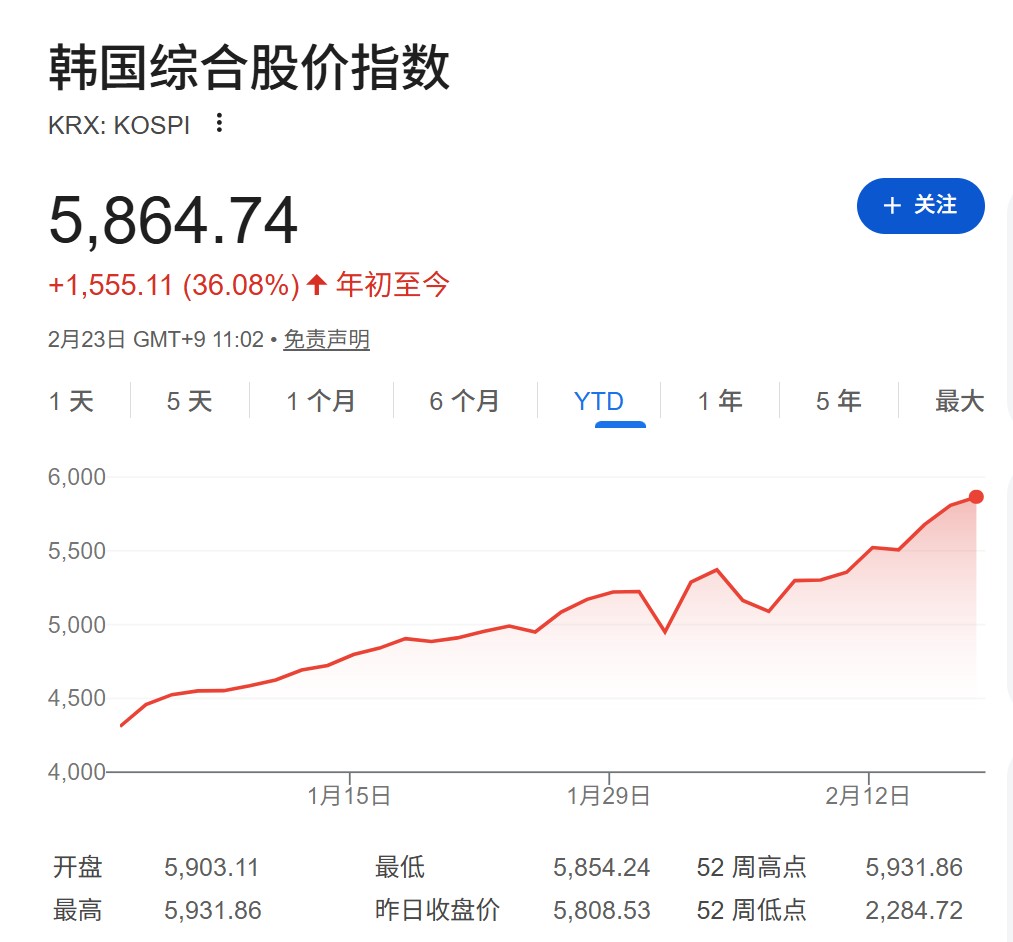
South Korean President Lee Jae-myung, drawing on his early experiences as a "retail investor" who suffered losses in stock trading, has initiated radical financial reforms after taking office by strengthening board accountability, reforming dividend taxes, and cracking down on market violations. These measures have propelled the Seoul Composite Index to rise 36% this year, far exceeding its "Kospi 5000" target. The reforms have shifted the wealth mindset of South Koreans from excessive asset concentration to financial investment

Before transforming South Korea into the hottest stock market in the world, Lee Jae-myung was just a trading novice in his thirties, losing money month after month. This painful experience of being "cut like chives" has now become the driving force behind this South Korean president's push for financial reform—he firmly believes that the losses of those years were exacerbated by unfair trading practices of major shareholders.

Since taking office in June last year, Lee Jae-myung has implemented a series of radical reforms, including rules for equal shareholder rights and strengthening board accountability. These measures have ignited the largest stock market rally globally. On the 23rd, the Seoul Composite Index in South Korea expanded its gains to 2%, having risen 36% this year, with a cumulative increase of 115% since Lee Jae-myung took office, far exceeding his campaign target of "Kospi 5000."

This rally has made Lee Jae-myung a "folk hero" among South Korea's 14 million retail investors. According to a Gallup Korea survey, his approval rating rose to 63% in mid-February, reaching a new high in over three months. Reform is also reshaping the wealth perception of South Koreans—real estate once accounted for nearly three-quarters of household assets. KB Securities global investment strategist Peter S. Kim stated, "The excessive concentration of real estate relative to financial assets is about to reverse, which is one of the most profound trends in South Korea over the next decade."

However, analysts attribute only part of the credit to Lee Jae-myung's reforms. Mixo Das, head of Korea equity strategy at JP Morgan, pointed out that the global AI boom has driven up Korean tech stocks like Samsung Electronics and SK Hynix, stating, "Reform is important and does help with valuations, but to say that the Kospi rose to 5000 solely due to government policy may exaggerate the impact." Many economists express the need for more evidence to prove that the stock market rise genuinely promotes growth; otherwise, even within Lee Jae-myung's party, there are concerns that his obsession with the stock market may ultimately backfire.

From Retail Losses to Reform Determination

Lee Jae-myung's early career was filled with challenges. According to media reports citing a close aide, Lee Jae-myung realized early on that public service offered meager income, so he began trading stocks as a side job, but it did not go well at first. "I became a day trader, trading all day... Looking back now, it was completely reckless," he recalled in an interview on the popular retail investor YouTube channel 3Pro TV, "I lost everything and was completely wiped out."

According to media reports citing several individuals close to Lee Jae-myung, what troubled him was not poor trading skills, but rather the unfair trading practices of major shareholders that repeatedly amplified his losses at the expense of ordinary investors. South Korea's commercial regulations bind board members' interests to those of major shareholders rather than all shareholders, further exacerbating this imbalance. Investors have flagged several transactions as warnings, including the 2015 merger of two Samsung affiliates, despite Elliott Management warning that the low acquisition price would harm shareholder interests In 2022, Lee Jae-myung first ran for president as a Democratic Party candidate with the slogan "Kospi 5000." "I believe Kospi 5000 is not difficult," he stated on the 3Pro TV YouTube channel, "If you believe in me, you should be more interested in the stock market." He lost to Yoon Suk Yeol by the narrowest margin in South Korean history, as voters were disappointed with the previous Democratic government's failure to address housing and economic inequality.

Exceeding Expectations in Reform Outcomes

Last June, Lee Jae-myung regained voter trust by relying on the Kospi 5000 promise to become president. Investors were initially skeptical of his campaign, with Namuh Rhee, chairman of the Korea Corporate Governance Forum, stating that past reforms "have never succeeded regardless of which party is in power." However, within a month of taking office, Lee pushed for amendments to expand the scope of fiduciary duties to enhance board accountability, reformed dividend taxes to encourage payouts, expanded enforcement resources to combat market violations, and announced a roadmap for achieving developed market status through MSCI inclusion.

"Every promise made by previous governments has been disappointing, but this time is different," Rhee added. Oh Gi Hyoung, a Democratic Party lawmaker leading the Kospi 5000 special committee, stated, "The pace of the rise has far exceeded our expectations." The committee was recently renamed the K Capital Market Committee.

To demonstrate his determination, Lee purchased 40 million won (approximately $27,600) worth of domestic stock market ETFs just days before the June election and pledged to invest 1 million won monthly for five years after taking office. As of September, these investments had a return rate of 26.4%. Last year, the head of the financial regulatory agency also sold an apartment in the affluent Gangnam district of Seoul to buy exchange-traded funds.

Doubts and Challenges Persist

Despite the strong momentum, challenges remain. The South Korean economy contracted in the fourth quarter, highlighting the difficulty for the Lee Jae-myung administration to turn things around. A lack of strong protections for minority shareholders and sluggish growth have led many retail investors to remain cautious during the rally, driving capital outflows and record inflows into the U.S. stock market, which in turn weakened the won. Democratic Party lawmaker Park Hong Bae stated, "Lee Jae-myung may believe that if we do not take any measures to address the deep distrust in the capital market, we may ultimately see all citizens investing in U.S. stocks."

Some party insiders are concerned that Lee must prove he can elevate the prosperity level of all South Koreans—not just the wealthy—by addressing inequality. South Korean households bear one of the highest debt burdens globally, which Lee himself has referred to as a "ticking time bomb," largely a result of soaring apartment prices. Meanwhile, decades of export-oriented growth have made the economy highly sensitive to global demand shocks, making the conversion of stock market gains into wealth effects even more critical.

Last month, Lee stated at a cabinet meeting that South Korea's long-underestimated capital market "is becoming a solid foundation for the growth of future innovative industries and the healthy accumulation of national wealth." The presidential office stated in a statement to Bloomberg News that it is working to enhance trust in the stock market by curbing manipulation and promoting long-term investment

Next Agenda

The real estate market remains overheated, despite repeated efforts by officials to curb speculation, and regional disparities still exist. However, a recent report by KB Financial Group pointed out that the allocation priorities of high-net-worth individuals between domestic real estate and stocks have become more aligned, which is a rare sign of rising market interest.

At the beginning of February, Lee Jae-myung issued an unusually stern warning to homeowners, stating that he was giving them a "last chance" to sell excess housing before the government raises real estate taxes, and vowed to curb housing prices "at all costs." His government announced last month plans to accelerate new housing construction as part of supply-side reform. His next priorities include eliminating share buybacks, rooting out insider trading and other illegal activities, and delisting unprofitable zombie companies.

Lee Jae-myung likes to remind everyone in public speeches that he was once a "big ant." One day, when his political career eventually ends, he will settle down and once again invest time in stock trading