Wall Street in-depth interpretation "Trump's IEEPA tariffs rejected": tariffs may be reduced in the second half of the year, tax rebates may become comprehensive stimulus, potential industry benefits

Wall Street analysts believe that although the government quickly initiated alternative tariffs, the effective tax rate has slightly decreased, and the policy has become more moderate after July. The core variable of the ruling is the potential tax refund of up to $180 billion, of which about $120 billion may be converted into middle-class stimulus payments before the midterm elections. As the transmission of inflation has largely been completed, the direct impact of this ruling on economic growth and prices is limited, but it may support the economy through fiscal expansion and lead to a weaker medium-term trend for the dollar due to the constraints on tariff tools
After the U.S. Supreme Court overturned the tariffs imposed by Trump under the International Emergency Economic Powers Act, major Wall Street investment banks believe that this ruling will have limited actual impact on the economy and markets, but it creates space for a more moderate tariff policy in the second half of the year, potentially leading to a voter rebate plan worth up to $120 billion. Analysis from Goldman Sachs and Morgan Stanley shows that the effective tariff rate has only slightly decreased by about 1 percentage point, inflation transmission has basically been completed, and the expiration of tariffs after July will force the government to take more exemption measures.
According to CCTV News, on the 20th, the U.S. Supreme Court ruled that the U.S. government's imposition of large-scale tariffs was "overreaching." The Supreme Court ruled 6-3 that the tariffs implemented by the Trump administration under the International Emergency Economic Powers Act (IEEPA) were unconstitutional. According to CCTV, on the 21st, Trump announced that the newly imposed "global import tariff" rate would be raised from 10% to 15%. These tariffs will last until July 24, after which more permanent tariff measures may be implemented under Section 301.
Goldman Sachs estimates that after the policy adjustment, the effective tariff rate increase since early 2025 will drop from slightly above 10 percentage points to about 9 percentage points, which is basically in line with market expectations. Morgan Stanley pointed out that if the current tariff structure is shifted to different legal authorizations and remains largely unchanged, and the rebate scale is limited (estimated at $85 billion as a midpoint), corporate spending or hiring intentions will not see significant changes.
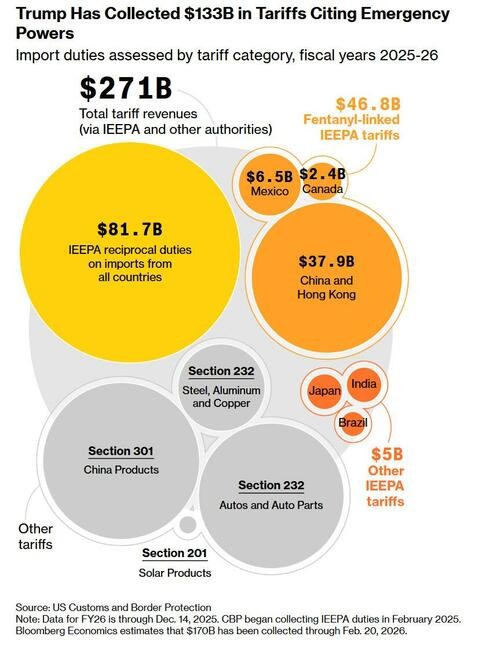
The rebate issue still carries significant uncertainty. The Supreme Court did not specify whether the government must refund the tariffs or the specific timeframe for doing so. Goldman Sachs estimates that approximately $180 billion in IEEPA tariffs have been collected, most of which will be refunded in batches over the next year. Since U.S. consumers bear about 90% of the tariff burden, this actually provides Trump with an opportunity to directly distribute up to $120 billion in stimulus payments to the middle class before the midterm elections.

The actual reduction in tariff rates is limited, and inflation pressure has peaked
Although the Supreme Court overturned the IEEPA tariffs, Wall Street believes that the impact on inflation and economic growth will be extremely limited. Goldman Sachs' analysis shows that the transmission of tariff costs to consumer prices has basically been completed.
Goldman Sachs estimates that as of January, tariff transmission has caused the core Personal Consumption Expenditures (PCE) price index to rise by about 0.7%, and will only raise prices by an additional 0.1% for the remainder of 2026. For goods that have been subject to tariffs for 10 months, the transmission rate has exceeded 60%, and the incremental transmission after the first five months is minimal, indicating that most of the price transmission was completed before the Supreme Court ruling. Goldman Sachs assumes that the transmission rate will peak at 70% Goldman Sachs' chief political economist Alec Phillips pointed out that although the effective tax rate has slightly decreased, the bank expects no net deflationary effect for the remainder of 2026, as the pace at which companies lower prices in response to tariff reductions is far slower than the pace at which they previously raised prices due to tariff increases. However, in the future, the price increases for most goods facing tariff reductions will be lower than usual levels.
In terms of economic activity, the latest changes will most directly impact U.S. imports. Tariff rates for certain countries will significantly decrease, and exports to the U.S. from these countries may rebound from low levels in the first and second quarters. However, Goldman Sachs believes that the impact on GDP should be offset by increased inventory accumulation, reduced imports from other transshipment trade countries, and a slight decline in imports from countries with increased tariffs.
Goldman Sachs has set its GDP tracking estimate for the first quarter of 2026 at 3.4%, which includes a 1.3 percentage point contribution from the end of the government shutdown in the fourth quarter of 2025, meaning that the potential growth rate, excluding this special factor, is a more moderate 2.1%. The bank maintains its forecast for a year-on-year growth of 2.5% in the fourth quarter of 2026, which is an acceleration of 0.3 percentage points compared to the year-on-year growth of 2.2% in the fourth quarter of 2025, partly reflecting the positive changes from the easing of tariff drag and the boost from tax cuts.
Tariffs may ease after July, with an expanded exemption scope expected
The statutory limitations of Section 122 provide Wall Street with key clues that tariff policy may shift towards moderation. This provision sets the tariff cap at 15% and limits the implementation period to 150 days, "unless Congress passes a bill to extend this period." The executive order signed by Trump on February 20 clearly states that the current tax rate will expire on July 24.
Morgan Stanley believes that although Trump quickly announced an increase in Section 122 tariffs to 15%, the president is expected to implement a more moderate tariff policy behind the scenes. This means more exceptions, exemptions, and extensions, consistent with recent measures taken by the government in the past few months. This could provide benefits for countries and products that are ultimately not included in the new Section 232 or Section 301 investigations.
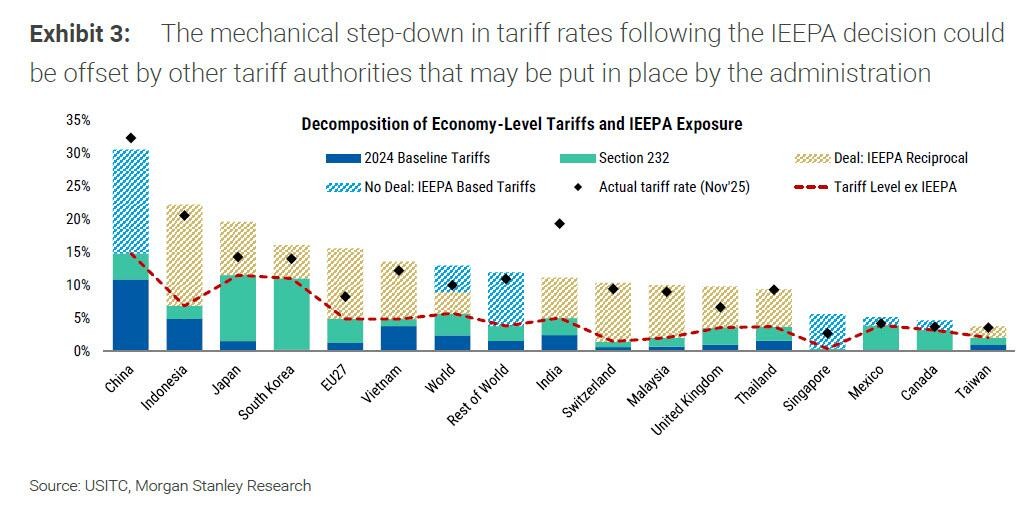
Goldman Sachs has analyzed the tariff changes faced by different trading partners in detail. Some larger economies, particularly the European Union, Japan, and Switzerland, previously reached agreements with the Trump administration to implement a maximum tax rate of 15%, including existing U.S. tariffs (which typically range from 0-2.5%). These trading partners may now face incremental tariff increases, as the 15% rate will now "stack" on top of existing U.S. tariffs.
On the other hand, Goldman Sachs expects several other trading partners, which account for slightly more than half of U.S. imports in 2025, to have agreements with the U.S. and are less likely to be prioritized for Section 301 investigations. This includes Argentina, Australia, Bangladesh, Cambodia, Ecuador, El Salvador, the European Union, Guatemala, India, Indonesia, Japan, South Korea, Malaysia, Switzerland, Thailand, the United Kingdom, and Vietnam.
Goldman Sachs anticipates that countries accounting for about 10% of U.S. imports face the greatest risk of recent Section 301 investigations, including Brazil and South Africa. Overall, Goldman Sachs expects the recently announced 15% tariff rate to persist until the end of the year, with the exemption scope being the same as IEEPA tariffs, but by early 2027, the government will use Section 301 and other authorizations to restore tariff rates to levels close to those before the Supreme Court ruling Morgan Stanley pointed out that risks point in different directions at different times. After July, the risk tends to lean towards lower tariffs, as the government may find it difficult to fully replace the soon-to-expire Section 122 tariffs with other authorizations. However, after the midterm elections and into early 2027, the risk leans towards higher tariffs.
Refund Procedures in Doubt, May Become Stimulus Tool for Midterm Elections
The issue of refunds could evolve into the biggest fiscal policy variable in 2026. The Supreme Court has not ruled on whether the Trump administration must refund tariffs or refund them within any specific timeframe. Justice Kavanaugh reiterated in a dissenting opinion that the refund process "could be a mess."
Nevertheless, the imposition of tariffs may cease immediately. Given that the Supreme Court has broadly overturned the IEEPA tariff authorization, continuing to impose tariffs would lack legal basis. This could lead to long-term uncertainty, as the refund issue will be left for lower courts to review.
Goldman Sachs estimates that approximately $180 billion in IEEPA tariffs have been collected to date, most of which will be refunded in batches over the next year. In the past, refunds were initially limited to companies that proactively filed complaints or lawsuits through procedures established by Customs and Border Protection (CBP) or the Treasury Department, which could ultimately limit the scope of refunds.
However, analysis indicates that various politicized media have calculated that American consumers bear 90% of the tariff impact, which effectively allows Trump to distribute stimulus payments to the American middle class before the midterm elections, directly depositing up to $120 billion (about 90% of the $133 billion IEEPA tariff refunds) at some point. This could be termed the "2026 Trump Tariff Refund Stimulus Plan."
Morgan Stanley believes that if importers receive refunds but must repay those refunds in the form of additional future import tariffs, this is close to the status quo outcome. However, if the government chooses to let the effective tariff rate decline during the completion of the new Section 232 and Section 301 investigations (most likely to occur later this year or in 2027), this would lead to temporary downward pressure on inflation and delay the time businesses pay new import tariffs until 2027, thus holding a more constructive view on economic activity growth.

Market Impact: US Treasuries Under Pressure in the Short Term, Dollar Weakens in the Mid Term
Wall Street's views on the market impact of the ruling have diverged, with significant differences in short-term and mid-term logic.
In the US Treasury market, Morgan Stanley believes that, given the government will use other existing authorizations to reimpose tariffs, investor expectations for the recent path of the fiscal deficit are unlikely to change. Regarding refunds, the Supreme Court's ruling "today made no indication of whether and how the government will refund the billions of dollars collected from importers" (citing Justice Kavanaugh's dissenting opinion).
Before investors understand the specific contours of the Supreme Court ruling, they may perceive risks leaning towards higher rather than lower Treasury yields. As expected, the initial market reaction was for investors to sell Treasuries, as they believe this will force the Treasury to increase bond issuance more quickly However, Morgan Stanley expects that this reaction will not last long, as most investors will eventually realize that the potential issuance increment brought about by this ruling will consist of short-term Treasury bills. Another important consideration is that, although the Treasury may face additional obligations, it does not need to wait until the tax refund time to start building the Treasury General Account (TGA) balance. Therefore, Morgan Stanley believes that the second round of more sustained reaction will be investors "buying the facts" and pushing yields lower, as their focus will return to the downside risks of inflation.
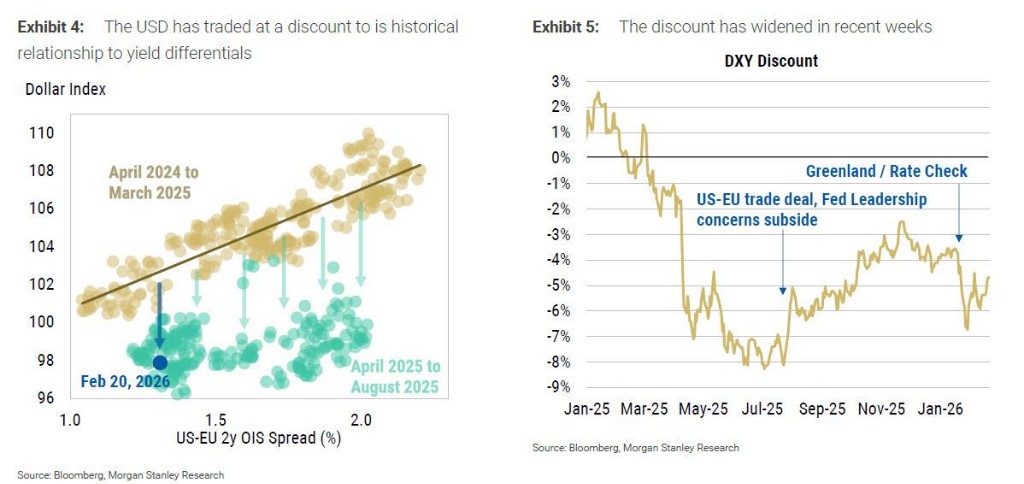
In the dollar market, Morgan Stanley expects that the U.S. government's use of immediate tariff authority as a tool of foreign policy will have less room, which may marginally reduce the negative risk premium associated with investors being cautious about holding dollar exposure.

However, offsetting factors may maintain (or even expand) this negative risk premium for the dollar, including geopolitical uncertainty and questions surrounding U.S. monetary policy. Additionally, the mechanical positive impact on global growth (as implementing tariffs under different authorizations takes time and may be implemented at lower levels) may boost global growth expectations, further dragging down the dollar. Therefore, Morgan Stanley continues to expect a decline in the dollar.
Goldman Sachs emphasizes that tariff rates for some countries will significantly decrease, and imports from these countries to the U.S. may rebound from sluggish levels in the first and second quarters, although the impact on GDP should be offset by other factors. This change in trade flows will also have differentiated effects on the currencies of different countries.
Overall, Wall Street believes that while the Supreme Court ruling has significant legal implications, its economic and market impact is relatively mild. The real uncertainty lies in the tariff path choices after July and how tax refunds translate into actual fiscal stimulus, both of which could bring unexpected positive impacts to the market in the second half of the year