Google executives respond to AI bubble concerns: This is an industrial revolution, but 10 times faster and 10 times larger

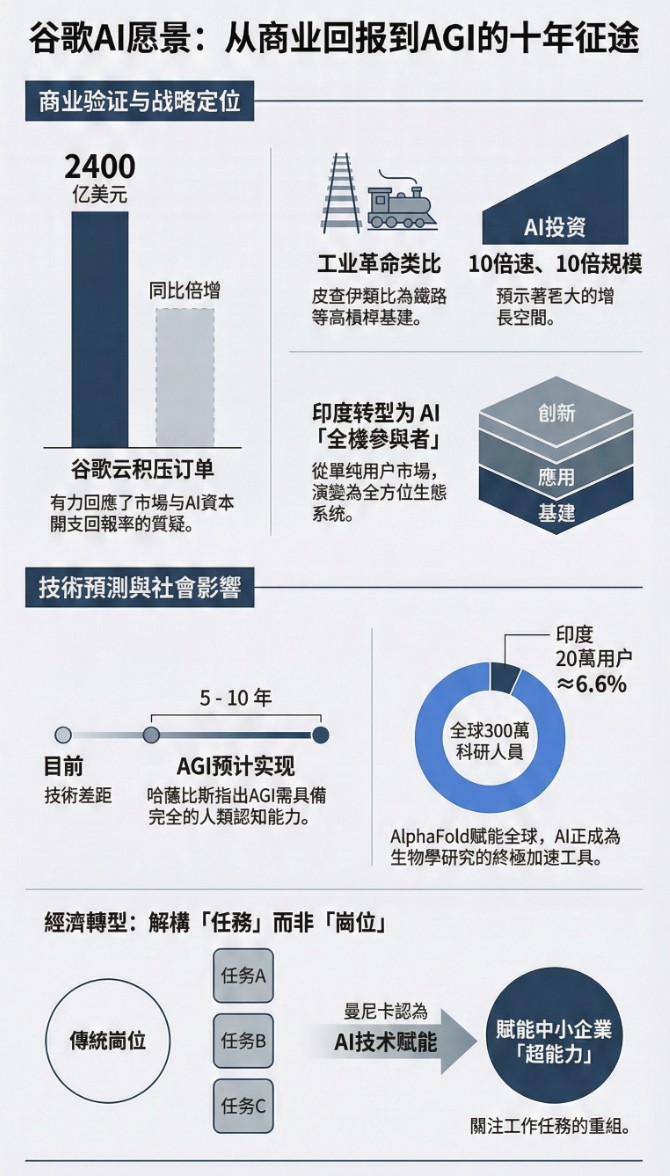
The CEO of Google revealed at the AI summit in India that Google Cloud's backlog of orders has doubled to $240 billion, demonstrating the rationale for high capital expenditures. The CEO of DeepMind predicts that achieving general artificial intelligence will still take at least 5-10 years. Google executives unanimously believe that AI will fundamentally change the workflows of small and medium-sized enterprises and scientific research, with India transforming from a mere market into a "full-stack builder" in the AI field

The core management team of Google gathered in India, responding to market concerns about massive capital expenditures while disclosing key business data and comparing the current AI wave to an "industrial revolution at ten times the speed."
On February 18, at an AI summit held in India, Alphabet (Google's parent company) CEO Sundar Pichai, Google DeepMind CEO Demis Hassabis, and Google Senior Vice President James Manyika appeared together rarely.
In the face of market skepticism regarding the return on investment in AI and concerns about an "AI bubble," the Google executive team elaborated in detail from three dimensions: the technology evolution cycle, commercialization data validation, and future macroeconomic impacts. Pichai revealed during the discussion that Google's cloud business backlog orders have doubled year-on-year, reaching $240 billion.

Addressing the "Elephant in the Room": This is Not a Bubble, It's New Infrastructure
As tech giants' capital expenditures on AI infrastructure continue to rise, Wall Street's anxiety about the cost recovery cycle is increasing. In response to the host's question about "how CEOs prove the cost rationality to the board," Pichai candidly compared the current AI moment to significant infrastructure cycles in history. Pichai stated:
"In some contexts, people talk about this as an industrial revolution, but ten times faster and ten times larger."
He likened the current AI investments to the U.S. railway system or the national highway system, believing these are highly leveraged investments that can drive tremendous growth and value.
To support this view, Pichai disclosed key data highlights:
" In just the cloud business, backlog orders have doubled year-on-year, reaching $240 billion. This indicates the potential for returns on the other side. Therefore, we are investing to meet this demand."
For Google, this investment not only serves the cloud business but also permeates emerging businesses such as search, YouTube, Waymo, and Isomorphic Labs. Pichai emphasized that given the technological advancements and the opportunities seen, "these investments are rational."
AGI Timeline: At Least 5 to 10 More Years
As the head of DeepMind, Hassabis provided a rigorous expectation for the definition and timeline of Artificial General Intelligence (AGI) Demis Hassabis has set a high standard for AGI, stating that systems must exhibit all cognitive abilities possessed by humans, including creativity, long-term planning, and better utilization of memory. He admitted that while today's systems are impressive, they have not yet reached that level. Hassabis said:
“I think we have a long way to go, at least 5 to 10 years.”
He views AGI as the ultimate accelerator for scientific discovery and revealed the latest progress of AlphaFold: currently, over 3 million researchers worldwide are using the tool, with more than 200,000 scientists in India alone utilizing AI for biological exploration.
Employment and Economy: Focus on "Tasks" Rather than "Jobs"
In response to the potential wave of unemployment triggered by AI, James Manyika proposed an analytical framework separating "Tasks" from "Jobs." Manyika pointed out:
“Most jobs are made up of different combinations of tasks... there may be some occupations that decrease, many that will grow, and even more that will change.”
He emphasized that there is a "lag effect" in technological change, meaning there is a time gap between the disappearance of old jobs and the creation of new ones.
For small and medium-sized enterprises, Manyika believes AI is the first technology that can fundamentally empower small businesses with "superpowers." Through collaborations like the "Vani project," Google is working to break down language barriers, allowing small business owners to build technological systems through voice commands without needing to become tech experts.
New Positioning of the Indian Market: Full-Stack Player
When discussing regional market strategies, Pichai has significantly changed his positioning of India. He no longer sees India merely as a vast user market but defines it as a "full-stack player" in the AI field. Pichai stated:
“I see Google as a full-stack company. I believe India will clearly also become a full-stack player in the AI space.”
He reflected on the transformation of "Digital India" over the past decade, believing that we are now at the "beginning of a decade-long AI transformation." From the vibrant developer ecosystem in Bangalore to the construction of local AI models, Google believes India has the potential for a comprehensive explosion in AI infrastructure, application layers, and innovation layers.
Here is the full translation of this Google executive interview:
Host:
Good afternoon, everyone. Sundar, Demis, James, you know, sitting here with the three of you feels like, it feels like a renaissance of AI. It’s like the three greats of the AI field have gathered together. It’s amazing. And you’re here in India at a time when the AI wave is sweeping across the country. When you attend the AI summit in India, what is the one thing you are most looking forward to? Let’s start with a quick-fire round. So, similarly, let’s start with you, Sundar.
Sundar Pichai:
Okay, maybe I would say, look, this is a transformative moment. Thinking back to about ten years ago when I came to India, seeing the transformation of "Digital India" and the similar excitement at that time makes me a bit nostalgic. Witnessing the progress over the past decade has been extraordinary So from a certain perspective, this feels like the beginning of a decade-long AI transformation. So, it is transformative.
Demis Hassabis:
Well, I actually just came from Bangalore, where I gave a talk at the Indian Institute of Science and Technology. The graduate students there left a deep impression on me; they were full of energy. We held a large lecture with about 700 students. It was really interesting to see their enthusiasm and energy for AI, as well as their excitement about the opportunities we bring. So I think I could feel this atmosphere throughout the summit, and seeing this was really exciting.
Host:
You are now very good at exponential thinking. Imagine an exponent of 700. You would see about 50,000 people in one place, enthusiastic about AI. That’s what you’re going to see, James.
James Manika:
I think this is an extraordinary moment for India and the Global South to showcase a few things. First, driving adoption and demand is entirely possible. Secondly, building and innovating in the AI space is also entirely possible. I think we often assume these things won’t happen in the Global South. I think this is a great time to demonstrate that.
Host:
No, that’s great, Sundar. I’ll start with you because my job is to try to figure out the future. So I’d like to ask you to make a little prediction about the future of India. In your view, let’s think about five years from now, okay? What will success in AI look like for India? Will we be the largest user base? Will we be builders? Will we be rule-makers? If I could add one thing, what is one thing we must do now to achieve this? Whatever goals we set for ourselves, or what you think we should set as goals.
Sundar Pichai:
Look, I travel to many countries around the world, and I do think India is unique and has a unique advantage at this moment. I think it has the opportunity to play an important role in all three areas. I see Google as a full-stack company. I think India will clearly also become a full-stack participant in the AI space. I think to be able to do that, it’s important to ensure… I think that’s exactly what this AI summit is about.
Sundar Pichai:
You have to ensure investment in all the foundational things you need: research, knowledge, and the institutions you have here. The government needs to promote AI across the country and in the economy to ensure it benefits the people. This means adopting AI in all areas and in a way that touches the daily lives of ordinary people, whether they are farmers, students, or doctors in healthcare, etc. And I think the foundation is being laid. You can see that just this week, the announcements regarding infrastructure investment illustrate this. So I think this lays a good foundation for India to achieve its goals. But I think the progress lies in promoting this technology, and I believe India can play a role in all three of these areas
Host:
So, changing the lives of women at the bottom of the food chain, that's what success should look like, right?
Sundar Pichai:
Absolutely right.
Host:
Okay, great. Demis, next I want to ask you. You know, I'm a huge fan of your work. You know, with AlphaFold, the most fascinating aspect is not just what it can do, but how many researchers, how many scientists it enables to explore and discover things that just a few years ago we couldn't even imagine discovering, right? For me, that's the real draw.
Host:
So, when you think about it, there are many problems to solve, but when you think about India, if we had to make one or two strategic bets, right, what should they be? In which areas do we want to deeply invest and make commitments, and say this is where we want to be a global leader? Healthcare, education, which two would you prioritize?
Demis Hassabis:
Well, first of all, I mean, we are very proud of the impact that projects like AlphaFold have generated. There are now over 3 million researchers globally using it, and actually over 200,000 in India alone. And, you know, almost every biologist and researcher in the world is using it. I think this is just the beginning of the impact that AI will have on science and medicine. I feel India can play a very dominant role in applying AI to science.
Demis Hassabis:
Perhaps what I want to say to India, and to many countries (I'm also advising the UK on this), is to double down on areas where you are already strong and important to the nation, like agriculture, and then become a leader in applying AI to areas where you are already world-leading. So I think agriculture, that's a topic I've discussed today with some ministers, like using AI to make crops adapt to climate change, and perhaps using tools like AlphaFold to help achieve that. Then another area might be Bollywood and the creative industries, leveraging the latest AI tools. In fact, James just mentioned, maybe he can talk about this.
Host:
How will DeepMind collaborate with the Indian government on such moonshot projects?
Demis Hassabis:
We are collaborating in various ways, all those that Sundar just announced. And we are ready and able to collaborate in a deeper way if the government is willing, whether through our main foundational model Gemini, our scientific tools like AlphaFold, or our open-source work like Gemma. So I think we can help the Indian government do a lot of things.
Host:
James, I want to ask you about the elephant in the room that everyone wants to know about, which is the current employment issue. I was listening to some of your comments at Davos earlier, very interesting, you talked about how with every technological change, jobs change, disappear, and then new jobs are created, but they don't happen simultaneously There is a lag. So there are two questions. First, how does the government address this lag, especially in countries like India with a young population structure? Second, what must we do to ensure that we ultimately become job creators?
James Manyika:
No, I think this might be one of the most important questions that nations, governments, and societies need to think about. I think it’s important to remember that when you think about the issue of AI and employment, what’s actually worth considering are the specific tasks, rather than the entire job.
Because most jobs are made up of different combinations of tasks. When you look at it this way, you suddenly realize that, as you said, there may be some occupations that decline, many that will grow, and even more that will change. I think it’s important to keep this in mind. So when you examine these issues sector by sector or occupation by occupation, you will see that a lot of transformation is underway. But back to the question of what the government should do to ensure they are actually creating jobs and facilitating change. I think one is to focus on scaling. In all these transformations, whether people are transitioning from declining jobs to growing jobs, or the jobs themselves are changing, one thing that will happen is that the required skills are changing. So investing in skills, spreading knowledge, etc., I think that is foundationally important. Another important thing is the kind of investment that countries and governments like India continue to make, investing in infrastructure and innovation. Because a lot of the growing jobs will come from these infrastructure investments and innovation investments. When you grow businesses, develop companies, and have innovation in the economy, that leads to job growth. So I think these investments in innovation, including both infrastructure and innovation itself, as well as skills, are the focus that governments need to pay attention to.
Host:
I think what you said is very important; you cannot just have a macro view of employment. You need to start understanding which specific tasks will be affected. You need to start planning for that. You need to start planning which industries will be impacted. So we do have some work to do to figure out where we will be hit hardest, where the opportunities are, and then plan accordingly. I think that’s an excellent suggestion. I completely agree. Now, Sundar, back to you, the other elephant in the room, will we see an AI bubble, or not? Right now, many CEOs, when you hear them talking with corporate CEOs, they are concerned about whether to scale investments massively because they worry about justifying the costs, what the board will say, and so on. Based on your experience, based on Alphabet's experience, please help us understand how CEOs should handle this issue and challenge today.
Sundar Pichai:
You know, we live in a truly globalized world. I thought I could avoid this issue by leaving the United States, but I cannot. Look, this indicates that I think this is an extraordinary moment. I think we are investing to meet that moment, right? I think in certain contexts, some people talk about this being an industrial revolution, but ten times faster and ten times larger. If you look back at the investment in American railroads or the national highway system, I mean, these are investments with such leverage. You know, on this basis, you drive tremendous growth and value.**
I think this is a transformative moment like that. As Google, I think we are fortunate, you know, we have been focused on this technology for over a decade, whether it's search, YouTube, cloud, or emerging businesses like Waymo and Isomorphic Labs, all benefiting from this. I think they are all getting better and growing faster based on this underlying technology. We can generate returns there. Just to give one example, the backlog of our cloud business has doubled year-on-year in the past year, reaching $240 billion. This indicates the return potential on the other side. Therefore, we are investing to meet this demand.
You know, that's what makes this moment so exciting. So, given the progress we are seeing, the technology, and the opportunities we see based on this, I think these investments are justified.
Host:
Demis, I have to ask you about the elephant in the room, which is what exactly is general artificial intelligence?
Demis Hassabis:
Because…
Host:
You know, we keep hearing about it, and the more we hear, the more it feels like we are trying to build something that will control all of us. Then the question is, why are we building it? So, is the ultimate goal really to control? Is the ultimate goal to enhance prosperity? Please help us understand your perspective. Also, how should India think about general artificial intelligence? Or if we need to prepare, what should we do?
Demis Hassabis:
Well, first of all, I want to say that the reason I have dedicated my entire career to AI is that I believe it could be the ultimate tool for accelerating scientific discovery and advancements in fields like medicine. So things like AlphaFold, I hope it will be the first of many advancements that demonstrate this. Then we can apply it to help solve many of the challenges society faces today, from diseases to climate change to inequality.
So I think, from a positive perspective, the opportunities of AI and AGI are limited only by that potential. In terms of how to define AGI, I have always set a high standard for AGI, which is a system that exhibits all the cognitive abilities that humans possess.
The reason it's important to use humans as a reference point is that the brain is the only evidence we have, the only proof of existence we have, that general intelligence is possible. So it's a bit like, unless it can do many things that we sometimes take for granted, we won't really know we have a fully general system. You know, things like creativity, long-term planning, better utilization of memory. So today's systems, they are impressive, but in my view, they have not yet reached that level. I think we have a long way to go, at least another 5 to 10 years. ** But of course, in the next phase, over the next ten or twenty years, I see it as an ultimate enhancement tool for us and science, you know, for human scientists, human experts, and for today's young people. This is the exciting part I saw during this visit to India — they will be able to use these incredible tools. So whatever that means, you know, starting businesses, creating art, I think they will almost be empowered with superpowers to do these things because they can use these tools anytime and anywhere, including in India, where they can access the world's top tools. So I think this will be a very exciting moment.
But there are also some risks we need to consider. You mentioned employment before, but there are also technological risks, ensuring these systems stay within their guardrails, serving our purposes and what we want as humans. Additionally, there are economic issues, namely how to share the benefits it will bring widely and equitably with the whole world. So these are all huge challenges that we still face in the future, but you know, if we do it the right way, the potential is there.
Host:
Listening to you, I suddenly thought of one point, which is that we are all talking about questioning the role of humans in the world of AI, and we don't know what the future will look like. But what you just said seems to tell me that the role of humans will become more important, right?
Demis Hassabis:
That's right, I think looking ahead to the next few decades, this will be our way. If you think about today's AI systems, they are passive systems. They are impressive, but they require you, the human user, to put in the effort and ask the questions. Even in the scientific field, we have to provide hypotheses and the right research questions. Then these tools will help us find answers faster. So I think this will be the next phase of the AI development story.
Host:
James, back to you. Sundar talked about his vision of success being when the last person in the value chain is empowered. Now in India, we have a very strong small and medium-sized enterprise sector, small micro-enterprises. They are indeed the backbone of our economy, right? In terms of technology adoption, they always lag behind. I mean, I ask you the same question. What should success for AI look like? But from the perspective of small and medium enterprises, what would your answer be?
James Manika:
I actually think this is one of the most exciting opportunities because for a long time, most small and medium enterprises, whether in developing or developed countries, frankly, in any economy, they have always lacked the capabilities and power that large companies have. I think this could be the first technology that fundamentally changes that. You could argue that the internet and mobile technology have done part of it, but this technology goes deeper.
Imagine what kind of superpowers this technology could bring to small and medium enterprises. Imagine a small and medium enterprise, it could be a trader, a retailer, or a small manufacturer making handicrafts. But imagine the ability to leverage technology without having to be a technology expert Imagine a small business owner who can describe the technology system they want for their small business in a way that is almost like "atmospheric coding," or by describing what they want. Then these systems can be built. So I think this superpower being available to small businesses would be extraordinary and exciting. I believe this potential is especially huge for countries like India and those in the Global South, where small and medium-sized enterprises are the largest part of the economy, reaching more people and more lives.
Now, you know, one thing we hope to contribute to this is that we are currently collaborating on the "Vani Project," for example, working with the Indian Institute of Science and Technology to explore how to make these technologies more accessible and usable in all languages. So we are currently very focused on, for example, Indian languages, how do we achieve this? How do we enable direct voice translation without going through a keyboard? We are already conducting research in this area. So I think these are some possibilities for small and medium-sized enterprises, and I am very excited about it.
Host:
That's great. We don't have much time left, so I'll let Sundar answer. You know, India has leapfrogged in every technological revolution. We went straight into the mobile era, the digital payment era, and so on. Everyone is talking about the leapfrogging opportunities of AI. What does that mean to you? If you were to describe it, what would it look like?
Sundar Pichai:
Okay, that's a great question. I think that's exactly what this opportunity represents. Look, I mean, it's a bit hard to describe, but I do expect every industry, every environment, and every workflow to be transformed by AI. So for me, you know, we are working with AIMS in India to explore how patients can input their symptoms or provide information, and then AI generates reports to assist doctors. We are still in the early stages of such projects. But for me, leapfrogging means fundamentally changing how workflows operate in every such industry. I mean, how do students learn? How does your hospital system operate? How does the government become more efficient in profound, foundational ways? I do believe that in fields like science, one of the things Demis and his team have been focused on is how to accelerate scientific discovery at a foundational level. I think what we are talking about here is a technology that allows you to create new things at an incredible, rapid pace. So I think, aside from knowing it will happen in a quite profound way, it's hard for us today to fully envision it. But in reality, I expect that on a day-to-day basis, people's lives will be significantly improved in every aspect they encounter.
Host:
One last question for you, Sundar. We are known for our talent, our young talent. We are very proud of people like you who go out and achieve such extraordinary accomplishments. But what does India need to change? So that the next Sundar, or Sundar 2.0, can stay here and build the most amazing AI company in the world in India
Sundar Pichai:
Well, I think, I mean, the situation has changed, you know, when I see, I mean, India has birthed many extraordinary companies, right? You know, when you look at companies like Flipkart and Ola, they have all grown locally here and are doing very well. Every time I come to India, I can feel the vibrancy of the developers here. You were recently in Bangalore, you know, it's unmatched, top-notch. The startup ecosystem here is thriving, you know, even some recent work by institutions developing local AI models reflects this. So I think what you are talking about is actually happening. And, you know, I don't see any obstacles. I think India is in a very favorable position.
Host:
Okay. Thank you very much to all three of you