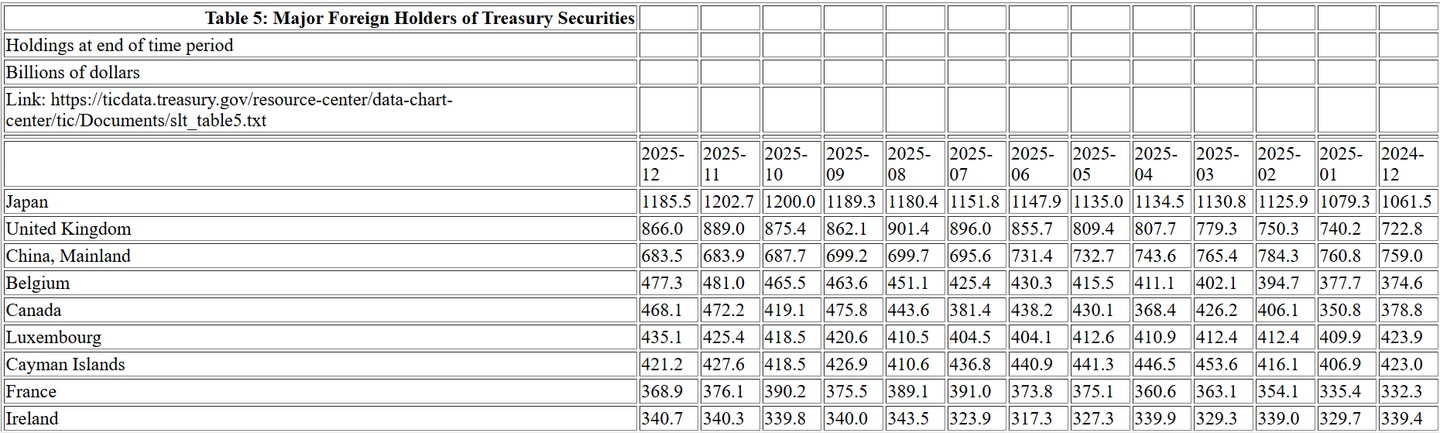
Last year, investors outside the United States accelerated their purchase of U.S. financial assets, but holdings of U.S. Treasury bonds decreased in December

In 2025, overseas investors net purchased USD 1.55 trillion of long-term financial assets in the United States, up from USD 1.18 trillion net purchases the previous year. In December, foreign investors' holdings of U.S. Treasury bonds decreased by USD 88.4 billion, falling to USD 9.27 trillion, the lowest since October; among them, Japan's holdings decreased by USD 17.2 billion to USD 1.19 trillion; the UK's holdings decreased by USD 23 billion to USD 866 billion; and mainland China's holdings decreased by USD 400 million
The U.S. Treasury Department reported on Wednesday that in 2025, the pace of U.S. financial asset purchases by foreign investors accelerated, primarily driven by demand for stocks and U.S. Treasury bonds, which strongly counters the increasingly popular narrative of "Sell America":
In 2025, overseas investors net purchased $1.55 trillion in U.S. long-term financial assets, up from $1.18 trillion in net purchases the previous year. Of this, $658.5 billion flowed into stocks, and $442.7 billion into U.S. Treasury bonds, including medium- and long-term bonds.
U.S. President Trump has repeatedly threatened to significantly raise tariffs, raising market concerns that foreign investors might sell U.S. assets and dollars. Previously, amid Trump's pressure on Denmark regarding Greenland, a Danish pension fund warned last month that it planned to exit its U.S. Treasury holdings. The largest pension fund in Europe, the Netherlands' Stichting Pensioenfonds ABP, also significantly reduced its exposure to U.S. assets last year.
However, U.S. Treasury Secretary Mnuchin has repeatedly rebutted the "Sell America" narrative, arguing that U.S. government economic policies have strengthened America's position as the preferred destination for global capital.
Industry insiders stated: "There are indeed geopolitical instability factors recently, making shorting the dollar popular. But fundamentally, U.S. Treasury bonds account for a large share of global sovereign debt holdings, and we do not believe this pattern will change."
Last year's dollar depreciation may have even encouraged some overseas asset managers to increase their holdings of U.S. securities. Analysts noted that this was the case after Trump's "liberation day" tariff announcement in April last year triggered significant market volatility. Data shows that cross-border investors took full advantage of the dollar valuation adjustment opportunity to increase their allocation to U.S. stocks. Although the allocation strength is not as robust as during the "American exceptionalism" period of 2023 to 2024, cross-border premiums still exist.
U.S. Treasury data indicates that many overseas investors were willing to increase their holdings of U.S. assets last year. In addition to stocks and Treasury bonds, net purchases of corporate bonds reached $327.8 billion. Net purchases of agency bonds, including Fannie Mae and Freddie Mac, amounted to $112.9 billion.
Major Countries and Regions' Holdings of U.S. Treasury Bonds

In December alone, foreign investors' holdings of U.S. Treasury bonds decreased by $88.4 billion, falling to $9.27 trillion, the lowest level since October. As the largest overseas holder of U.S. government debt, Japan's holdings decreased by $17.2 billion to $1.19 trillion; the UK's holdings decreased by $23 billion to $866 billion; and China's mainland holdings decreased by $400 million.
For the entire year, Europe contributed a net inflow of $872.8 billion in long-term financial assets (defined as those with maturities over one year). The Cayman Islands net purchased $277.2 billion, Japan net purchased $56 billion, and Canada $84.4 billion China net reduced its holdings of long-term U.S. financial assets by $208.6 billion. China's holdings of U.S. Treasury bonds fell to $683.5 billion by the end of the year, the lowest level since 2008.
The U.S. Treasury Department warns that identifying the ultimate holders of assets is challenging. Some of the largest net buying sources are regions known for tax advantages, such as the Cayman Islands and Guernsey; others are global financial custody centers, such as the UK and Belgium.
Other Key Points from TIC Data
The U.S. Treasury's TIC data also shows:
- In December, the total net foreign purchases of all long-term securities, U.S. short-term securities, and bank fund flows amounted to a net inflow of $44.9 billion. Among these, the net inflow from the foreign private sector was $32.7 billion, and from the foreign official sector was $12.2 billion.
- In December, foreign residents increased their holdings of U.S. long-term securities with a net purchase of $62.9 billion. Among these, foreign private investors net purchased $55.7 billion, and foreign official institutions net purchased $7.2 billion.
- U.S. residents increased their holdings of foreign long-term securities with a net purchase of $34.9 billion.
- After adjusting for factors (such as estimated portfolio investments by foreign investors in U.S. stocks through stock swaps), the overall net purchase of U.S. long-term securities by foreigners in December is estimated to be $28 billion.
- Foreign residents increased their holdings of U.S. Treasury bills by $9.7 billion. The total amount of U.S. short-term securities and other custodial liabilities held by foreign residents increased by $12.1 billion.
- Banks' net liabilities in U.S. dollars to foreign residents increased by $4.8 billion.
The U.S. Treasury's TIC data for January this year is scheduled to be released on March 18, 2026