U.S. stock market closed, tech stocks dragged down European stock rebound, gold lost "Chinese momentum" and fell below $5,000, and the RMB rose above 6.89

Wallstreetcn
2026.02.16 22:06
portai
I'm PortAI, I can summarize articles.

The pan-European stock index halted two consecutive declines, while the UK stock market rose for two consecutive days, reaching a new closing high. The banking sector rose over 1%, while the technology sector fell more than 1%. Japan's GDP was disappointing, and the yen stopped its five-day rise. The offshore yuan rose 200 points during the day, breaking 6.89 for the first time in nearly three years. Bitcoin surged and then fell back, briefly surpassing $70,000 before dropping nearly 4%. Gold fell over 1% during the day, and silver futures dropped over 4%; London tin fell over 2%, London aluminum declined for three consecutive days, and London copper retreated to a new low in over two weeks; crude oil turned to rise over 1% during the day

On Monday, global markets saw light trading due to holiday factors, but the performance of various assets was distinctly mixed. U.S. stocks were closed for Presidents' Day, while some Asian markets, including mainland China, were closed for the Spring Festival. European stocks rebounded slightly, driven by the financial sector, but technology and luxury goods stocks weighed on the gains. Investors remained focused on the Federal Reserve's interest rate cut path and the impact of artificial intelligence (AI) on corporate earnings.

With the Chinese market closed, gold and silver lost an important upward driver and failed to maintain the rebound momentum brought by last Friday's CPI boost after the interest rate cut, with gold falling below the $5,000 mark. News last Friday that the U.S. government plans to eliminate some steel and aluminum tariffs put pressure on the industrial metals market, while rising copper inventories weakened base metals.

Last Friday's U.S. CPI inflation data came in below expectations, reinforcing the Fed's interest rate cut expectations for this year. Traders have fully priced in the expectation of a rate cut in July and believe the likelihood of a cut in June has increased. This expectation supported a rise in bond market prices, with the benchmark 10-year U.S. Treasury yield hitting a nearly two-month low during trading last Friday. After the U.S. bond market was closed on Monday, UK bonds continued to rise, and German bonds stabilized.

Andrea Gabellone, global head of equities at KBC Securities, stated, "The stock market backdrop is positive following the CPI data release." However, he also pointed out, "More divergence may occur in the future, as sentiment around key AI-related sectors remains very critical."

This week, the market will welcome a series of important data, including the ADP private sector employment data to be released on Tuesday and the minutes from the Fed's January meeting to be released on Wednesday, from which investors will seek the latest signals on economic conditions.

Pan-European Index Rebounds Slightly, Bank Stocks Offset Technology Stock Declines

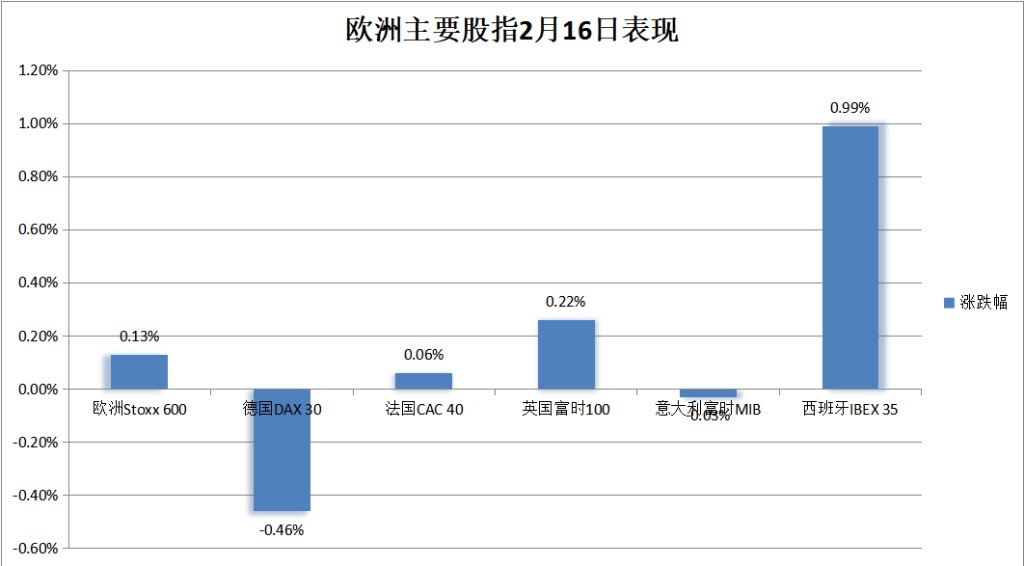
The pan-European index halted two consecutive declines on Monday. The Stoxx 600 index closed up 0.13% at 618.52 points, not continuing to fall away from the record closing high set last Wednesday.

Major European country indices showed mixed results on Monday. The German stock market, which rebounded last Friday, retreated, while the Italian stock market fell for the fifth consecutive day. The UK stock market rose for the second consecutive day, refreshing the record high set last Wednesday, while the French stock market, which had fallen for three consecutive days, and the Spanish stock market, which had fallen for four consecutive days, rebounded. The Spanish benchmark index, which has a significant weight in the banking sector, performed the best, closing up about 1%.

Bank stocks were the main driver of the rise in European stocks on Monday. Among the sectors in the Stoxx 600, banks, which had fallen over 5% last week due to concerns over AI disruption, rose more than 1.4%.

Among the constituents, UK bank NatWest rose nearly 4.8%, marking its largest daily gain since October 2025. This was after Citigroup analysts raised its target price to the highest level on Wall Street and upgraded its pre-tax profit and earnings per share (EPS) expectations, reflecting its acquisition of wealth management company Evelyn Partners and growth in net interest income.

Meanwhile, the technology sector of the Stoxx 600 fell by 1.05%. Among the constituents, French software company Dassault Systemes fell over 10.4% due to investor concerns about its ability to achieve its 2029 revenue and cloud business targets, leading the decline among Stoxx 600 constituents XTB Research Director Kathleen Brooks stated: "As the new week begins, the AI panic trading has paused. More and more people believe that the concerns about artificial intelligence swallowing a large number of jobs and industries globally have been exaggerated, and we may see some sectors that experienced the most severe sell-off recover this week."

U.S. stock markets were closed on Monday, with U.S. stock futures fluctuating slightly.

On Monday's New York close, S&P 500 futures rose 0.03%, Dow futures rose 0.08%, and Nasdaq 100 futures fell 0.24%, reflecting cautious sentiment towards technology stocks.

AI Divergence Intensifies, Institutions Warn of "Replacement" Risks

The impact of artificial intelligence on different industries is drawing close attention from Wall Street institutions. JPMorgan strategists, including Mislav Matejka, have warned about stocks facing the risk of AI "erosion," including software, business services, and media companies.

Goldman Sachs has launched a new basket of software stocks, going long on companies that will benefit from AI applications while shorting companies whose workflows may be replaced.

Despite the concerns about divergence, corporate earnings resilience remains a key support. Nataliia Lipikhina, head of EMEA equity strategy at JPMorgan, told Bloomberg TV: "When you look at the current earnings season, companies are showing a 13% growth. Overall, this is why we remain optimistic about the S&P 500 index."

Bloomberg strategists noted that global stock markets may pull back as the divergence in AI prospects will weigh on large tech stocks and sectors vulnerable to disruption, and a decline in the stock market will help bonds continue their upward trend.

Goldman analysts pointed out that with a surge in capital expenditures, the buyback scale of the S&P 500 index has decreased by 7% year-on-year. The capital expenditure plans of major cloud service providers have ballooned to $660 billion, $120 billion higher than at the start of the earnings season.

Spring Festival Holiday Weakens Trading Momentum, Japan's GDP Disappoints, Yen Retreats, Offshore Yuan Breaks 6.89 for the First Time in Nearly Three Years

The stock markets in mainland China, Taiwan, and South Korea were closed due to the Spring Festival holiday, and the U.S. market was closed for Presidents' Day, leading to a significant reduction in global trading volume. The MSCI Global Index remained stable, with limited fluctuations in the currency and bond markets.

Japan's data on Monday was disappointing. Due to government spending dragging down economic activity, Japan's fourth-quarter GDP annualized quarterly growth rate was only 0.2%, far below the market expectation of 1.6%. The Nikkei 225 index, which rose about 5% last week, fell 0.2% on Monday.

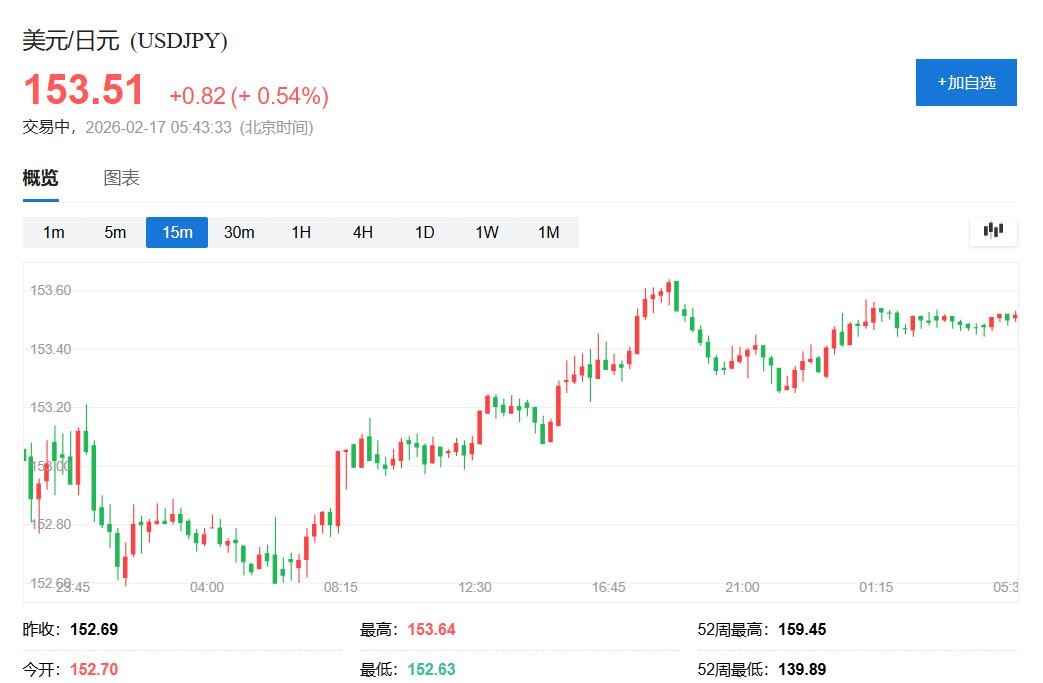
The yen, which had surged nearly 3% last week, marking the largest weekly gain since November 2024, halted its five-day winning streak. The USD/JPY maintained its upward trend after turning positive at the beginning of the Asian session on Monday, reaching a daily high of 153.64 during European trading, up over 0.6% for the day.

The retreat of the yen boosted the rebound of the dollar, which had turned down after the CPI release last Friday. The ICE Dollar Index (DXY) was mostly in an upward trend on Monday, refreshing its daily high to 97.12 during the usual U.S. stock midday session, up about 0.2% for the day The offshore renminbi rebounded after stopping a six-day rise last Friday.

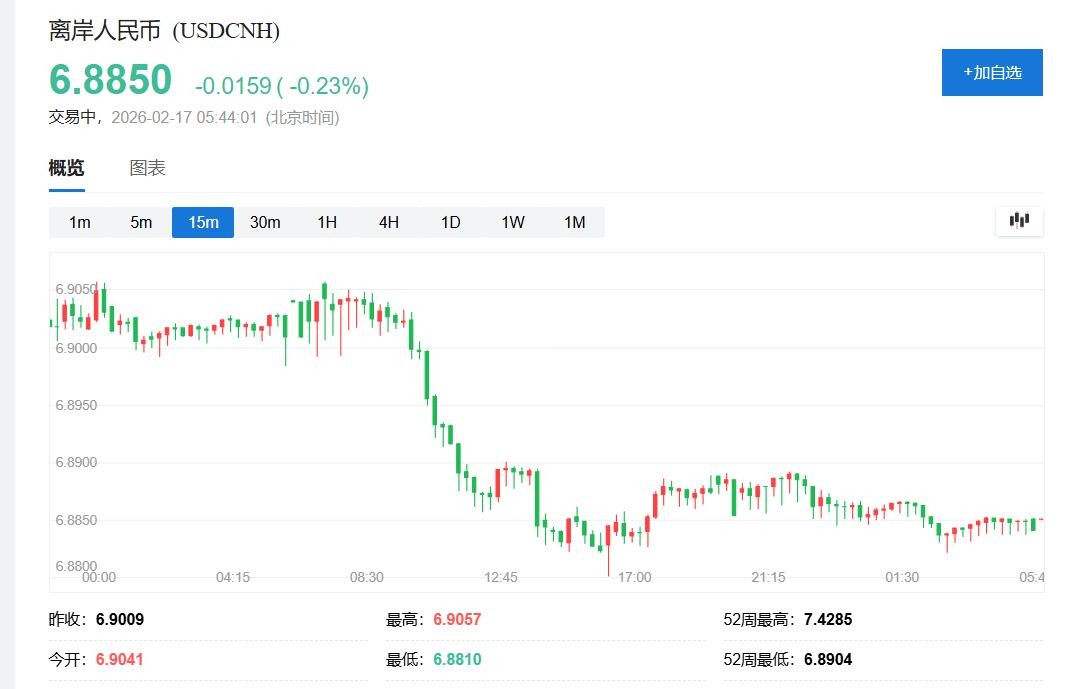
The offshore renminbi (CNH) against the US dollar refreshed its daily low at 6.9058 in the Asian market early morning, then turned to rise and maintained its upward trend, reaching 6.8810 in the European market early morning, refreshing its high since April 21, 2023, when it rose to 6.8780, breaking 6.89 intraday for the first time since April 2023, with a daily increase of 202 points.

Bitcoin surged and then fell back, briefly rising above the $70,000 mark during the European stock market session, refreshing its daily high, but then turned to decline, with the US stock market early morning approaching $67,300, refreshing its daily low, down over $2,000 from the daily high, a drop of nearly 4%.

This week, a large amount of economic data will be released, including inflation data from the UK, Canada, and Japan, as well as preliminary global business activity and the US fourth-quarter GDP data to be released on Friday. Deutsche Bank strategist Jim Reid stated, "Our economists expect US real GDP growth to slow to 2.5% in the fourth quarter, a significant drop from the previous quarter's 4.4% growth rate."

Metals Generally Under Pressure, Gold Drops Over 1% Intraday, Silver Futures Drop Over 4%

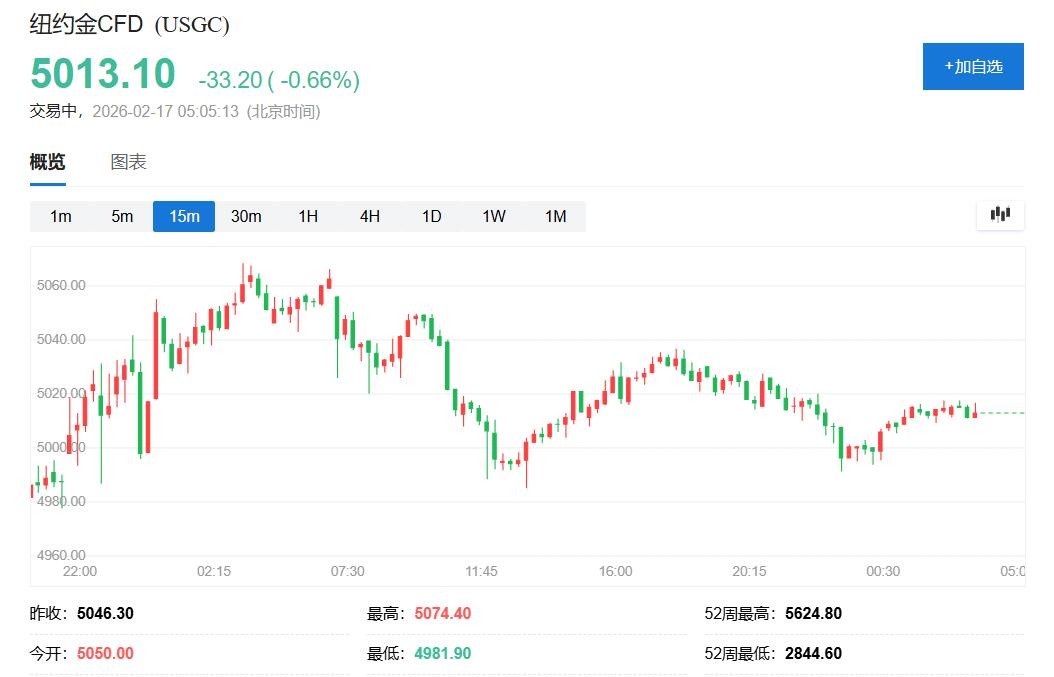
The precious metals market retreated on Monday. Gold, which had regained the $5,000 mark last Friday, fell back below this level on Monday, remaining in a downward trend throughout the day. When refreshing its daily low in the Asian market, New York gold futures fell to $4,981.9, down nearly 1.3% for the day, while spot gold dropped to $4,966.41, down about 1.5% for the day.

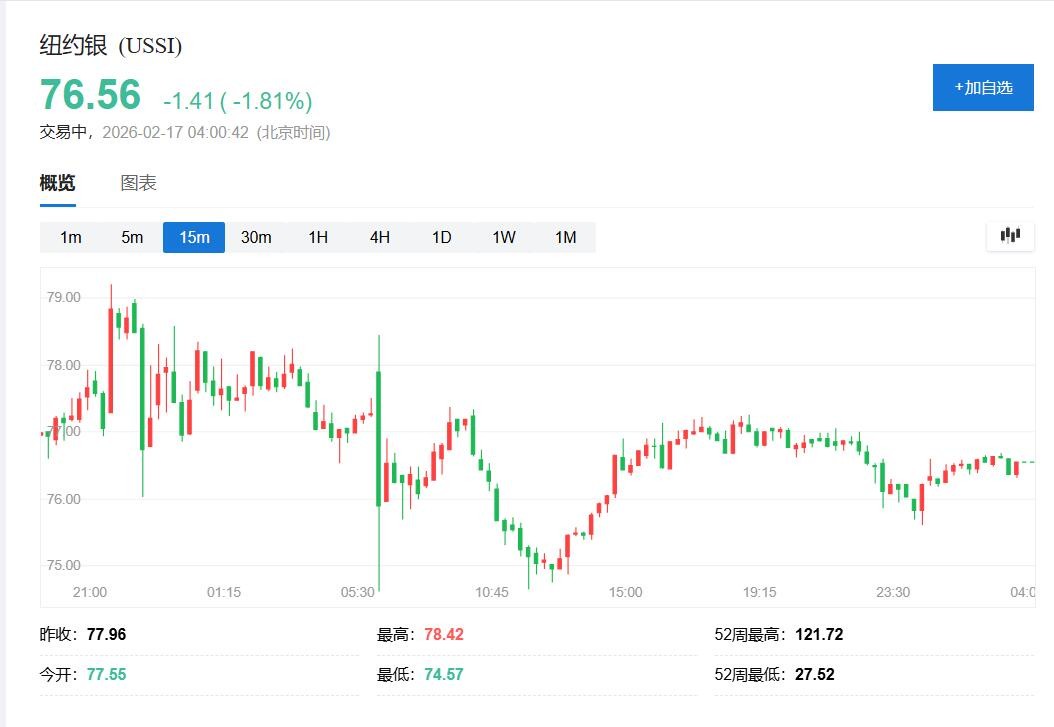
New York silver futures also maintained a downward trend throughout the day on Monday. When refreshing its daily low in the Asian market, COMEX March silver futures fell to $74.57, down nearly 4.4% for the day, while spot silver dropped to $74.5948, down over 3.6% for the day.

Analysts at Saxo Bank stated, "China has been a key driver of the sustained month-long rise in precious metals and some industrial metals, but the Chinese market will remain closed until February 23, which may limit further upside in the short term. The key price levels to watch for gold are $4,860 on the downside and $5,140 on the upside."

The base metals market is also under pressure.

London base metal futures mostly fell on Monday. Tin dropped over 2%, leading the decline for two consecutive trading days. LME tin futures closed down $1,021, a drop of 2.19%, at $45,681 per ton, hitting a new low since January 9.

Zinc fell over 1%, with LME zinc futures closing down 1.44%, at $3,290 per ton, hitting a new low since January 23, along with three consecutive declines for both aluminum and lead. London aluminum and lead refreshed their lows for over a week Last Friday, London copper, which had a slight rebound, fell back to a low not seen in over two weeks. LME copper closed down 0.23% at $12,850 per ton, marking a new low since January 22. Meanwhile, London nickel, which had seen two consecutive declines, experienced a slight rebound, temporarily leaving its low of over a week.

Comments suggest that the decline in metals like London aluminum is due to reports last Friday that the U.S. government is considering reducing some steel and aluminum tariffs. London copper is also affected by the continuous increase in inventory. Copper stocks in London Metal Exchange (LME) warehouses have been growing at the fastest rate since July 2025, pushing the total inventory across Shanghai, London, and New York exchanges to surpass 1 million tons last Friday.

Although there is a positive outlook with the U.S. canceling some tariffs, the fundamentals of the aluminum market remain largely unchanged. Analysts at ING stated, "Global aluminum supply remains tight, inventories are low, speculative positions are high, and policy risks are leading to increasing fragmentation in regional markets."

Crude Oil Turns Up Over 1% During Trading, Market Focuses on OPEC+ Production Policy

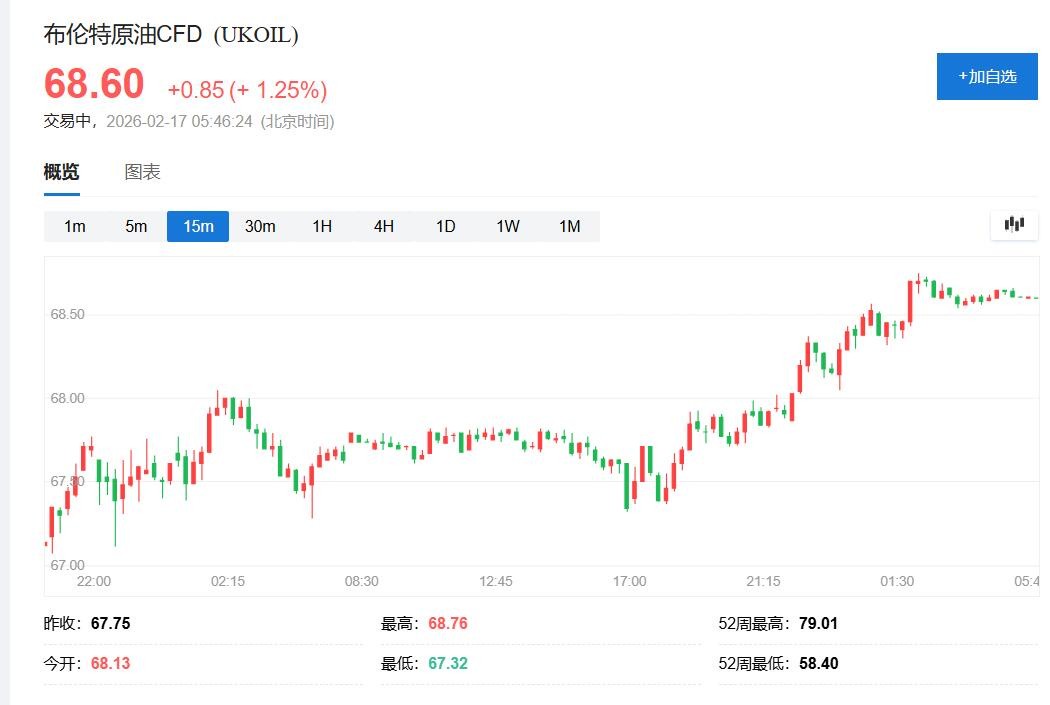
International crude oil futures on Monday mirrored last Friday's intra-day turnaround, with European stocks dropping over 0.6% when hitting a daily low, but completely shaking off the decline during the trading session. Typically, when U.S. stocks hit a daily high during the midday session, WTI crude oil rose to $63.87, up nearly 1.6% for the day, while Brent crude oil rose to $68.76, up nearly 1.5%.

Ultimately, at the close, Brent crude oil recorded gains for two consecutive trading days, while there was no closing quote for U.S. oil due to the public holiday. Brent April crude futures closed up $0.9, a rise of 1.33%, at $68.65 per barrel, continuing to move away from the low set on February 3.

OPEC+ member countries are scheduled to hold a virtual meeting on March 1 to discuss production policies for the coming months. Reports last Friday indicated that OPEC is inclined to resume oil production increases starting in April to address the upcoming summer fuel demand peak and the situation of rising oil prices due to tensions in U.S.-Iran relations.

Kpler senior oil analyst Naveen Das predicts that OPEC+ will resume oil production increases after pausing in the first quarter of 2026, gradually lifting the remaining voluntary reduction of 1.66 million barrels per day within six months. However, not all OPEC+ member countries can fully comply with their production quotas, such as Russia, which has limited production capacity. Therefore, Das expects that Brent crude prices will not face significant downward pressure. He currently predicts an average Brent crude price of $65 per barrel this year.

Kpler senior oil analyst Naveen Das predicts that OPEC+ will resume oil production growth after pausing in the first quarter. The alliance is expected to gradually lift the remaining voluntary reduction of 1.66 million barrels per day within six months. However, not all member countries can fully meet their quotas, such as Russia, which has limited production capacity. Therefore, Das expects no significant downward impact on Brent crude prices, with Kpler currently forecasting an average price of $65 per barrel this year