


"SaaS is dead, SaaS is here"! Altman predicts the era of "all AI companies" has begun

OpenAI CEO Sam Altman predicts that "fully AI enterprises" will emerge, with AI evolving from an auxiliary tool to a fully autonomous executor. OpenAI products will soon achieve 100% code written by AI, covering the entire development and decision-making process, marking a fundamental shift from the traditional "Software as a Service (SaaS)" model to the new paradigm of "Service as Software (SaaS)."
OpenAI CEO Sam Altman predicted at the CISCO AI Summit that artificial intelligence is transitioning from a tool that assists humans to a fully autonomous executor, marking the dawn of the "full AI enterprise" era. This shift signifies the end of the traditional "software as a service" model, replaced by a new paradigm of "service as software." In this new era, a company's competitive advantage will no longer depend on the number of engineers but on the strategic clarity in directing autonomous AI systems.
Altman recently revealed that OpenAI's "AI Defense" product will soon achieve 100% code written by AI. This is not merely a technical assistance but a substantive replacement. AI is no longer just helping to build the tech stack; it is the tech stack itself—covering code writing, infrastructure building, and decision-making, all autonomously operated.
Altman pointed out that AI systems are no longer just enhancing work efficiency but are fundamentally changing organizational structures. In future workflows, AI will be responsible for building, deploying, and optimizing, while humans will provide strategic direction. In short, humans decide "what to do," while AI decides "how to do it" and executes it thoroughly. In this model, engineering capability is no longer a limiting factor; the ability to guide AI in executing tasks faster than human teams will become the core competitive advantage.
Market observers believe that OpenAI's shift to full autonomy is not just a simple product demonstration but proves that this model has the capability to replace existing human organizational structures. This transformation means that companies merely using AI to accelerate development processes are still optimizing a model on the verge of extinction, while those allowing AI to act as developers will operate in a radically different economic reality, rendering competitors structurally obsolete.
From Assistance to Replacement: The Rise of Full AI Enterprises
According to Altman's vision, "full AI enterprises" not only mean better software but also represent a completely new organizational structure. In this structure, AI can execute complete workflows, not just assist engineers. Yesterday, people were still using AI tools; tomorrow, AI will serve humans as employees do for management.
Altman emphasized that the core of this transition lies in AI taking on all aspects of code writing, infrastructure management, and daily decision-making. As OpenAI's products move towards 100% AI-written code, traditional engineering teams are no longer the ones being enhanced but are facing the risk of being "deprecated." This also marks a shift in the constraints of technology development from "engineering capacity" to "strategic clarity."
Business Model Reconstruction: SaaS is Dead, Service as Software is Here
With the enhancement of AI's autonomous capabilities, the traditional "Software as a Service" (SaaS) business model is being redefined as "Service as Software" (SaaS). In this new model, AI is no longer just a tool assisting humans in building software; it directly provides complete service outcomes The economic reality brought about by this transformation is harsh: Companies that use AI merely to speed up developers are essentially optimizing an outdated model. In contrast, those that allow AI to directly take on the role of developers will operate in this entirely new economic reality. Once AI-driven companies clearly surpass human-driven companies in speed, this transformation will no longer be optional but a necessary condition for survival.
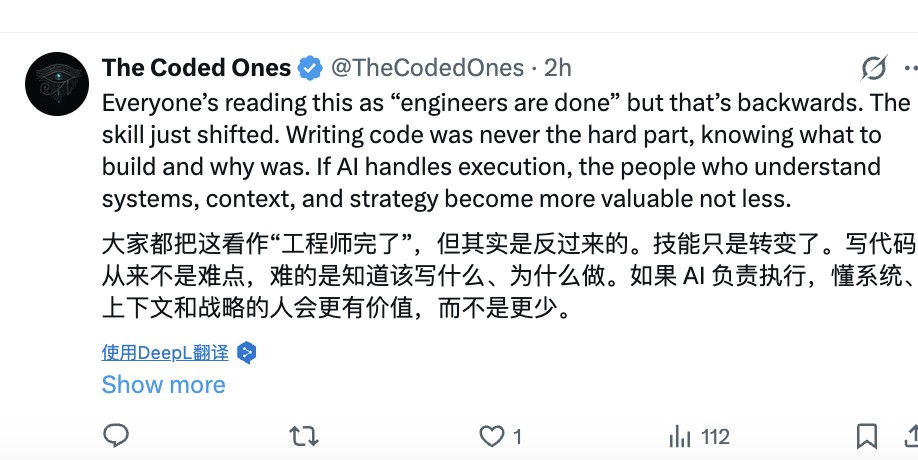
Some analysts believe that skills have merely shifted, and those who understand systems, context, and strategy will be more valuable.
Dramatic Changes in Competitive Landscape: Dimensionality Reduction of Speed and Structure
Altman's remarks reveal the fundamental changes in the nature of future corporate competition. When 100% of the code is written by AI, a company's advantage will no longer depend on the number of engineers it has but rather on the clarity and speed with which it directs AI to perform tasks.
This means that organizations that are the first to recognize and complete this transformation not only gain a competitive advantage but actually render all other competitors structurally outdated. If companies do not complete the transformation ahead of their competitors, they will face the fate of being eliminated by rivals that operate at an unbeatable speed. OpenAI's move towards full autonomy is a strong testament to the feasibility of this new organizational structure
