


AI demand remains strong but cannot drive stock prices! NVIDIA has only risen 1% since the fourth quarter, and market sentiment is turning cautious

Despite the continuous expansion of AI capital expenditures, NVIDIA's stock price has only risen about 1% since the fourth quarter. Changes in the competitive landscape have become the core driver of cautious sentiment: Jensen Huang's acquisition of Groq technology licensing this month confirms the competitiveness of other companies; Anthropic has also turned to non-NVIDIA suppliers. Although NVIDIA remains the market leader, cracks are appearing in its monopoly position, and the market is shifting from "betting on a single leader" to "repricing competitive risks."
Despite the continuous expansion of capital expenditure in the field of artificial intelligence, NVIDIA's stock performance has cooled down. The AI chip giant has only risen about 1% since the fourth quarter, with a current price-to-earnings ratio of approximately 24 times, roughly in line with the Nasdaq 100 index, indicating that the market is reassessing its valuation premium.
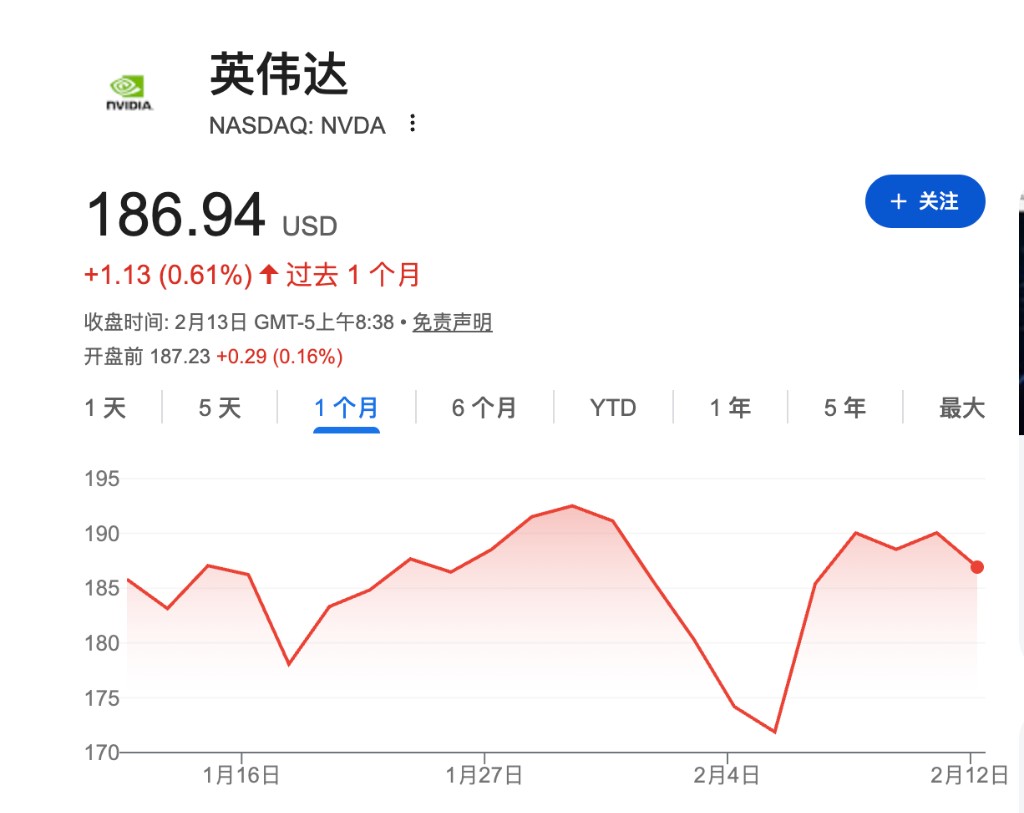
The change in the competitive landscape has become the core driver of the wait-and-see sentiment. NVIDIA CEO Jensen Huang's acquisition of the technology license from the inference hardware startup Groq for about $20 billion this month, along with the recruitment of most of its chip team, itself confirms the competitiveness of other companies in specific areas. Meanwhile, Cerebras has signed a $10 billion rapid inference chip supply agreement with OpenAI, and Anthropic has also reached cooperation with several non-NVIDIA chip suppliers.
These transactions are reshaping the market's perception of the AI chip landscape. Several startups have reported a noticeable increase in interest from potential investors since the Groq deal. SambaNova has even abandoned discussions to sell the company at a valuation far below the last round, instead seeking a new round of financing.
For investors, this series of signals means: Although NVIDIA remains the undisputed leader in the AI chip field, its monopoly position may no longer be as unassailable as in the past. The market is shifting from "betting on a single leader" to "repricing competitive risks."
The Inference Chip Market Becomes the Focus of Competition
In the arena of AI chips, an increasing number of startups and investors are turning their attention to "inference," which is the critical step of running models and generating answers after model training is completed. This subfield is being viewed as a breakthrough point to challenge NVIDIA's dominance.
This month, trading firm Jump co-led a $230 million financing round for inference chip startup Positron and has become its customer. The company's Chief Technology Officer Alex Davies stated:
"Almost everyone is using NVIDIA for training and inference, but we see the industry is changing, and this situation will not last. We do not believe there can be only one winner."
NVIDIA dominates large-scale parallel training computations with its high-bandwidth memory chips. However, a number of startups are attempting to achieve faster response times in inference scenarios by exploring different types of memory architectures. Meanwhile, as inference AI models make real-time judgments when queried, rather than relying entirely on pre-trained results, the boundary between training and inference is becoming blurred, creating opportunities for new chip architectures.
Sid Sheth, CEO of AI chip company D-Matrix supported by Microsoft, pointed out that since the debut of DeepSeek early last year, market interest in rapid inference chips has significantly increased. The company completed a $275 million financing round last November
Tech Giants Accelerate Self-Developed Chip Layout
Large tech companies are competing to develop their own AI chips to reduce dependence on NVIDIA. OpenAI released a model running on Cerebras chips for the first time on Thursday; Anthropic has reached usage agreements with Amazon's Trainium and Google's TPU; Microsoft launched its second-generation self-developed AI chip Maia last month and obtained rights to use OpenAI's chip IP.
Startups are also actively positioning themselves. The inference chip company Etched raised about $500 million last month, aiming at NVIDIA's dominance; AI model startup Simile has emerged from stealth mode, securing $100 million in funding led by Index Ventures, dedicated to helping businesses predict human behavior.
However, despite the giants accelerating self-development, Amazon, Google, Microsoft, and OpenAI still purchase a large number of NVIDIA GPUs to support their AI products and cloud services. This reality highlights that NVIDIA's position as a market leader remains solid, even as the competitive landscape quietly evolves.
NVIDIA's Defense and Market Outlook
NVIDIA has proven to be a powerful market leader. The company has multiple product lines and commits to a complete redesign of its chips every year. The deal with Groq provides NVIDIA with further expansion opportunities. When asked whether the agreement would lead to the launch of new chips specifically for inference, Jensen Huang did not make a commitment, only stating, "Maybe somewhere we might create something unique."
Sheth expects NVIDIA to announce some measures in March's flagship conference to address the demand for fast inference chips. According to Bloomberg, at different times, both startups and established companies have claimed they could compete with NVIDIA, but in most cases, they have been unable to do so, at least not on a large scale or comprehensively. However, cracks are beginning to appear in the market.
Davies stated:
"If you look at the growth rate of this industry, you will see dedicated hardware. This has been the case throughout engineering history. You start with something general, then it grows wildly, and then someone discovers you can't just have one thing."
