The US stock market is extremely fragile! From SaaS, PE to insurance, real estate, and even logistics, there have been "successive large declines," and Goldman Sachs traders are "exhausted and shocked."

Wallstreetcn
2026.02.13 00:50
portai
I'm PortAI, I can summarize articles.

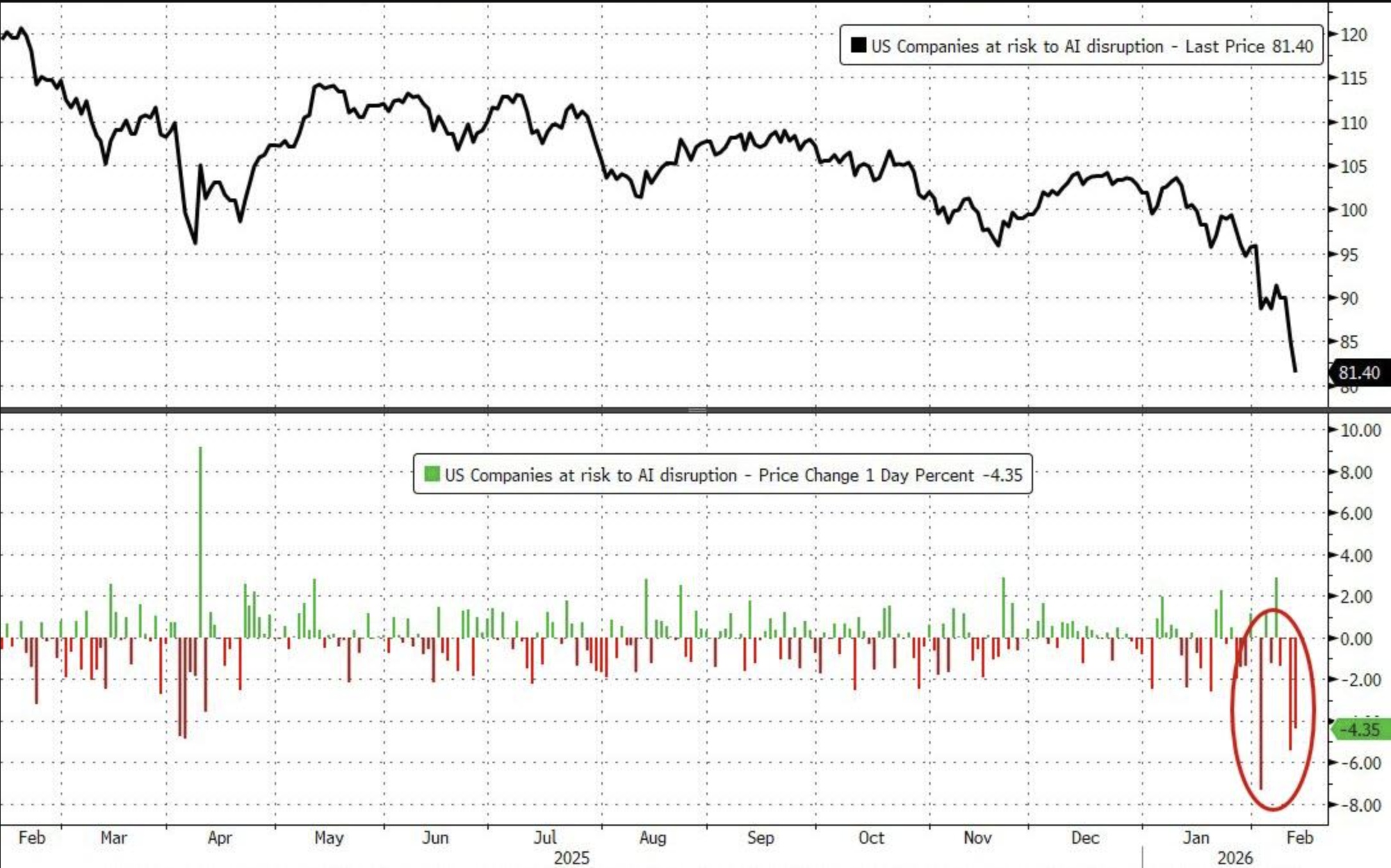
AI's disruptive expectations have impacted various sectors of the U.S. stock market like a domino effect, with logistics becoming the latest hard-hit area, while finance and healthcare are also under pressure, and the technology sector has collapsed across the board. Market breadth is deteriorating, with 350 components of the S&P 500 index falling on Friday. Goldman Sachs traders noted that over 40 S&P components experienced abnormal fluctuations exceeding three standard deviations, reaching the highest level in their memory, while investors have generally lost the willingness to buy the dip

The U.S. stock market is experiencing a rare and widespread panic sell-off, with AI disruptions impacting various industry sectors like a domino effect.

Goldman Sachs trader Ryan Shakey described the current market as "extremely fragile," noting that over 40 S&P component stocks exhibited abnormal fluctuations exceeding three standard deviations on Friday, marking the highest level he can recall. This level of volatility far exceeds the 15 stocks from the previous trading day.

The market shows a clear defensive tendency, with utilities, consumer staples, real estate investment trusts, and healthcare sectors leading the way, while technology, media, and telecommunications sectors faced significant declines. Goldman Sachs' AI risk exposure basket (GSTMTAIR) again experienced a drop of three standard deviations, plunging 510 basis points in a single day.

The latest trigger for market panic was comments from Microsoft's AI business leader. According to reports, the executive stated that most white-collar jobs will be replaced by AI within 12 months and claimed that "the programming capabilities of AI models have surpassed those of humans." This statement prompted investors to reassess the scope and speed of AI disruptions.

What shocked traders the most was the widespread loss of willingness among investors to buy the dip. Goldman Sachs' trading desk observed that while hedge funds and long institutions were selling, the scale was small, indicating that "fatigue is accumulating." A few buy orders were concentrated in cyclical and defensive sectors such as industrials, consumer staples, utilities, REITs, and energy.

Market Breadth Deteriorating Sharply

Market breadth is deteriorating, with 350 component stocks in the S&P 500 declining on Friday, with Apple, Amazon, Microsoft, Meta, and Cisco being the biggest drag on the index. The activity level on Goldman Sachs' trading desk surged from 4/10 in the morning to a high, with inquiry volume reaching its highest in two weeks.

Factor rotation is exhibiting extreme characteristics. Defensive sectors have become a safe haven for funds, while previously strong technology sectors have collapsed across the board. Traders pointed out that the most notable feature of the market is that investors are "completely unwilling to buy the dip in any AI-related sharp declines," a phenomenon that spans all industry sectors.

Logistics Becomes the Latest Hard-Hit Area, Finance and Healthcare Also Under Pressure, Technology Collapses Across the Board

Transportation stocks within the industrial sector became the focus on Friday. Logistics company CH Robinson experienced a drop of eight standard deviations, highlighting that AI panic is spreading from the tech industry to traditional sectors.

According to Goldman Sachs industrial sector trader Novak, AI has been sweeping through industries one by one over the past week or two, looking for potential "losers." The sell-off of CH Robinson reflects a 180-degree shift in investor sentiment—previously viewed as a beneficiary of AI. The debate centers on whether using chatbots to match freight can improve efficiency and reduce labor costs, but it may also lead to the commoditization of business.

Alternative asset management companies turned from gains at the open to declines, and bank stocks also began to falter. Goldman Sachs financial sector trader Degrasse noted that super regional banks, previously seen as an "attractive safe haven" for the financial sector, are seeing this logic unravelDefensive REITs continue to rise, but the strong earnings report from commercial real estate services company CBRE failed to boost its stock price. Traders noted, "In the current market environment, performance clearly doesn't matter," although bulls insist it will eventually be important.

The contract research organizations (CROs) in the healthcare sector have plummeted 32% so far this month, following Pfizer's announcement that it will use AI for most clinical trials. ICLR fell 38% in a single day on Friday, further impacting this segment.

The technology, media, and telecommunications sectors fell across the board, except for memory chips. Software, internet, and the newly added media sector on Friday all faced pressure. Goldman Sachs TMT traders pointed out that previously "winning" stocks were sold off amid risk-averse sentiment.

The market is reassessing companies that were previously seen as AI winners, with valuation factors beginning to take effect. Investors are confused about "what exactly is wrong with these earnings reports," but in the current panic, fundamental analysis seems to have been cast aside