AI panic spreads, tech stocks drag down US stocks again, real estate stocks suffer heavy losses for consecutive days, Apple evaporates $200 billion in one day

Wallstreetcn
2026.02.12 23:28
portai
I'm PortAI, I can summarize articles.

Over the past three years, investors have mostly held an optimistic view of AI. They focused on "How can AI improve the efficiency of businesses or industries?" Now, they seem to be pondering "How will AI disrupt the profit models of businesses or industries?" Investors are no longer looking for winners but are searching for potential losers

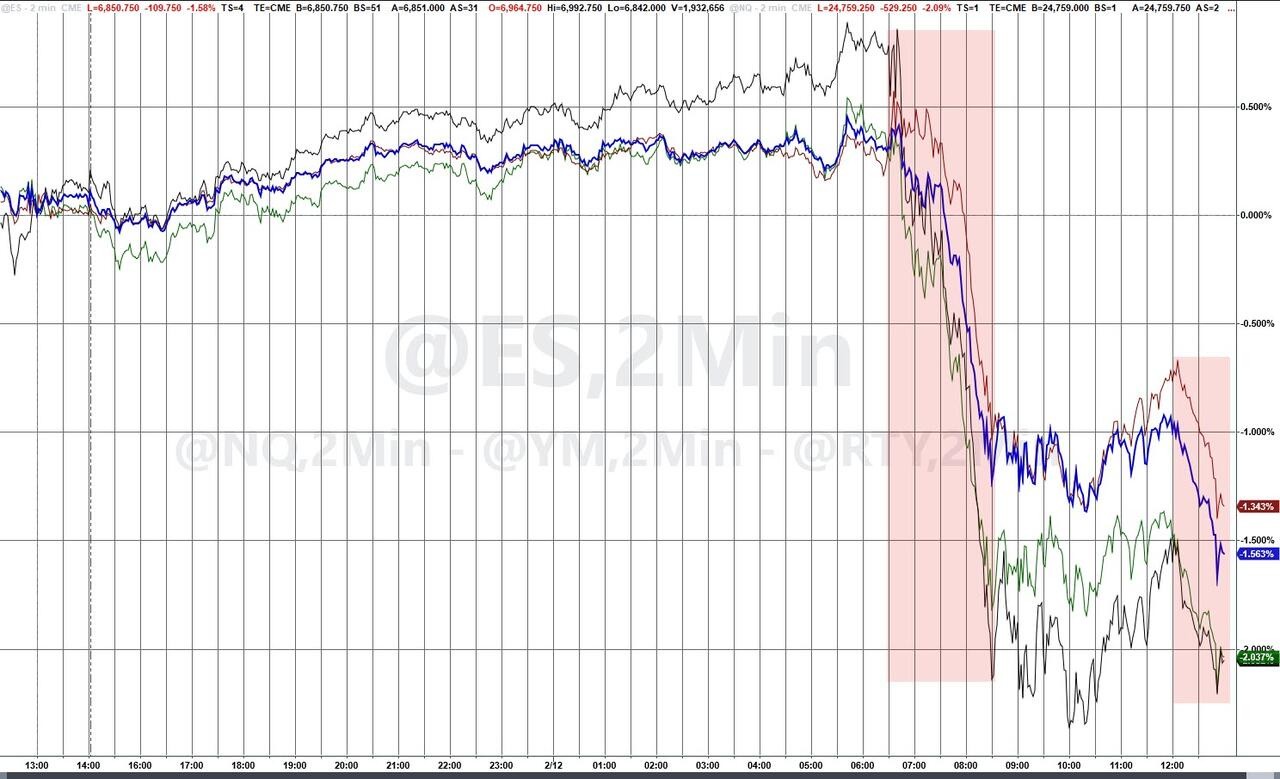
On Thursday, December 12th, Eastern Time, artificial intelligence (AI) once again became the eye of the storm in the market, with its disruptive threat to traditional industries spreading from the software sector to logistics, real estate, and other fields, triggering panic selling among investors.

The three major U.S. stock indices all closed down by at least 1%, with the Nasdaq falling about 2%, marking its third consecutive decline. The Dow Jones Industrial Average, which had repeatedly set closing historical highs in the first two days of the week, closed below the 50,000-point mark for the first time in a week.

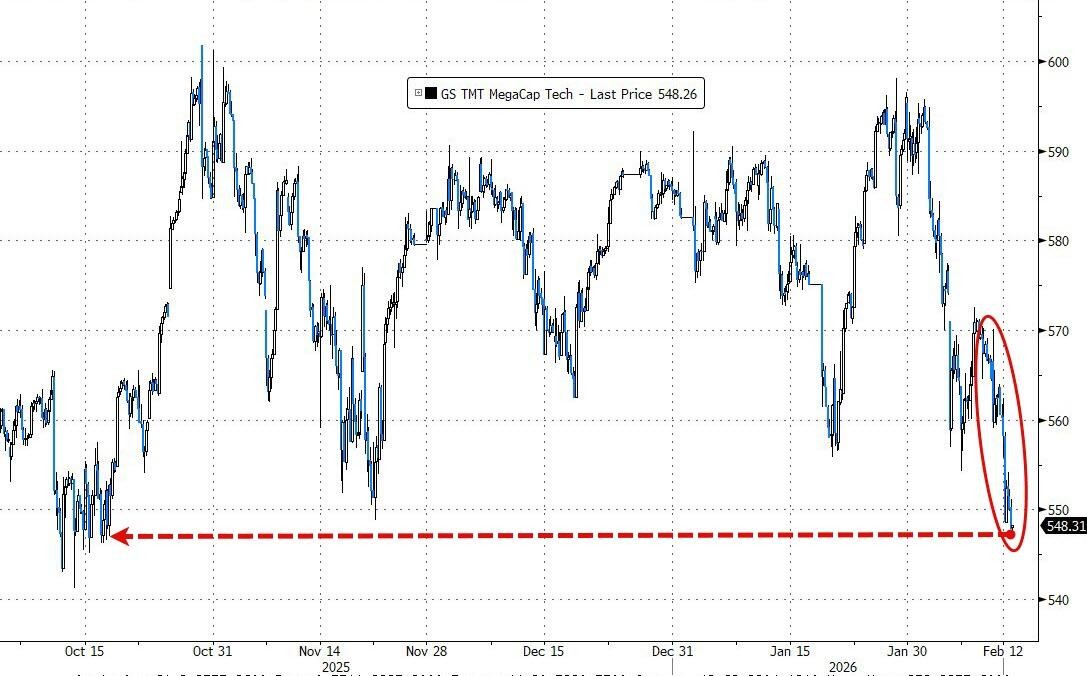
Tech stocks were the "culprits" behind the sharp decline in U.S. stocks on Thursday, with Cisco's disappointing gross margin guidance causing its stock to plummet by 12%. All seven major tech giants closed down, with Apple leading the decline, losing about $202 billion in market value in one day, marking the second-largest single-day market value loss since the company's listing. The industry ETF fell by 2.7%.

From logistics transportation to commercial real estate services, the business model threats posed by AI have triggered a chain reaction, leading to a sharp drop in the Dow Jones Transportation Average, with real estate service companies like CBRE and Jones Lang LaSalle seeing cumulative declines of over 25% in two days.

This round of selling comes as the market questions the return on AI investments across multiple industries. Although tech giants have stable earnings, Amazon, Google, Meta, and Microsoft are expected to spend a total of about $650 billion on AI competition this year, exacerbating concerns about whether capital expenditures can be monetized.

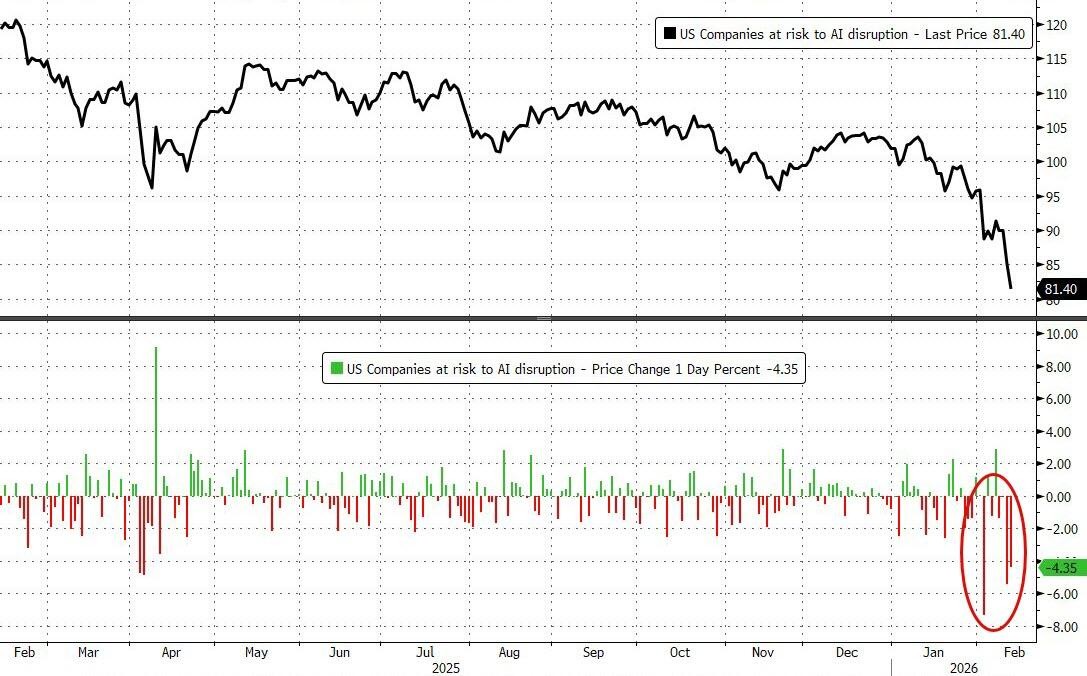
Over the past two years, AI has almost become the sole narrative of the U.S. stock market bull run, with funds concentrated in chip, cloud computing, software, and AI application companies. However, recently, the market narrative has shifted significantly: from "who will benefit from AI" to "who will be replaced by AI."

Several institutions describe the market as transitioning from "AI euphoria" (AI-phoria) to "AI panic" (AI-phobia). Investors are beginning to reassess whether AI capital expenditures are overheated, whether commercialization is lagging, and more importantly—whether AI is threatening the profit models of certain traditional industries.

Against this backdrop, concerns surrounding the realization of AI profits and "replacement risks" are rapidly spreading, putting pressure on industries that rely on human labor and information intermediaries, such as software, insurance brokerage, asset management, and commercial real estate services. Coupled with cautious sentiment ahead of inflation data releases and programmatic selling amplifying volatility, the market is undergoing a repricing centered around the AI narrative.

Tech Stocks Under Pressure, AI Investment Returns Questioned

Tech stocks were the main driver of the market decline on Thursday, as investor anxiety over whether AI investments can generate actual returns continued to fester.

Networking equipment giant Cisco saw its stock price plummet by 12%, as the company reported a year-over-year decline in adjusted gross margin for the current fiscal quarter after the market closed on Wednesday, falling short of Wall Street expectations, indicating that rising memory chip prices are eroding profits. This news raised concerns about cost pressures across the entire tech industry.

After Lenovo warned that memory chip shortages would lead to shipping pressures, personal computer manufacturers HP and Dell Technologies fell by 4.5% and 9.2%, respectively.

Software stocks came under pressure again, with the S&P 500 Software Index closing down about 1.5%, after the sector had just rebounded from a sharp decline last week, with a cumulative rebound of over 3% as of Tuesday.

Despite reporting fourth-quarter earnings and sales that exceeded expectations and attempting to downplay AI concerns, advertising software company AppLovin saw its stock price crash by 20%.

Chip stocks generally retreated after a rebound on Wednesday, with the Philadelphia Semiconductor Index closing down 2.5%, erasing Wednesday's gains. Nvidia's rival AMD fell about 3.6%, Broadcom dropped about 3.4%, but memory chip stocks maintained their upward momentum, with Seagate Technology rising nearly 5.9%, SanDisk up 5.2%, Western Digital increasing by 3.8%, and Micron Technology gaining nearly 0.9%.

Chip equipment leader Applied Materials provided a relatively optimistic guidance for the current fiscal quarter in its earnings report after hours, with its stock price, which had fallen over 3%, jumping more than 10% in after-hours trading. This indicates that the AI capital expenditure chain has not collapsed entirely, but there is a clear divergence within the sector.

Tom Essaye, founder of The Sevens Report and former NYSE floor trader, commented: “This is the most uncertain period for the outlook of AI and tech-driven rallies since the start of this bull market. This does not mean that tech stocks won't recover as they have in the past. However, I do want to remind everyone not to view this weakness merely as ‘another bump in the road ahead.’”

Dennis DeBusschere, chief market strategist at 22V Research, pointed out: “Currently, there is more bad news about AI disruption than good news regarding AI implementation and profitability.” He believes that the market action on that day was a broad deleveraging.

Market Sentiment Reversal, Investors Turn to Identify Losers

Investor attitudes towards AI have fundamentally shifted from seeking beneficiaries to identifying potential victims.

Steve Sosnick, chief strategist at Interactive Brokers, stated that in recent weeks, especially in the past few days, the market seems to be “littered with AI traps.” He noted that the software industry, insurance brokers, wealth management, and real estate agencies have all seen their stock prices battered due to concerns that advancements in AI could undermine their business models In Sosnick's view, such a drastic drop in stock prices proves that momentum-driven markets can overreact to both positive and negative news. This also indicates a significant change in market psychology.

Sosnick stated:

"For the past three years, investors have generally been optimistic about AI. They were focused on 'how can AI improve the efficiency of businesses or industries?' Now, they seem to be thinking 'how will AI disrupt the profit models of businesses or industries?'—investors are no longer looking for winners, but are searching for potential losers."

Adam Crisafulli, founder of Vital Knowledge and market commentator, stated: "AI may be driving economic growth through massive capital expenditure investments and productivity improvements, but it is becoming a net negative factor for the stock market." He pointed out that AI is "destroying" stocks in traditional industries.

Yardeni Research strategists wrote in a research report: "From AI euphoria to AI fear. For those who experienced the emergence of the internet, this feels 'familiar.' Both AI and the internet are technologies that can disrupt almost all human behavior."

Real Estate Services Industry Hit Hard, Analysts Say Market Overreacted

Commercial real estate service companies became the latest sector to be impacted by AI anxiety this week.

CBRE, Jones Lang LaSalle, and Cushman & Wakefield saw their stock prices plummet on Wednesday and Thursday, with a cumulative decline of over 25% in two days. The market is concerned that AI may automate tasks such as research, pricing analysis, and transaction procurement, thereby reducing brokerage commissions and decreasing the demand for large consulting teams.

Keefe Bruyette & Woods stated in a report on Thursday: "The extent of the market decline this week seems disproportionate to the recent earnings risks." The firm noted that concerns about new technologies squeezing brokerage and other services have repeatedly failed to materialize.

CBRE announced record fourth-quarter revenue and double-digit profit growth on Thursday, but AI concerns became the focus during the company's earnings call.

CBRE CEO Bob Sulentic acknowledged that automation could simplify some valuation and assessment work, but he believes AI will empower rather than replace brokers, and the company expects to save costs in research and data acquisition. Sulentic stated: "The core of what we do—strategic thinking, creativity, interpersonal relationships—is not something AI can replace in the short term."

Transportation Stocks Join the Decline, Apple Sees Record Single-Day Market Value Loss

Several non-tech sectors also did not escape, with transportation stocks and Apple facing significant setbacks.

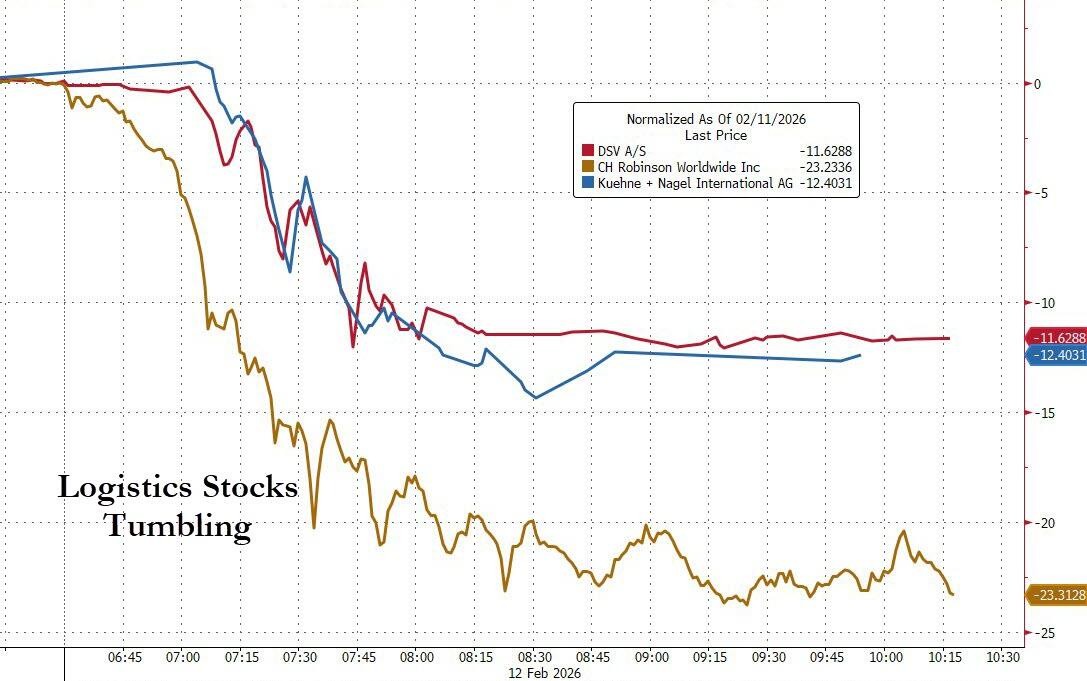
The Dow Jones Transportation Average fell, with stocks of CH Robinson, Landstar, and Expeditors International plummeting. Wall Street Journal previously mentioned that the new platform launched by AI technology company Algorhythm Holdings has made trucking companies the latest target of investor concerns about AI disruption Scott Helfstein, the Chief Investment Strategist at Global X, stated: "The employment report shows weakness in hiring within the transportation sector. Coupled with the potential disruption from automation and the risks of weakening demand."

Apple's stock price fell 5% in a single day, more than double the decline of the Nasdaq, resulting in a market value loss of approximately $202 billion, marking the second-largest single-day market value drop since the company went public in the late 1980s.

Commentators believe that two main factors contributed to Apple's significant drop: first, reports on Wednesday indicated that Apple has postponed the highly anticipated Siri AI feature update to May, and possibly even to September; second, Apple News is facing pressure from the Federal Trade Commission (FTC) due to issues of political bias.

FTC Chairman Andrew Ferguson sent a letter to Apple CEO Tim Cook on Wednesday, requesting a review of Apple News' terms of service and content moderation policies, citing recent "reports" that Apple News promotes left-leaning media while suppressing conservative content.

Additionally, Apple is facing cost pressures, as flash memory suppliers are signaling price increases, which could raise the storage costs of Apple's hardware products and compress profit margins.

As the AI narrative experiences fluctuations, Apple's pullback, being one of the largest tech companies by index weight, has significantly amplified the index's decline.

Ed Yardeni, President of Yardeni Research, remarked: "Investors are very anxious about the impact of AI, whether good or bad. Right now, they are focusing on its disruptive aspects."

The market is awaiting the release of the January U.S. Consumer Price Index (CPI) report on Friday, with expectations that the report will show a slowdown in year-on-year CPI growth to 2.5%. Traders continue to believe that the likelihood of a Federal Reserve rate cut in March is low, while a rate cut in July is fully priced in