


Breakfast | AI concerns compounded by CPI uncertainty, U.S. stocks and commodities fall together, risk aversion sentiment rises

Ahead of the CPI, global risk appetite has sharply declined, concerns about AI's impact on business models have intensified, and U.S. stocks, commodities, and cryptocurrencies have all fallen, with funds flowing back to U.S. Treasuries; the Asian market is mixed, with computing power and domestic large model concepts gaining strength. Domestically, the Ministry of Commerce has been actively responding to trade and economic issues, and price regulation in the automotive industry is tightening; Zhizhu products have sold out upon launch, and Hua Hong Semiconductor has turned a profit and raised its guidance. The competition in overseas technology is intensifying, with frequent developments from Google, OpenAI, and Anthropic, and the storage industry is showing strengthened prosperity
Market Overview
On the eve of the U.S. CPI data release, panic over AI escalates, with deep concerns that artificial intelligence will disrupt the business models of many industries, leading to a significant drop in U.S. stocks, commodities, and cryptocurrencies, while funds flow into U.S. Treasuries.
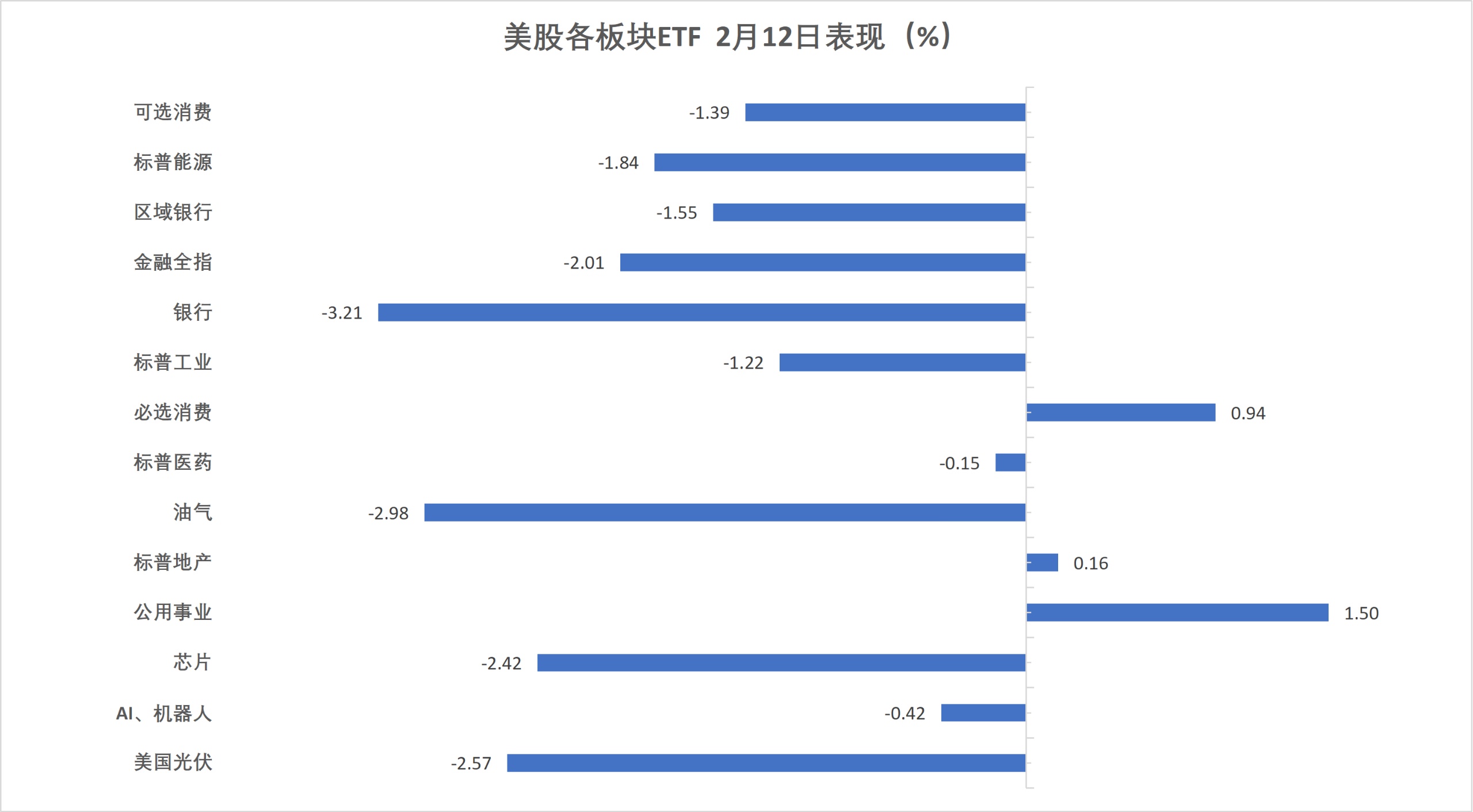
The S&P 500 fell 1.6%, the Nasdaq plummeted over 2%. Cisco's weak guidance caused a 12% drop. Apple fell 5%, leading the decline among tech giants. Software stock ETFs dropped 2.7%. The impact of AI on freight logistics saw the Russell 3000 Trucking Index plunge 9% during the session. Commercial real estate stocks also fell sharply.
U.S. Treasuries strengthened, with the yields on 30-year and 10-year Treasuries both declining by over 7 basis points.
The U.S. dollar index remained flat. The yen rose for the fourth consecutive day. Bitcoin fell 3%, dropping below $66,000.
The sharp decline in U.S. stocks seemingly triggered algorithmic selling in metals. Gold dropped over 3%, falling below $5,000, while silver plunged 11%. Copper fell 3.6%. Platinum and palladium also saw significant declines. Oil prices dropped 3%, with Brent crude briefly falling below $67.
During the Asian session, the ChiNext Index rose over 1%, with computing hardware stocks surging across the board. The Hang Seng Index fell over 1%, while Zhizhu surged nearly 30% and MINIMAX-WP skyrocketed 15%. The renminbi strengthened past the 6.9 mark.
Key News
China
The Ministry of Commerce responded intensively, involving tax exemptions for Volkswagen SUVs, dairy product tariffs, and close communication between China and the U.S.
The Chinese government introduced new pricing regulations for the automobile industry: “Significant legal risks exist if the actual factory price is below production costs.”
The official GLM Coding Plan from Zhizhu sold out immediately upon launch.
Elon Musk praised Seedance 2.0, stating, “The development speed is too fast,” while ByteDance remarked, “It is still far from perfect.”
Huahong Semiconductor achieved a record high in Q4 sales revenue, turning a profit for the quarter, with expected sales revenue in Q1 between $650 million and $660 million.
Overseas
Bessent eased up to Republican lawmakers: supporting the Senate to take over the Powell investigation, rather than the Department of Justice.
The first three projects focus on “data centers, crude oil terminals, and synthetic diamonds,” with a $550 billion investment fund from the U.S. and Japan set to launch soon.
Google's Gemini 3 underwent a significant upgrade in its deep thinking model, achieving record high scores in ultimate testing, targeting research and engineering applications.
NVIDIA faced competition: OpenAI released support for the Cerebras chip model for the first time.
Anthropic finalized a $30 billion financing round at a valuation of $380 billion.
Confirming the NAND supercycle, storage giant Kioxia raised its full-year profit guidance by 60% above consensus, with a net profit of 87.81 billion yen in Q3
Market Report
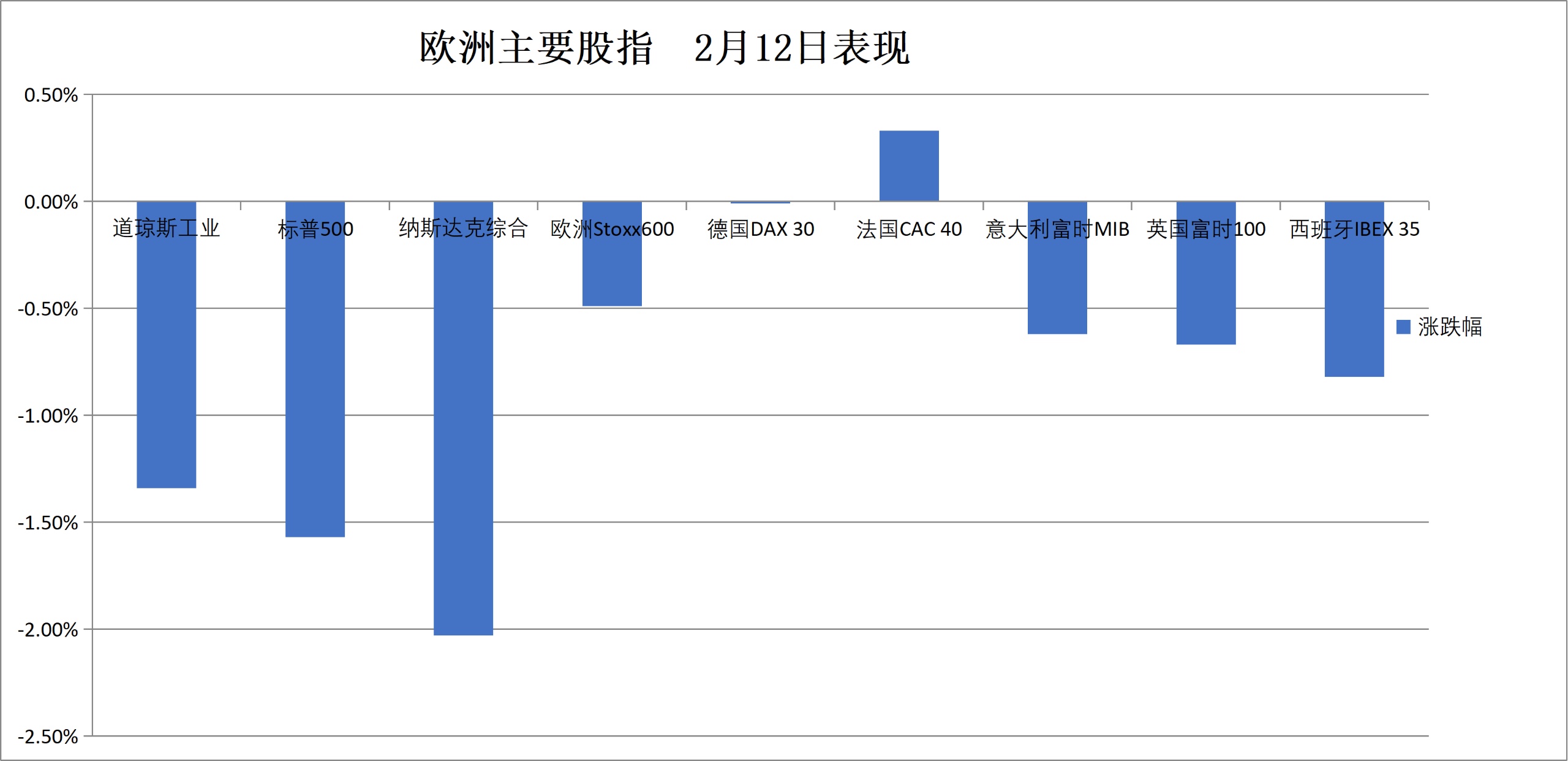
US and European Stock Markets: The S&P 500 fell by 1.57%, closing at 6832.76 points. The Dow Jones Industrial Average decreased by 1.34%, closing at 49451.98 points. The Nasdaq dropped by 2.04%, closing at 22597.148 points. The European STOXX 600 index closed down 0.49%, at 618.52 points.
A-shares: The Shanghai Composite Index closed at 4134.02 points, up 0.05%. The Shenzhen Component Index closed at 14283.00 points, up 0.86%. The ChiNext Index closed at 3328.06 points, up 1.32%.
Bond Market: The yield on the 10-year U.S. Treasury bond fell by 7.05 basis points, to 4.1019%. The yield on the 2-year U.S. Treasury bond fell by 4.57 basis points, to 3.4642%.
Commodities: WTI March crude oil futures fell by 2.77%, closing at $62.84 per barrel. Brent April crude oil futures fell by 2.71%, closing at $67.52 per barrel. COMEX gold futures fell by 3.06%, closing at $4942.50 per ounce. COMEX silver futures fell by 10.56%, closing at $75.050 per ounce.
News Details
Global Highlights
China
The Ministry of Commerce responds intensively, involving EU tax exemptions on SUVs, dairy product tariffs, and close communication between China and the US. The Ministry of Commerce stated that imported dairy products originating from the EU are subsidized, causing substantial harm to related industries in China. On February 12, 2026, the Ministry issued a final ruling announcement, determining that the tax rate for EU companies is 7.4%-11.7%, and decided to implement countervailing measures starting from February 13, 2026, for a period of five years. The EU automotive industry is deeply integrated and mutually beneficial. It is hoped that the EU will earnestly implement the important consensus reached at the China-EU leaders' meeting and the results of case consultations, and look forward to more Chinese companies reaching agreements with the EU on price commitments.
The Chinese government has introduced new pricing regulations for the automotive industry: “Selling at a price lower than production costs poses significant legal risks.” The "Guidelines" clearly define "selling complete vehicles and parts below production costs" as a pricing behavior that poses significant legal risks, and adopts a broad definition of "production costs" that includes manufacturing costs and period expenses, blocking price competition from a compliance perspective. The new regulations list nine types of risky behaviors, with the core regulation being "selling at a price below costs for the purpose of eliminating competitors." Hong Kong stocks' AI concept exploded, Zhizhu up 40%, MiniMax up 25%, chip sector also surged! On February 12, the Hong Kong stock AI sector erupted, with Zhizhu rising over 40%. TianShuZhiXin, known as the "four little dragons of domestic GPUs," saw its afternoon gains expand to 25%, while Biran Technology rose nearly 10%. Zhizhu's GLM-5 doubled its parameters and raised prices against the trend, while MiniMax M2.5 focuses on native Agent capabilities. Domestic models are shifting from a "price war" to a technology race centered on programming and intelligent agents.
Stock price skyrocketed 32%, GLM-5 topped global open source, completing a full system in 25 minutes. On February 7, Zhizhu quietly launched the GLM-5, codenamed "Pony Alpha," igniting overseas communities with its extreme system engineering capabilities. The model can reconstruct complex code at once, completing a full-stack monitoring system in 25 minutes, and even replicating MacOS applications from screenshots, with a programming experience approaching Claude Opus 4.5. Parameters expanded to 744B, integrating sparse attention and asynchronous reinforcement learning frameworks, with SWE-bench and other evaluations dominating the open-source rankings.
- Zhizhu's official GLM Coding Plan sold out immediately. The paid package for domestic AI programming models was snapped up, which is rare in the industry.
Elon Musk praises Seedance 2.0, "The development speed is too fast," ByteDance says "still far from perfect". ByteDance's video model Seedance 2.0 has exploded overseas, with Musk stating its "development speed is too fast." The model was fully integrated with Doubao and Jimeng on Thursday and opened for enterprise trial, with its "multi-modal input" and "multi-camera long narrative" capabilities targeting professional production scenarios. ByteDance stated that the product is leading but still far from perfect, and will continue to explore deep alignment between large models and human feedback. Doubao's large model 2.0 will be released on February 14.
Huahong Semiconductor's Q4 sales revenue hits a record high, achieving profitability in a single quarter, with Q1 sales revenue expected to be between $650 million and $660 million. Huahong Semiconductor's Q4 revenue increased by 22.4% quarter-on-quarter, successfully turning a profit. Benefiting from the explosion of the Chinese market and consumer electronics demand, the company's capacity utilization exceeded 103.8%, with all 8-inch and 12-inch production lines fully loaded. Driven by a surge in discrete device business and the AI hardware boom, the company's stock price has doubled this year. The guidance for the first quarter of 2026 is robust, with revenue expected to remain high, indicating sustained recovery resilience Lenovo's Q4 revenue hits a record high, adjusted net profit up 36% year-on-year, AI business accounts for 32%. Lenovo's revenue in the fourth quarter increased by 18% year-on-year to USD 22.20 billion, setting a historical high. The AI business is becoming the core engine of Lenovo's growth, with AI-related revenue increasing by 72% year-on-year this quarter, accounting for 32% of the group's total revenue. Adjusted net profit increased by 36% year-on-year, far exceeding market expectations.
Overseas
Yellen softens stance towards Republican lawmakers: supports Senate taking over Powell investigation, not the Justice Department. U.S. Treasury Secretary Yellen agreed to transfer the investigation of Powell from the Justice Department to the Senate Banking Committee, aiming to persuade Republican Senator Tillis to drop his obstruction of the nomination of Waller as Federal Reserve Chairman. Tillis had previously stated that he would block any appointments unless the investigation into Powell was dropped.
The first three projects focus on "data centers, crude oil terminals, and synthetic diamonds," as the U.S.-Japan $550 billion investment fund is about to launch. The first three projects under the U.S.-Japan agreement are: a data center infrastructure project led by SoftBank, a deep-sea crude oil terminal project in the Gulf of Mexico, and a synthetic diamond project for semiconductors. These projects align with the investment framework established during Trump's visit to Japan last year, covering areas such as energy, artificial intelligence, and critical minerals, involving companies like SoftBank, Westinghouse Electric, and Toshiba. According to the agreement reached by the U.S. and Japan, once the projects are confirmed, Japan must initiate funding within 45 working days.
Gold briefly drops over 4%, silver plunges 11%, did the U.S. stock market crash trigger algorithmic trading sell-offs in precious metals? On Thursday, spot gold fell by 4.1% at one point, and silver plummeted by 11%. Amid renewed concerns about whether massive AI investments can truly be implemented on a large scale, U.S. tech stocks fell sharply. Analysts suggest that metal prices suddenly dropped under suspected algorithmic trading sell-offs, forcing some investors to exit commodity positions, including gold and silver, to gain liquidity.
AI impacts the freight industry, Russell 3000 truck transportation index plunges 9% during trading. AI technology company Algorhythm released a white paper stating that its platform can reduce truck empty mileage by over 70% in actual deployment, and can expand freight volume by up to 400% without increasing operational personnel. Amidst the industry's fundamentals not showing significant recovery, the concerns raised by this document became the "last straw" that crushed sector sentiment, with industry leader C.H. Robinson dropping over 20% during trading. Google Gemini 3 Deep Thinking Model Major Upgrade, Ultimate Test Scores Reach New Highs, Aiming at Scientific Research and Engineering Applications. Without tool assistance, the model achieved a 48.4% accuracy rate in the "Human's Last Exam" (HLE) benchmark test and scored 84.6% in the ARC-AGI-2 test; the written portions of the 2025 International Physics Olympiad and Chemistry Olympiad both reached gold medal levels. Google stated that the new model is aimed at driving discoveries and helping researchers solve "unsolvable" problems—from identifying flaws in research papers to optimizing semiconductor crystal growth.
NVIDIA's Corner Being Cut: OpenAI Releases Cerebras Chip-Supported Model for the First Time. OpenAI released GPT-5.3-Codex-Spark on Thursday, designed specifically for real-time coding, which is a streamlined version of OpenAI's latest code automation software Codex and the first result following the over $10 billion agreement signed with Cerebras last month. An OpenAI spokesperson stated that the partnership with NVIDIA is "foundational," and they will continue to evaluate the most cost-effective chips across all use cases; for applications such as research and reasoning, GPUs remain the preferred choice.
Anthropic Finalizes $30 Billion Financing at a $380 Billion Valuation. Anthropic has completed its latest financing round, raising $30 billion from investors, bringing its post-financing valuation to $380 billion (including this round's funding), further strengthening the AI company's position in competition with rival OpenAI.
Confirming the NAND Super Cycle, Storage Giant Kioxia's Annual Profit Guidance Exceeds Consensus by 60%, Q3 Net Profit at 87.81 Billion Yen. Kioxia's annual performance forecast far exceeds market expectations, with operating revenue and net profit targets approximately 35% to 60% higher than analyst predictions. Although Q3 performance slightly missed expectations, the NAND flash memory market has entered a strong recovery cycle driven by surging demand for AI-driven data centers and enterprise-level servers, reversing the supply-demand dynamics and significantly boosting product prices, while the company's financial condition continues to improve.
SoftBank Turns Profit in Q3, but Net Profit Falls Short of Expectations, Heavy Investment in OpenAI Yields 2.8 Trillion Yen Investment Returns in the First Three Fiscal Quarters. The financial report shows that Q3 net profit for FY2025 reached 248.59 billion yen, turning profitable year-on-year, but only 30% of market expectations. The improvement in performance is mainly attributed to AI investments, particularly the heavy bet on OpenAI, which contributed 2.8 trillion yen in paper gains in the first three fiscal quarters In addition, the Vision Fund has significantly recovered, and SoftBank has also cashed out by selling T-Mobile shares to support its AI layout.
Research Report Highlights
Renowned hedge fund Gusu Capital: The AI bubble will only wait until OpenAI goes public; it's not about short-term speculation but thinking about the world pattern in 3-5 years. Gusu Capital's co-CIO David Craver pointed out that the current market is experiencing severe short-term volatility and is decoupled from fundamentals. The core advantage for investors lies in extending their perspective and considering the world pattern 3-5 years ahead. He remains optimistic about AI, believing the industry is still in its early stages, and the real bubble may only appear after OpenAI goes public. In addition to infrastructure, Craver proposed the investment theme of "The Revenge of the Dinosaurs," predicting that traditional large enterprises will significantly reduce costs and improve efficiency through AI technology, leading to a profit explosion in the coming years.
In the worst-case scenario for Oracle: AI orders completely lost, stock price only drops 15%? Bernstein's extreme stress test shows that even if AI clients like OpenAI completely withdraw their orders, Oracle can still support a valuation of $137 per share based solely on its core database and enterprise cloud business, with only a 15% downside from the current stock price, providing a clear margin of safety. The report also dissects market concerns: the annual risk exposure of $248 billion in leasing contracts is only $13-16.5 billion, hardware procurement is flexible, and asset versatility is strong. With recent financing landing, if an AI winter does not occur, the risk-reward ratio is already highly attractive.
AI vs SaaS: Sell first, ask later; did the market only "sell half right"? The trillion-dollar sell-off triggered by Anthropic has exposed market panic. Investors misjudged the boundaries of AI's capabilities; while AI can encroach on the software application layer, it is difficult to shake the foundation of the "system recording layer" that collects real data. Barclays' report points out that the repricing of software stocks will continue, and investors need to distinguish which companies rely on application layer profits and which companies' value is rooted in the irreplaceable system recording layer.
Global market "huge changes": "Real" returns, "technology" differentiation. Goldman Sachs pointed out that the global bull market has not ended, but the drivers have changed: funds are shifting from crowded U.S. tech stocks to emerging markets, commodities, and value stocks. Although AI maintains high Capex, ROI anxiety has intensified, and the differentiation of the Magnificent Seven (Mag7) is evident, with the software sector undergoing valuation resets. Data center and energy constraints are highlighted, benefiting "old economy" sectors like utilities, while real assets and value styles are undergoing revaluation, increasing the importance of diversified allocation.
Domestic Macro
The head of the Treaty and Law Department of the Ministry of Commerce answers reporters' questions regarding the EU's request for the establishment of an expert group by the WTO on the China-EU trade dispute case The Chinese side has repeatedly emphasized that we always attach great importance to intellectual property protection, strictly adhere to the rules of the World Trade Organization and our commitments upon accession, continuously improve intellectual property protection legislation and enforcement, and the achievements are evident. The Chinese side expresses regret over the European side's decision.
Domestic Companies
China's large model "Spring Festival file" has begun! Waiting for consumer-level AI to produce "blockbusters". The Spring Festival raid tactic of DeepSeek in 2025 has become an industry textbook. By 2026, everyone has learned this trick. ByteDance, Alibaba, Zhipu, and DeepSeek have intensively released flagship models during the "Spring Festival file," shifting the competitive focus from pure model performance to "efficiency" and the implementation of "intelligent agents." Analysts indicate that if DeepSeek V4 achieves cost reduction in reasoning, it will promote the transition of AI from independent apps to high-frequency applications like WeChat, with Tencent likely becoming the biggest beneficiary.
The differentiation of major companies under the multimodal "Deepseek moment": ByteDance focuses on "efficiency," Kuaishou attacks "professionalism," and Alibaba focuses on "e-commerce"! Huachuang Securities stated that at the beginning of the year, domestic multimodal models were intensively updated, with significant improvements in "controllability" from models like Keqing 3.0 and Seedance 2.0, marking a leap from AI video entertainment to industrial production. By reducing the "card drawing" waste rate, the marginal cost of video production converges towards computing power costs. ByteDance emphasizes efficiency infrastructure, Kuaishou delves into professional narratives, and Alibaba focuses on vertical e-commerce, collectively driving a revolution in content supply and IP value reassessment.
Key breakthrough in reusable rocket technology! The first stage of the Long March 10 carrier rocket successfully controlled its splashdown, aiming for "net recovery," experts say: net recovery is more stable. According to the China Aerospace Science and Technology Corporation, this rocket's first stage successfully completed its return flight and controlled splashdown, marking significant progress in China's reusable rocket technology. "This lays a solid foundation for subsequent full-profile flights of this type of rocket and achieving offshore net recovery, and also marks a substantial key step in breaking through and mastering reusable rocket technology in China."
A company in Shenzhen gives away 5 sets of houses at its annual meeting, along with a Porsche, BMW, and 36 grams of cash, employees: those who received houses are not executives! Insta360's annual meeting awarded 5 sets of commercial housing in the Greater Bay Area, all won by employees born in the 1990s, excluding executives; there were also 6 luxury cars, including Porsche, Li Auto, BMW, and Tesla. The prize-winning rate at the annual meeting reached 80%, with the special prize of 36 grams of cash won by a new employee who joined just 10 days ago, and an intern also won an iPhone 17 Pro. Founder Liu Jingkang revealed that revenue in 2025 will reach a historic high, with Q4 growth nearing a peak not seen in nearly ten quarters. The company plans to raise 1.938 billion yuan through its listing on the Sci-Tech Innovation Board in 2025, with a net profit of 272 million yuan in the first three quarters Overseas Macro
Winter Interference, U.S. January Existing Home Sales Drop by Largest Margin in Four Years. The annualized number of existing home sales in the U.S. for January was 3.91 million, below the expected 4.15 million, with the previous value at 4.35 million; existing home sales in January decreased by 8.4% month-on-month, compared to an expected decrease of 4.6% and a previous increase of 5.1%. The median sale price of existing homes rose by 0.9% year-on-year to $396,800.
AI Hits "Disaster Zone," Indian IT Stocks Plummet, Is India's Export Engine About to Stall? Due to the impact of AI automation tools like Anthropic, Indian IT stocks plummeted over 4% to a four-month low on Thursday, with industry leader Tata Consultancy Services suffering significant losses. Concerns over business replacement triggered by AI, combined with weakened expectations for U.S. interest rate cuts, led to a substantial evaporation of industry market value. Despite favorable policies and attempts at corporate transformation, the traditional labor-intensive model is facing fundamental challenges, causing a crisis of market confidence.
Overseas Companies
xAI All-Hands Meeting: Musk Restructures Four Major Teams, Launches "Macrohard" Project to Challenge Microsoft, Plans to Build Satellite Factory and Data Center on the Moon. At the first all-hands meeting following the merger of xAI and SpaceX, Musk announced the restructuring of four major teams, focusing on the launch of the "Macrohard" project aimed at automating white-collar work, intending to challenge Microsoft. He also revealed plans for an interstellar computing project to establish a satellite factory and electromagnetic catapult on the Moon. Financially, SpaceX's profits will support xAI's cash burn rate of about $1 billion per month.
Apple Employees Confirm: iPhone 16e Inventory Has "Dried Up," Countdown to 17e Release Begins. Apple retail employees reported that the inventory of the iPhone 16e has nearly run out, and the iPad Air is also facing supply shortages. This phenomenon typically indicates that Apple is clearing channel space for new products, with expectations that the iPhone 17e and M4 version of the iPad Air will be unveiled in the coming weeks.
Cryptocurrency Lending Platform BlockFills Suspends Customer Withdrawals, Evoking Tragic Memories of "FTX Collapse" in the Crypto Circle. The institutional-level cryptocurrency lending platform BlockFills has suspended customer deposits and withdrawals due to recent market volatility, raising concerns about a repeat of the 2022 chain of collapses in the lending industry. The company serves about 2,000 institutional clients, with an annual trading volume that once reached $60 billion. This crisis comes as Bitcoin's price has fallen about 45% from last year's peak, with a sell-off triggered by tariff threats from the Trump administration and stagnation in U.S. legislation exacerbating liquidity pressures in the industry Hermès' fourth-quarter revenue grew by 9.8%, exceeding expectations, with strong performance in the U.S. market driving results against the trend. In the luxury goods winter, Hermès demonstrates "steady running against the wind." In terms of regions, the Americas market surged by 12.1%, surpassing expectations, indicating that American consumers' purchasing power for top luxury goods remains strong. In terms of products, the leather goods department saw an organic growth of 14.6%, with core items in high demand. Benefiting from the stickiness of ultra-high-net-worth clients, the company's annual operating profit margin climbed to 41%, while also announcing a price increase of 5%-6% in 2026.
North American sales are recovering, but comparable sales growth fell short of expectations, with L'Oréal ADR experiencing the largest intraday drop in nearly six years. L'Oréal's comparable sales growth in the fourth quarter was 6%, below market expectations. Despite the recovery in North American demand and strong performance in the dermatological beauty business, the company's U.S. ADR saw an intraday drop of 8.9% on Thursday, marking the largest intraday decline since 2020. Management expressed optimism about the global beauty market outlook and plans to continue driving growth through new products and acquisitions.
Industry/Concept
- HBM | According to Sina Finance, on February 12, Samsung Electronics announced via a press release that HBM4 memory has now entered mass production and is delivering commercial products to customers. It has become the first company in the industry to achieve commercial delivery of HBM4. The first batch of delivered products mainly supplies global core customers, including NVIDIA, marking Samsung's transition from sample testing to actual mass production and commercial delivery.
Commentary: Analysts believe that HBM (High Bandwidth Memory) is a high-end storage chip designed specifically for AI accelerators and high-performance computing devices, playing a core role in breaking the memory bandwidth bottleneck brought about by increased computing power. It is also a core component in cutting-edge fields such as AI large model training and autonomous driving. Currently, the global demand for AI computing power continues to explode, leading to rapid growth in HBM market demand. The large-scale mass production of HBM4 chips not only promotes the iteration and upgrade of global storage technology but also provides strong support for performance breakthroughs in the next generation of AI computing platforms. The performance and reliability of HBM highly depend on advanced packaging materials, especially in terms of heat dissipation, insulation, and structural support. With breakthroughs in domestic material technology, some companies have already gained the capability to enter the supply chains of international major manufacturers.
- Quantum Communication | On February 12, the official WeChat account of the School of Physics at Peking University announced that a team led by Professors Wang Jianwei and Gong Qihuang from the Institute of Modern Optics, along with a team led by Researcher Chang Lin from the School of Electronics, published a groundbreaking research result titled "A Large-Scale Quantum Communication Network Based on Integrated Photonic Quantum Chips" in the prestigious academic journal Nature. This achievement showcases several key innovations and lays a solid foundation for the engineering and large-scale application of quantum networks.
Commentary: The research team successfully developed a fully functional integrated high-performance quantum key distribution chip and an optical microcavity frequency comb source chip, and based on this, constructed the world's first large-scale quantum communication network based on integrated photonic quantum chips. This network consists of 20 independent quantum emission chips on the user side and one integrated optical microcavity frequency comb chip on the server side, achieving parallel communication among 20 chip users, with all links capable of communicating over distances of up to 370 kilometers Breaking through the "non-relay" physical limit, the networking capability (number of clients × communication distance) reaches 3,700 kilometers, setting a new international record. This marks the advancement of quantum communication from "single-link breakthrough" to "large-scale networking." The research has achieved full-chain innovation across multiple dimensions, including architecture, core chips, networking capabilities, manufacturing processes, and industrial feasibility, becoming a milestone in the field of quantum information and advanced communication.
- 3D Printing | According to Xinhua News Agency, Professor Dai Qionghai, an academician of the Chinese Academy of Engineering, led a research team at Tsinghua University's Imaging and Intelligent Technology Laboratory. Based on deep practical work in computational optics, they discovered that computational optics can manipulate high-dimensional holographic light fields to construct three-dimensional entities, ultimately creating the "Digital Incoherent Synthetic Holographic Light Field (DISH)" 3D printing technology, which can complete high-resolution 3D printing of complex objects in millimeter size in just 0.6 seconds, setting a new record for 3D printing speed.
Commentary: Analysis indicates that DISH provides a new solution for technological upgrades in related fields. For example, in engineering manufacturing, it can mass-produce photonic computing devices, mobile phone camera modules, and other micro-components, printing parts with sharp angles and complex surfaces. In the future, it is expected to expand into complex scenarios such as flexible electronics, micro-robots, and high-resolution tissue models. As a transformative technology in the industry, 3D printing is on the verge of industrialization. With the support of cost reduction, improved standards, and increasing demand, the application of 3D printing technology is becoming more widespread across various fields, driving the manufacturing industry into the era of intelligent manufacturing. It is expected to exceed 100 billion yuan by 2029, driving the scale of the upstream and downstream industrial chain to over 300 billion yuan.
- Hydrogen Energy | To implement the "Medium and Long-term Plan for Hydrogen Energy Industry Development (2021-2035)," "National Standardization Development Outline," and "Guidelines for the Construction of Hydrogen Energy Industry Standard System (2023 Edition)," further improve the standard system for the entire hydrogen energy production-storage-transportation-usage chain, and accelerate the supply of hydrogen energy standards, the National Hydrogen Energy Standardization Technical Committee has organized the formation of 19 national standard consultation materials, including "Hydrogen Fuel Quality Requirements," which are now open for public consultation. Relevant materials include "Technical Requirements for Hydrogen Production Systems Using Renewable Energy Water Electrolysis," "Technical Requirements for Hydrogen Fuel Cell Vehicle Refueling Agreements," "Integrity Management Specifications for Hydrogen Transport Pipeline Systems," and "Technical Specifications for Public Data Collection at Hydrogen Refueling Stations."
Commentary: Analysis believes that the hydrogen energy market is on the eve of large-scale explosion, with technological breakthroughs (such as reduced electrolyzer costs and improved storage and transportation efficiency) and policy dividends (such as hydrogen transport pipelines and carbon trading mechanisms) jointly driving the industry into a high-speed growth phase. In the short term, attention should be paid to the economic viability of green hydrogen and the improvement of the standard system. In the medium to long term, an application ecosystem integrating "transportation-industry-energy" will form, with the market scale expected to reach 4 trillion yuan by 2030, becoming a core pillar of global energy transition.
- Low-altitude Economy | The National Development and Reform Commission, the Financial Regulatory Administration, and the Civil Aviation Administration of China have issued implementation opinions on promoting the high-quality development of low-altitude insurance. The opinions state that by 2027, a mandatory insurance system for unmanned aerial vehicle liability insurance will be initially established, low-altitude insurance products will continue to diversify, better meeting the insurance needs of various application scenarios; by 2030, a basic policy framework for low-altitude insurance will be formed, and the role of insurance in ensuring the safe and healthy development of the low-altitude economy will continue to strengthen Commentary: Guojin Securities stated that the low-altitude economy is the preferred direction for local balance sheet expansion, and the "low-altitude +" economy, represented by new productive forces, can bring a multiplier effect on investment. Zheshang Securities believes that the low-altitude economy has made significant breakthroughs at multiple levels, including policy and industry, and the sector is in an accelerated implementation phase, with a trillion-yuan market expected to gradually emerge.
Today's News Preview
The National Bureau of Statistics will release the monthly report on residential sales prices for 70 large and medium-sized cities.
U.S. January CPI.
Eurozone Q4 GDP.
Dallas Federal Reserve President Logan and Federal Reserve Governor Mulan will speak.
The Munich Security Conference will be held from February 13 to 15.
The Hang Seng Index Company will announce the results of the fourth quarter review.
