


What doubts lie behind the unexpectedly strong January non-farm payrolls?

The U.S. non-farm payroll data for January exceeded expectations, but analysts expressed concerns about the sustainability of the data. Galaxy Securities pointed out that the new jobs are highly concentrated in a few industries such as healthcare, and there has been no improvement in structural characteristics. HTSC believes that the Federal Reserve will pause interest rate cuts before June; although the risks in the labor market have eased, the sustainability of data improvement still needs to be verified. Market expectations for interest rate cuts in 2026 have narrowed, and analysts believe that the January data has not materially changed the policy path
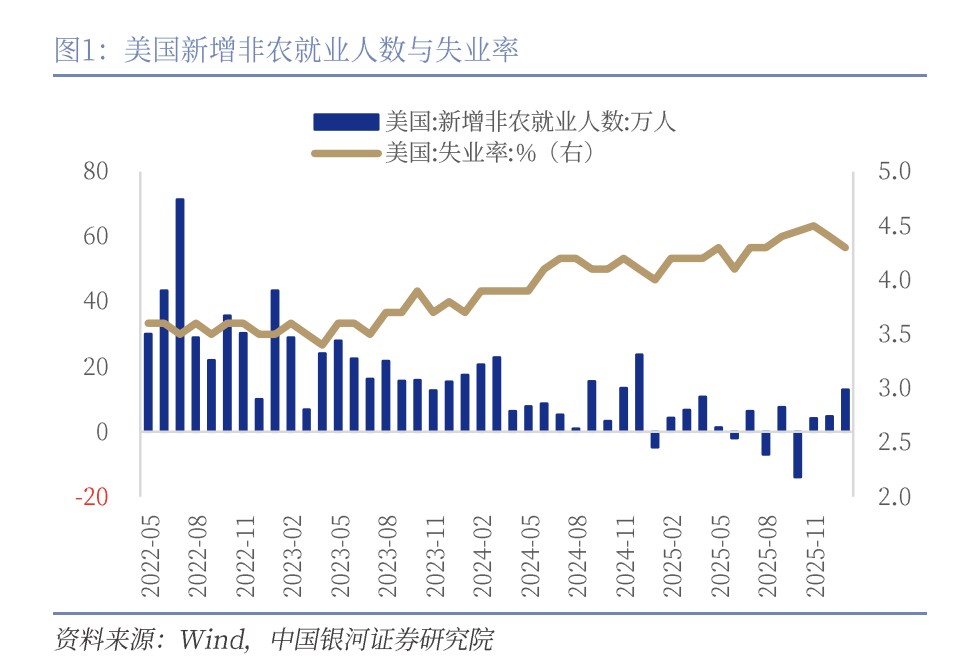
The U.S. non-farm employment data for January exceeded expectations across the board, but institutions generally believe that the foundation for labor market recovery remains unstable in the context of the annual benchmark revision revealing last year's inflated employment and highly concentrated industry growth.
Galaxy Securities pointed out that January's employment growth is still highly concentrated in a few industries such as healthcare, and there has been no improvement in structural characteristics, with the sustainability of the economic upturn still to be observed. Huatai Securities maintains its judgment that the Federal Reserve will pause interest rate cuts before June, stating that while the downside risks in the labor market have eased, the sustainability of data improvements still needs further verification.
After the data release, the market's pricing for interest rate cuts throughout 2026 narrowed by 8 basis points to 52 basis points, with the 2-year and 10-year U.S. Treasury yields rising by 7 basis points and 5 basis points, respectively. Analysts believe that the January data provides new evidence for the Fed to "stay put," but does not materially change the policy path.
Employment Growth Concentrated in a Few Industries
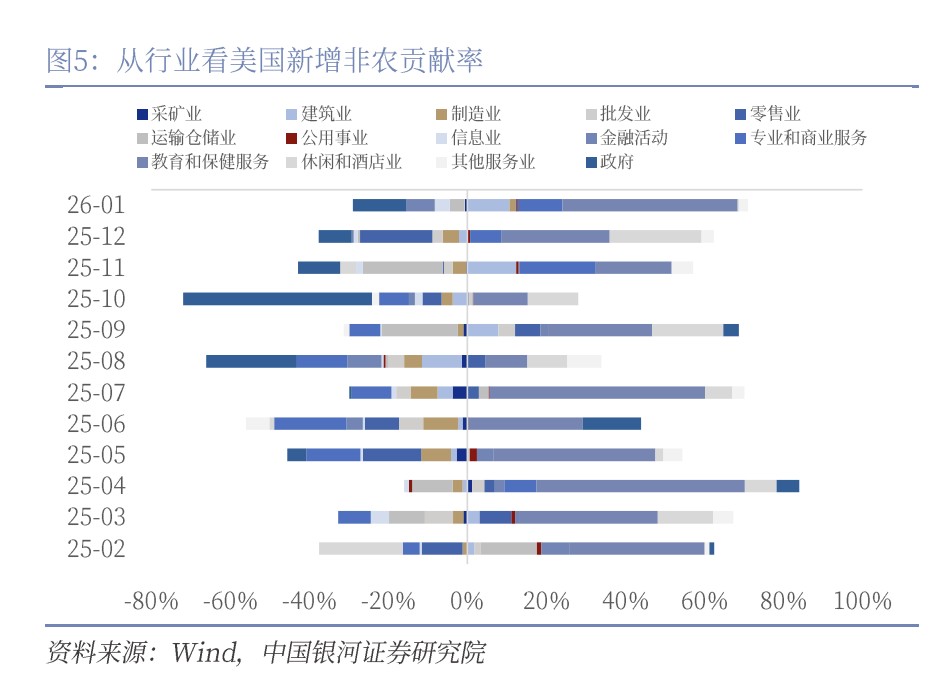
Huatai Securities stated that the employment increase in January is still concentrated in a few industries such as healthcare, retail, and construction, with the sustainability of the economic upturn still to be observed. Guolian Minsheng Securities further pointed out that the breadth of industry recovery in employment remains insufficient, with nearly all new jobs in January coming from the healthcare and social assistance sectors, a structural characteristic that may constrain overall productivity recovery.
Specifically, in January, the private sector added 172,000 non-farm jobs, reaching a monthly high since 2025, but the distribution across industries is highly uneven. The service sector contributed 136,000 jobs, with the healthcare industry alone adding 124,000 jobs in a month, a significant jump from the average of 52,000 jobs per month in the fourth quarter of last year; the retail sector saw limited growth, while the leisure and hospitality sector marginally declined by 44,000 jobs, and financial activities shrank by 21,000 jobs.
In the goods sector, construction added 33,000 jobs, an increase of 37,000 jobs month-on-month, possibly boosted by recent marginal recovery in real estate and warmer weather in January; manufacturing saw slight growth, while mining experienced a slight contraction. Employment in government sectors marginally decreased by 26,000 jobs to -42,000, with federal and state/local governments declining by 34,000 and 8,000 jobs, respectively.
Questions About Data Quality
Several institutions have expressed reservations about the credibility of the January non-farm data. This report was released simultaneously with the final value of the 2025 corporate survey benchmark revision, which shows that the non-farm employment level for March 2025 was revised down by 862,000 jobs; during the cycle from April 2024 to March 2025, the average monthly increase in non-farm employment was revised down by 72,000 jobs to 75,000 jobs.
Guolian Minsheng Securities pointed out that the January non-farm data has historically had significant seasonal overestimation risks, with the downward revision of the initial value in recent years exceeding 100,000 jobs, which may mainly reflect deviations in seasonal adjustment factors and data models. Galaxy Securities further mentioned that the BLS has introduced a new "Business Birth-Death Model" in this report for the first time. Although theoretically it can improve data accuracy, it may also cause short-term disturbances in the January readings. The new model incorporates more current sample information, which may exacerbate the already volatile January data fluctuations.
In addition, the BLS routinely updates the population control benchmark based on Census Bureau forecast data every January. However, due to the previous partial federal government shutdown, this adjustment has been postponed to be implemented with the release of the February non-farm report. This means that the employment data under the January household survey will still use the monthly population estimates from January 2025, and there may be comparability issues with the subsequent February data.
Wages and Employment Improve Simultaneously
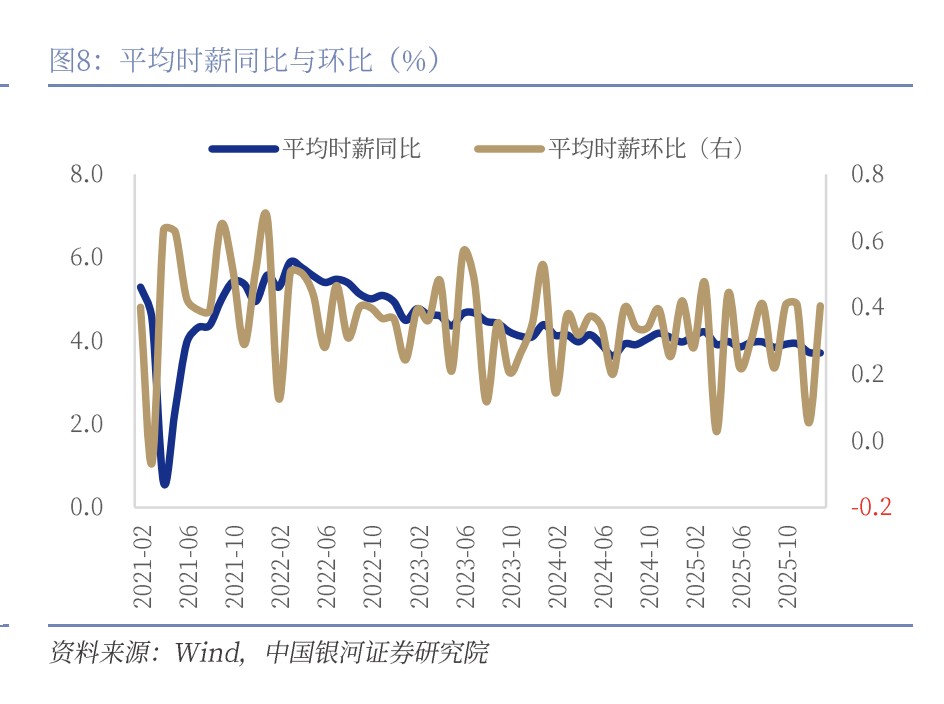
In January, hourly wages increased by 0.4% month-on-month, accelerating by 0.1 percentage points compared to December, and remained flat year-on-year at 3.7%. Data from Galaxy Securities shows that wages in the service sector rebounded by 0.41 percentage points to 0.41%, with accelerated expansion in the education and healthcare sectors, while the growth rate in the information sector significantly slowed down; wages in the goods sector decreased by 0.03 percentage points to 0.29%, with only the manufacturing sector recording a slight rebound.
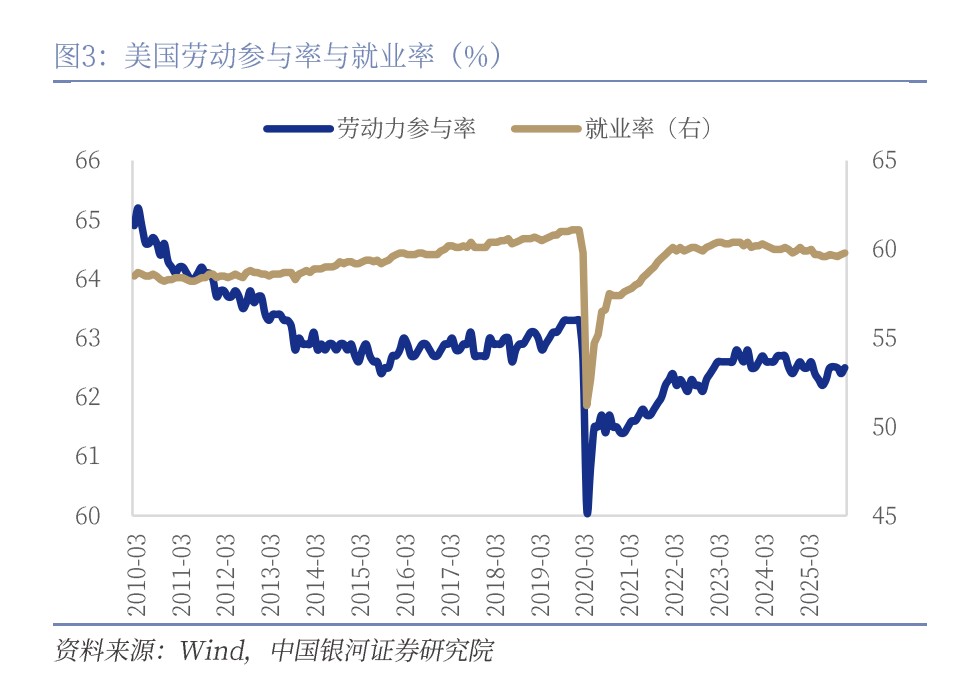
 In terms of the unemployment rate, the unemployment rate in January fell by 0.1 percentage points to 4.3%, better than market expectations. Huatai Securities pointed out that the decline in the unemployment rate, against the backdrop of a rising labor participation rate, is consistent with the overall better-than-expected initial and continuing claims data since January. The labor participation rate unexpectedly rose by 0.1 percentage points to 62.5%, and the average weekly hours worked also unexpectedly increased by 0.1 hours to 34.3 hours, indicating an improvement in labor utilization intensity.
Federal Reserve Policy Outlook
Despite the January non-farm data exceeding expectations across the board, many institutions remain cautious about its sustainability and generally maintain the judgment that the Federal Reserve will pause interest rate cuts before June.
Huatai Securities pointed out that although the downside risks in the labor market have significantly decreased, the overall improvement in January's non-farm and initial claims data still needs to be verified for sustainability. It is expected that the Federal Reserve will remain on hold before June and may consider cutting rates 1-2 times after the new chair takes office, depending on the situation.
Guolian Minsheng Securities believes that given the dual considerations of economic data recovery and policy independence, there is a high necessity for Powell to pause interest rate cuts in the short term. The further release of rate cut expectations will depend on whether the labor market softens, whether inflation rises can be slowed, and the policy statements of incoming chair Walsh. **
Galaxy Securities also stated that current inflation is generally mild, and the sustainability of employment data is in doubt, so the Federal Reserve is likely to remain on hold before the June meeting. Whether the impact of interest rate cuts on the labor market can continue still needs to be verified by subsequent data.
Risk Warning and Disclaimer
The market has risks, and investment should be cautious. This article does not constitute personal investment advice and does not take into account the specific investment goals, financial situation, or needs of individual users. Users should consider whether any opinions, views, or conclusions in this article align with their specific circumstances. Investment based on this is at their own risk
