Lenovo's Q4 revenue hits a record but net profit declines by 21%, AI business accounts for 32% |Financial Report Insights

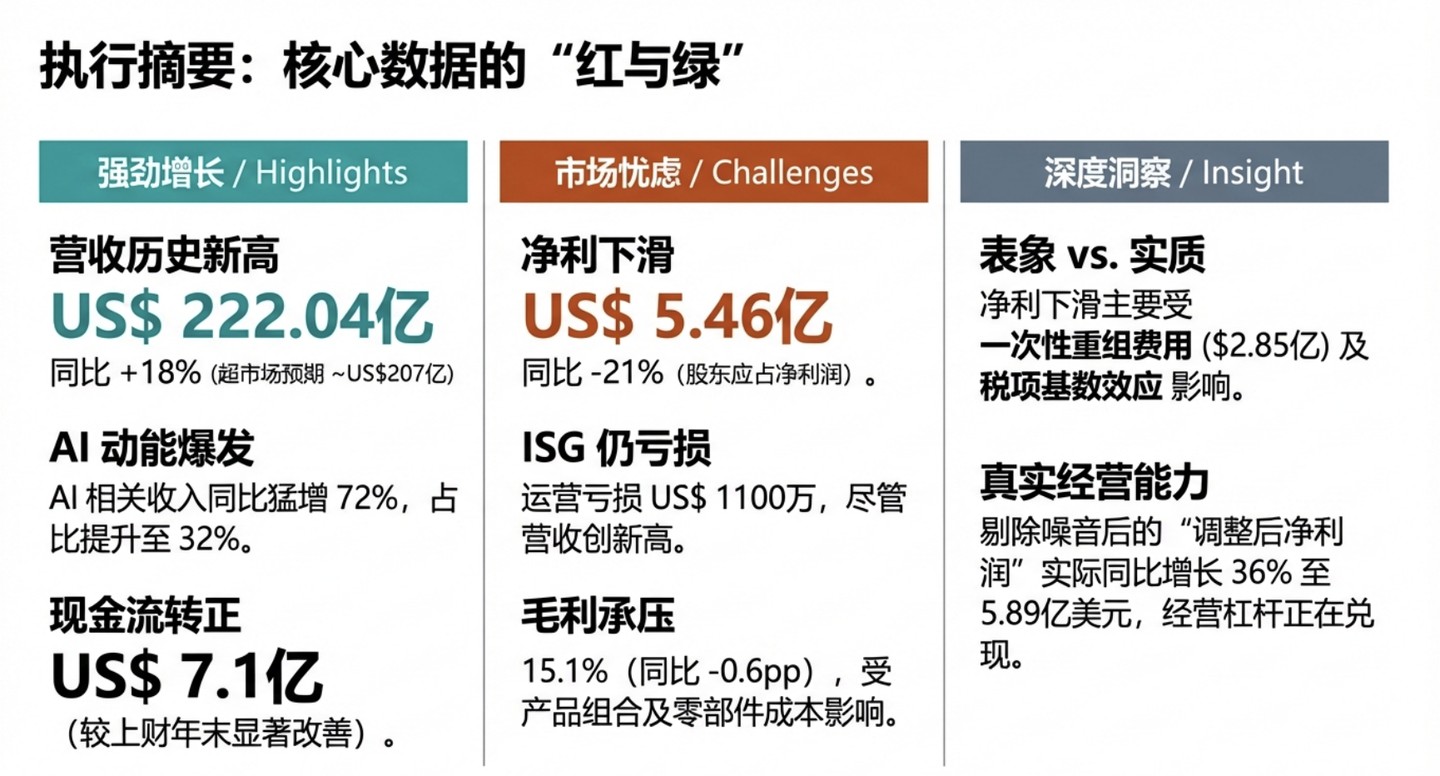
Lenovo's revenue in the fourth quarter increased by 18% year-on-year to USD 22.2 billion, setting a historical high. The AI business is becoming the core engine of Lenovo's growth, with AI-related revenue growing by 72% year-on-year, accounting for 32% of the group's total revenue. However, net profit attributable to shareholders decreased by 21% year-on-year to USD 546 million, and the gross margin fell to 15.1%. Although the infrastructure business achieved record revenue, it is still in a loss-making state
Lenovo's Hong Kong stock fell more than 5% on Thursday afternoon. Despite AI driving record high revenue in the third fiscal quarter, net profit declined by 21% year-on-year, gross margin was below expectations, and the infrastructure business continued to incur losses, raising market concerns about its profit quality.
On Thursday, Lenovo announced its third fiscal quarter financial report (for the three months ending December 31, 2025). The company's net profit attributable to shareholders decreased by 21% year-on-year to USD 546 million, which still exceeded market consensus expectations (approximately USD 451 million).
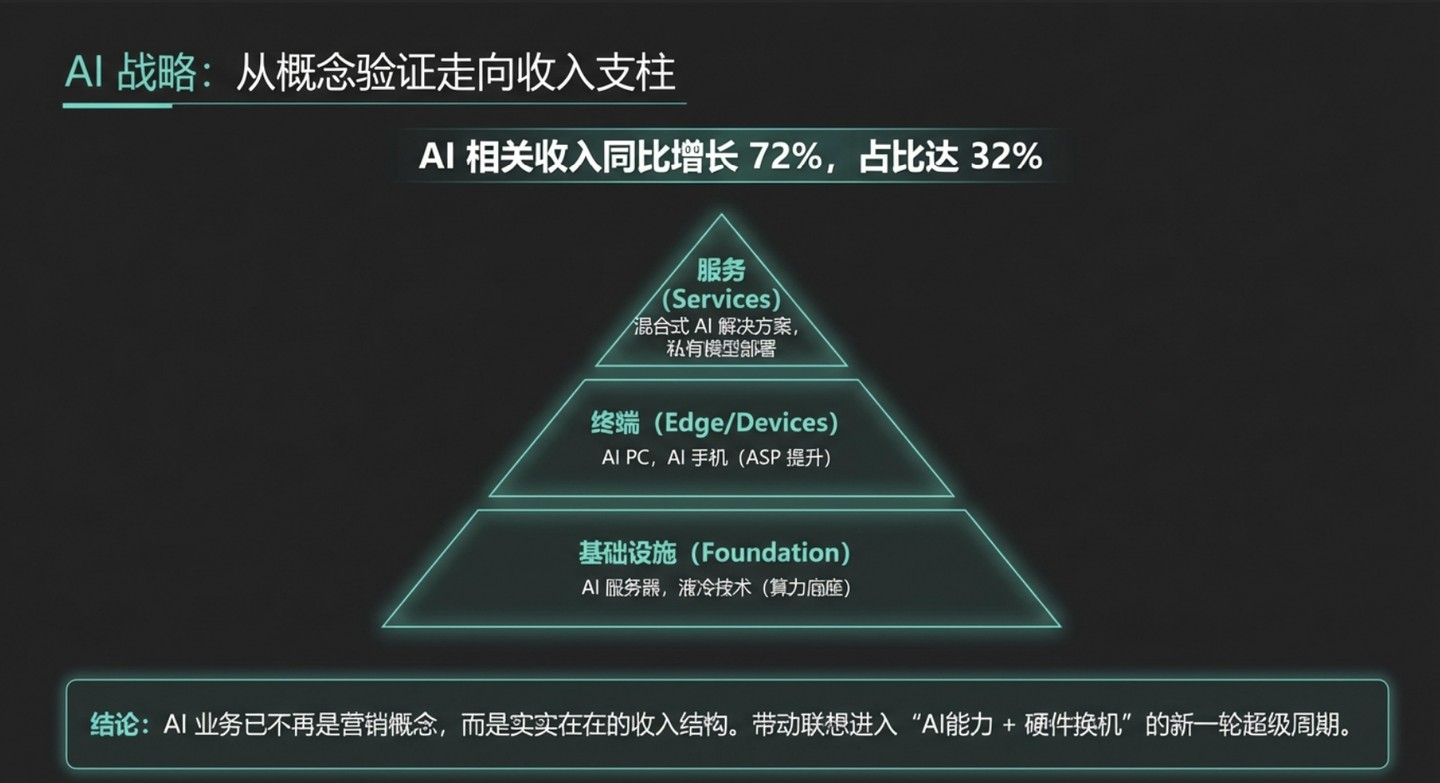
In contrast to the profit decline, Lenovo's revenue performance was strong this quarter: revenue increased by 18% year-on-year to USD 22.204 billion, setting a new historical high, significantly above expectations (around USD 20.76 billion/near USD 20.6 billion). The AI business is becoming the core engine of Lenovo's growth. AI-related revenue grew by 72% year-on-year this quarter, accounting for 32% of the group's total revenue, covering areas such as AI PCs, AI smartphones, AI servers, and AI services.
However, the gross margin fell to 15.1%, down 0.6 percentage points year-on-year and below the expected 15.4%, reflecting that changes in product mix and cost pressures are still constraining margin improvement. Although the infrastructure business achieved record high revenue, it remains in a loss state, becoming a key constraint for market valuation.
Revenue hits a new high, but net profit attributable to shareholders declines by 21% year-on-year
Specifically:
Revenue: USD 22.204 billion, year-on-year +18% (exceeds expectations)
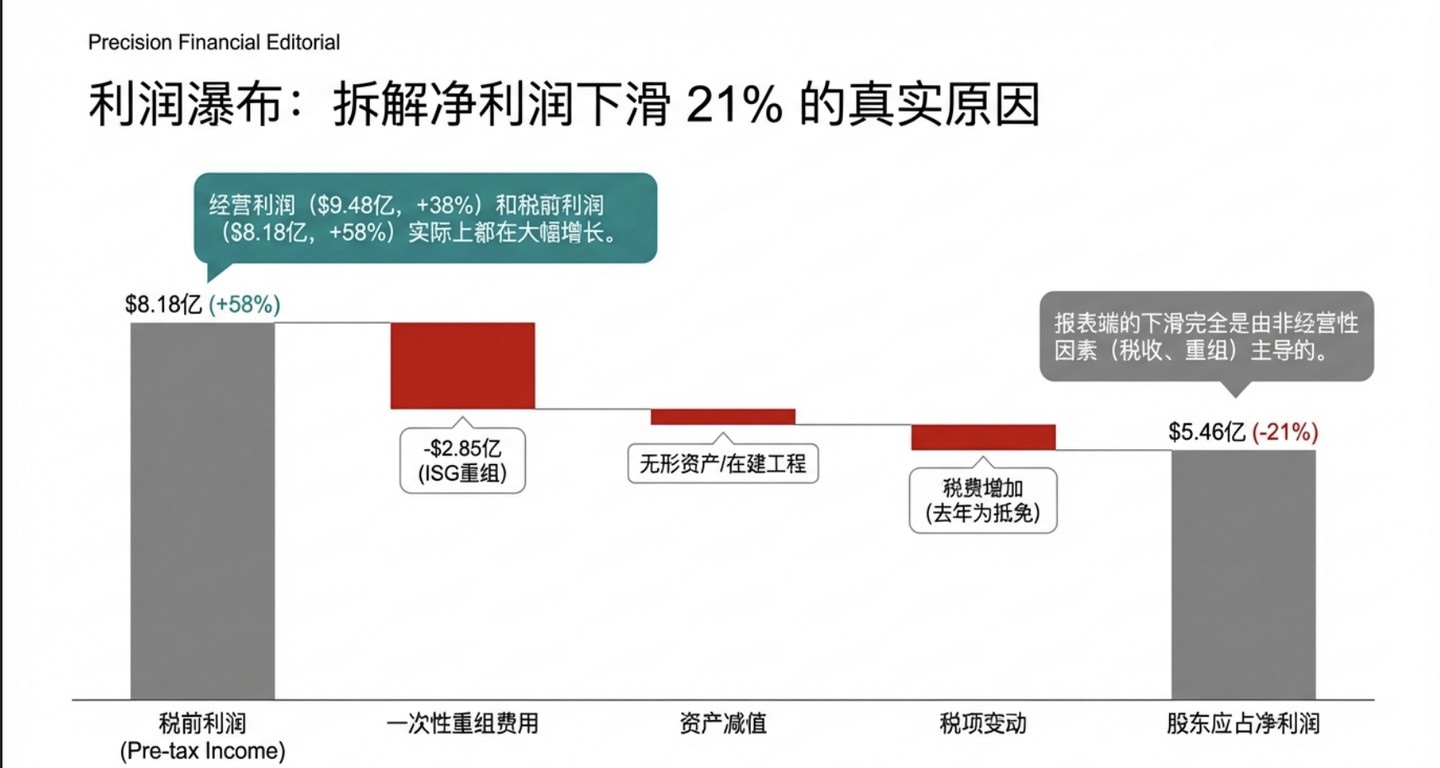
Operating profit: USD 948 million, year-on-year +38%
Profit before tax: USD 818 million, year-on-year +58%
Profit for the period: USD 648 million, year-on-year -8%
Net profit attributable to shareholders: USD 546 million, year-on-year -21% (still exceeds expectations)
Gross margin: 15.1%, year-on-year -0.6 percentage points (below expectations)
Both operating profit and profit before tax are increasing, but the final net profit attributable to the parent company is declining, indicating that taxes, one-time items, minority shareholder gains/losses/structural factors have a stronger disturbance on net profit.
Lenovo's management emphasized that the main adjustments this quarter include:
One-time restructuring costs of approximately USD 285 million (related to the restructuring of the infrastructure business)
Impairment of intangible assets and construction in progress (related expenses reflected in this quarter's operating profit are higher)
There are also hedging items: such as fair value changes of derivative financial liabilities related to warrants, and fair value changes of certain financial assets (accounted for in current profit and loss, but with strong volatility)
All three major businesses achieved double-digit growth, driven by AI's "comprehensive recovery"
Lenovo disclosed that all three major business groups recorded double-digit revenue growth this quarter, with AI-related businesses shifting from "product selling points" to "revenue structure."
AI-related revenue increased by 72% year-on-year, accounting for 32% of the group's total revenue.
The company stated that AI-related businesses have become an important growth engine, covering AI PCs, AI smartphones, AI servers, and AI services.
The significance of this structural change for Lenovo is that as the PC industry transitions from inventory updates to a new cycle of "AI capabilities + Windows upgrade cycle," leading manufacturers are more likely to benefit simultaneously in terms of ASP and market share; on the server side, the transition of AI from training to inference presents new requirements for hardware forms and delivery capabilities, providing comprehensive manufacturers with new entry points.

Intelligent Devices (IDG): PC market share continues to expand, high-end smartphones drive growth
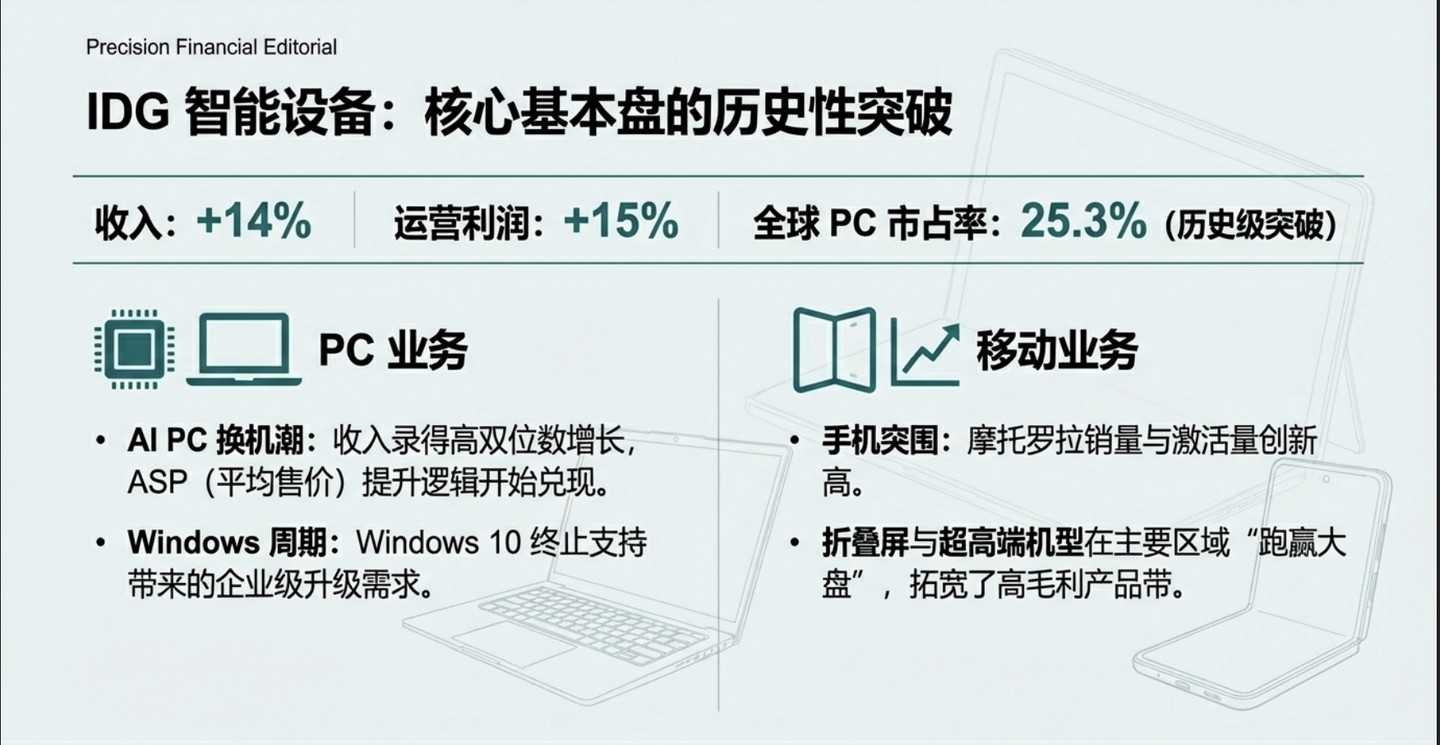
The Intelligent Devices business group this quarter: revenue increased by 14% year-on-year, and operating profit increased by 15% year-on-year.
Among them, the PC business continues to consolidate its global leadership: the company disclosed a global market share of 25.3%, emphasizing that it has become the only PC manufacturer in 30 years to break the 25% global share for two consecutive quarters. The company attributes the growth drivers to: high double-digit growth in AI PC revenue, a balanced mix of commercial and consumer products, and upgrade opportunities brought by the end of Windows support. In terms of smartphones, Motorola's sales and activations reached new highs, while revenue growth in major regions "outperformed the market," and the product range was expanded through foldable screens and ultra-high-end models.

Infrastructure Solutions (ISG): Revenue hits a new high but still incurs losses, restructuring points to "profit inflection point"
The Infrastructure Solutions business group this quarter: revenue reached $5.2 billion, up 31% year-on-year, setting a quarterly record; however, it still recorded an operating loss of about $11 million, an improvement from the previous quarter.
The highlight is that demand for AI servers remains resilient, with a project reserve of $15.5 billion; revenue from liquid cooling business "Poseidon" increased by 300% year-on-year. The pressure lies in the fact that this business has relatively thinner profit margins and is still in a structural adjustment phase.

Solutions and Services (SSG): Continuous double-digit growth for 19 consecutive quarters, profit margin nearing historical highs
The Solutions and Services business group continues to act as a "profit ballast": revenue increased by 18% year-on-year (the 19th consecutive quarter of double-digit growth), operating profit increased by 30% year-on-year, and the operating profit margin reached 22.5%, close to historical highs, with the proportion of operation and maintenance services and project/solution revenue increasing to 59.9% Against the backdrop of significant fluctuations in the hardware cycle, the sustained growth and high profit margins of SSG are often seen by the market as an important validation point for Lenovo's transformation from a "hardware company to a hardware + services company."

Gross Margin Under Pressure, Cash Flow Improvement Provides Buffer
The overall gross margin for this quarter was 15.1%, below the expected 15.4%, and down 0.6 percentage points from the same period last year. The company attributes this to the increased proportion of infrastructure business, which depresses the overall gross margin, rising component costs, and external disturbances such as tariff uncertainties.
Lenovo's operating cash flow for the third fiscal quarter was $952 million, with free cash flow at $451 million. As of the end of the period, cash and cash equivalents stood at $5.221 billion, with net cash of approximately $710 million, a significant improvement from the net debt position at the end of the previous fiscal year. The loan-to-equity ratio decreased to 0.59.
Research and development expenses for this quarter were $638 million, accounting for about 3% of revenue. The improvement in cash flow and net cash provides a stronger buffer for the company's capital expenditures and supply chain turnover in the expansion of AI PCs, AI servers, and service businesses, while also reducing financial vulnerability amid rising external uncertainties